
Add ₹999 more to unlock FREE SHIPPING!
Your sacred cart is currently empty.
Shop Photo FramesOne of the significant and historical temples dedicated to Nar-Narayan in the world is situated in the Kalbadevi area of Mumbai. Nar-Narayan are considered a twin incarnation among the twenty-four incarnations of Lord Vishnu. According to mythology, this same incarnation later took the forms of Arjuna (Nar) and Lord Krishna (Narayan). The idols of Arjuna and Lord Krishna are consecrated in this temple in Kalbadevi. This temple, which is over one hundred years old, also houses a cowshed (Goshala) and a small pigeon house. Festivals like Gokulashtami and Holikotsav are celebrated here with great enthusiasm.
Along with the ten incarnations (Dashavatara) of Lord Vishnu—Matsya, Varaha, Kurma, Narasimha, Vamana, Parashurama, Shriram, Shrikrishna, Buddha, and Kalki—there are a total of twenty-four incarnations, including Sanatkumara, Narada, Kapil Muni, Dattatreya, Suyajna (Yajna Purusha), the Jain Tirthankara Rishabhadeva, King Prithu (the ideal king who initiated agriculture on Earth), Dhanvantari, Mohini, Vedavyasa, Balarama, Hayagriva, Hamsa, and Nar-Narayan. According to the ‘Kalika Purana’, Nar was born from the human part of the Narasimha incarnation, and Narayan was born from the lion-faced part. The ‘Bhagavata Purana’ states that these two later became the sons of Dharma and Murti during the ‘Chakshusha Manvantara’. In the ‘Bhagavata’, Narayan is considered the unmanifest, attributeless (Nirguna) principle, while Nar is considered the manifest, with-attributes (Saguna) form. This Purana refers to Nar and Narayan as sages.
The mythological legend regarding them states that after their birth, Nar and Narayan went to Badarikashrama in the Himalayas and began penance. They performed severe penance for one thousand years. Lord Indra became frightened by this penance and sent celestial nymphs (Apsaras) like Rambha to them to create obstacles. Narayan decided to show Indra that he possessed the power of penance to create Apsaras even more beautiful than the ones Indra had sent. He immediately struck his thigh. From that thigh, an extremely beautiful woman was created. She was the Apsara named Urvashi. Thereafter, to serve the Apsaras sent by Indra, Narayan created exactly sixteen thousand and fifty Apsaras and told them to return to heaven with Urvashi. At that moment, the Apsaras prayed to Narayan Muni himself to accept them. To this, Narayan promised them, “I will marry you in my next incarnation.” Then, all those Apsaras returned to the celestial realm. These same Nar-Narayan later incarnated as Krishna and Arjuna.
According to another mythological legend regarding this incarnation, one day, Hiranyakashipu’s son Prahlad, while on a pilgrimage with his army, went near the ashram of Nar-Narayan. Seeing various types of bows, arrows, quivers, and other war-related equipment there, he felt that the sages in that ashram were not of a peaceful nature but must be hypocrites. This led to an argument that turned into a war. This fierce battle lasted for one thousand years. Neither side was willing to accept defeat. Then, Lord Vishnu appeared and stopped the war. According to information from the fourth volume of the ‘Bharatiya Sanskriti Kosha’ by Pandit Mahadevshastri Joshi, the worship of these Nar-Narayan began in ancient times, and Krishna and Arjuna also began to be worshipped in that form. In the thirteenth century, Hemadri (Hemadpant or Hemadi Pandit) was the minister of the Yadava King Ramchandrarav of Devgiri. In his book ‘Chaturvarga Chintamani’, he described how the idols of Nar-Narayan should be made. He stated that the figure of Nar should be made dark like Durva grass, two-armed, and powerful. Narayan should have the complexion of a blue lotus and be four-armed. Between them, a jujube (Bori) tree laden with fruits should be erected, as mentioned therein. (Durvashyamo narah karyo dvibhujashcha mahabalah | Narayanashchatarbahurnilotpaladalachhavih || Tayormadhye tu badari karya phalabhushana |) This clarifies that idol worship of this twin incarnation of Vishnu has been practiced in Maharashtra for at least eight hundred years.
This Nar-Narayan temple was built in the early twentieth century in the Kalbadevi area. It was the era of Lord Curzon. At that time, a great famine had struck the country, and the plague epidemic had begun in Mumbai in 1896-97. Consequently, there was large-scale migration, and textile mills faced a crisis.
Additionally, political unrest had spread due to the decision of the Partition of Bengal. In such a turbulent period, a local merchant, Sheth Manmohanadas, established this temple in accordance with the final wishes of his father, Sheth Kahandas Narandas. It is said that the cost of building the temple at that time was about one lakh rupees.
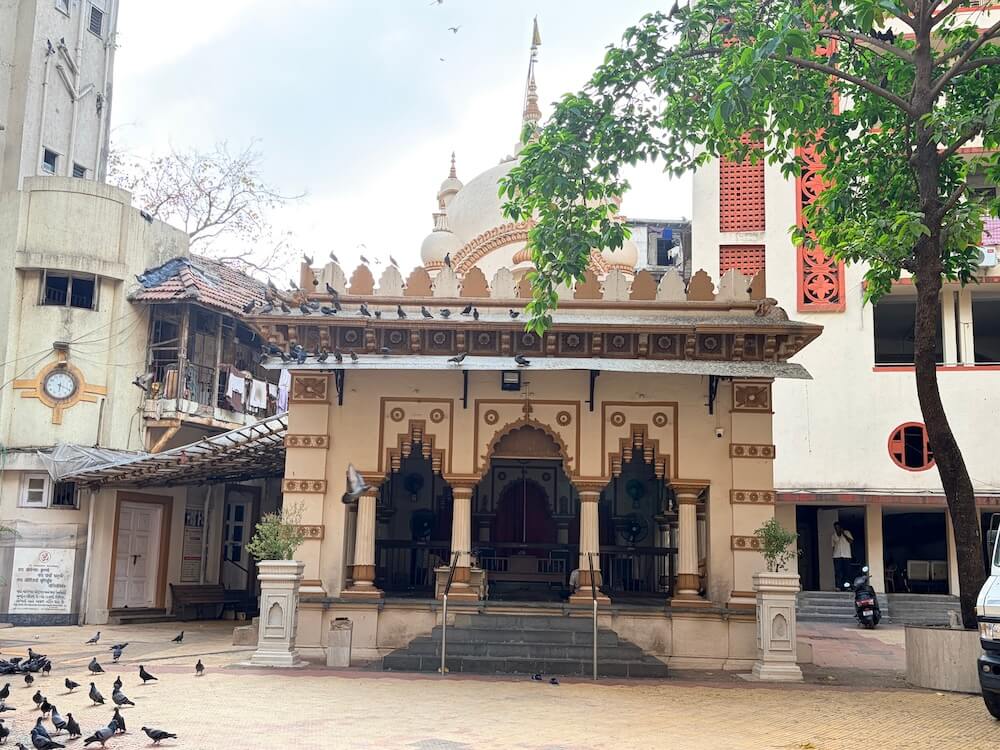
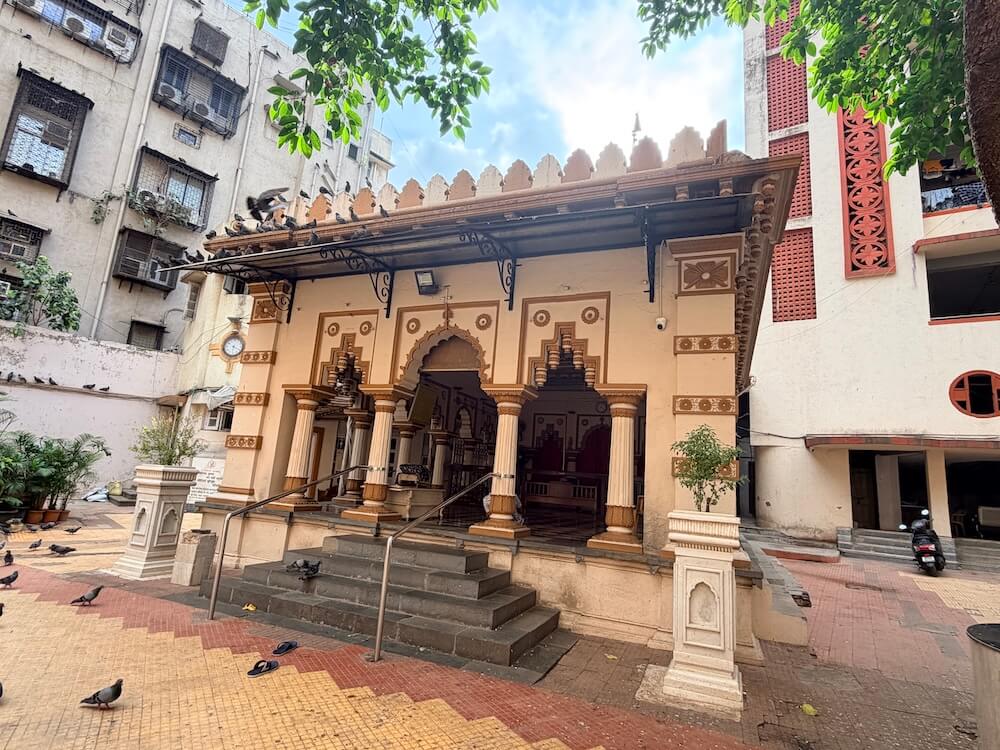
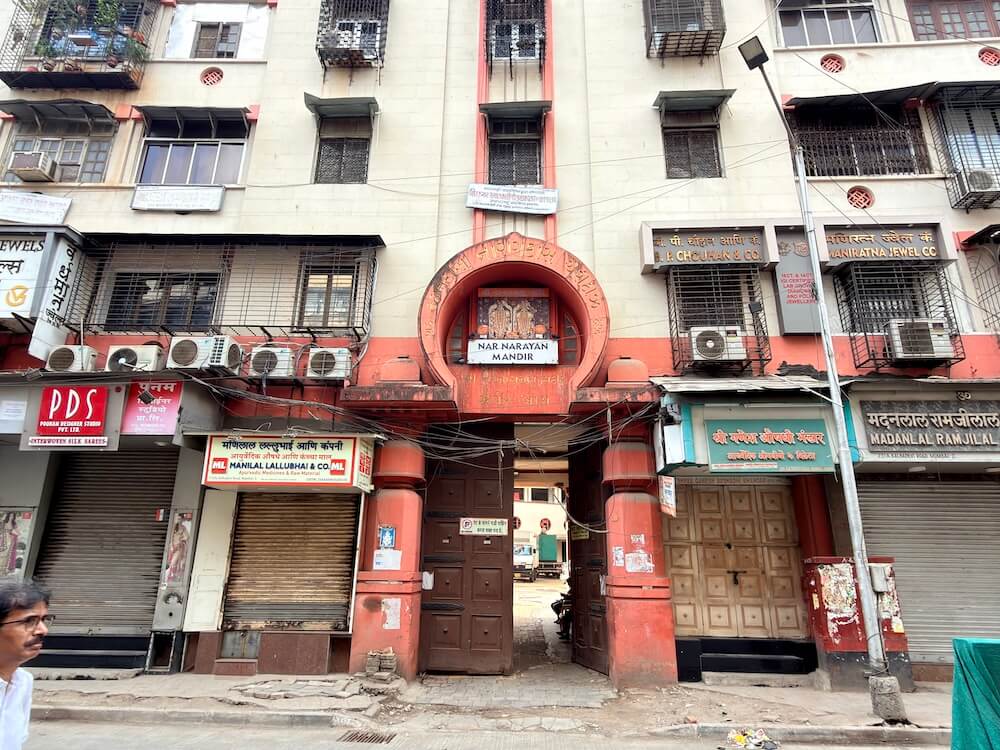
The temple is situated in a large courtyard, surrounded by tall buildings known as ‘Zaver Bagh’. The courtyard has a distinctive entrance with stone pillars and a wooden door. Directly in front stands the temple, bearing the impression of the ancient Haveli style. The temple, which has a structure comprising a Sabhamandapa (assembly hall), Antarala (vestibule), and Garbhagriha (sanctum sanctorum), is built on a high stone platform. In the two corners in front of the Sabhamandapa, there are two Tulsi Vrindavans made of marble stone.
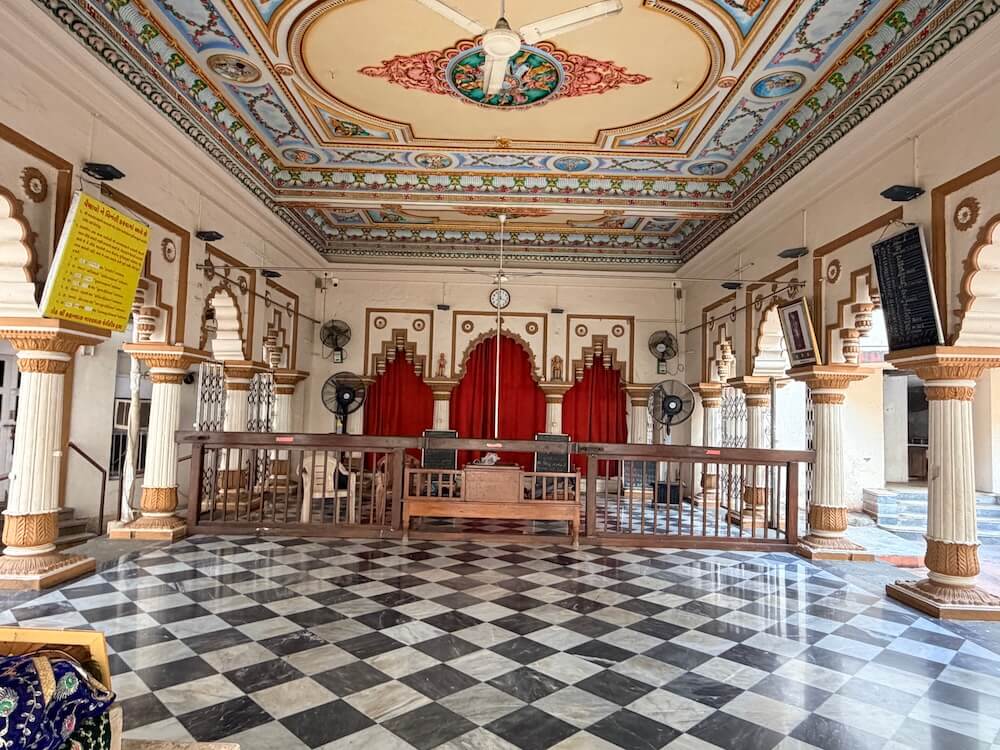
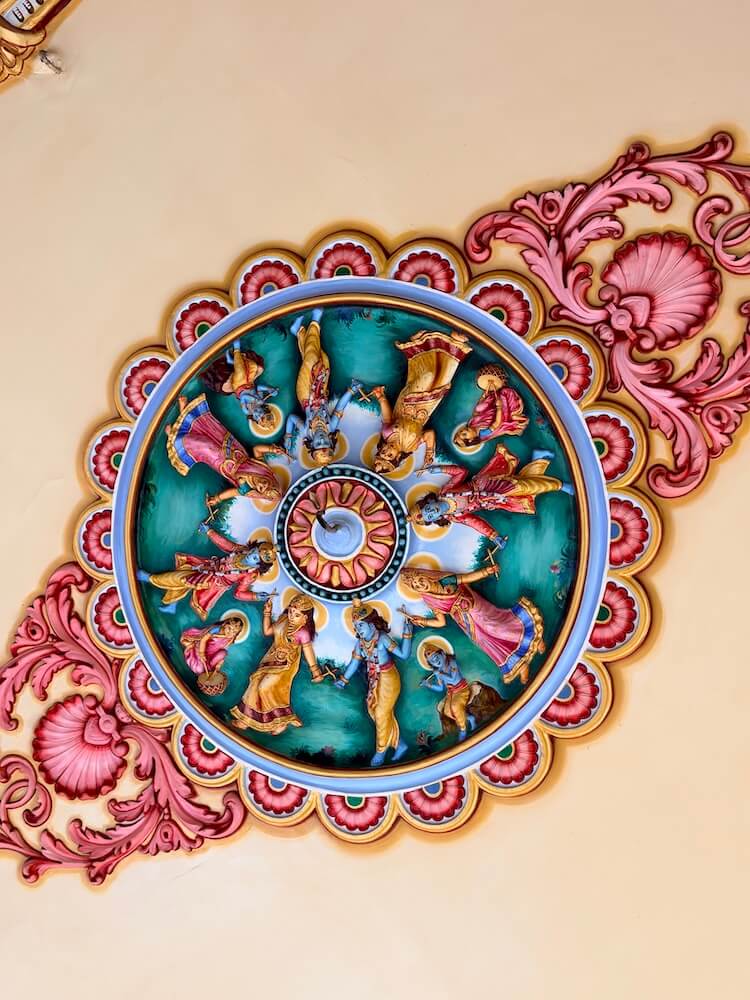
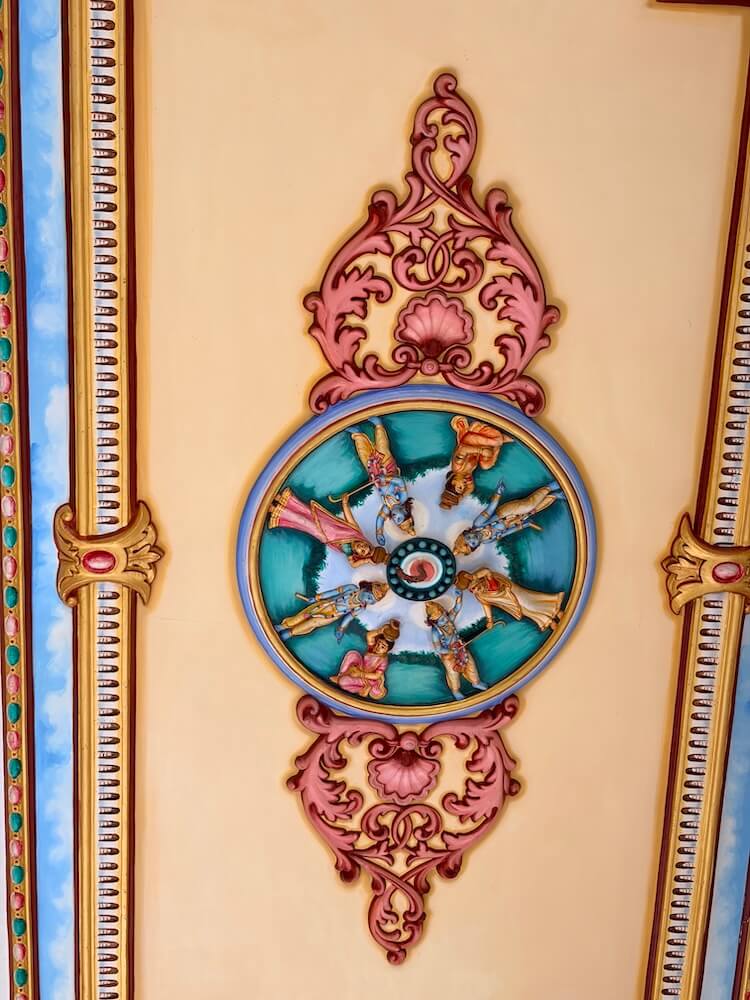
One enters this Sabhamandapa by climbing five wide stone steps. With cylindrical stone pillars, arched and square-shaped arches, a parapet on the roof, and a dome-shaped spire, this Sabhamandapa has marble flooring arranged like a chessboard. The ceiling of the Sabhamandapa is flat. On it, along with elegant floral and leaf patterns, there are relief carvings of the ten incarnations of Vishnu and the Raslila of Shrikrishna.
The small, room-like Antarala here has three entrances. On the pillars of the middle entrance, there are small idols of Hanuman and Ganesha. The entrance to the Garbhagriha is covered with finely crafted silver plating. In this Garbhagriha, decorated with marble tiles, the beautiful idols of Nar and Narayan, i.e., Arjuna and Shrikrishna, are consecrated on a high pedestal. Carved in marble stone and seated on a silver throne, these idols are adorned with ornaments such as garments, armlets, wristbands, and necklaces.
Here, Lord Shrikrishna is four-armed. He holds a conch, discus, flower, and mace, while Arjuna holds a bow and arrow in his hands. Both idols have beautiful crowns on their heads, and behind them, a peacock feather, which is dear to Shrikrishna, is placed. There is a large dome-shaped section over the Garbhagriha of the temple, and a high pinnacle (Kalash) is placed upon it.
There is a Kadamba tree in the temple premises. Similarly, there is also a cowshed here. Food is offered to pigeons in the space in front of the temple.
In this temple of Nara-Narayana, devotees can have Darshan from 6 in the morning to 4 in the afternoon and from 5:15 in the evening to 8 at night.
The daily rituals performed here are as follows: Mangala Aarti from 6:30 to 7:15 in the morning, Shringar from 8:30 to 10:00, Rajbhog from 11:00 to 11:30, Bhog Aarti in the evening from 5:30 to 6:15, and Shayan Aarti in the evening from 7:00 to 7:30.
Festivals and celebrations such as Gokulashtami, Holi, Durga Puja, and Diwali are celebrated in the temple with great enthusiasm and fervor. During the festival period, activities such as lectures by renowned speakers on spiritual topics, devotional programs, and dance performances are organized here.
The administration of the temple is managed through the ‘Sheth Kahandas Narandas Charities Trust’. Various social and healthcare initiatives are implemented by this trust.
This sacred temple stands as a testament to deep spiritual devotion, ancient architectural grandeur, and rich local cultural traditions.
The sanctum sanctorum houses the divine idol consecrated according to ancient Vedic traditions, surrounded by serene courtyards and traditional temple architecture.
Navratri, Maha Shivratri, Annual Temple Jatra & Deepotsav
Compare and book flights, secure top-rated local hotels near the temple, hire reliable guides, and rent cars instantly.
Extend your pilgrimage by visiting other highly sacred temples located nearby.


Add ₹999 more to unlock FREE SHIPPING!
Your sacred cart is currently empty.
Shop Photo FramesFill in your delivery details below to place your order.
Add comment