
Add ₹999 more to unlock FREE SHIPPING!
Your sacred cart is currently empty.
Shop Photo FramesThere are many ancient and historical temples in Beed district. Many of these temples reflect the architectural heritage of the Chalukya, Shilahara, and Yadava periods. The district is deeply influenced by the Nath tradition, and there are numerous Nath monastic establishments and Samadhi temples of the Navnath saints here. Along with this, monasteries and temples of sub-sects like Giri, Puri, Gosavi, and Kanphate are scattered throughout the district. Due to the strong influence of the Warkari tradition in the district, many shrines and forts are mentioned as centers for the propagation and dissemination of this tradition. Among these, Narayan Gad is considered an important shrine and is famous as ‘Dhakti Pandhari’ (the smaller Pandharpur).
Villagers state that this shrine of Vitthal-Rukhumai is hundreds of years old. There is also an ancient Shiva temple here. It is said that Narayana, born into the Avadambar family in the village of Poundul, had a deep inclination toward spirituality and divinity from childhood. He renounced worldly life at a young age, took shelter in the Shiva temple on the hill, and began chanting the name of Vitthal. After receiving a direct vision of Lord Vitthal, he became famous as ‘Nagadnarayan’. Gradually, the number of devotees visiting this place began to increase. For hundreds of years, the work of this fort has been carried on through the Guru-Shishya (teacher-disciple) lineage. The list of the Guru-Shishya lineage here is as follows: Adya Guru Adinath, Vidhi, Atri, Dattatreya, Janardan, Eknath, Gavba, Anant, Dayanand Swami Paithankar, Anandrishi, Nagadnarayan, Mahadev (first), Shetibaba (Dadasaheb Maharaj), Govind Maharaj, Narsu, Mahadev (second), Manikbaba, Bhagwanbaba, Mahadevbaba, and the current Mahant Shivaji Maharaj.
The mythological legend regarding this temple is that while Lord Shriram was returning to Ayodhya by aerial chariot with his loved ones after slaying Ravana, the chariot rested for a moment on this hill. Through his divine insight, Shriram realized that Siddha sages were performing penance on this hill and were eager to have his darshan. Rama landed the chariot on the hill, gave darshan to the Siddha sages, and blessed them to continue their penance on this sacred hill until the Kaliyuga.
This temple is situated on a high hill, approximately seven kilometers long and three kilometers wide, near Poundul village. A paved road is now available to reach the hilltop. In the center of the hill, there is an underground pond. To reach it, there is a narrow tunnel passage from the western side. The path that previously existed from the north is now closed due to a landslide. It is said that in ancient times, seven Siddha sages were seated in penance on the banks of this very pond. Outside the temple fortifications, there are many structures. These include offices providing facilities to devotees, restrooms, a school, a college building, and other structures.
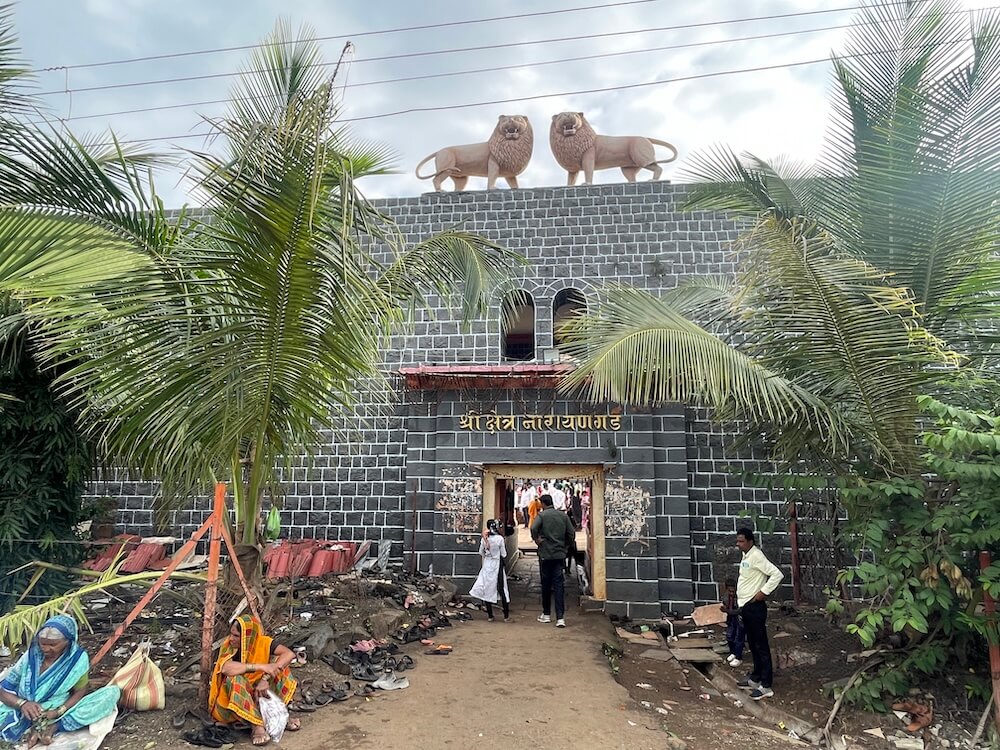
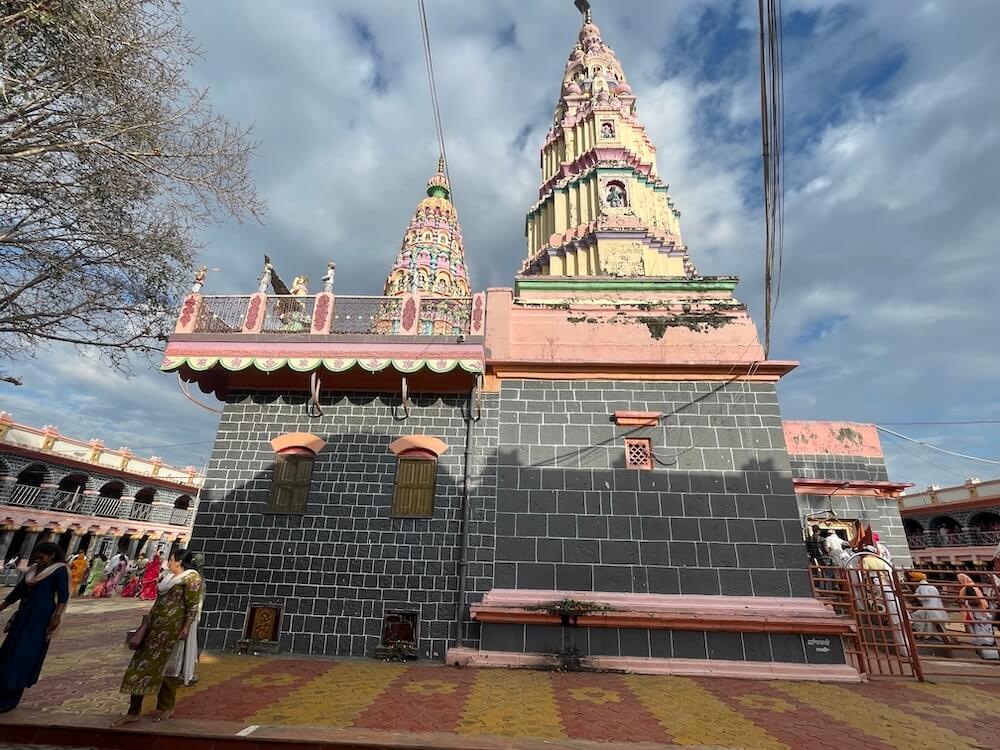
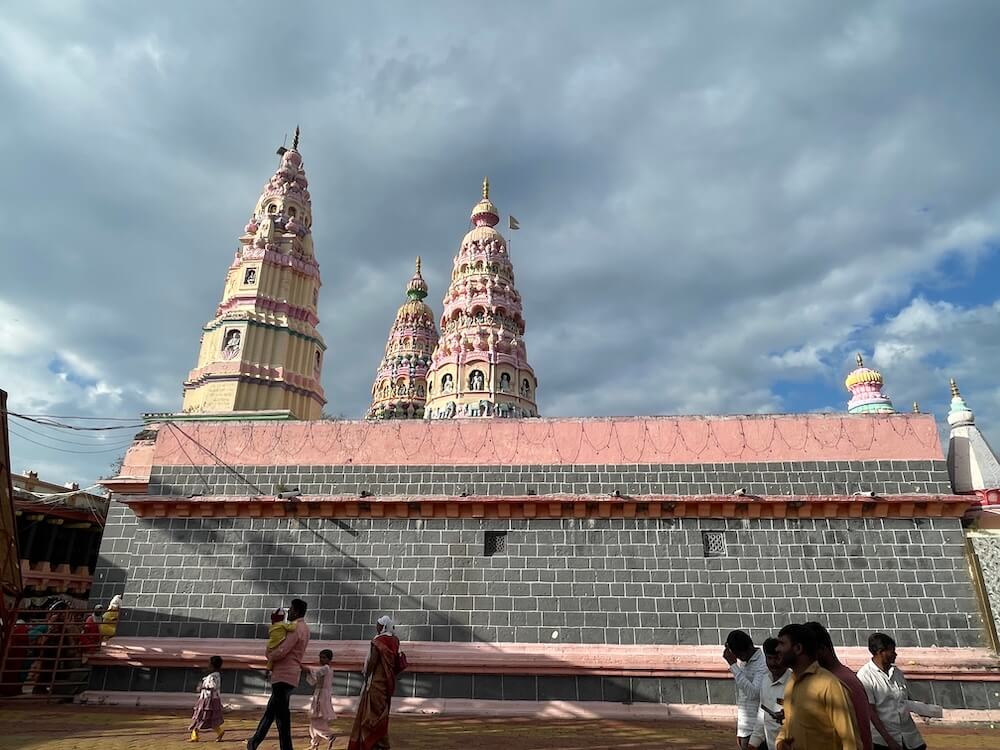
The temple has a sturdy fortification wall about twenty feet high. Monkey sculptures are carved onto this wall. The fortification has two-storied entrance gates in the east, south, and north directions. In front of the main eastern entrance, there are platforms on both sides, upon which elephant sculptures are placed. There are shops for worship materials in front of the entrance. On both sides of the entrance, there are guard chambers with guard sculptures above them. The entrance has ornate wooden doors and guard rooms on the inside. On the floor above the entrance is the Nagarkhana (drum house). On the front wall of this Nagarkhana, there is an arched torana with a Ganesha sculpture beneath it. On the ceiling, there is a massive Garuda sculpture, flanked by sculptures of various deities.
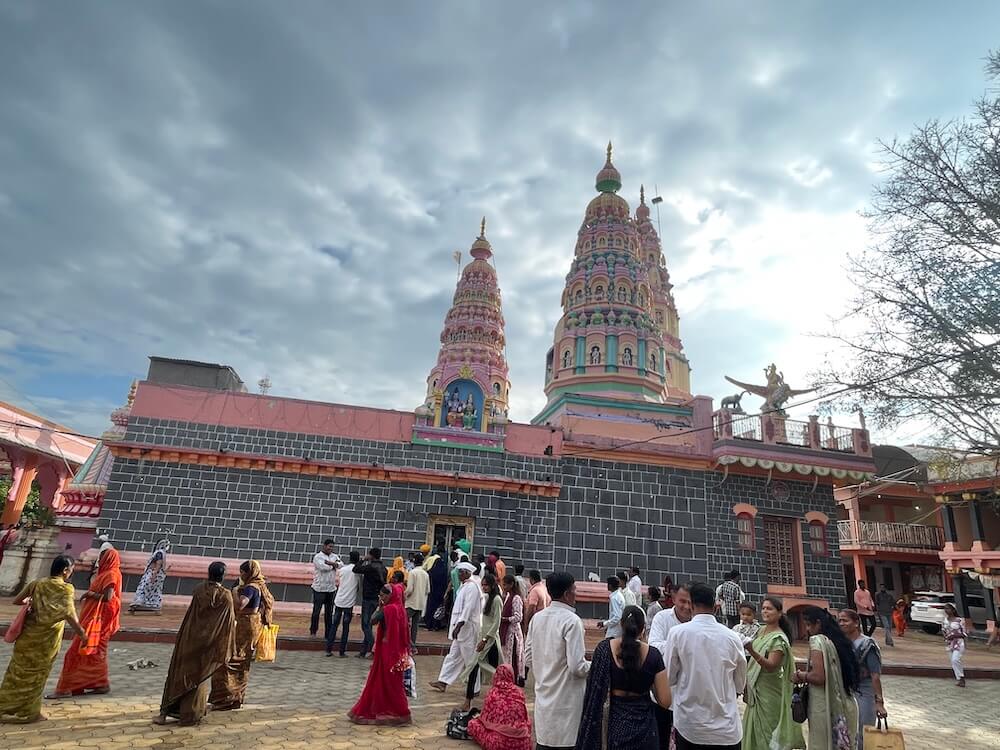
Upon entering through the gate, one enters a spacious courtyard. The courtyard is lined with two-storied cloisters on all four sides along the fortification. There are a total of 364 chambers in the fortification, including 90 in the north, 62 in the south, 88 in the east, and 72 cloisters and 52 upper rooms in the west. This structure is used to accommodate devotees during festivals. In the courtyard, in front of the temple, there are two platforms on both sides with circular lamp towers (Deepmalas) on them. The courtyard contains various types of trees and small temples dedicated to local deities. Additionally, the palace-like residence of the current Mahant, Shivaji Maharaj, is located here. Nearby stands an ancient Peepal tree with a stone platform built around its base.
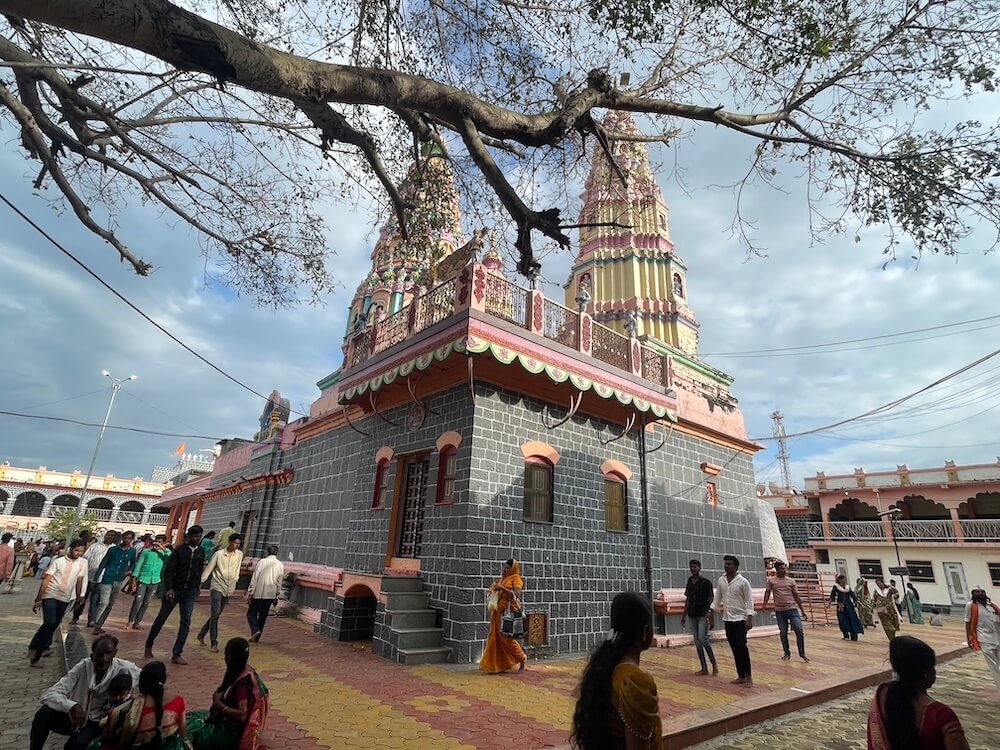
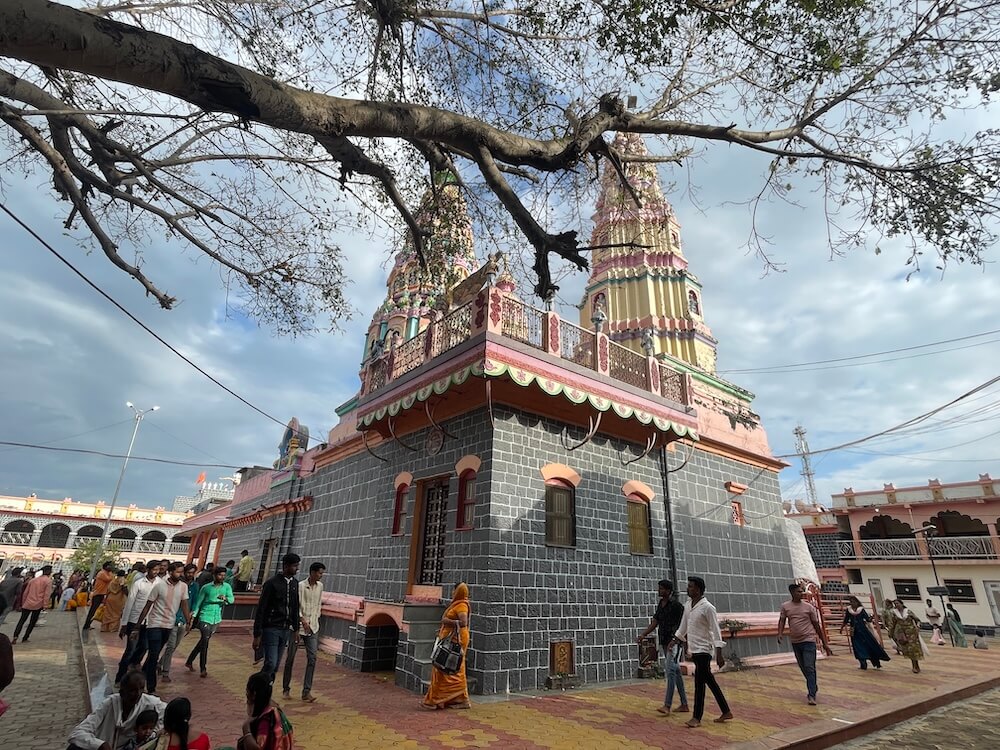
In the center of the courtyard is the Vitthal-Rukhumai temple. The temple structure consists of a Sabha Mandap (assembly hall), a main Sabha Mandap, and the Garbhagriha (sanctum sanctorum). The semi-open Sabha Mandap has ten circular ornate pillars on the outer side. All pillars are connected to each other by arched beams. Since this Sabha Mandap was built in recent times, its architectural style appears modern. Further ahead, there is about five feet of open space, and in front of the ancient-style Vitthal-Rukhumai temple, to the left, is the Samadhi temple of Mahant Mahadevbaba. The Samadhi temple houses a statue of Mahadevbaba in a meditative posture. To the right of the temple is the Samadhi temple of Bhimabai and a Tulsi Vrindavan. The entrance to the main Sabha Mandap of the temple is slightly elevated. One enters the Sabha Mandap by climbing four steps from the courtyard. There are safety railings on both sides of the steps. The door frames of the entrance feature vertical fluted carvings and floral patterns, with a Ganesha sculpture on the lintel. The enclosed main Sabha Mandap has two rows of ornate pillars. In the main Sabha Mandap, to the left and right, are the Samadhis of the departed Mahants of the Guru-Shishya lineage. The Samadhi of Nagadnarayan Maharaj is in a separate sanctum. Behind the Samadhi platforms in the main Sabha Mandap, the walls are decorated with glass inlay work. Further to the right is the Garbhagriha of Mahadeva. The wooden door frame of the Garbhagriha features vertical fluted carvings. There is a Kirtimukha on the lintel. In the center of the Garbhagriha floor is a Swayambhu (self-manifested) Shiva Linga. In the Garbhagriha on the left, there are idols of Vitthal-Rukhumai on a Vajra-pitha (diamond throne). The ceilings of all three Garbhagrihas have five-tiered circular Shikhara (spires), which contain niches with idols of various deities. The Shikharas are adorned with floral, pillar, and lotus carvings. At the apex of all three Shikharas are the Amalaka and Kalasha.
A grand fair is held on the fort during Tripurari Purnima, that is, Kartik Purnima. Many religious and social programs are organized during this eight-day festival. A blood donation camp is also organized at this time. Dussehra is the main annual festival at Narayan Gad. Influential political leaders from the state make it a point to be present on this occasion. Thousands of devotees from across the state come to seek the blessings of the deity and to fulfill their vows. On the occasion of Ashadhi and Kartiki Ekadashi, the Palkhi of Narayan Maharaj departs from the fort to Pandharpur, in which thousands of devotee Warkaris participate. An Akhand Harinam Saptah is organized in the temple three times a year. During all festivals, programs such as Bhajan, Kirtan, Pravachan, music, and Mahaprasad are organized in the temple. Festivals such as Dussehra, Diwali, Chaitra Padwa, Shravan Maas, and Kojagiri Purnima are celebrated in the temple. There is a large crowd of devotees in the temple during all festivals. The number of devotees is also high in the temple on days like Ekadashi, Pradosh, Purnima, and Amavasya.
This sacred temple stands as a testament to deep spiritual devotion, ancient architectural grandeur, and rich local cultural traditions.
The sanctum sanctorum houses the divine idol consecrated according to ancient Vedic traditions, surrounded by serene courtyards and traditional temple architecture.
Navratri, Maha Shivratri, Annual Temple Jatra & Deepotsav
Compare and book flights, secure top-rated local hotels near the temple, hire reliable guides, and rent cars instantly.
Extend your pilgrimage by visiting other highly sacred temples located nearby.


Add ₹999 more to unlock FREE SHIPPING!
Your sacred cart is currently empty.
Shop Photo FramesFill in your delivery details below to place your order.
Add comment