
Add ₹999 more to unlock FREE SHIPPING!
Your sacred cart is currently empty.
Shop Photo FramesAmbajogai in Beed district was once the capital city of the Chalukya and Yadava dynasties. Many kings who ruled this region were devout devotees of Lord Shiva, evidence of which can be seen at every step in the district. Parli Vaijnath, the fifth and an important Shiva temple among the twelve Jyotirlingas, is also located in this district. Beed city alone has twelve Shiva temples, while in various parts of the district, many ancient and renowned temples like Kankaleshwar, Rameshwar, Someshwar, and Papneshwar can be found. One such ancient Shiva temple is located in Ukkadpimpri village in Gevrai Taluka. The ancient sculptures on this temple attract the attention of devotees as well as scholars.
Scholars believe this temple dates back to the Chalukya period, around the eleventh century. Although no inscription or copper plate precisely dating the temple is available, its Hemadpanti architectural style, the sculptures on its pillars and ceilings, and the Veergal (hero stones) found in the vicinity are sufficient to prove the antiquity of this structure. This temple is situated on an elevated spot near the village entrance, alongside the road, a short distance from the banks of the Sindphana River. There is a stone-built stairway leading from the road to the temple. The dilapidated idol of a horseman on the platform in front of the temple is said to be an idol of Lord Khandoba. The temple courtyard is adorned with various types of trees.
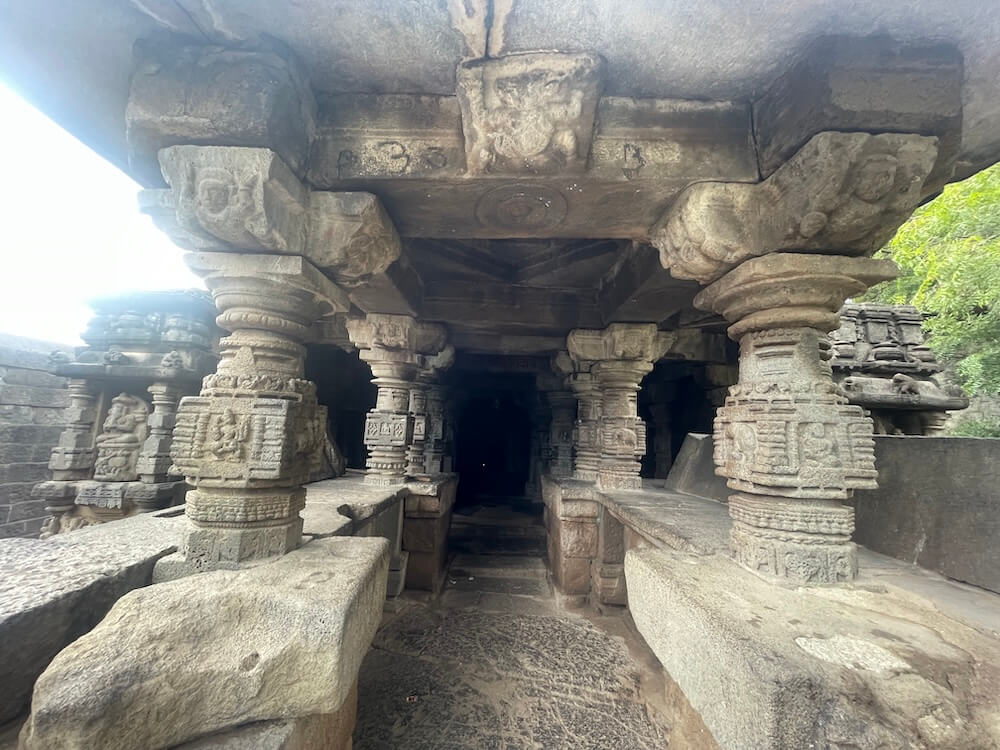
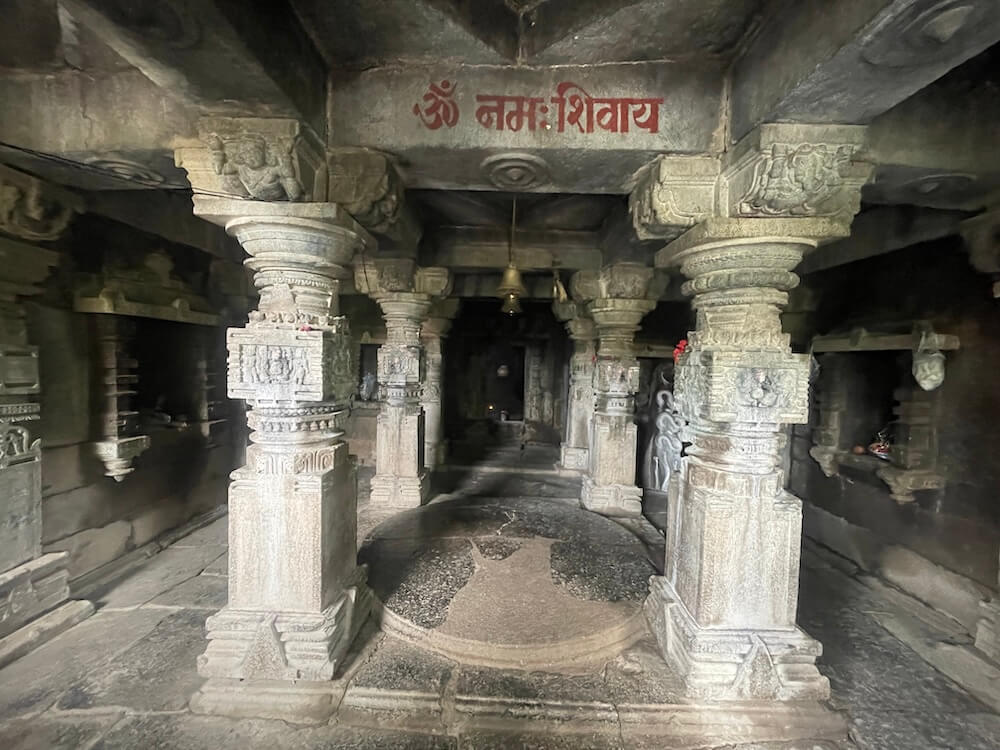
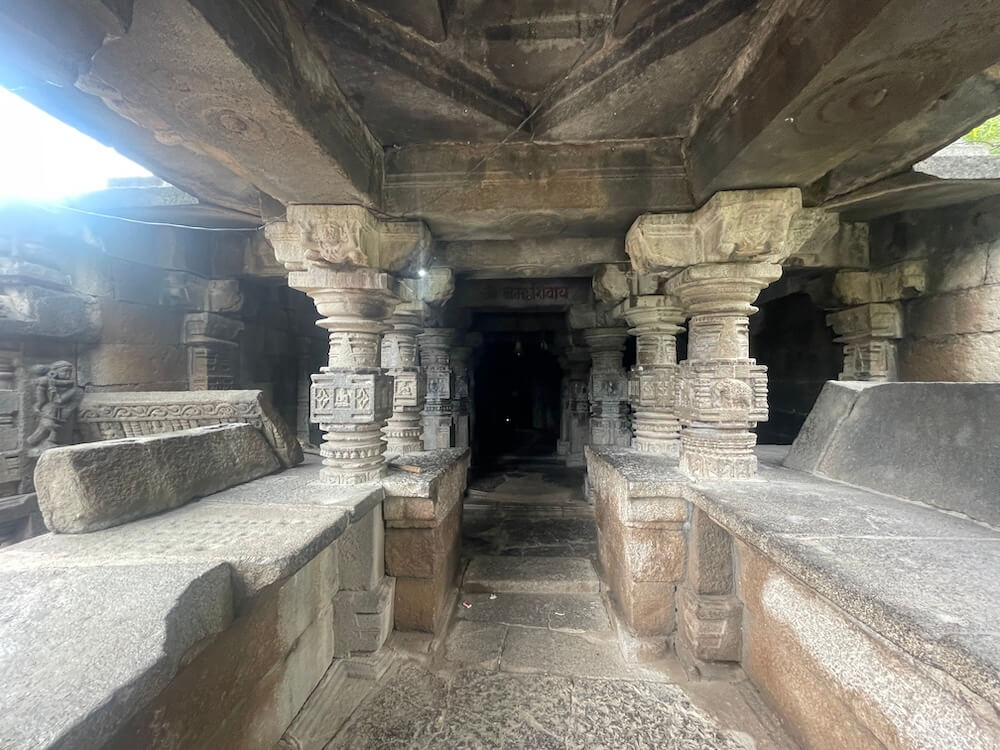
The temple’s structure comprises a Mukhamandapa (front porch), Sabhamandapa (assembly hall), Antarala (vestibule), and Garbhagriha (sanctum sanctorum). In the semi-open Mukhamandapa, excluding the entrance, there are Kakshasanas (stone benches) on all three sides for devotees to sit. These Kakshasanas feature four half-pillars. The pillar shafts are carved with various geometric shapes such as squares, hexagons, octagons, and circles, and the beams and roof are supported by the Hastas (brackets) on the capitals of the pillars. In the center of the Mukhamandapa’s ceiling (Vitan), there is a rare and unique sculpture of Lord Shri Krishna playing the flute with Gopis. The enclosed Sabhamandapa features four rows, each with four intricately carved pillars. All these pillars stand on square pillar bases (Stambhapadas). The square panels on the pillar shafts are carved with various mythological scenes and decorative patterns. On the capitals of the pillars, there are sculptures of Yakshas supporting the weight of the roof with their Hastas (brackets). The octagonal ceiling (Vitan) between every four pillars also features chakra (wheel) patterns. Between the four pillars in the Sabhamandapa, there is a circular Rangashila (performance platform), which was used for dance and music in ancient times. In the Sabhamandapa, on both sides of the Antarala, there are two Devakoshthakas (niches for deities), and above them are Ghatapallava (pot-and-foliage) sculptures. Here, on the right side, there is a Panchphani Nagashila (five-hooded serpent stone) about four feet high.
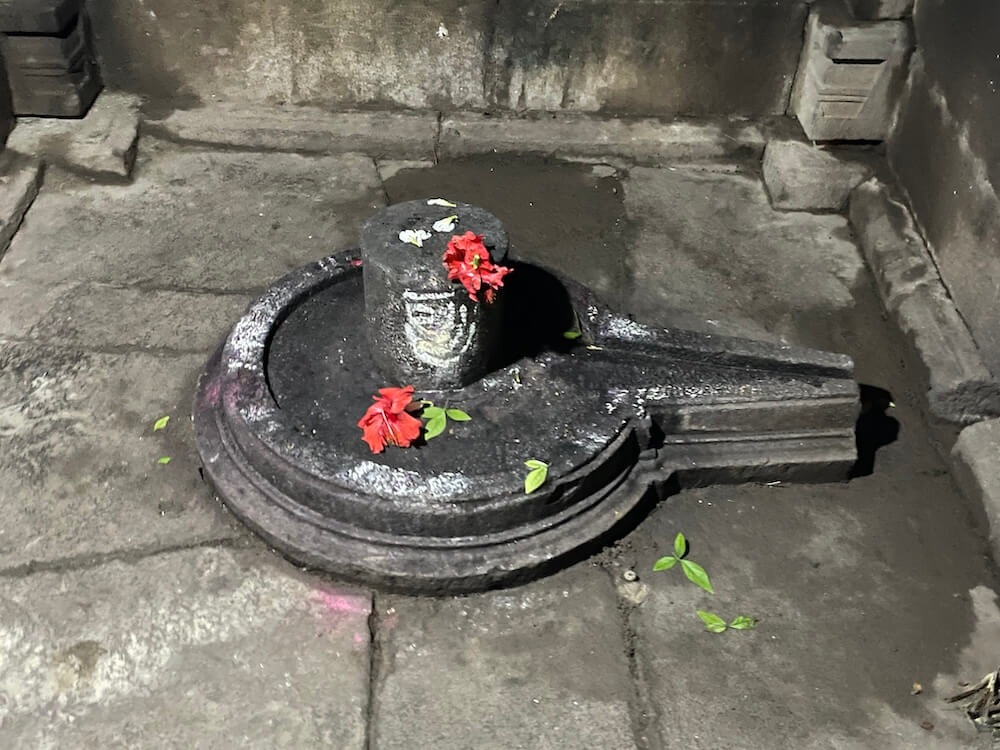
Beyond the Sabhamandapa lies the Antarala and the entrance to the Garbhagriha. The entrance to the Garbhagriha has five Dwarashakhas (door jambs) adorned with creeper motifs (Velbutti), foliage creepers (Parnalata), floral creepers (Pushpalata), pillars (Stambha), and human figures (Narashakha). At the lower part of these, sculptures of Dwarpals (gatekeepers), Dwarpalikas (female gatekeepers), Ganga, and Yamuna are carved, and below them are animal sculptures. On the Lalatabimba (lintel center), there is a sculpture of Lord Ganapati, and the Lalatapatti (lintel band) features leaf and flower patterns. The Torana (archway) has Shikhara (spire) sculptures, while the Mandaraka (door sill) has a Chandrashila (moonstone) and Kirtimukhas (glory faces) on both sides. Inside the Garbhagriha, at the center of the floor, there is a Swayambhu Shivpindi (self-manifested Shiva Lingam). A brass serpent holding a canopy (Chatra) is placed over the Shivpindi, and a copper Abhishekapatra (vessel for ritual pouring of water) is suspended from the ceiling to drip water.
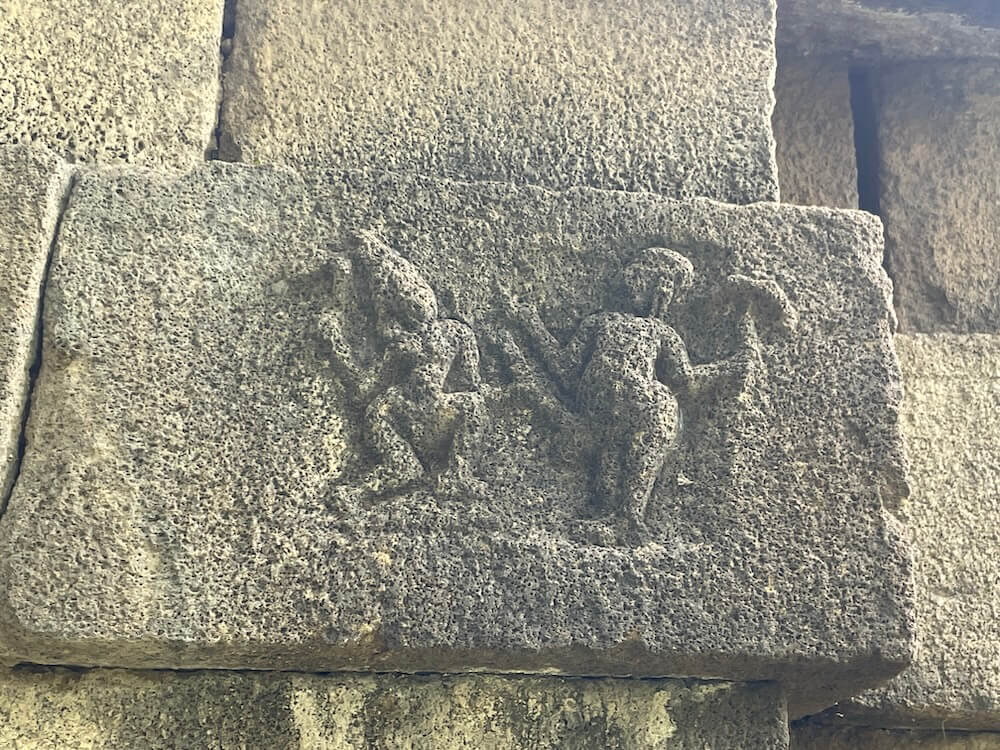
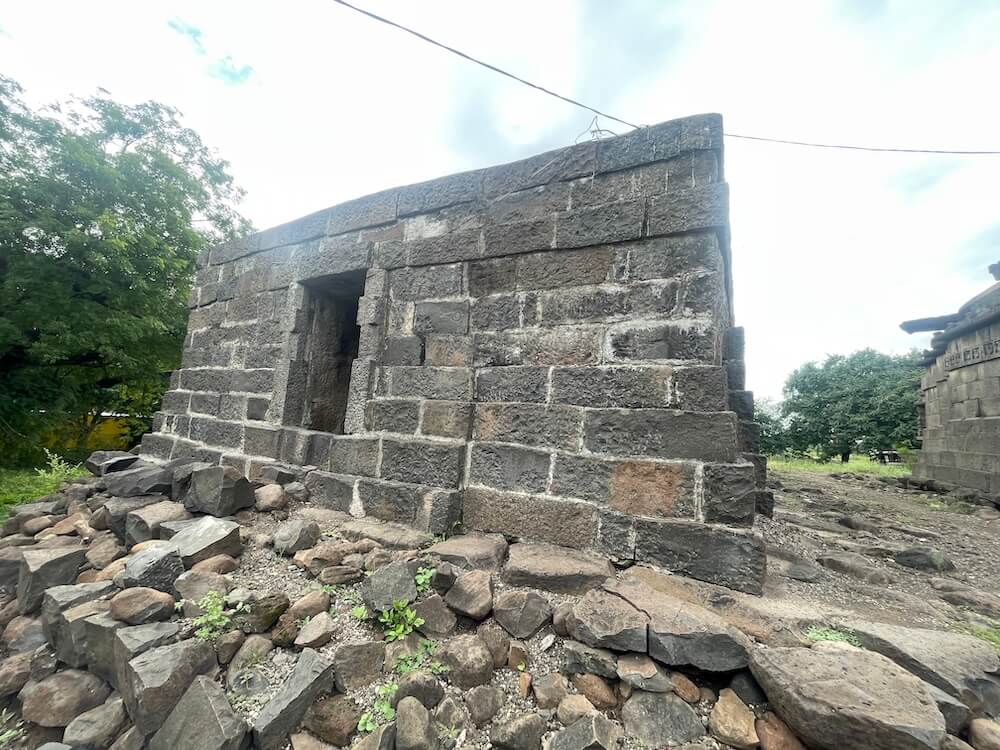
On the outer walls of the temple’s Mukhamandapa, at the base, there are Gajathar (friezes of elephants), Narathar (friezes of human figures), and Pushpathar (friezes of flowers), while on the upper part, there are Vyal (mythical beast) and Mayur (peacock) sculptures. On the left wall of the Mukhamandapa, there is a sculpture of Bhairava holding a Damaru (drum), Trishul (trident), and Kapala (skull cup), and in the Devakoshthaka (niche) on the rear wall, there is a sculpture of Surya Dev (Sun God) seated on a chariot drawn by seven horses (Saptashvaratharudh). On the Mandovar (outer wall), there are friezes depicting scenes like cavalry battles (Ashvayuddha), elephant battles (Gajayuddha), and camel battles, along with various postures of animals and birds. Here, there are sculptures of various deities and Devakoshthakas (niches). The temple roof has Pranalas (water spouts) to drain rainwater. Adjacent to the temple is an enclosed Mandapa (hall) with four rows of five square pillars. As this Mandapa lacks intricate carvings and sculptures, scholars believe it might have been used as a Yatrinivas (pilgrim’s lodging) in ancient times. Temple remnants and Veergal (hero stones) are scattered throughout the courtyard. An ancient temple of Lord Maruti is located nearby.
Mahashivratri is the main annual festival celebrated here with great enthusiasm. During this time, thousands of devotees from the surrounding areas come for Darshan (sacred viewing). The crowd is also significant during the month of Shravan. Devotees visit the temple for Darshan and to fulfill their vows (Navas) during festivals such as Chaitra Padwa, Chaitra Pournima, Dussehra, Diwali, Vaikuntha Chaturdashi, and Kartik Pournima. During festivals, Bhajan (devotional singing), Kirtan (narrative devotional singing), and musical programs are organized at the temple.
This sacred temple stands as a testament to deep spiritual devotion, ancient architectural grandeur, and rich local cultural traditions.
The sanctum sanctorum houses the divine idol consecrated according to ancient Vedic traditions, surrounded by serene courtyards and traditional temple architecture.
Navratri, Maha Shivratri, Annual Temple Jatra & Deepotsav
Compare and book flights, secure top-rated local hotels near the temple, hire reliable guides, and rent cars instantly.
Extend your pilgrimage by visiting other highly sacred temples located nearby.


Add ₹999 more to unlock FREE SHIPPING!
Your sacred cart is currently empty.
Shop Photo FramesFill in your delivery details below to place your order.
Add comment