
Add ₹999 more to unlock FREE SHIPPING!
Your sacred cart is currently empty.
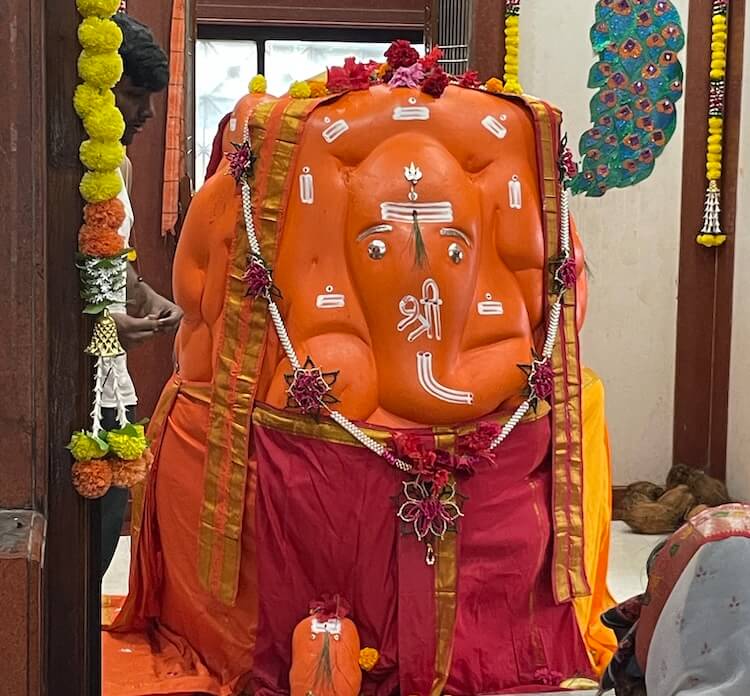
Shop Photo FramesIn Hindu Dharma, the Ganapatya sect possesses a distinct history and unique methods of worship. In this sect, Ganapati is considered the supreme deity, and many forms of Ganesha are worshipped here. Among them, the Chaturmukh (four-faced) Ganesha is regarded as a fierce deity. This deity is considered a protector and a bestower of prosperity. He is also the lord of meditation, knowledge, brilliance, and wealth. One of the few famous temples of Chaturmukh Ganapati is located in the village of Navgan Rajuri in Beed district. It is said that this is the only unique Ganesha idol in the country, featuring four Ganesha forms carved into a single stone facing the four cardinal directions.
The legend of this temple states that Lord Brahma, the creator of the universe, had planned to perform a great Yajna on this land. When he began the Yajna, demons started creating obstacles in his work. They began throwing impure objects into the sacrificial fire and harassing the sages. To find a way out of this crisis and to protect the Yajna, Brahma prayed to Ganesha. Consequently, Ganapati incarnated at this place and destroyed the demons. After the destruction of the demons, Brahma installed Ganesha so that no obstacles would arise in any future religious activities. It is believed that at this time, Ganapati established his existence in nine different forms or in nine directions, which gave this place the name ‘Navgan’. These nine locations are as follows – 1 to 4: The Chaturmukhi idol (4 forms combined) in the sanctum sanctorum facing East, West, North, and South; the fifth idol is considered the Utsav Murti (processional idol) of this same temple; the sixth location is at Tippatwadi on the eastern border; the seventh is in the Radhabai area on the western border; the eighth location is at Shirapur on the northern border; and the ninth location is Limba Ganesh at Sangameshwar on the southern border.
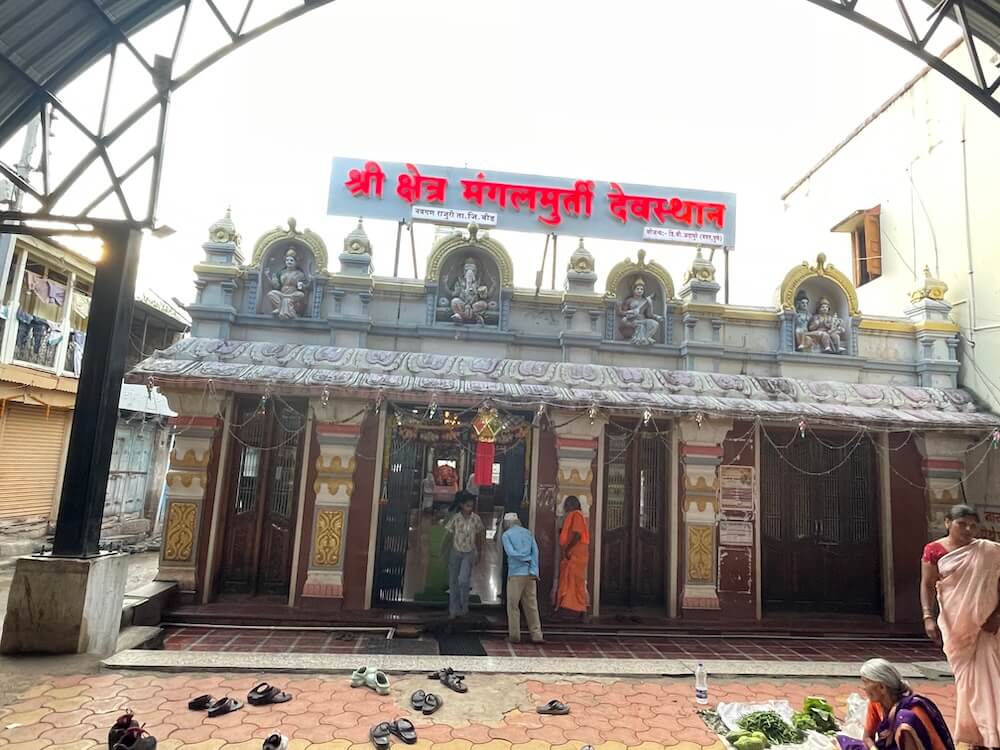
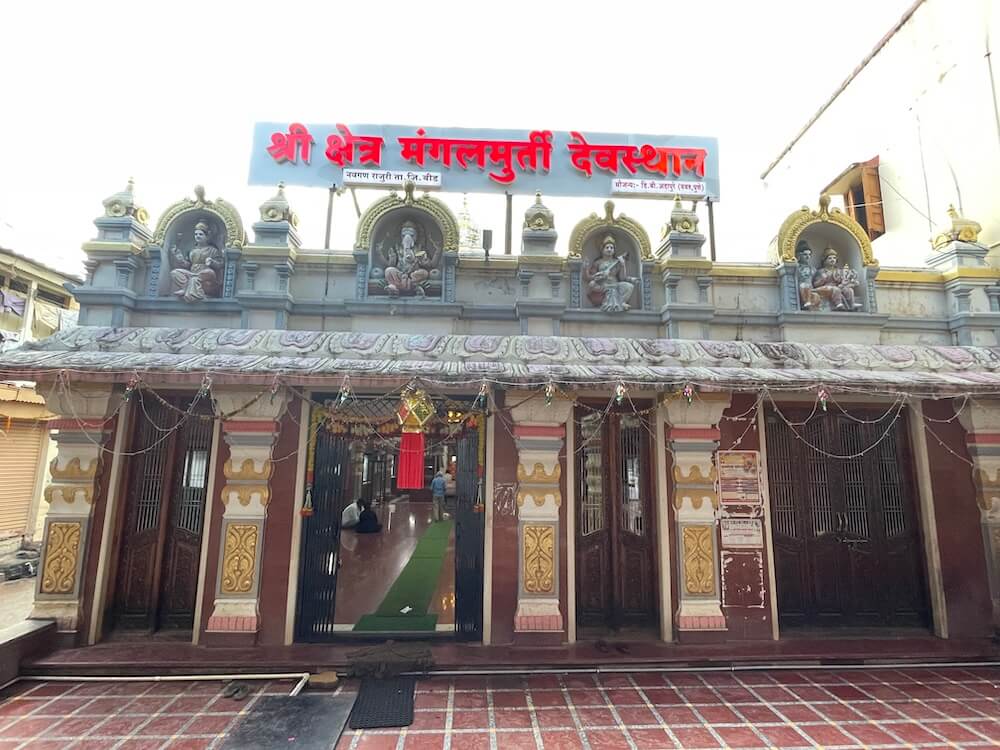
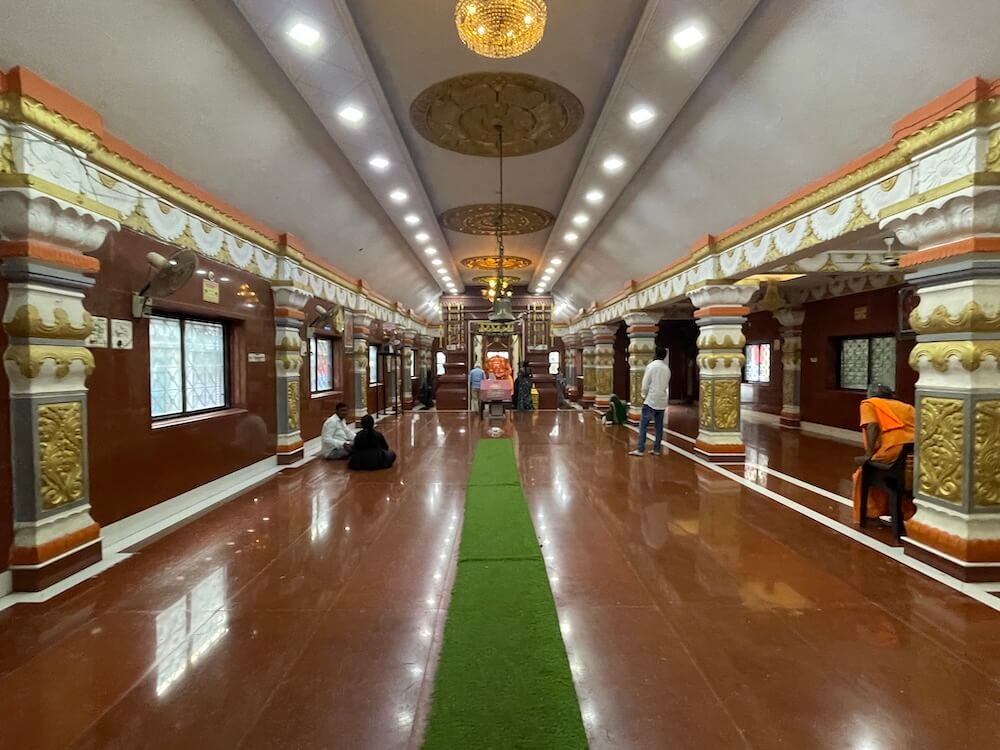
This temple is situated along the busy village road. The temple stands on a plinth that is a few inches higher than the road. The structure consists of a Sabha Mandap (assembly hall) and a Garbhagriha (sanctum sanctorum). The Sabha Mandap has four entrances from the front side. There are ornate pillars on both sides of each entrance. The Sabha Mandap contains three rows of eight ornate square pillars each. This hall is enclosed. The pillars in the left and right rows are embedded in the walls. All pillars stand on square bases, and their shafts are carved with floral patterns. In the Sabha Mandap, there is a silver tortoise sculpture in a glass case on the floor, and a brass sculpture of the Mushaka (mouse), Ganesha’s vehicle, on a Vajrapitha (pedestal). In front of the Mushaka sculpture are silver Padukas (footprints). Further ahead is the Garbhagriha, which has doors on all four sides. The walls of the Garbhagriha feature pillar carvings, and the door frames have vertical edge carvings. All four doors have ornate wooden shutters. Inside the Garbhagriha, on a Vajrapitha, is the idol featuring four forms of Ganesha in a single stone. In this stone are Mahamangal Ganraya (facing East), Shesabdhishthit Ganraya (facing West), Mayureshwar (facing South), and Uttishtha Ganraya (facing North). There is another small Ganesha idol in the front of the Garbhagriha. There is a circumambulation path (Pradakshina Marg) around the exterior of the Garbhagriha. While performing circumambulation, one can see all four Ganeshas.
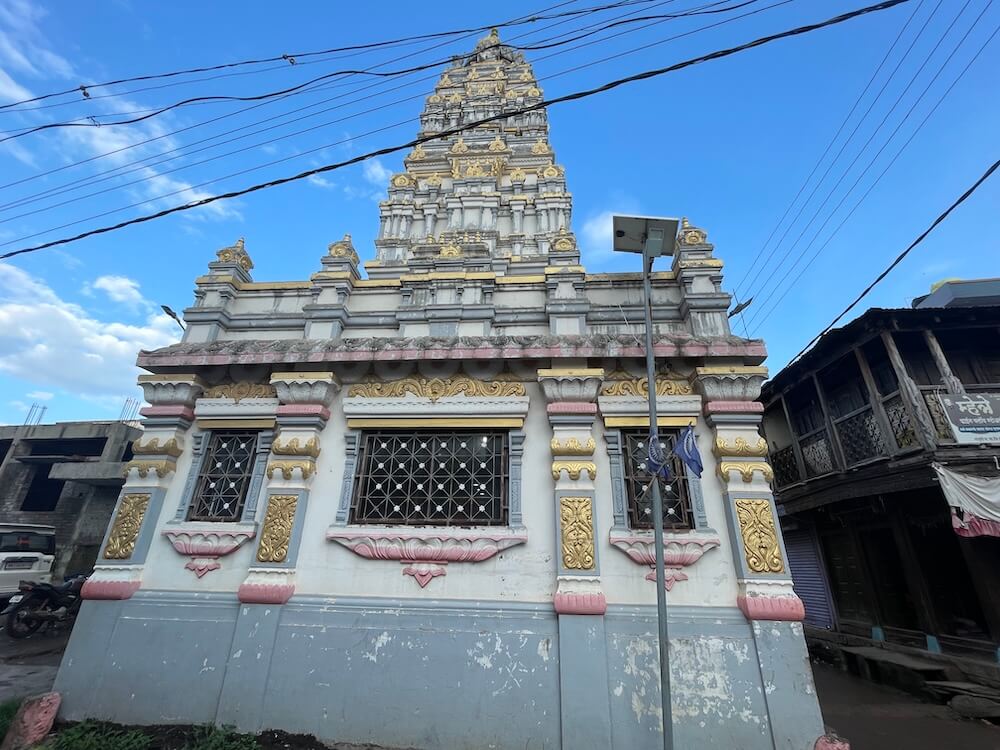
The temple roof has a sloping eave on all four sides with a parapet wall. On the front side of the parapet, there are four niches (Devakoshthakas) containing idols of Shri Ganesha, Mahalakshmi, Saraswati, and Gaurihar. On both sides of each niche are small spires (Laghushikhara) topped with finials (Kalash). The roof of the Garbhagriha has a four-tiered Dravidian-style square Shikhara. Each tier of this Shikhara features Kut and Shala structures on all four sides. The fourth tier has a Stupika surrounded by six Urushringi Shikharas topped with finials. The main finial is atop the Stupika.
The Maghi Ganeshotsav and the ten-day Parthiva Ganeshotsav in the month of Bhadrapada are the two main festivals celebrated here on a grand scale. The Maghi Ganeshotsav begins from the Shuddha Pratipada. During the first four days (Pratipada to Chaturthi), Dwar-Puja (door worship) is performed, where the four guardian Ganeshas located in the four directions of the village are worshipped ritually. On the fifth day, the ‘birth anniversary’ of Ganapati is celebrated. In the evening, a Kirtan is organized, and the birth celebration ceremony takes place. On the eighth day, the Palakhi (palanquin) of Ganapati is taken out. This Palakhi is carried through the entire village. During this time, programs such as Maha-Abhishek, Maha-Aarti, Bhajans, discourses, Kirtans, and Maha-Prasad are organized at the temple. During festivals, thousands of devotees come for Darshan and to fulfill their vows. Vows are fulfilled by offering Modaks and Puran Poli to the deity. Apart from this, there is a large crowd of devotees at the temple on days like Sankashti Chaturthi, Vinayaki Chaturthi, and Tuesdays.
This sacred temple stands as a testament to deep spiritual devotion, ancient architectural grandeur, and rich local cultural traditions.
The sanctum sanctorum houses the divine idol consecrated according to ancient Vedic traditions, surrounded by serene courtyards and traditional temple architecture.
Navratri, Maha Shivratri, Annual Temple Jatra & Deepotsav
Compare and book flights, secure top-rated local hotels near the temple, hire reliable guides, and rent cars instantly.
Extend your pilgrimage by visiting other highly sacred temples located nearby.


Add ₹999 more to unlock FREE SHIPPING!
Your sacred cart is currently empty.
Shop Photo FramesFill in your delivery details below to place your order.
Add comment