
Add ₹999 more to unlock FREE SHIPPING!
Your sacred cart is currently empty.
Shop Photo FramesThe Pataleshwar Cave Temple is located on Jangli Maharaj Road in the Shivajinagar area, formerly known as Bhamburde, in the heart of Pune city. This Shiva temple, carved out of a single monolithic black basalt rock during the Rashtrakuta dynasty in the eighth century, is situated on a rocky hill to the west of the confluence of the Mula and Mutha rivers. Geologically, this region falls within the Deccan Trap belt, formed by volcanic lava, and because it was created by excavating below ground level, it was named Pataleshwar, meaning the Lord of the Netherworld. In records from the Peshwa era, this temple is referred to as the Underground Mahadev.
It is believed that these caves were constructed between the years 753 and 982 CE during the reign of the Rashtrakuta kings, particularly under the rule of Krishna I. Although this dynasty, which held influence in India from the sixth to the tenth century, followed the Jain faith, they also held deep respect for the Shaiva, Vaishnava, and Shakta traditions. Therefore, it can be seen that almost all of their inscriptions begin with the worship of Lord Vishnu or Lord Shiva. The Rashtrakuta kings played a significant role in the construction of many famous structures in southern India, including the Ellora and Elephanta caves in Maharashtra. The copper plate of Rashtrakuta King Krishna mentions ‘Punyavishaya’, ‘Punakavishaya’, and the Pataleshwar temple located there; it is also stated that ‘Punyavishaya’ and ‘Punakavishaya’ are terms used to refer to Pune.
It is believed that this temple may have been built by the Shilahara king of North Konkan, who was loyal to the Rashtrakutas and had expanded his kingdom up to Pune. However, there is still no concrete evidence regarding exactly when this structure was erected. The architecture of these caves, especially the design of the pillars and the carvings in the monolithic rock, bears a resemblance to the world-famous Kailasa Temple at Ellora. This temple has been carved from a single large rock from top to bottom using the ‘monolithic’ technique. This stands as a testament to the advanced engineering skills of that era.
Although the entrance to the temple, the Nandi Mandapa, and the Sabha Mandapa in the Pataleshvara caves are complete, the carvings on the walls and a portion of the circumambulation path remain in an unfinished state. Historians and archaeologists suggest two primary potential reasons for this incompleteness. The first is a technical reason: while the excavation was underway, the artisans likely encountered a structural fault line at the rear of the rock sanctum, making further work hazardous to the integrity of the structure. The second reason is the strong possibility that the work was halted midway due to political instability during the Rashtrakuta dynasty or the withdrawal of royal patronage. However, this incompleteness does not diminish the beauty or the mystery of this monument in any way.
According to a legend, the Pandavas visited this region during their period of exile and resolved to build this temple in a single night to worship Lord Shiva. Using their divine powers, they began the work by carving into the solid rock. However, dawn broke before the work could be completed, and fearing that their identity would be revealed, the Pandavas had to leave the work unfinished and depart. Furthermore, according to some folklore, the name ‘Panchaleshwar’, found in old documents and common parlance, is associated with Draupadi, the wife of the Pandavas, It is associated with the district also known by the name ‘Panchali’. There is also a prevalent belief that it is called ‘Panchaleshwar’ as it is a Linga established by the five Pandavas and Panchali.
Numerous references to these caves are found in historical and literary sources. In the Marathi book ‘Pune Shaharache Varnan’ published by Na. Vi. Joshi in 1868, while describing the state of Pune in the eighteenth and nineteenth centuries, Pataleshwar is mentioned as a ‘quiet place outside the city’ and as ‘Pandav Leni’. According to the records from the Peshwa era in Rao Bahadur Parasnis’s book ‘Poona in Bygone Days’, there is a record of a donation of one rupee given to Pataleshwar, referred to as ‘Bhuyaratil Mahadev’, in the list of donations given by the second Bajirao Peshwa to the temples of Pune in 1810. Furthermore, in the 1885 ‘Gazetteer of the Bombay Presidency: Poona’, the British administration referred to it as the ‘Panchaleshwar Caves’ or ‘Bhamburde Caves’ and provided a scientific description of it. A scholarly reference to the structure of this monument also appears in Dr. M. S. Mate’s book ‘Maratha Architecture’.
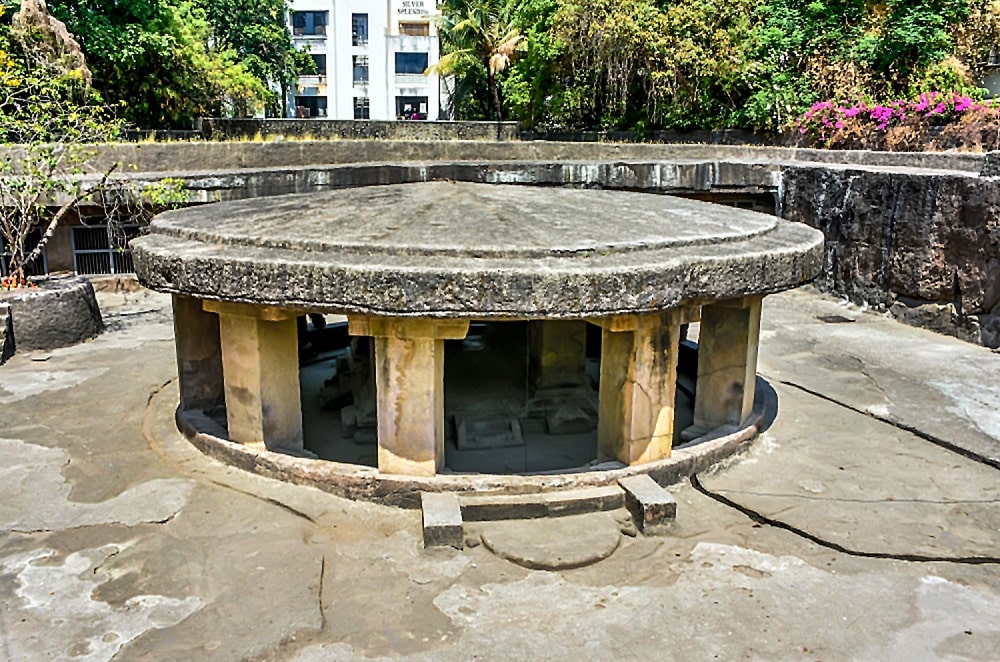
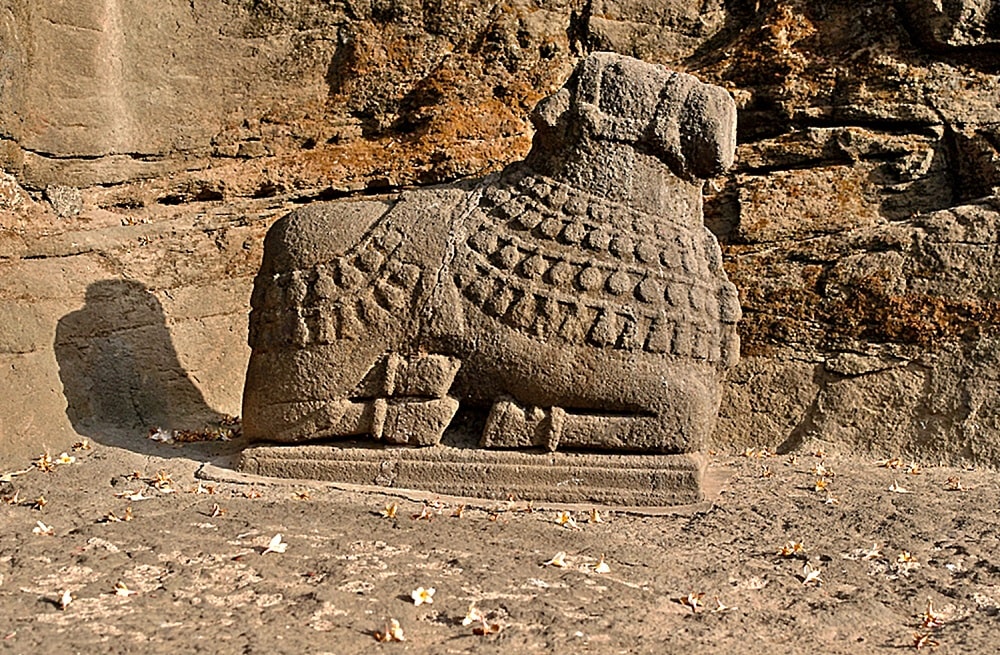
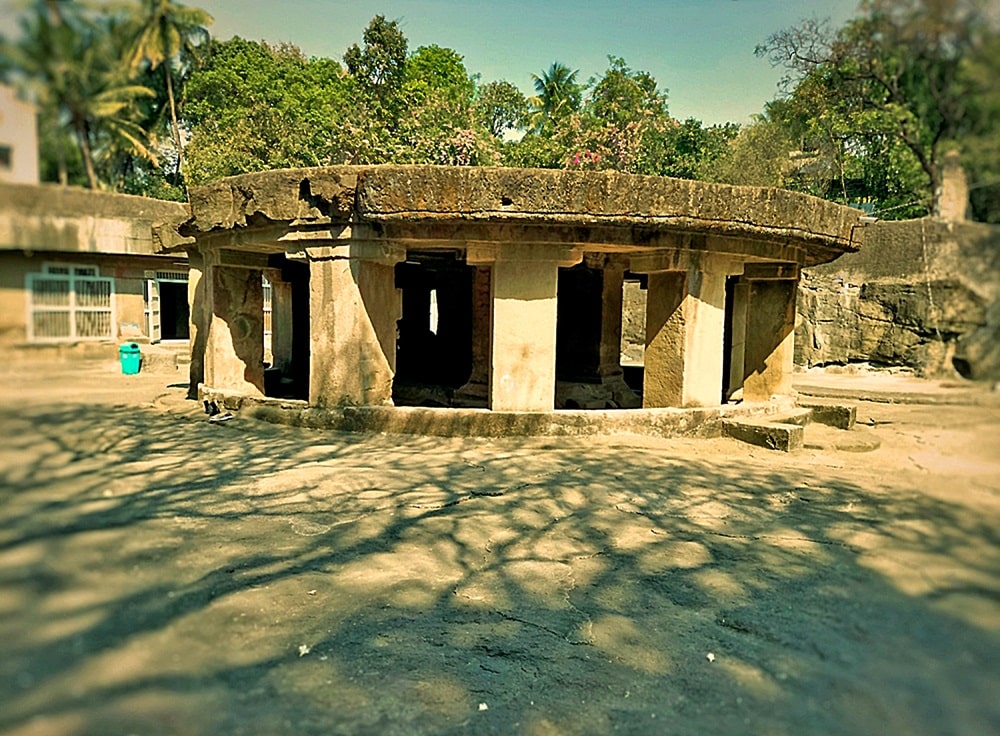
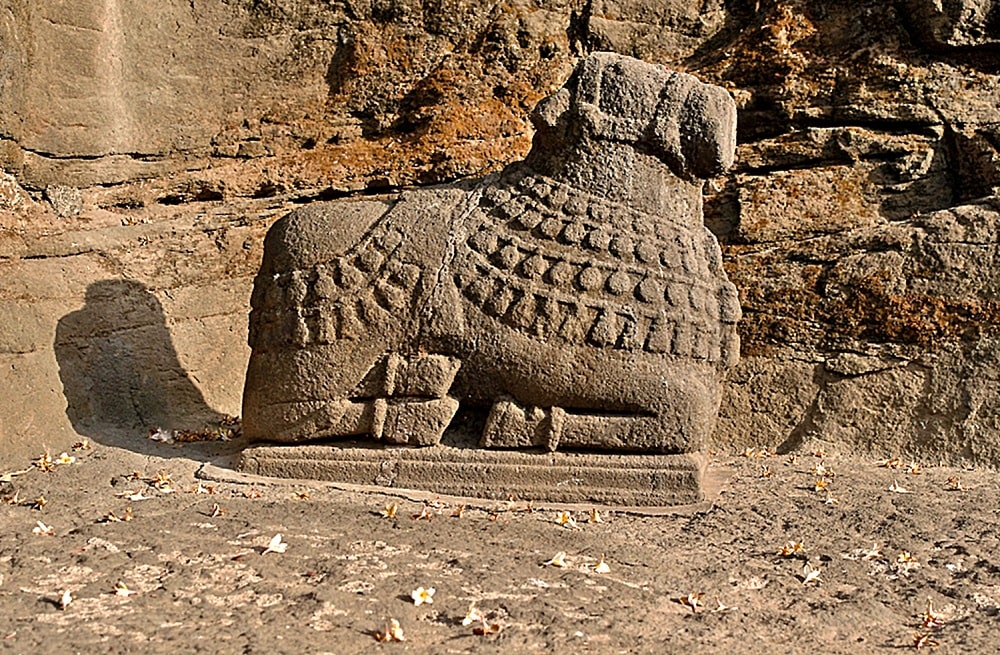
This Shiva temple, carved from a single monolithic rock, is situated along Jangli Maharaj Road. The temple features a double fortification, and one must climb a flight of stairs to reach the courtyard, which is elevated above the road and accessed through an entrance gate. The beautifully landscaped garden makes this area appear scenic and pristine. After crossing the second fortification made of iron railings, one must descend a flight of stairs carved directly into the rock. Directly in front of these caves stands a Nandi Mandapa, also carved from a single monolithic stone. This circular roof, which resembles a large umbrella, is supported by a total of sixteen square pillars—twelve on the outer perimeter and four on the inner side. In the center of this mandapa, on a raised platform, Nandi is enshrined, and right next to the Nandi-mandapa in the courtyard, there is an ancient water tank.
In front of the Nandi Mandapa, on the left side, lies the main entrance to the caves, situated within a rock-cut veranda. In front of the entrance are four steps carved into the rock. Near this entrance, there is an inscription in the Devanagari script. Upon entering through the gateway, one steps into a spacious assembly hall (Sabha Mandapa) carved out of a single monolithic rock. On the left and right walls of the assembly hall are friezes adorned with floral and creeper motifs. There are a total of thirty massive stone pillars in this assembly hall. These pillars are simple and square. In the center of the assembly hall, between four pillars, is an idol of Nandi on the floor. In the assembly hall, in front of the sanctum sanctorum on the left, there is an idol of Maruti made of black stone placed on a pedestal (Vajrapitha), and on another pedestal, there are marble idols of Shri Rama, Lakshmana, and Janaki. It is said that these four idols were installed in recent times. The faint sculptures of Saptamatrika, Gajalakshmi, Tripurantaka Shiva, and Lingodbhava Shiva on the walls of the assembly hall reflect the influence of the Shaiva and Shakta traditions. According to records in the British Gazetteer of the year 1885, there were paintings of the Mahabharata and Mahadeva on the walls of this assembly hall in the latter half of the nineteenth century.
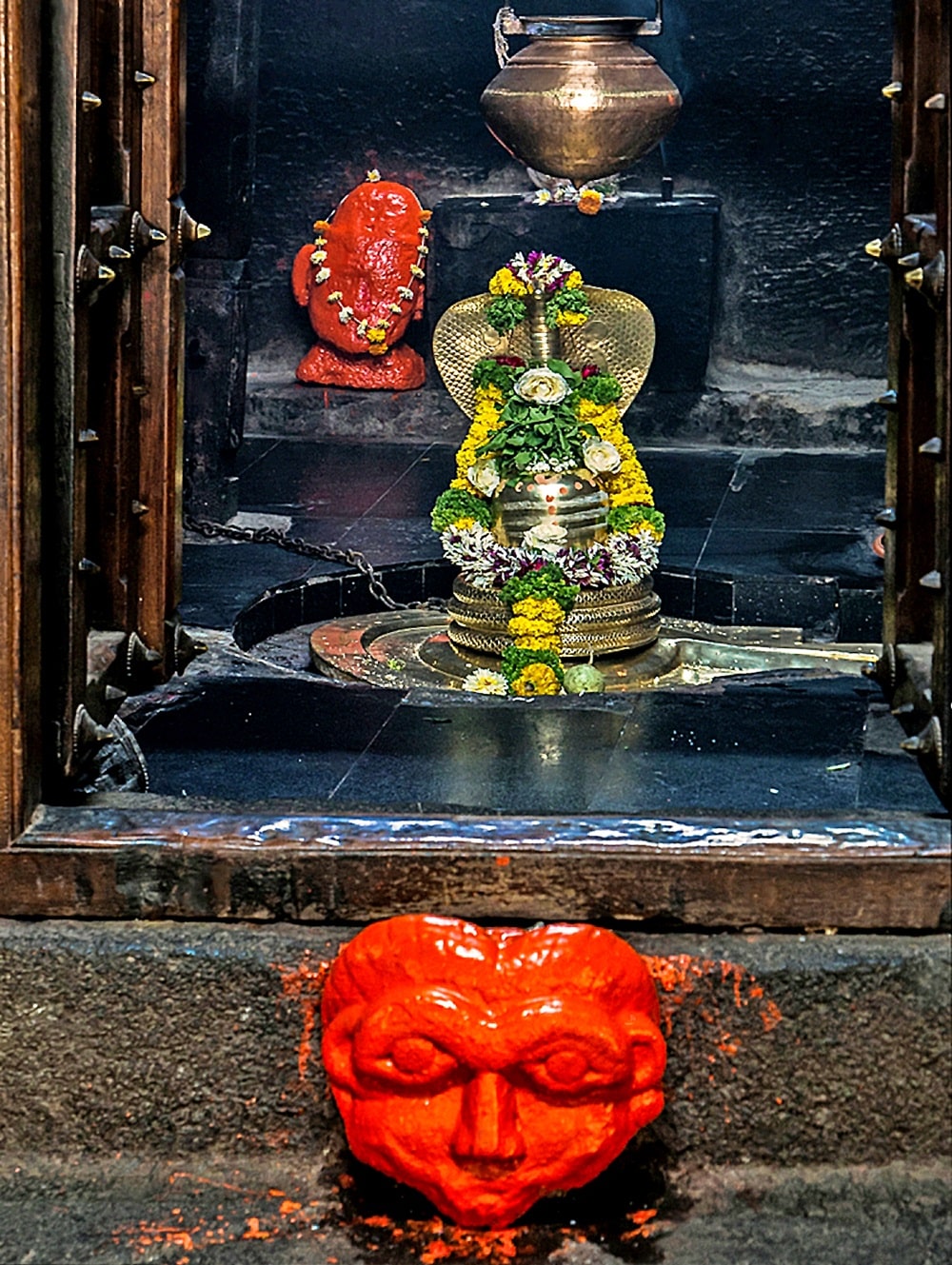
The main cave contains three sanctums. In the central sanctum, there is a self-manifested Shiva Linga of Pataleshwar, encased in a brass covering. The entrance to this sanctum features beautiful intricate carvings. Inside the sanctum, there is a shrine of Lord Ganesha on the left and Goddess Parvati on the right. It is speculated that according to the original Trimurti concept, there might have been idols of Brahma and Vishnu here as well. A path has been carved directly into the rock around this sanctum for circumambulation. Walking through this dark passage while performing circumambulation offers an experience of the cave’s profound mystery. Since one must descend below ground level to enter this temple, the cave likely earned the name ‘Pataleshwar’.
Among the festivals celebrated at the temple, the ‘Deepotsav’ on Tripurari Purnima is significant. On the evening of Kartik Purnima, the entire temple premises illuminate with the golden glow of thousands of earthen lamps. On this day, Annakut and Maha-Aarti are organized at the temple. Additionally, there is a large influx of devotees during the holy month of Shravan and on Mahashivratri. Rudrabhishek is performed on the Shiva Linga here using Panchamrit, consisting of milk, curd, ghee, honey, and sugar. Every Monday during Shravan, the atmosphere here resembles a fair.
This sacred temple stands as a testament to deep spiritual devotion, ancient architectural grandeur, and rich local cultural traditions.
The sanctum sanctorum houses the divine idol consecrated according to ancient Vedic traditions, surrounded by serene courtyards and traditional temple architecture.
Navratri, Maha Shivratri, Annual Temple Jatra & Deepotsav
Compare and book flights, secure top-rated local hotels near the temple, hire reliable guides, and rent cars instantly.
Extend your pilgrimage by visiting other highly sacred temples located nearby.


Add ₹999 more to unlock FREE SHIPPING!
Your sacred cart is currently empty.
Shop Photo FramesFill in your delivery details below to place your order.
Add comment