
Add ₹999 more to unlock FREE SHIPPING!
Your sacred cart is currently empty.
Shop Photo FramesAmongst the ancient cities of Vidarbha, Bhadravati is revered as a historical and religiously significant place. The hundreds of temples, viharas, palaces, lakes, wells, hills, caves, rock-cut caves, inscriptions, and countless idols found here bear witness to its ancient opulence. This city stands today, holding within its heart a treasure trove of remains from prehistoric times, through the medieval period, and beyond. One of the most important religious and ancient sites amongst these is the temple of Chandika Mata. For approximately one thousand years, this temple has stood firmly here, unmindful of the sun, wind, and rain.
According to one legend, Bhadravati once had three hundred and sixty temples, three hundred and sixty lakes, and three hundred and sixty wells. Alexander Cunningham, in his writings, mentioned that the temple of Śrī Caṇḍikā Mātā was located to the southeast of Bhadravati city. He also described the archaeological grandeur of this temple. Alexander Cunningham is revered as the father of the Archaeological Survey of India. In the year एक हजार आठशे एकसष्ट, Lord Canning established the Archaeological Survey of India and appointed Cunningham as its first Surveyor. During this period, Cunningham unveiled many facets of ancient Bharat’s history to the world.
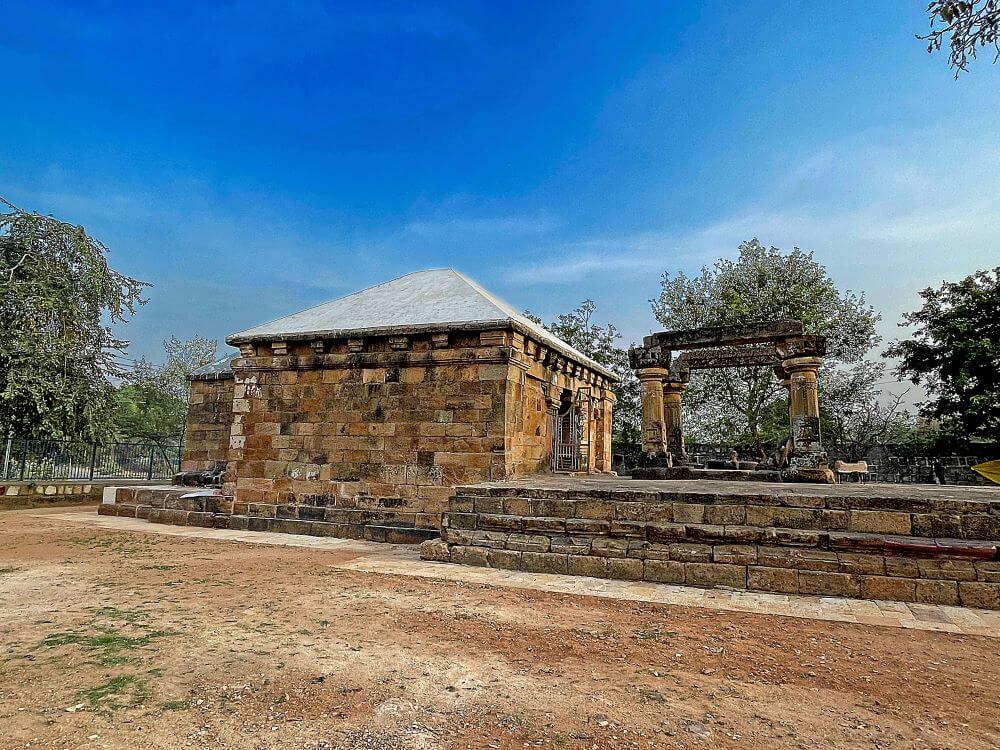
This ancient temple of Śrī Caṇḍikā Mātā is situated in the Pañcaśīlanagar Akhāḍā area, right in the heart of Bhadrāvatī city. Adjacent to this temple is a Śvetāmbara Jain temple. Formerly located outside the city, this temple has now come to be in the central part of the city due to the growth of the surrounding settlement. The temple complex, fortified on all four sides, is spacious. Upon entering the temple premises through the fortified gateway, there is a path leading to the temple through a beautiful garden. Along this path and around the temple, arrangements have been made for devotees to sit on benches.
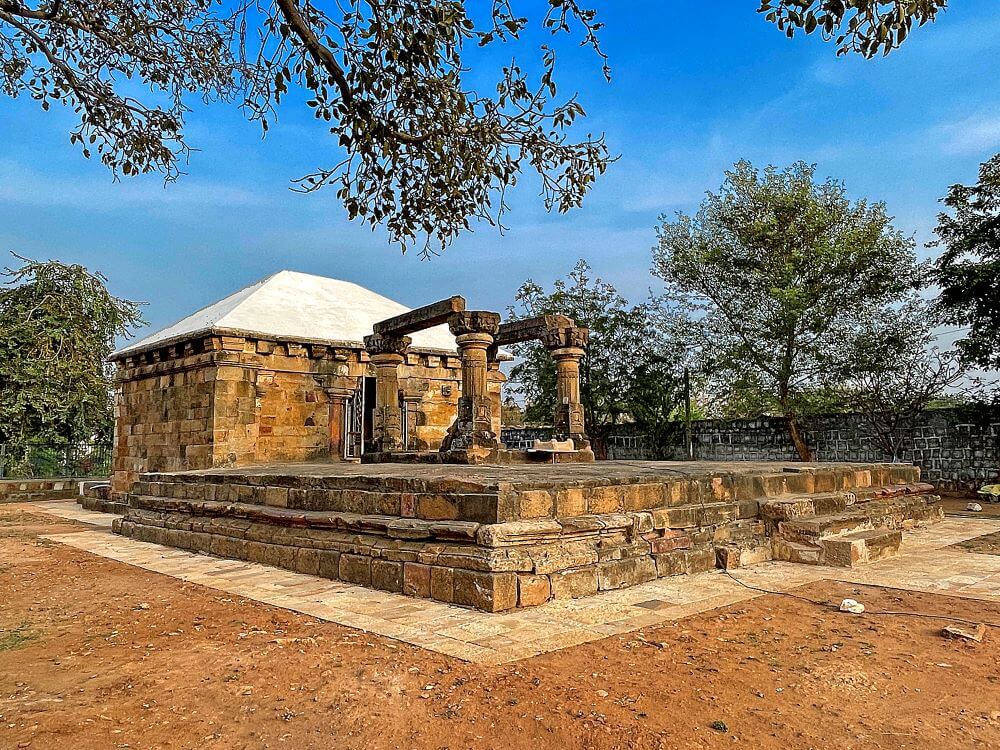
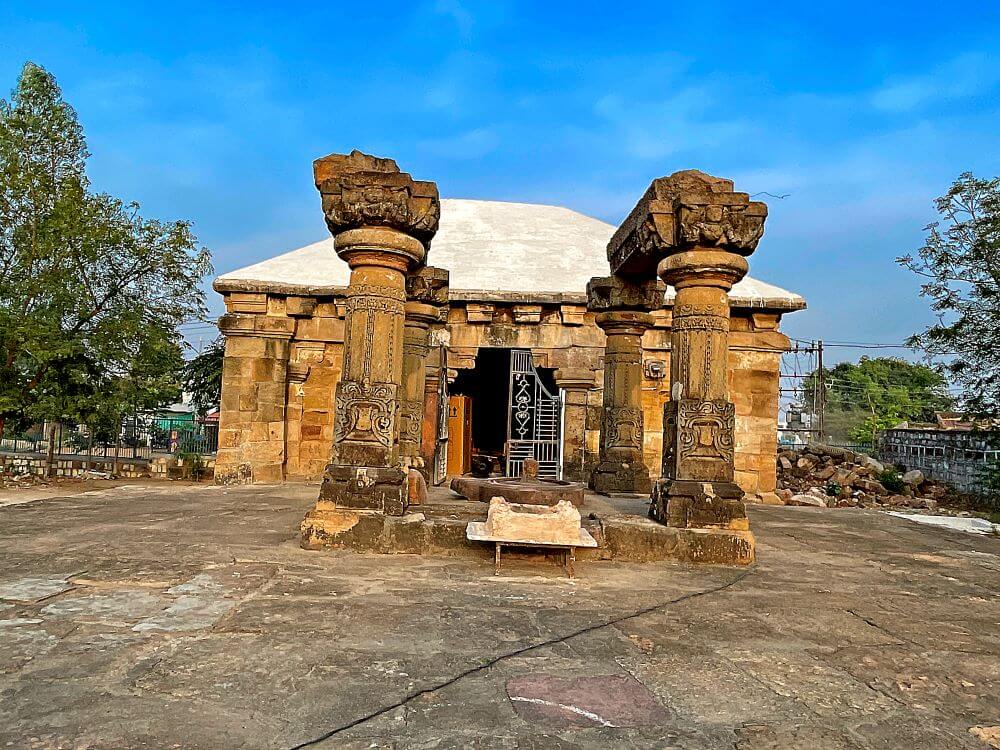
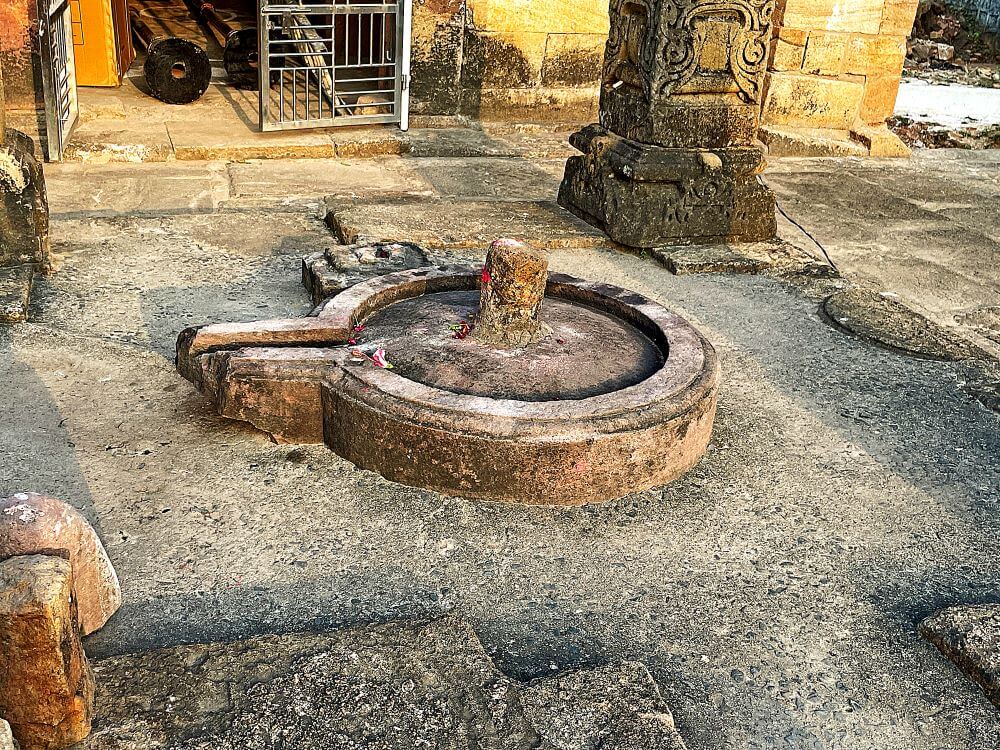
The sacred shrine of Mother Chandika Devi is gracefully situated upon an elevated plinth. According to the description provided by Shri Alexander Cunningham approximately one hundred and fifty years ago, there were three steps leading up to this plinth, which are still visible today. In front of the main temple’s entrance, there is a mukhamandapa, a porch, adorned with four exquisitely carved stone pillars. These pillars do not support a roof; instead, they are crowned only by connecting stone beams (square wooden or stone pillars placed horizontally upon two columns or atop two walls). The size and intricate artistry of all four of these pillars are identical. The lower portion of each pillar is square, while the middle section is octagonal. Above the octagonal part, there is circular, torana-like ornamentation, from which hang chains adorned with bells, creating a beautiful embellishment. At the very top of the pillars, there are Amalaka-shaped forms, and above these, one can behold images of Yakshas, the divine bearers. In the center of the pillars, there is a large Shiva Lingam and several ancient murtis.
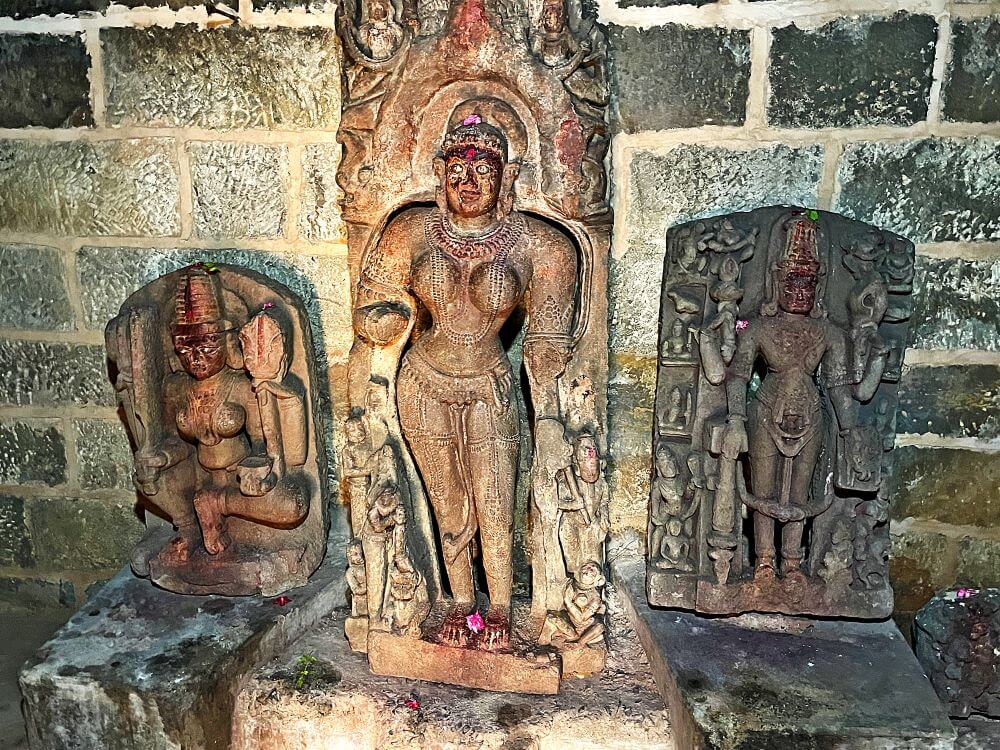
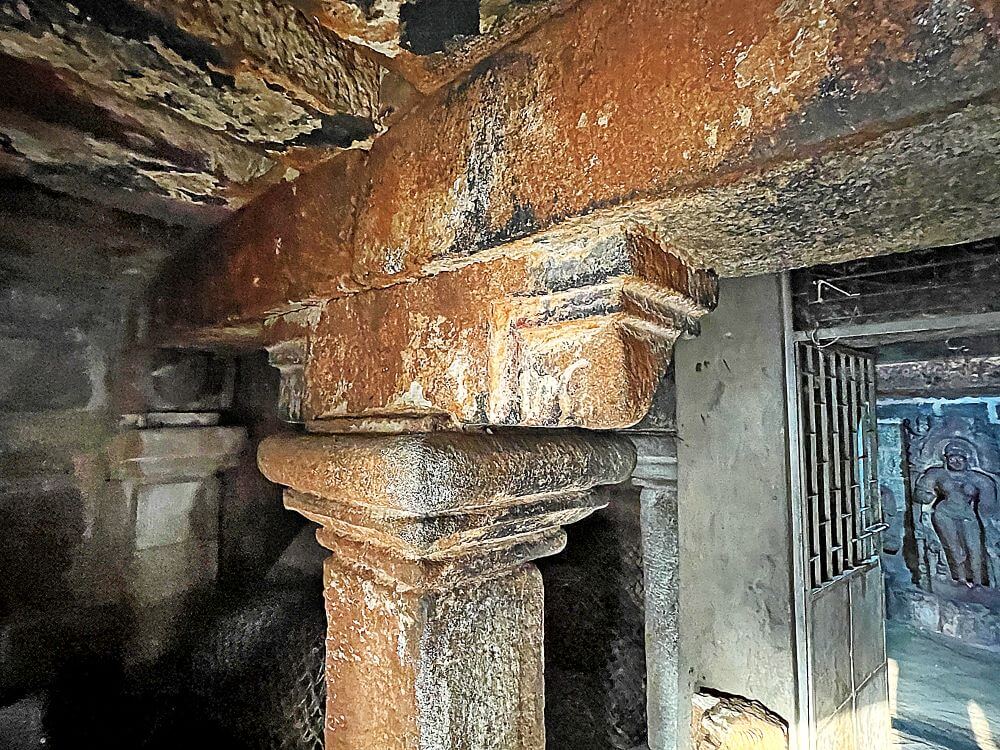
This west-facing temple’s sabhamandapa is graced by sixteen stone pillars. While these pillars do not feature elaborate carvings, one of them bears an inscription detailing the temple’s history. This inscription, located on a pillar to the right of the garbhagriha, is carved in Devanagari script and states that it was inscribed in the year one thousand and seventy-six of the Christian era, and that this is a temple of Chandika Devi. Although the inscription is somewhat faded now, it is invaluable in determining the period of the temple’s construction. Within the sabhamandapa, one can also behold many ancient murtis of various devas and devis.
Upon observing the temple, it becomes evident that the area which was formerly the antarala has been merged into the garbhagriha during restoration. Proceeding inward through this elongated garbhagriha, one beholds the monolithic murti of Chandika Mata. To one side of this murti stands a murti of Bhagwan Vishnu, and to the other, a murti of Bhairava. A unique feature of this temple is the absence of a shikhara. The beams resting on the pillars within the sabhamandapa appear to emerge from the area near the ceiling and are adorned with intricate carvings. Adjacent to the temple is a water kund. Presently, this temple is under the purview of the Department of Archaeology. The Department of Archaeology has undertaken the renovation of the temple and the beautification of its surroundings.
This sacred temple stands as a testament to deep spiritual devotion, ancient architectural grandeur, and rich local cultural traditions.
The sanctum sanctorum houses the divine idol consecrated according to ancient Vedic traditions, surrounded by serene courtyards and traditional temple architecture.
Navratri, Maha Shivratri, Annual Temple Jatra & Deepotsav
Compare and book flights, secure top-rated local hotels near the temple, hire reliable guides, and rent cars instantly.
Extend your pilgrimage by visiting other highly sacred temples located nearby.


Add ₹999 more to unlock FREE SHIPPING!
Your sacred cart is currently empty.
Shop Photo FramesFill in your delivery details below to place your order.
Add comment