
Add ₹999 more to unlock FREE SHIPPING!
Your sacred cart is currently empty.
Shop Photo FramesSateri Devi is considered the Gramadevata (village deity) of Sindhudurg. Sateri is regarded as one of the Saptamatrikas (seven mother goddesses). Shanta Durga is a form of this very Goddess. According to mythology, Shanta Durga, who established peace by ending a war, is a famous deity of Goa. At Vadacha Pat in Malvan, this Goddess is worshipped in two forms: Shanta and Durga. Devotees believe that the deity’s presence here is vibrant and that she fulfills the vows of her worshippers.
The greatness of Goddess Durga is described in the latter half of the Kashi Khanda of the Skanda Purana. According to the legend, in ancient times, there was a powerful demon named Durg. He had received a boon that he could not be killed by a man. Due to this boon, he defeated all the gods and brought them under his control. Consequently, all the deities sought refuge with Lord Shiva. Following Shiva’s command, Rudrashakti Kalratri waged war against him and annihilated him. Thereafter, the Goddess declared that since she had slain the demon named Durg, she would henceforth be known as Durga. Goddess Durga is the wielder of weapons who fights against demons. There is also a mythological legend about how she came to be named Shanta Durga.
According to this legend, a war once broke out between Shiva and Vishnu. It continued for a long time, but there seemed to be no possibility of either side winning. Seeing that the cosmic order would not function smoothly unless this war ended, Lord Brahma finally sent Goddess Durga to the battlefield. She preached to both of them, ended the war, and established peace. Therefore, she came to be known as Shanta Durga. The ‘Vishwakosh’ states regarding this, ‘The perspective of resolving the conflict between Shaivites and Vaishnavites is evident behind this story.’ In the Konkan region adjacent to Goa, Shanta Durga is also worshipped in the form of Sateri. The temple of this very Goddess is at Vadacha Pat. However, she is enshrined there in two forms: Shanta and Durga.
There is a legend about this temple that a cowherd’s cow used to go to a specific spot every day and release its milk. After noticing this, he inquired about it, but he did not receive an explanation. Finally, one night, he had a divine vision. In it, the Goddess told him that she resided at that spot. The next day, he took some people from the Palav community of the village and cleaned the area. At that time, a pickaxe struck a stone there. Blood began to flow from it. Subsequently, that stone was installed here as the Goddess.
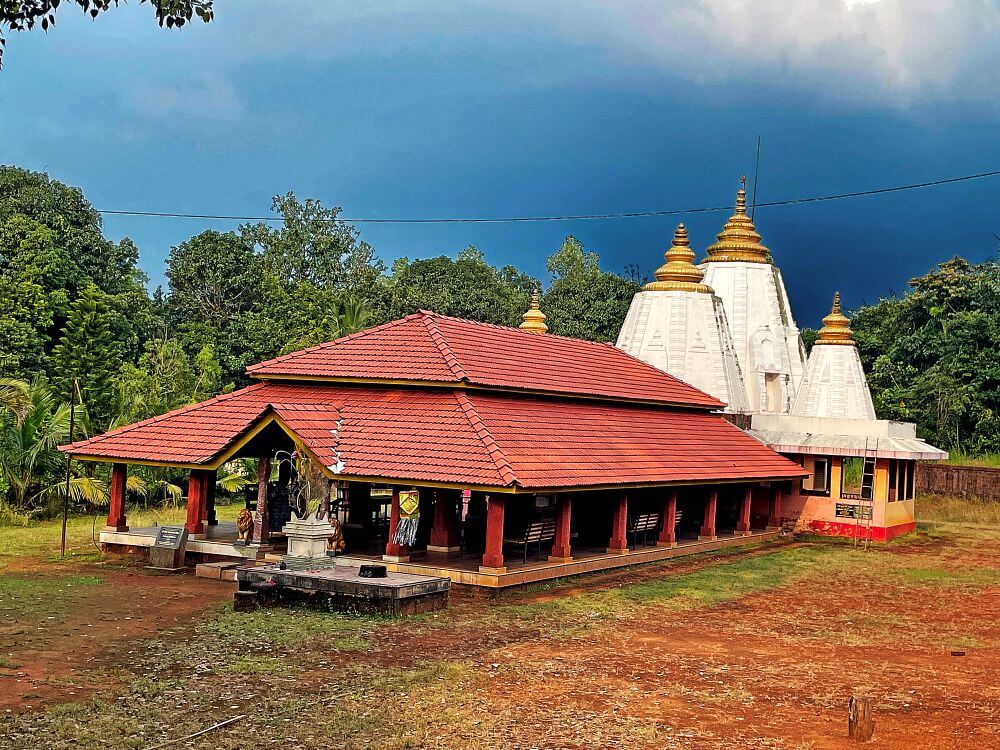
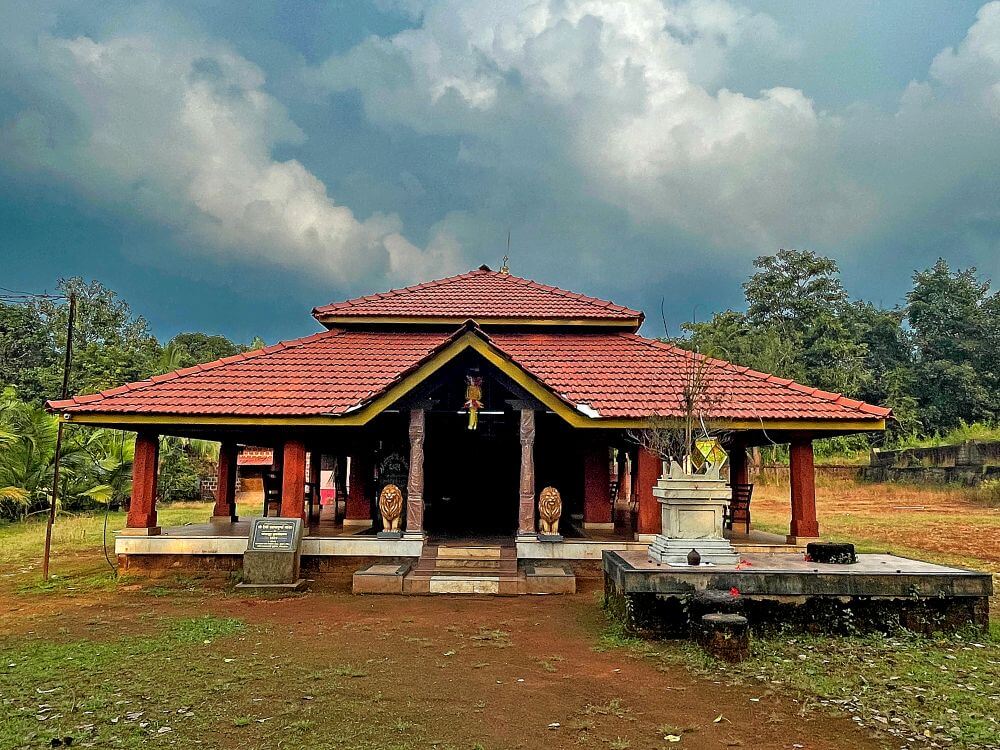
The Shanta Durga Temple here is situated in a spacious courtyard. There is a boundary wall around the temple. In front of the temple, on a platform, there is a Tulsi Vrindavan and next to it is the stone of a local deity. There is a Sabha Mandap (main hall), an Upa-Sabha Mandap (secondary hall), an Antarala (vestibule), and a Garbhagriha (sanctum sanctorum) within the Antarala, as well as two temples attached to the left and right sides of the Upa-Sabha Mandap. These temples, as well as the Upa-Sabha Mandap and the Antarala, have spires (shikharas). The main spire of the temple is naturally taller than the others. This spire, which is somewhat pyramid-shaped, has niches for deities on all four sides. The spire has a four-tiered Amalaka and a Kalasha atop it. The roof of the Sabha Mandap, however, is tiled. Its design is in the Konkan architectural style.
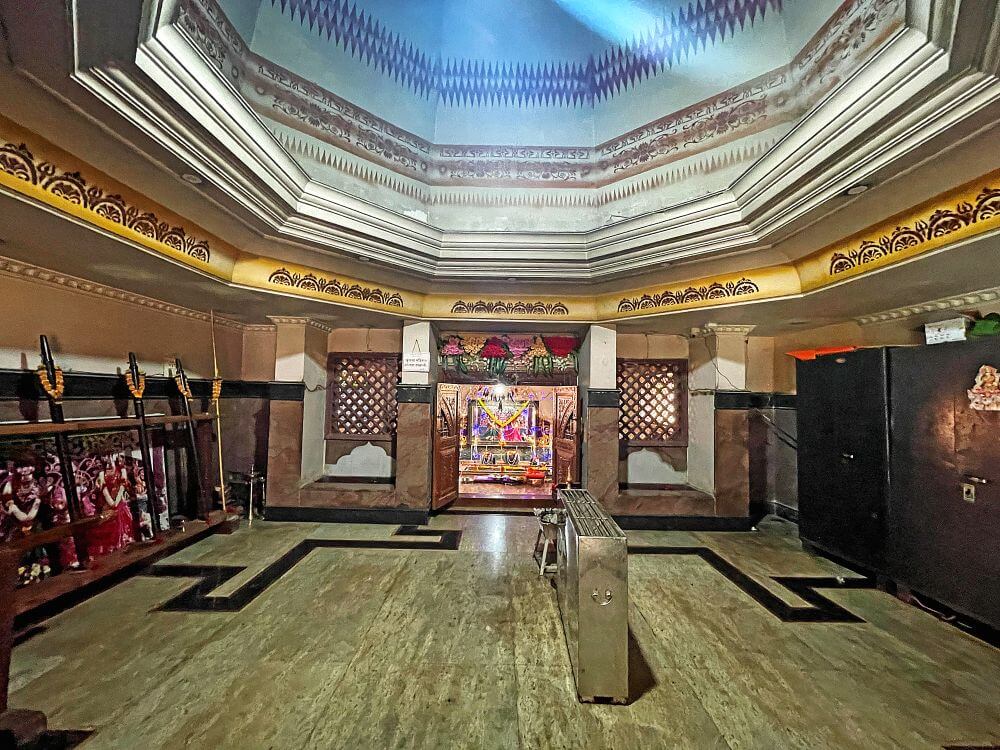
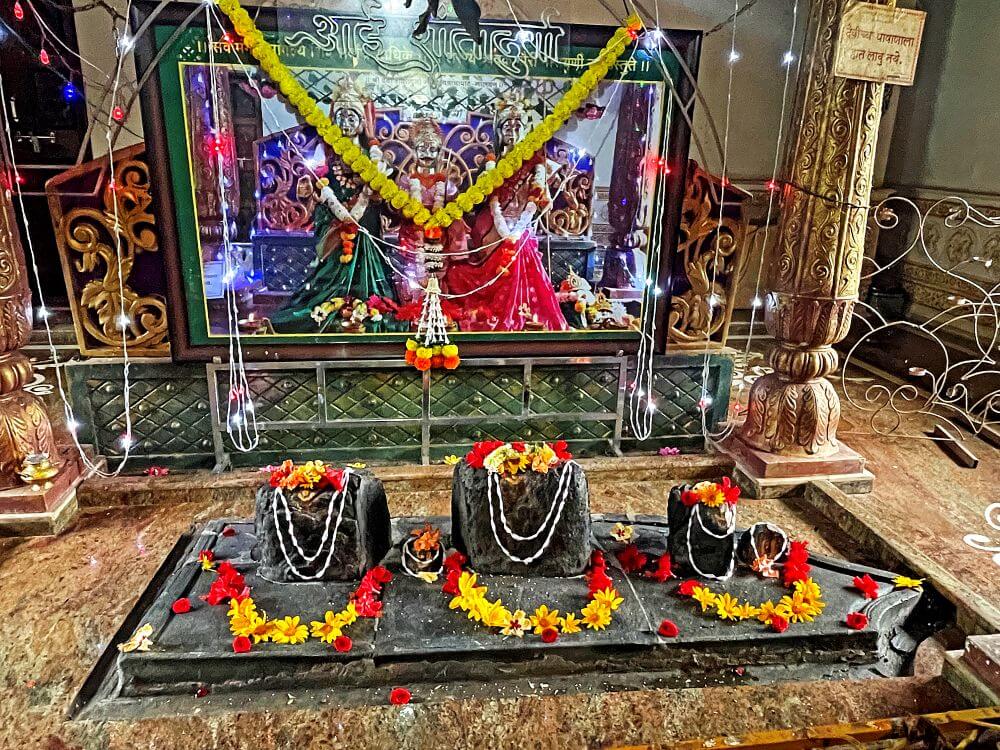
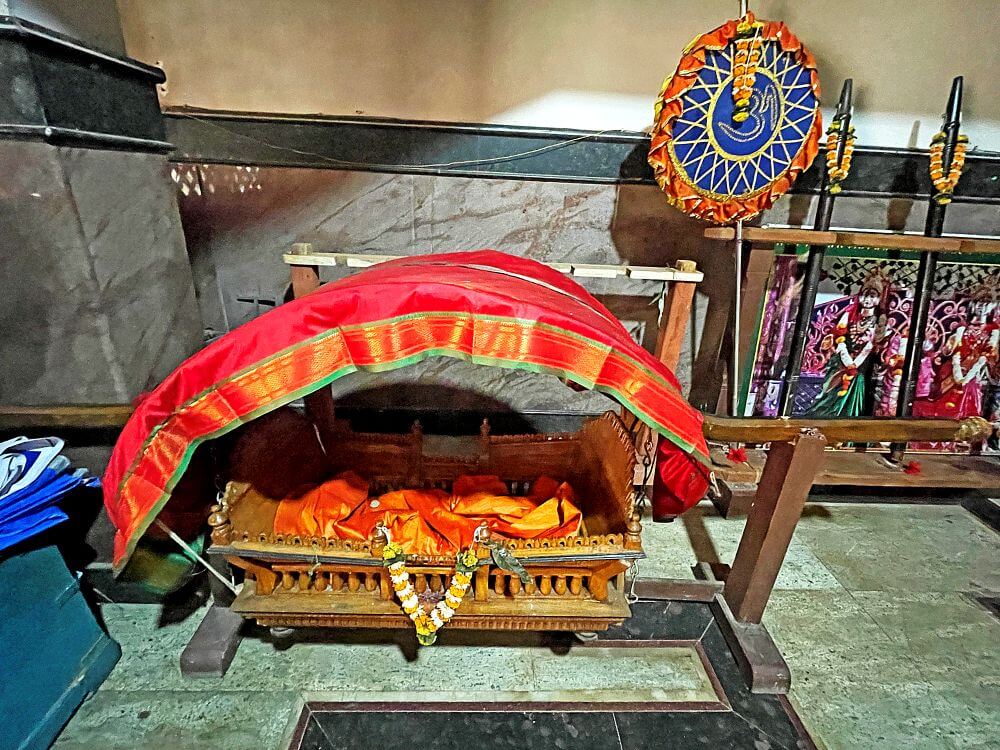
Near the entrance of the Sabha Mandap, there are two large lion statues beside the steps. The wooden palanquin of the deity, as well as the Tarang-kathya (processional poles) and Abdagiri (ceremonial umbrella), are kept here. The ceiling here is octagonal and tapers upwards from the inside. There is intricate carving on the door frame of the Antarala. At the Lalat-bimba (lintel) position, there is a Kirtimukha. In the center of the Antarala is an open-style Garbhagriha with carved pillars. Here, on a low-height Vajrapitha (pedestal), are the stones of Shanta, Durga, and Mangesh. Beside them are the stones of the Gavrahti. Behind these stones is a large image of Shanta, Durga, and Mangesh in their ceremonial form. On one side in the Antarala is the stone of Gango Deva.
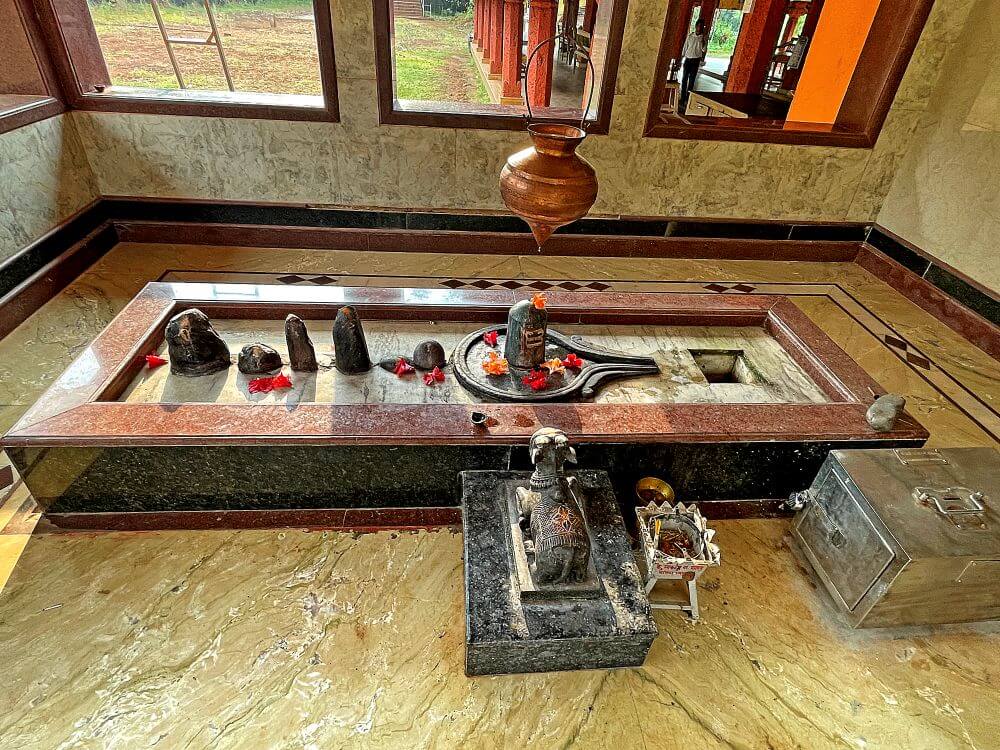
Beside the Upa-Sabha Mandap of this temple is the temple of the Palav, the progenitor of the village of Vadacha Pat. In this temple, which has a semi-open Garbhagriha, there are stones of various deities as well as a Shiva Linga on a rectangular Vajrapitha. In front of this Linga is a small, beautifully carved stone Nandi. In the area behind the temple, there is a water tank, and its water is used for the Jalabhisheka (water anointment) of the Goddess.
The Jatrotsav (fair/festival) of the Goddess begins here on Paush Purnima. This festival lasts for five days. During the festival, masks are placed on the stones of Shanta, Devi, and Mangesh, and they are adorned with garments. At night, the palanquin of the Goddess is taken out with great enthusiasm and fervor. The palanquin is taken out three times during the festival. During this time, programs such as Abhisheka of the Goddess, Kirtan, Bhajan, and Dashavatar plays are held here. For cultural programs, a large stage has been erected on one side of the temple premises. During the Jatrotsav, Mahaprasad is distributed to the devotees.
This sacred temple stands as a testament to deep spiritual devotion, ancient architectural grandeur, and rich local cultural traditions.
The sanctum sanctorum houses the divine idol consecrated according to ancient Vedic traditions, surrounded by serene courtyards and traditional temple architecture.
Navratri, Maha Shivratri, Annual Temple Jatra & Deepotsav
Compare and book flights, secure top-rated local hotels near the temple, hire reliable guides, and rent cars instantly.
Extend your pilgrimage by visiting other highly sacred temples located nearby.


Add ₹999 more to unlock FREE SHIPPING!
Your sacred cart is currently empty.
Shop Photo FramesFill in your delivery details below to place your order.
Add comment