
Add ₹999 more to unlock FREE SHIPPING!
Your sacred cart is currently empty.
Shop Photo FramesMahim is the city that served as the capital for Mumbai’s first king, Pratap Bimb, and the renowned King Bimbdev, also known as Bhimdev Yadav, who ascended the throne about one hundred and fifty years later. In this city, known in ancient times as ‘Bimbasthan’, stands the ancient and famous temple of Sheetaladevi. Sheetala or Sheetalamata is a folk deity. She is considered an incarnation of Durga. This Goddess is the family deity (Kulaswamini) for many families of the Kshatriya and Chandraseniya Kayastha Prabhu communities. Devotees believe that the Sheetala Devi here is ‘Jagrut’ (awakened/manifest) and capable of curing various ailments. Because of this, the temple is always bustling with devotees.
In Sanskrit, the word ‘Sheetala’ means ‘she who provides coolness’. Sheetaladevi is originally a folk deity. In the past, she was worshipped as the deity of epidemics. For instance, ‘Jari’ was considered the goddess of fever epidemics, while ‘Mari’ was considered the goddess of cholera and smallpox epidemics. Similarly, Sheetaladevi is regarded as the deity who destroys diseases like fever, measles, and chickenpox in children. This Goddess is established in the form of an uncarved stone or ‘Tandala’. Over time, the Vedic Aryan religion elevated this deity and bestowed upon her a mythological character. Mentions of this Goddess are found in the ‘Prabhas Kshetra Mahatmya’ of the ‘Skanda Purana’ as well as in the ‘Ayodhya Mahatmya’. The ‘Ayodhya Mahatmya’ states that the temple of this Goddess was in Ayodhya.
A chapter in the medieval Ayurvedic text ‘Bhavaprakasha’ discusses measles and chickenpox. Its sub-chapter contains the ‘Sheetala Stotra’. In it, Sheetaladevi is referred to as the deity of diseases. Similar to the ‘Bhavaprakasha’, the ‘Brihannaradiya Mahapurana’ describes the idol of Sheetaladevi. Her form is also revealed through her prayer mantra. This mantra is: “Vande’ham Sheetalam Devim Rasabhastham Digambaram. Marjanikalashopetam Surpalankritamastakam.” This means, “I bow to Goddess Sheetala, who is seated on a donkey, is naked (digambara), holds a broom and a pitcher in her hands, and has a head adorned with a winnowing basket.” According to this verse, the Goddess’s vehicle is a donkey, and she holds a broom and a pitcher. Based on this, it is opined that she is the goddess of cleanliness.
The oldest inscription mentioning Sheetaladevi is found in the ancient ‘Sachiya Mata’ temple at Osian, near Jodhpur in Rajasthan. This Sachiya Mata is considered the daughter of the demon king Pauloma. An inscription on the front wall of the sanctum sanctorum of her temple mentions the installation of idols of three goddesses—Sachiya, Sheetala, and Chandika—in the eleventh century AD. One of her most ancient idols is in the Sheetaleshwar Mahadev Temple on the banks of the Chandrabhaga River near Jhalrapatan, Rajasthan. It is said that this temple was built in the year 689 AD. A sculpture of Sheetaladevi is also found in the eleventh-century Modhera Sun Temple in Gujarat. This Goddess has been worshipped extensively since ancient times in regions like Gujarat, Madhya Pradesh, Bihar, Uttar Pradesh, and West Bengal. It is speculated that her worship in Maharashtra has been taking place since the twelfth century. Since Mumbai’s first king, Pratap Bimb, had connections with Gujarat, scholars believe that the Sheetaladevi of Mumbai came from Gujarat.
According to the ‘Mahikavatichi Bakhar’, Pratap Bimb was the brother of Govardhan Bimb, the King of Champaner, who was a feudatory of the Chalukyas of Anahilwad Patan in Gujarat. In the long introduction to this chronicle, the historian V. K. Rajwade has clearly stated that the Solankis, i.e., the Chaulukyas or Chalukyas, were originally a Maratha clan. Among the many other Marathi clans that went to the Patan region, i.e., Anahilwad Patan, along with this clan, was the Bimb Maratha clan. These Kshatriyas with the surname Bimb were related to the Kshatriyas with the surname Bhaum who ruled in Paithan. The Bimb were originally Maharashtrians, i.e., Marathas. Govardhan Bimb of Champaner sent his brother Pratap Bimb to attack North Konkan in the year 1138 AD, and in 1140 AD, he conquered the region from Daman to Chinchani-Tarapur, Palghar, Kelwe-Mahim, and Vasai. Pratap Bimb established his capital at Kelwe-Mahim, i.e., Mahikavati. Later, he asked his son Mahi Bimb to bring people from Champaner for colonization, and Mahi Bimb brought 66 clans from there. It was natural for these clans to bring their deities with them. An ancient temple of Sheetaladevi still exists in Kelwe-Mahim today. Many devotees from states like Gujarat and Rajasthan also come for her darshan.
Subsequently, in the year 1142 AD, Pratap Bimb sent his minister Balkrishnarao Somvanshi to conquer the region up to Walkeshwar. After winning this area, Pratap Bimb carried out ‘Deshvasahat’ (colonization) here. He established his capital on an island known as ‘Baradbet’ and named it after his first capital, Mahim-Kelwe. That is today’s Mahim. Pratap Bimb gave some villages here as inams (grants) to many of his officers, commanders, etc., and settled the people who had come from Mahim-Kelwe. These people gave the names of their previous villages and hamlets to the local villages and hamlets here and also installed their deities. Scholars speculate that the Sheetaladevi of Mahim-Kelwe must have been installed in this new Mahim-Mumbai at that time.
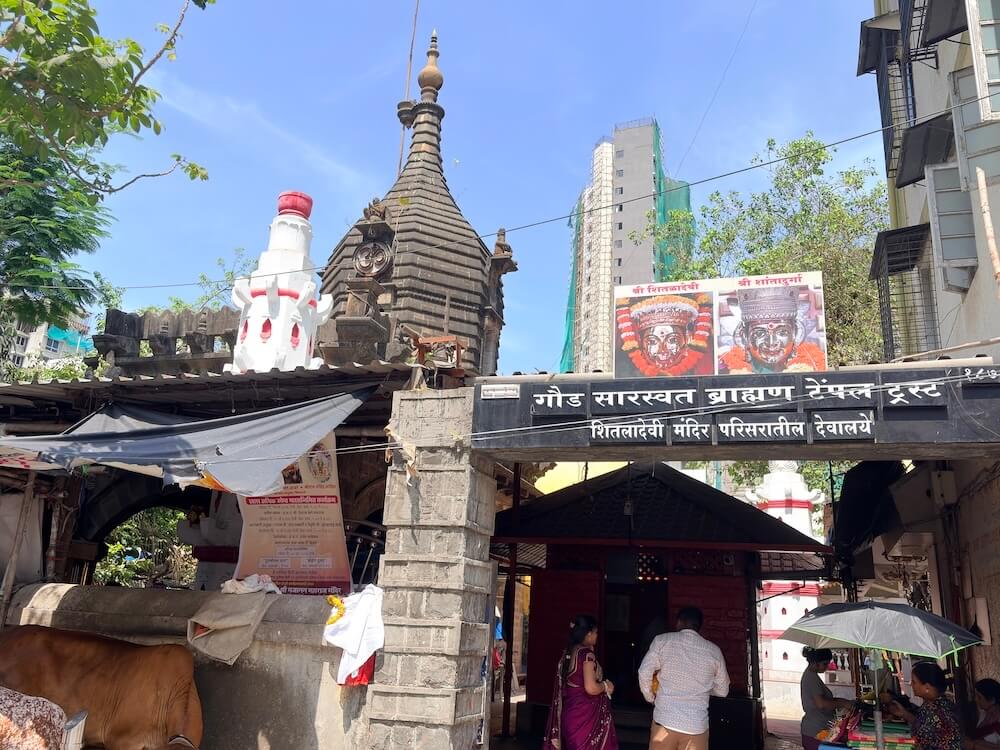
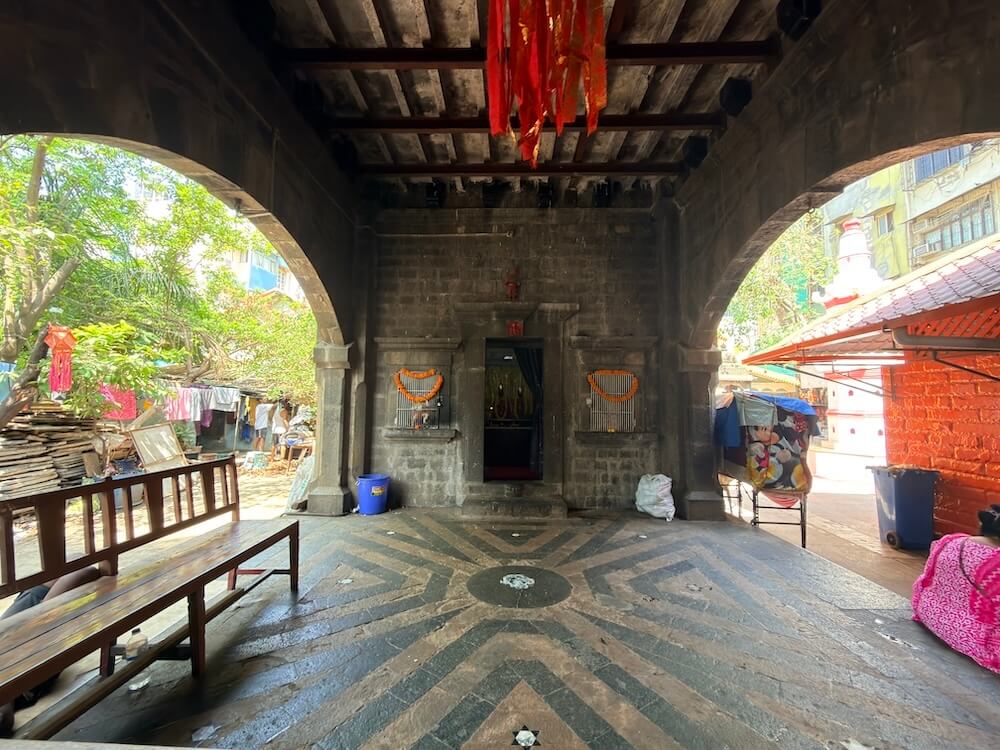
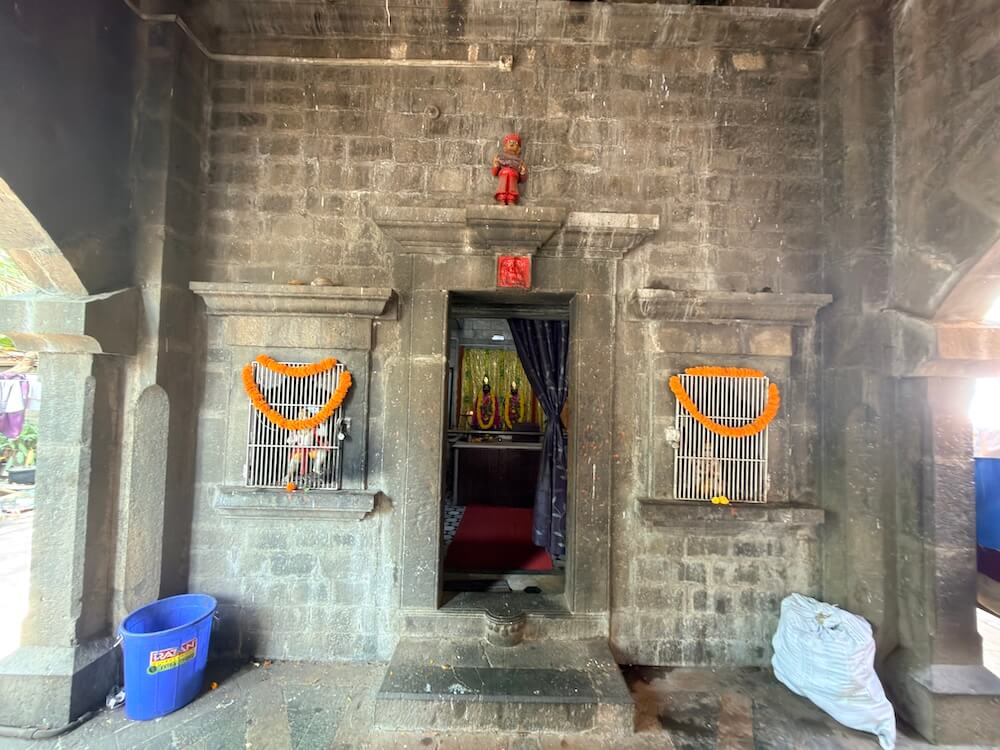
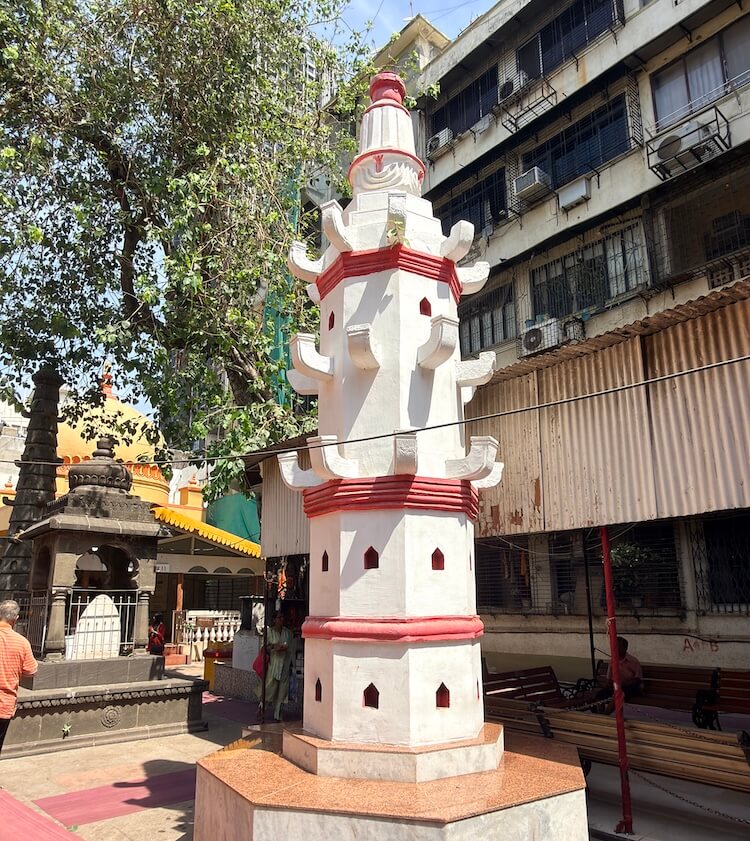
A new metro station in Mahim is named after this Goddess. The temple is situated in a spacious courtyard near the Lady Jamshedji Road here. Upon entering this courtyard, which has a recently built stone entrance, there is a temple of Vitthal-Rukmini on the left. A specialty of this temple, built entirely in carved stone, is its shikhara (spire). This shikhara, generally shaped like a pitcher, appears to be built by placing horizontal stone slabs one on top of the other. This temple has a grand assembly hall (sabhamandap) with stone arches. In the niches on the front wall of the sanctum sanctorum are idols of Hanuman and Garuda. Additionally, the idol of Vitthal-Rukmini is installed on a high pedestal inside. The statues of the gatekeepers, which are usually found at the entrances, are enshrined in both corners of the sanctum sanctorum of this temple. Near the temple, there is a tall octagonal lamp tower on a marble platform. To the right of this temple is a temple of Lord Hanuman. Additionally, the premises house temples dedicated to Lord Mahadev, Sai Baba, Lord Hanuman, the three-faced Mahakali Mata, and Shantadurga Devi. In front of the Shitaladevi temple stands a large stone lamp tower erected about one and a half centuries ago. The inscription on this lamp tower reads: “On Shalivahan Shake 1807, Samvat 1942, Magh Vadya Dashami, Sunday (18 February 1866), this lamp tower was built by the widow of Fakir Bapu Patil, Ganga Bhagirathi Budhibai alias Janabai of the Suryavanshi Kshatriya clan, in memory of her late father Hira Pandu Raut.”
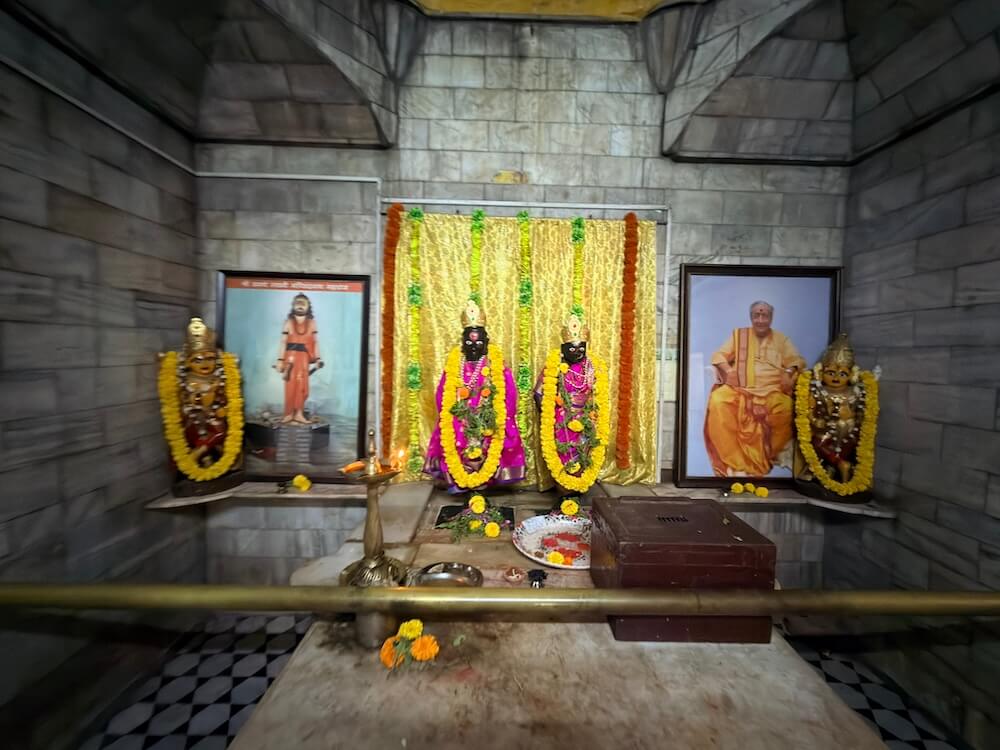
The Shitaladevi temple reflects the influence of old Konkani and Islamic architectural styles. The structure consists of a main hall (sabhamandap) and two sanctum sanctorums. The sabhamandap features a sloping Konkani-style roof on both sides. The temple is topped by a spherical dome-shaped spire with a tall finial. A unique feature of this temple is that the deity, Shitaladevi, is enshrined on a high altar within the sabhamandap itself. It is said that the goddess was originally located at a spot some distance away from where the temple stands today, and was later formally installed in the sabhamandap. The goddess is installed here only in the form of a mask. Large, prominent eyes are visible on this mask, which is carved out of black stone. The goddess wears a carved crown of her own. During the Navratri festival, a gold mask is placed on the deity. In the sanctum to the left of the goddess’s altar, statues of Lord Hanuman and Lord Ganesha are installed. Both these statues are made of stone and are smeared with vermilion. The Hanuman statue is adorned with a brass mask. In the sanctum to the right, the Shiva Lingas are enshrined. A distinctive feature of this temple is the presence of two Lingas side-by-side in the same sanctum. One Linga has a square base (shalunka), while the other has a circular base. Their drainage channels (pranali) meet at a single point. The stone Lingas are covered with brass casings, topped with a serpent canopy (nagchhatra) and an abhishek vessel. Near these Lingas, on a small pedestal against the back wall of the sanctum, are marble statues of Shankar-Parvati-Ganpati, as well as the four-armed, smiling Goddess Durga and Goddess Gayatri.
The administration of these temples is managed by the GSB Temple Trust of the Gaud Saraswat Brahmin community. The darshan timings at the Shitaladevi temple are from 6 to 1 in the morning and 4 to 9 in the evening. Aarti is performed in the temple daily at 8.30 in the morning and 7 in the evening. Countless devotees, especially women, visit here daily for the goddess’s darshan. The Koli community of the Mumbai and Mahim areas holds deep faith in this goddess. During any auspicious occasion, the local Koli community makes a formal prayer (sangane) to the goddess. There is an ancient well in the temple premises. It is customary to use water from this well during weddings, and the tradition of applying turmeric soaked in this water to the bride and groom is still followed today. If young children suffer from diseases like measles or chickenpox, they are bathed with water from this well. Some believe that this helps cure these illnesses. Many women offer an ‘oti’ to the goddess here, praying for the long life of their husbands. There is an ancient temple of Shitalamata at Chaul in the Raigad district. There is a special connection between the Shitaladevi of this glorious ancient town and the Shitaladevi of Mahim. Many people visit Chaul to make vows to Shitaladevi. Devotees believe that those who cannot travel to Chaul come to the Shitaladevi temple in Mahim to fulfill their vows, and these vows reach the Shitaladevi of Chaul. Shravan Shukla Saptami is known as ‘Shitala Saptami’. On that day, special worship of the goddess is performed here. The Navratri festival is the largest celebration here. During this period, the festivities begin every morning with the sound of the sanai-chaughada. Aarti is performed every morning and evening. Many dignitaries and famous personalities from Mumbai make it a point to attend the evening aarti. The sacrificial fire (homa) performed on the Ashtami of Navratri is famous. It is said that at least seven to eight thousand people attend this homa.
This sacred temple stands as a testament to deep spiritual devotion, ancient architectural grandeur, and rich local cultural traditions.
The sanctum sanctorum houses the divine idol consecrated according to ancient Vedic traditions, surrounded by serene courtyards and traditional temple architecture.

Navratri, Maha Shivratri, Annual Temple Jatra & Deepotsav
Compare and book flights, secure top-rated local hotels near the temple, hire reliable guides, and rent cars instantly.
Extend your pilgrimage by visiting other highly sacred temples located nearby.


Add ₹999 more to unlock FREE SHIPPING!
Your sacred cart is currently empty.
Shop Photo FramesFill in your delivery details below to place your order.
Add comment