
Add ₹999 more to unlock FREE SHIPPING!
Your sacred cart is currently empty.
Shop Photo FramesThe Creator has showered an abundance of natural beauty upon the Konkan region, especially South Konkan, but has bestowed an even greater measure upon Dhamapur in the Malvan taluka. The mountains here, the lush greenery, the coconut and areca nut groves, and, of course, the historic Dhamapur Lake create such a magnificent natural landscape that it has captivated everyone—from litterateurs to commoners, and from scientists to devotees. This lake, a World Heritage Irrigation Site, and the Goddess Bhagwati temple situated on its banks, represent a divine confluence of the auspicious and the beautiful.
The historical legend of this temple and lake is narrated as follows: Nagesh Naik, the provincial governor of the Vijayanagara Empire, constructed the lake at Dhamapur and the Bhagwati Devi temple on its banks in the year 1530. This region was a part of the Vijayanagara Empire, which was established by Harihara and Bukka in the fourteenth century. Later, in the year 1470, the Wazir of the Bahmani Sultanate, Mohammad Gawan, Goa was conquered, and this part of the Konkan region fell under foreign rule. Over time, the Adil Shahi dynasty established its authority over the Konkan. On November 25, 1510, with the assistance of the Vijayanagara admiral Thimmayya, the Portuguese commander Afonso de Albuquerque attacked Goa, and it fell into Portuguese hands. At that time, it is unlikely that Nagesh Naik was the ruler here, or if he was, he must have been an official under the Adil Shahi administration. He raised funds from the public for the common good and constructed this lake-dam.
This vast lake-dam has been created by constructing an earthen embankment. Spanning an area of five acres, this reservoir is surrounded by the dense forests of Dhamapur and the village of Kalse to its east. With its extremely serene surroundings, clear and pristine water, the reflections of the surrounding trees dancing upon its surface, and its ever-changing appearance throughout the day, this lake attracts countless visitors. Being an ideal location for biodiversity, irrigation, fishing, and tourism, the ancient temple of Goddess Bhagwati stands on the banks of this reservoir. The villagers believe that this Goddess protects the Dhamapur region and this lake-dam. Villagers recall that even during the drought of the year 1972, this lake remained full.
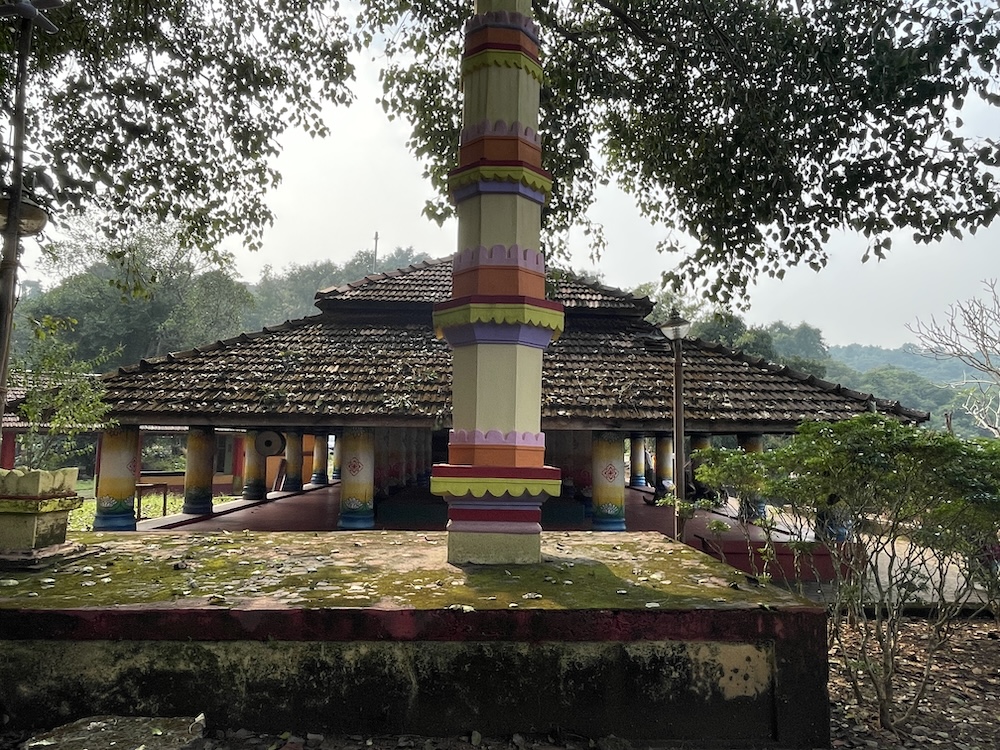
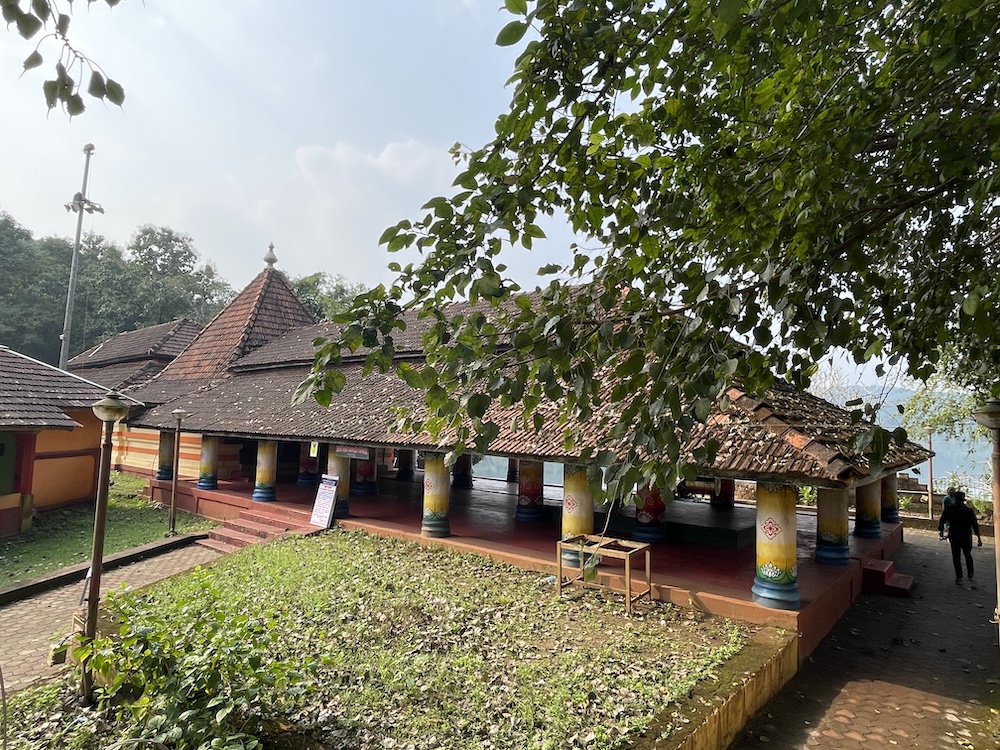
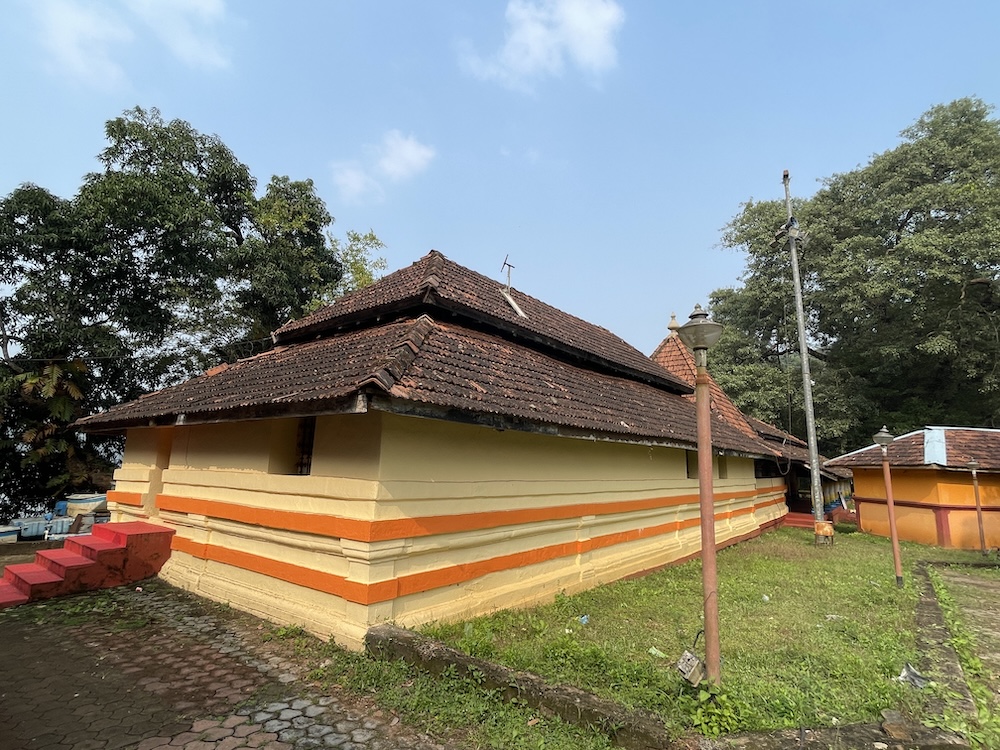
After climbing a few steps from the welcome arch located right next to the main road and reaching a high hillock, one finds the tiled temple of Goddess Sateri on one side. This old temple consists of a Sabhamandap (assembly hall) and a Garbhagriha (sanctum sanctorum). Inside, Goddess Sateri resides in the form of a tall anthill. Walking a few steps on the paver-blocked path between this temple on the left and a small, freshly painted Tulsi Vrindavan on the right, one faces the temple of Goddess Bhagwati. Even today, the ancient charm of this temple has been preserved as it was.
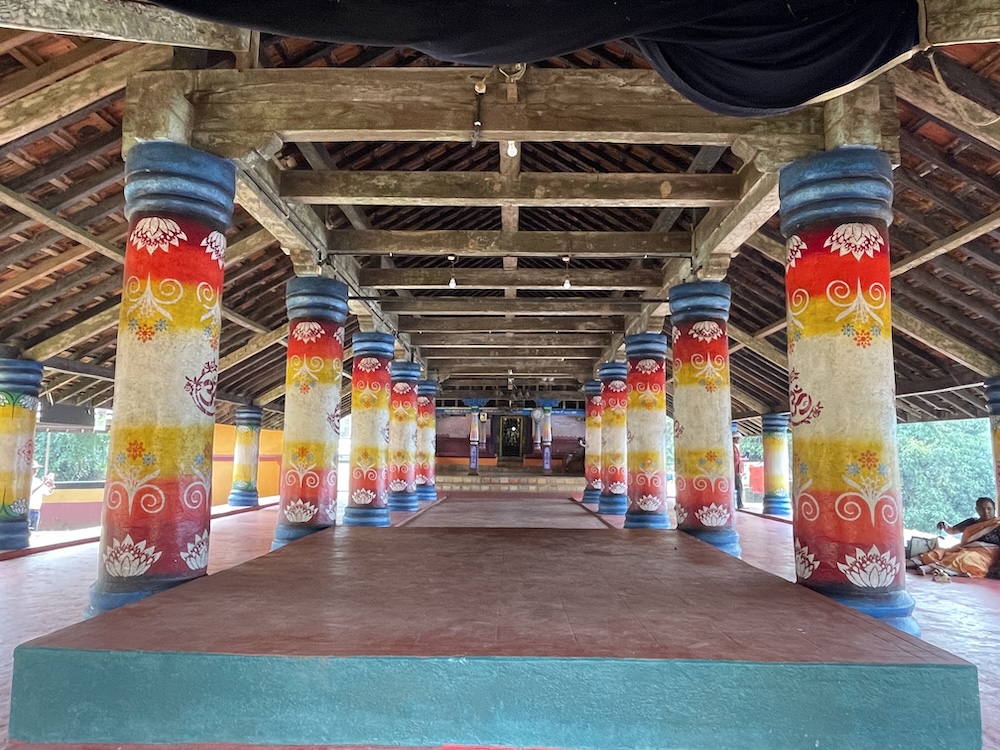
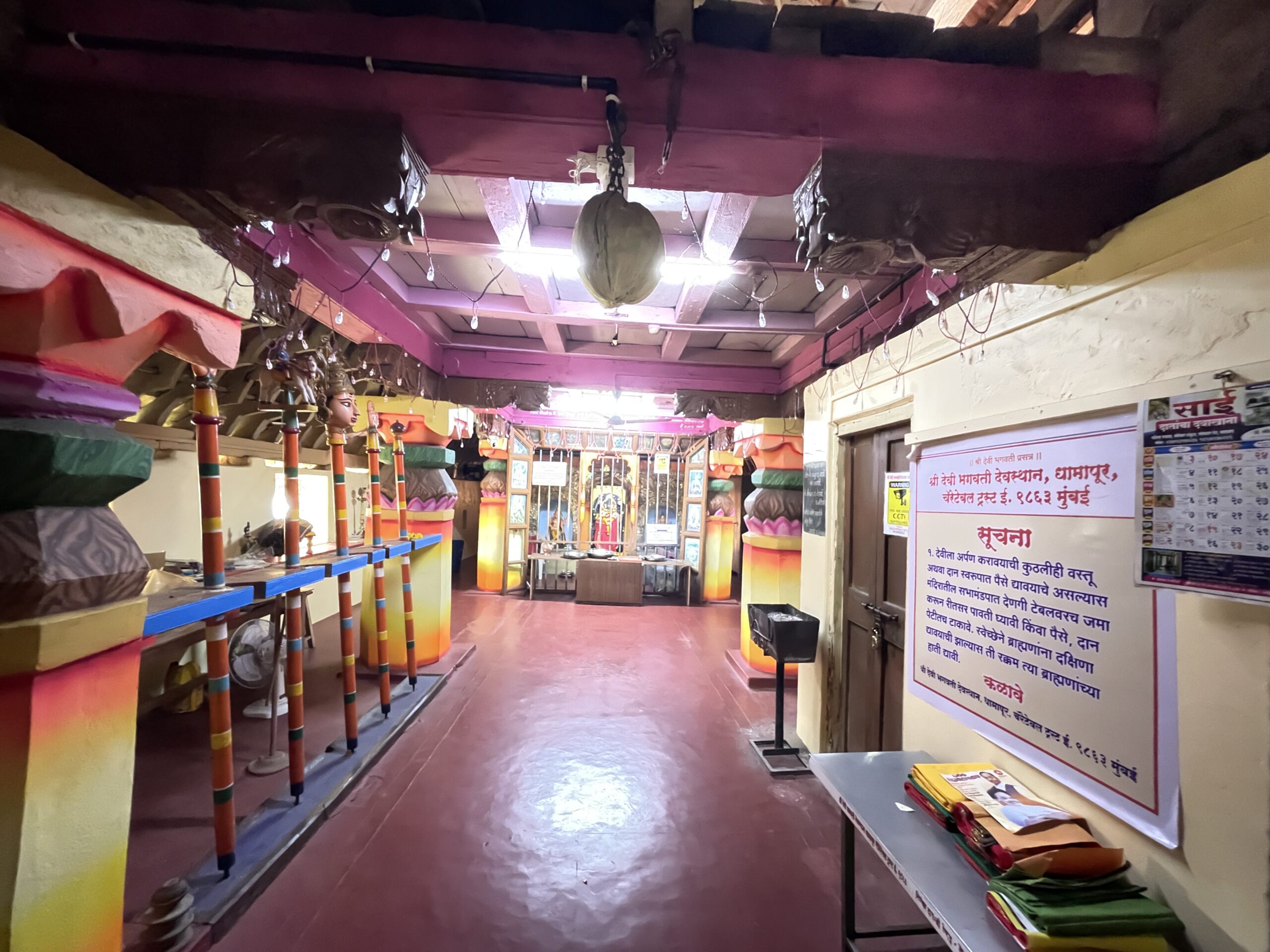
The temple is built in the Konkani architectural style. Its structure comprises a Sabhamandap, an Upasabhamandap (sub-assembly hall), an Antarala (vestibule), and a Garbhagriha with a circumambulatory path. The main Sabhamandap is tall, tiled, two-sided, open-style, and elongated. In this hall, there are six large circular pillars on both sides, topped with horizontal wooden beams. On one of these beams, the text “Sabhamandap built in Shake 1827” and below it “Dhondi Vishram Thavi” is carved. This clarifies that this Sabhamandap was built in the year 1904 by the carpenter Dhondi Vishram Thavi. There are four to five households of the Thavi family in Dhamapur. Their ancestors were responsible for the construction of this Sabhamandap as well as the temple.
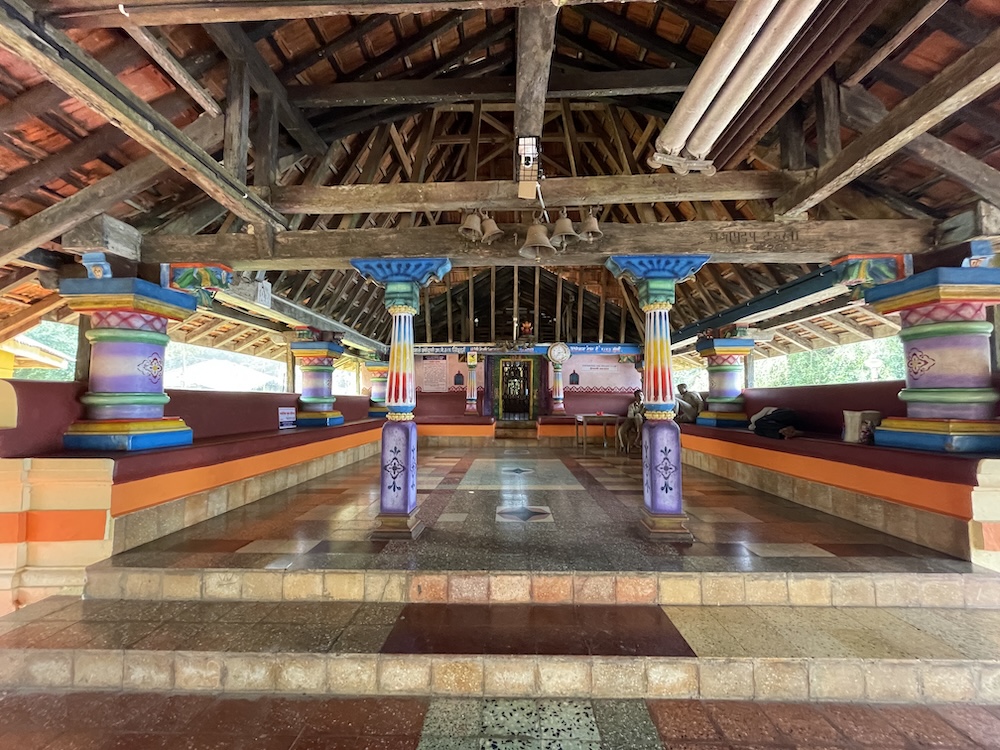
In front of the main assembly hall, at a height of about one foot, lies the sub-assembly hall. This sub-assembly hall features stone benches on three sides, adorned with short, intricately carved stone pillars, with two additional pillars standing at a distance further inward. These pillars are square at the base, fluted towards the top, and crowned with ornate bracket capitals. Two steps higher from here is the vestibule of the temple. The wooden entrance to the vestibule is a magnificent example of woodwork. Two of the three branches of this triple-framed doorway are carved with floral motifs. On the first broad branch, there is a lion figure at the base. Above it, on one side, is a carved sculpture of Lord Hanuman, and on the other, a sculpture of Garuda. The outermost branch is carved like a pillar. On the lintel of the door frame, at the center, is an image of Lord Ganesha, flanked by attendants waving fly-whisks. On the horizontal panel above the door frames, serpent deities are carved, with a large Kirtimukha in the center. Inside the vestibule, on the right side, there are bracket capitals. These brackets depict deities such as Dandekar, Ravalnath, Jain Brahmin, Pavanai, Baracha Purvas, and Ghadivas. Directly ahead, in the sanctum sanctorum, on a Vajrapitha pedestal, within a beautifully carved arch, stands the four-armed black stone idol of Goddess Bhagavati. To the right of the Goddess is the idol of Lord Ganesha, and to the left is the idol of Lord Mahadeva. The front portion of the sanctum sanctorum features portraits of various deities in an antique painting style. A unique feature of this temple is that the spire is situated over the assembly hall rather than the sanctum.
Behind this temple, the reservoir of the Dhamapur Lake dam stretches out. There is a beautiful ghat built there. Regarding this, a legend is told here: in ancient times, if there was a wedding ceremony in anyone’s home in Dhamapur and they were not financially capable of making gold ornaments for it, those people would come here and pray to Goddess Bhagwati. People would place flowers and a list of the required ornaments in a basket and release it into the lake. The next day, those people would find all the ornaments mentioned in the list on the bank of the lake. The condition was that after the auspicious ceremony at home was completed, those ornaments had to be placed back in the basket and released into the lake. It is said that a person in the village became greedy for those ornaments. He took the ornaments from the Goddess but did not return them later. Consequently, the Goddess was angered, and since then, the ornaments stopped appearing from the lake. Notably, this is the second lake in Konkan that used to assist in auspicious ceremonies. A. M. T. Jackson, who was the Collector in Nashik during the British era and was assassinated by Anant Kanhere, was a scholar and an officer with a deep interest in Indian culture. He had compiled folk tales of Maharashtra. On page number १५ of the second volume of his book ‘Folklore Notes’, which pertains to Konkan, a similar story of a lake in Khopoli, Raigad district, is given. In that village, if there was a wedding ceremony at anyone’s home, the Sati Asara (seven nymphs) of that lake would provide the necessary utensils. However, those utensils had to be returned. The story states that one person did not return them, and thus, that practice ceased.
In the premises of this temple of Goddess Bhagwati, who is considered a form of the primordial power, there are two independent temples, the Narayan Temple and the Brahman Dev Temple, similar to the Sateri Devi temple. These temples consist of two sections: the sanctum sanctorum and the assembly hall.
At the Bhagwati Devi Temple, devotional vigils are held for nine days during Navratri. On Ashtami, Homa-Havan and Kumarika Pujan are performed, and Mahaprasad is served on Navami. The Dussehra program is conducted at the Bhavai Devi Temple in the village, where the wedding ceremony of Shiva and Shakti takes place. Gold is symbolically distributed. The Bhagwati Devi idol, carried in a palanquin procession, is then brought back to the temple. Festivals like Ram Navami and Hanuman Jayanti are also celebrated with great devotion at this temple. During the Chaitra Navratri program, Puran readings, Kirtans, and palanquin processions of the Goddess take place every night. The temple is managed collectively by five honoraries and twelve ancestors.
The most precious treasure of this temple is the adjacent Dhamapur Lake. The height of the dam wall here is ११.४३ meters, and its length is २७१ meters. The irrigation capacity of Dhamapur Lake is २३८ acres, and currently, १२५ acres of land are under irrigation. १२५ species of birds are found in the vicinity of this lake. Rare species of wild birds and plants are also found here. Wildlife experts and botanists frequently visit this area for research.
In २०२३, four petroglyphs were discovered at two locations on the plateau near Dhamapur. These petroglyphs are located within the boundaries of Godyachi Wadi in Dhamapur, as well as on the plateaus of Mograne and Salel villages. These petroglyphs found in Konkan date back to the prehistoric era. Along with animals, geometric patterns are also found in them. Researchers believe that these carvings were created by humans in the primitive era.
This sacred temple stands as a testament to deep spiritual devotion, ancient architectural grandeur, and rich local cultural traditions.
The sanctum sanctorum houses the divine idol consecrated according to ancient Vedic traditions, surrounded by serene courtyards and traditional temple architecture.
Navratri, Maha Shivratri, Annual Temple Jatra & Deepotsav
Compare and book flights, secure top-rated local hotels near the temple, hire reliable guides, and rent cars instantly.
Extend your pilgrimage by visiting other highly sacred temples located nearby.


Add ₹999 more to unlock FREE SHIPPING!
Your sacred cart is currently empty.
Shop Photo FramesFill in your delivery details below to place your order.
Add comment