
Add ₹999 more to unlock FREE SHIPPING!
Your sacred cart is currently empty.
Shop Photo FramesKalika Devi is considered the principal deity of the Shakta sect. As the presiding goddess of the Tantra path, she is regarded as the symbol of Shakti (power) and death. She is the presiding deity of Karani, Muth, Jaran, and Maran. Although the Goddess’s form is fierce, she is compassionate and benevolent toward her devotees. While there are hundreds of temples of Kalika Mata across the country, the ancient temples in Kashi, Kolkata, and Ujjain are particularly famous. One such renowned temple of Kalika Mata is located in the taluka of Shirur Kasar in Beed district. Devotees firmly believe that this is a ‘Jagrut’ (awakened) site that grants their prayers.
According to mythological legends, Kalika is a form of Goddess Mahakali. In the ‘Kalika Purana’, it is mentioned that Goddess Kalika was born from the womb of Mahamaya. According to references in the Mahabharata, Kalika is the daughter of Daksha Prajapati and the wife of Sage Kashyapa. In ‘Devi Mahatmya’, it is stated that the primordial nature, Adimaya Bhagwati Mahalakshmi, created two forms: Mahakali from Tamoguna and Mahasaraswati from Sattvaguna. Thereafter, Mahalakshmi created a pair of man and woman, each suitable for the respective qualities of Mahakali and Mahasaraswati. commanded to create. From that, the universe and creation subsequently came into being. In this way, just as Mahakali is the destroyer, she is also the Mother of the Universe and the Sustainer of the Universe.
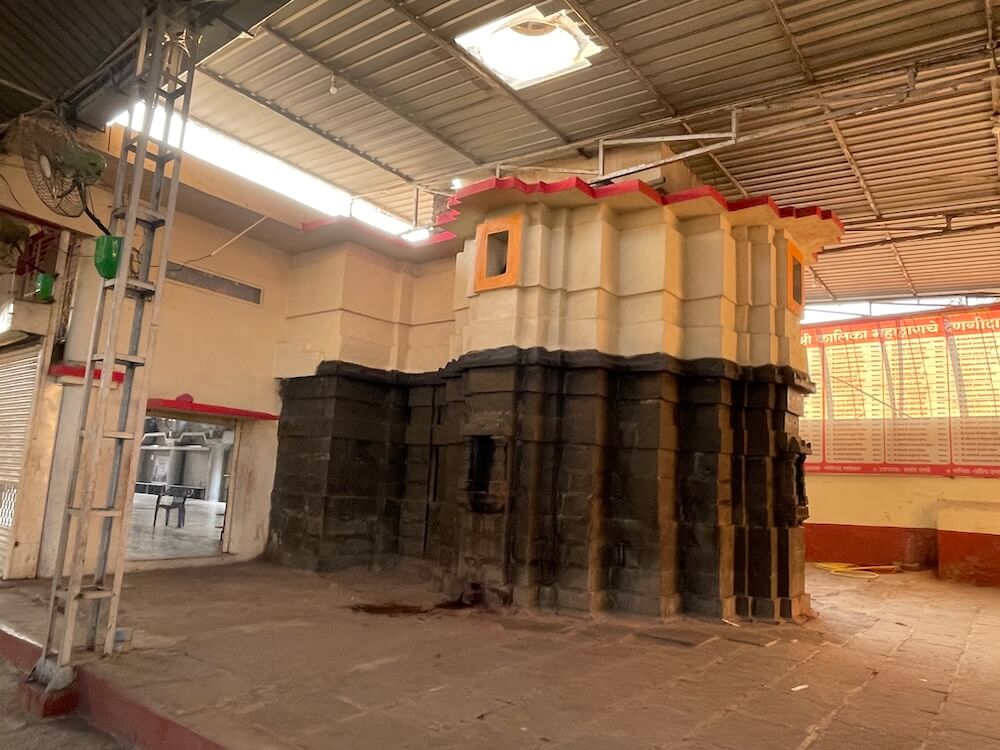
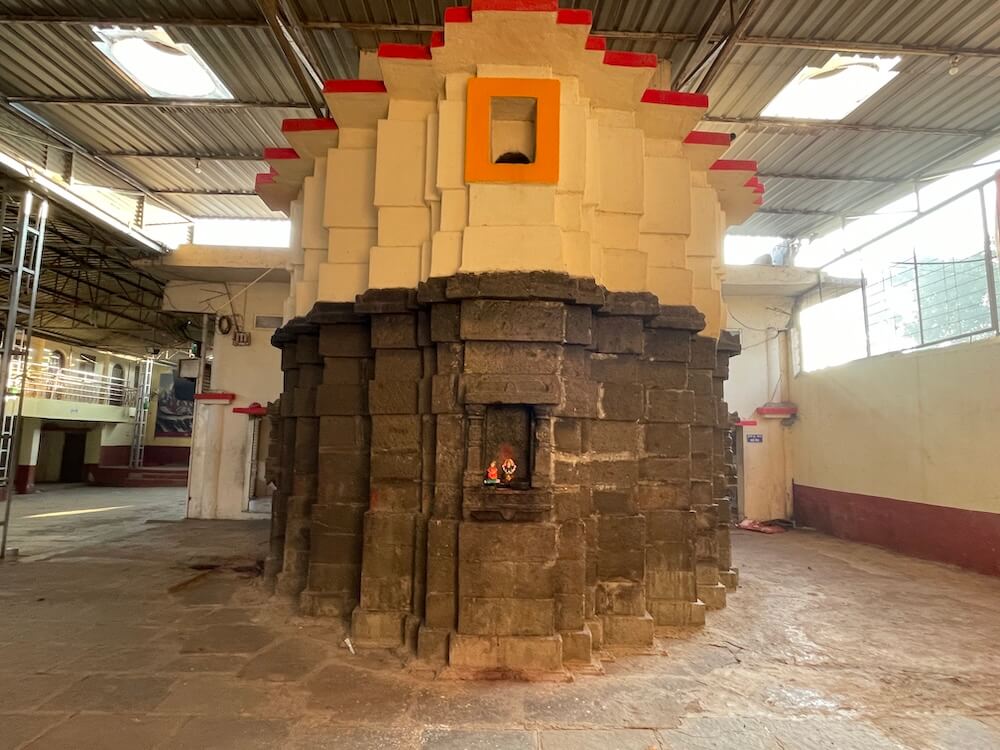
Situated on the banks of the Sindhphana River, this temple, built in the Hemadpanti architectural style, is approximately 900 years old. It is said to date back to the 11th century, during the Yadava period. According to the legend associated with the temple, in ancient times, the gold and silver vessels required for the devotees’ Mahaprasad would emerge from the bed of the Sindhphana River. After completing their rituals, the devotees would return these vessels to the riverbed; however, once, a devotee committed a mistake. He took a gold ladle obtained from the riverbed to his home, and ever since then, the vessels stopped emerging from the river.
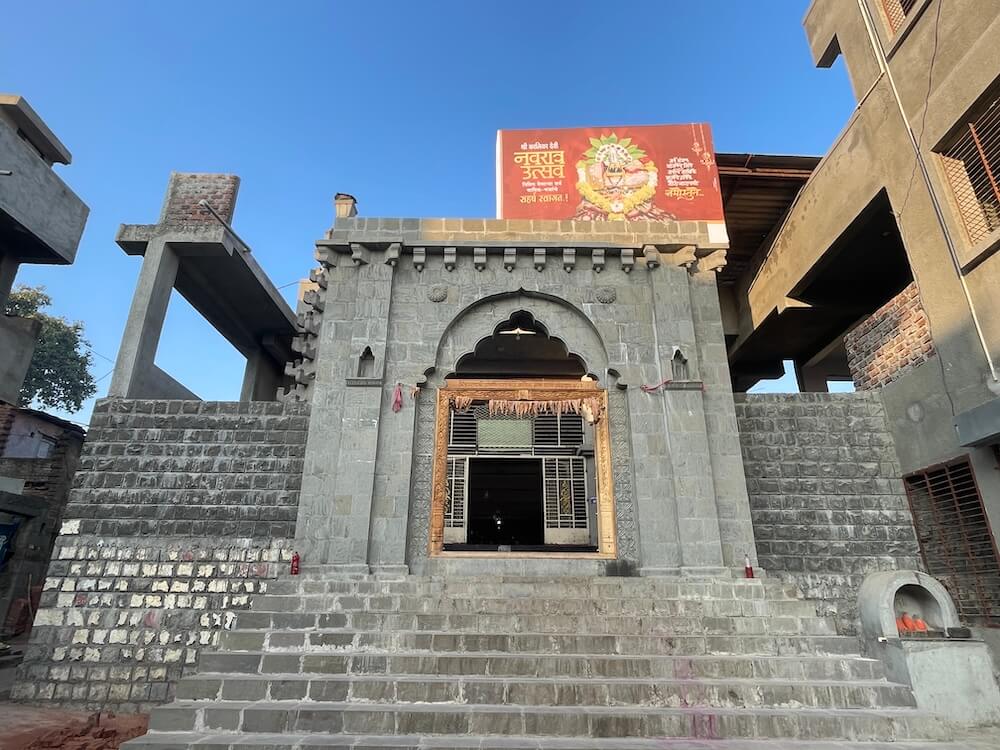
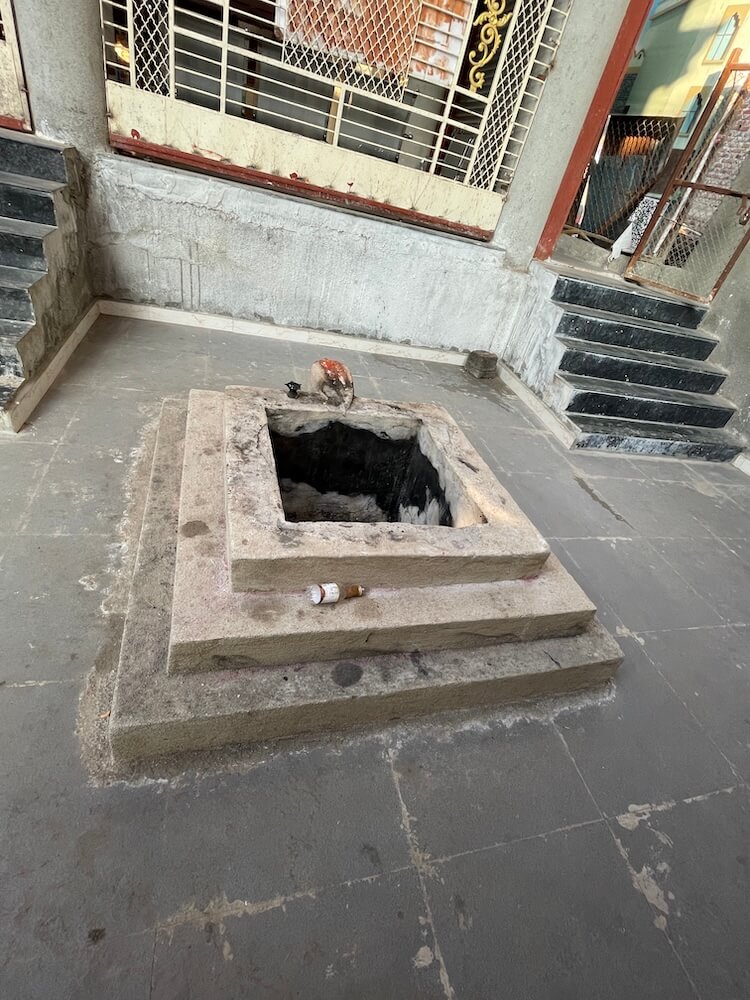
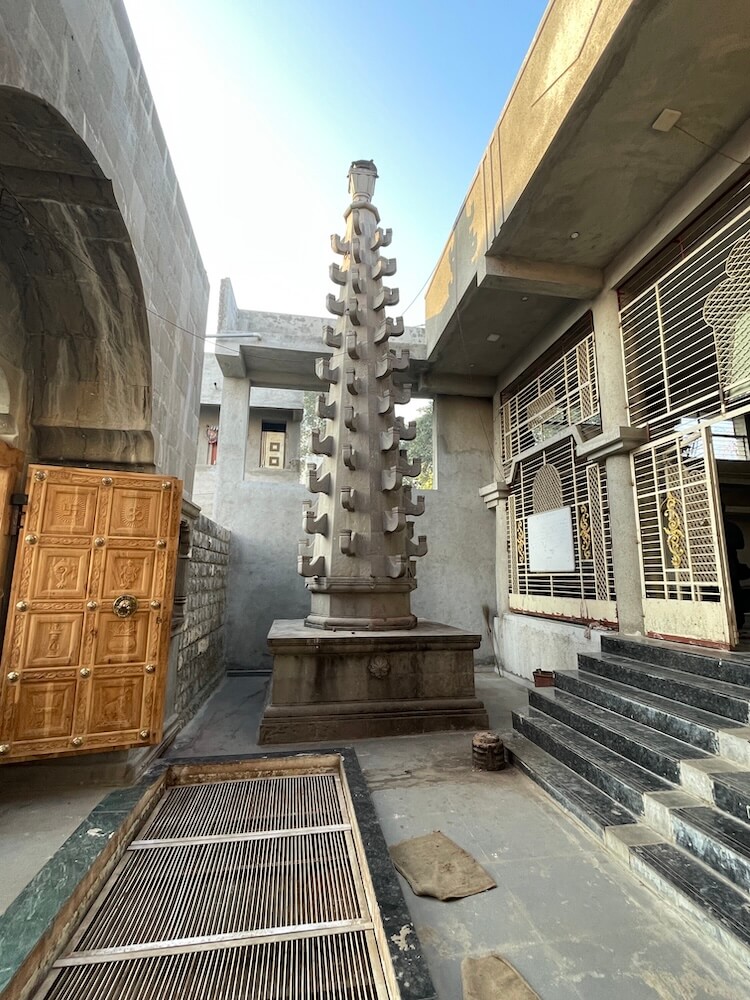
There is a grand welcome arch on the road leading to the temple. The sturdy fortification wall surrounding the temple has two entrances, one at the front and one at the back. Since both entrances are about eight feet higher than the road, they are accessed by stairs. The entrances feature wooden door frames and shutters. In the paved courtyard of the temple, a Tulsi Vrindavan is erected along the fortification wall. In front of the temple, there is an octagonal Deepmal (lamp tower) on a platform about five feet high. There is a Yajna Kund in the courtyard in front of the temple.
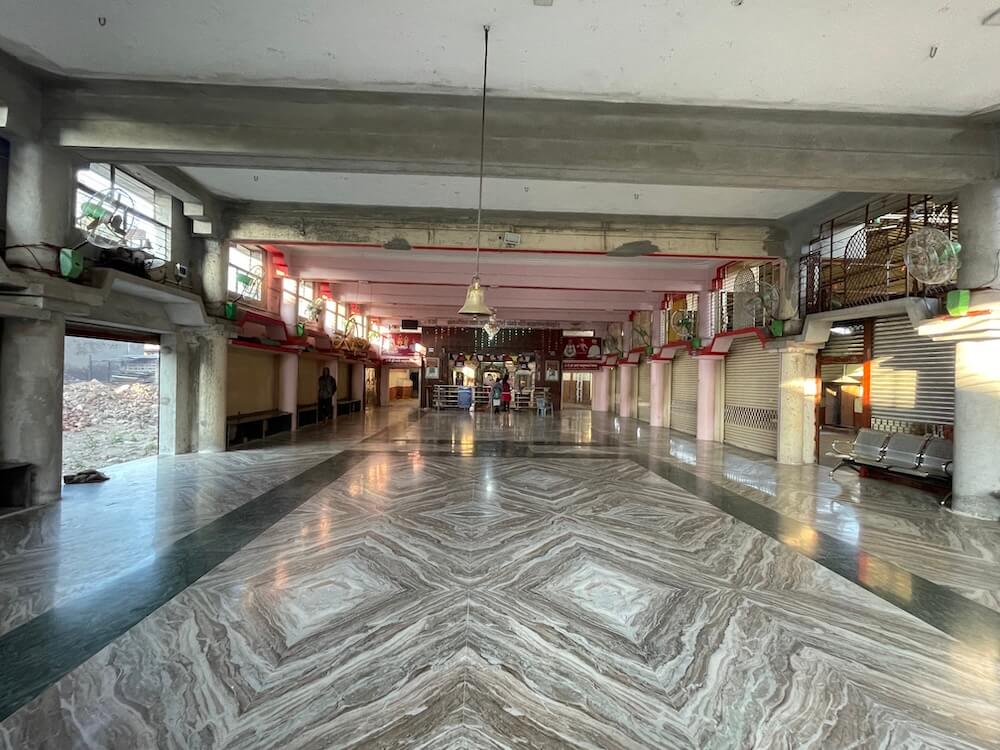
Along the perimeter wall in the courtyard are the residences for the sevaks (servants) and priests, the temple office, the bhakta niwas (pilgrim accommodation), a stage for cultural activities, and other structures. The courtyard is covered with a tin roof supported by iron pillars, protecting devotees from the sun and rain. A new ghat has been constructed on the riverbank behind the temple. The temple structure consists of a sabhamandap (main hall), antarala (vestibule), and garbhagriha (sanctum sanctorum). The antarala and sabhamandap have been newly constructed and attached to the original Hemadpanti stone-built garbhagriha. The construction of the sabhamandap and antarala has been carried out in a modern architectural style using cement-concrete.
The entrance to the Sabha Mandapa (assembly hall) is elevated above the courtyard, with five steps leading up to it. The semi-open Sabha Mandapa is surrounded by circular pillars. Further ahead lies the Antarala (vestibule), which has doors on its left and right sides leading to the Pradakshina Patha (circumambulatory path). Glass enamel work (Meenakari) can be seen on the front wall of the Antarala. In the Antarala, directly in front of the entrance to the Garbhagriha (sanctum sanctorum), there is a brass lion—the vehicle of the Goddess—placed upon a pedestal. The entrance to the sanctum sanctorum (Garbhagriha) features leaf motifs (parnashakha), floral motifs (pushpashakha), and pillar motifs (stambhashakha), with a sculpture of Lord Ganesha on the lintel (lalatbimba). The archway (torana) is adorned with miniature spire sculptures (shikhar-shilpe). Inside the sanctum, a four-armed idol of Goddess Kalika, carved from black stone, is enshrined upon a vajrapitha. The Goddess, adorned in various garments and ornaments, wears a silver crown on her head. Behind the idol, the silver prabhavali (halo) features a vyal-torana with a kirtimukha at the top. The prabhavali is also decorated with silver symbols of the conch (shankha), discus (chakra), and the flag of righteousness (dharmadhwaja). Beneath the vajrapitha, near the wall, lies the original stone idol of the Goddess, anointed with vermilion (shendur). There is a circumambulatory path (pradakshina marga) along the exterior of the antarala (vestibule). On the exterior wall behind the sanctum, there are two niches (devakoshthakas), one at the bottom and one at the top. The sanctum is crowned by a five-tiered octagonal spire (shikhara), with each tier containing eight niches housing divine idols. The summit of the spire is adorned with an amalaka and a kalasha.
Sharadiya Navratri is the main annual festival celebrated here. During these ten days, the temple trust provides refreshments for devotees who observe fasts. On the day of Phalguna Amavasya, ‘Navyachi Amavasya’ is celebrated at the temple. On this occasion, offerings of rotis made from new wheat and jaggery are made to the Goddess. Chaitra Amavasya is celebrated as ‘Junyachi Amavasya’. On Chaitra Shukla Ashtami and Dussehra, the ‘Song’ (procession) of the Goddess is taken out. From the residence of the temple priest, Giri, the Bhagat, adorned with sindoor tilak and dressed in a saree, mounts the tiger of the Song. Accompanied by Vaghyas-Muralis, the Goddess’s Muraris, devotees, and musicians, the Song of the Goddess is brought to Gandhi Chowk in the city amidst singing and dancing. Hundreds of devotees from the district gather to witness the Song festival. The priests here state that the tradition of the Song procession has been ongoing for one hundred and fifty years.
The Palkhi (palanquin) procession of the Goddess is celebrated four times a year: on Dussehra, Chaitra Shuddha Ashtami, Phalguna Amavasya, and Chaitra Amavasya. During all these festivals, the sacred water (Tirtha) is brought from Rakshasbhuvan to perform the Abhisheka of the Goddess. Traditional musical instruments such as Sanai-Chaughade, Tasha-Rabbani, and Shingade are played during the procession. During the procession, torches (Divtya) and lamps (Kakade) are lit, and resin (Ral) is scattered. There is a special influx of devotees at the temple on Tuesdays, Fridays, Ashtami, Pournima, and Amavasya.
This sacred temple stands as a testament to deep spiritual devotion, ancient architectural grandeur, and rich local cultural traditions.
The sanctum sanctorum houses the divine idol consecrated according to ancient Vedic traditions, surrounded by serene courtyards and traditional temple architecture.
Navratri, Maha Shivratri, Annual Temple Jatra & Deepotsav
Compare and book flights, secure top-rated local hotels near the temple, hire reliable guides, and rent cars instantly.
Extend your pilgrimage by visiting other highly sacred temples located nearby.


Add ₹999 more to unlock FREE SHIPPING!
Your sacred cart is currently empty.
Shop Photo FramesFill in your delivery details below to place your order.
Add comment