
Add ₹999 more to unlock FREE SHIPPING!
Your sacred cart is currently empty.
Shop Photo FramesLocated near Nandivade village, close to Jaigad in Ratnagiri, the Karhateshwar Temple is one of the ancient Shiva temples of the Konkan region. This temple, dating back to the Shilahara era, is situated right along the vast, deep blue sea. Despite the saline seawater nearby, a natural miracle exists here: a freshwater spring flows in the form of the Ganga from a *Gomukh* (cow-faced spout) located just 10 to 15 steps away. Karhateshwar is the *Kuladaivat* (family deity) of the Jog and Kanitkar families residing in the area.
The legend of the temple states that a cowherd named Jogi once followed his cow, which would wander through the forest and release its milk over a stone near the seashore. When the owner discovered that the cow gave no milk after returning home, he followed her and discovered a *Swayambhu* (self-manifested) Shiva Linga here. In the local language, a laterite rock is called *Kata-Karhata*. Because this Linga was found on such a *Karhata*, the deity came to be known as Karhateshwar. Even after the cow died, for many years, its horn was tied to a chain and used to perform *Abhishek* (ritual bathing) of milk over the Karhateshwar Linga. Later, after an *Abhishek* vessel was created, the horn was placed in the *Garbhagriha* (sanctum sanctorum) for worship. Even today, the cow’s horn can be seen in a niche in the upper part of the *Garbhagriha*.
The Karhateshwar Temple is mentioned in the text ‘Wadeshwar Mahatmya’, written by the learned scholar Vishwanath Pitre in 1637 AD. It states that Karhateshwar is situated on a mountain peak in the middle of the sea and that the origin of the ‘Ganga-Kolahal’ is in this area. This confirms that the temple existed before 1637.
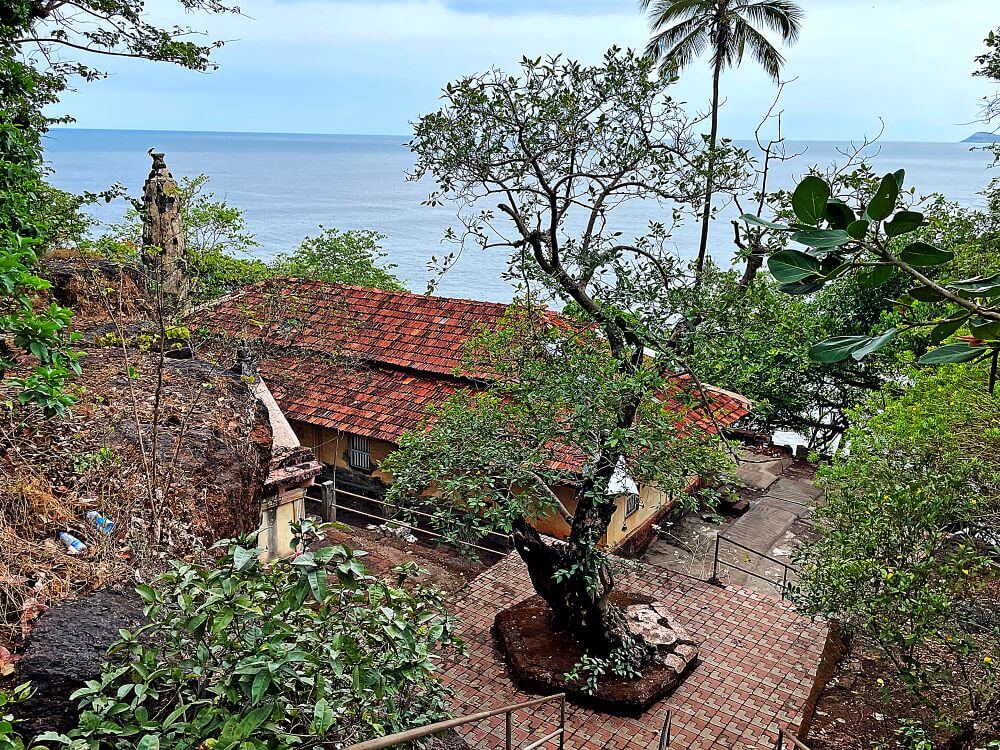
The Karhateshwar Temple is located five kilometers from the road turning left from the entrance of the JSW project in Jaigad. Built on a large rock on the seashore, it appears as if it is standing on a single fragment of land. There is a retaining wall on the sea side, and the premises are paved with laterite stones. It is said that this temple was built during the Shilahara period in the 11th century. In place of the current tiled-roof structure, there was once a small hut thatched with grass. The Nandi idol was located outside this hut. Records indicate that the temple was renovated in 1600, 1764, 1921, and 1970 AD. During the British era, the temple was constructed using laterite stones.
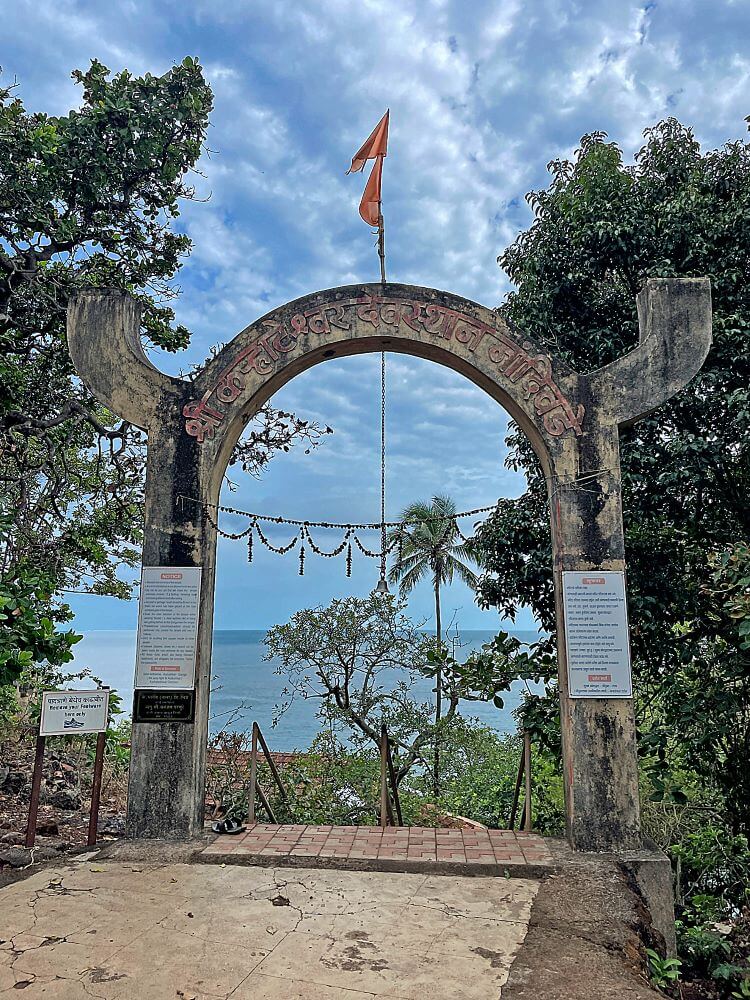
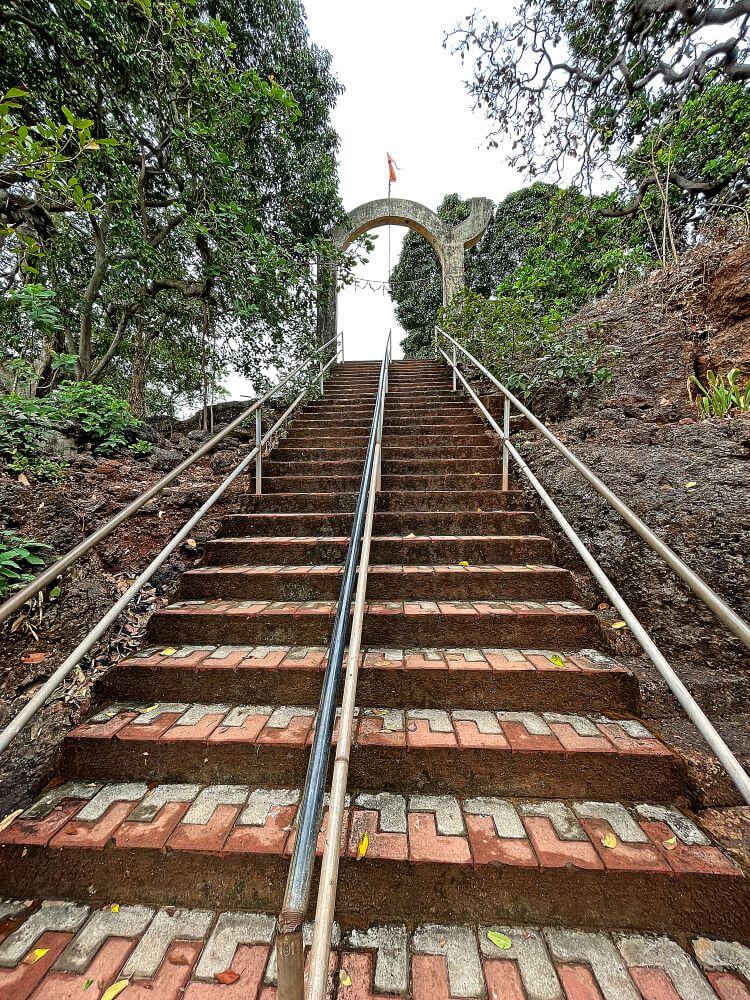
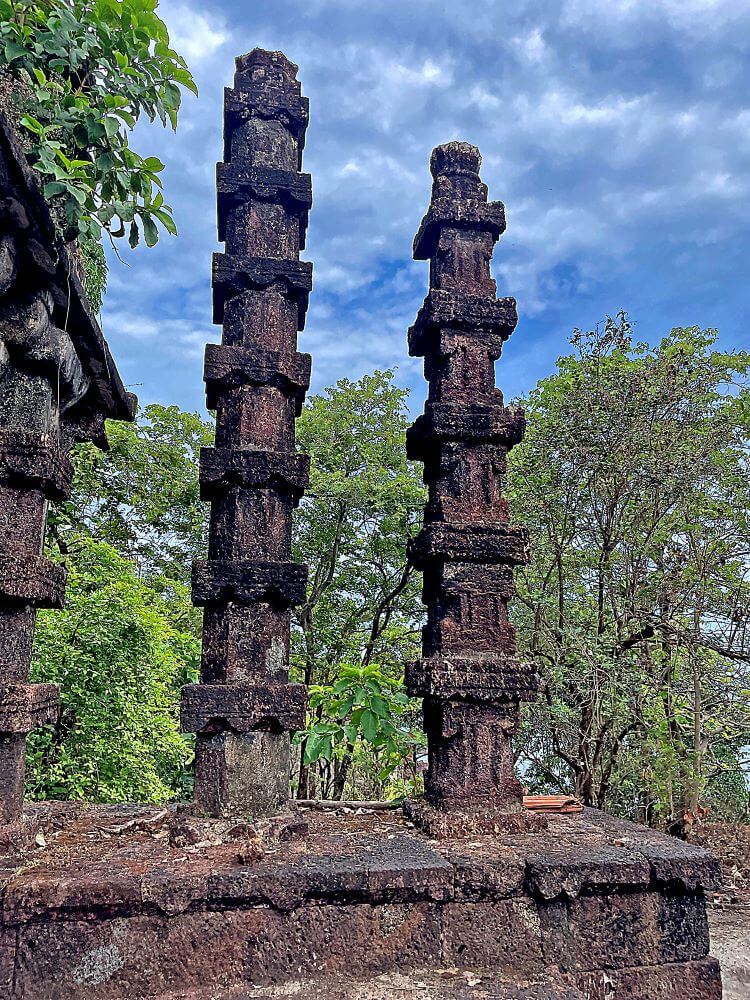
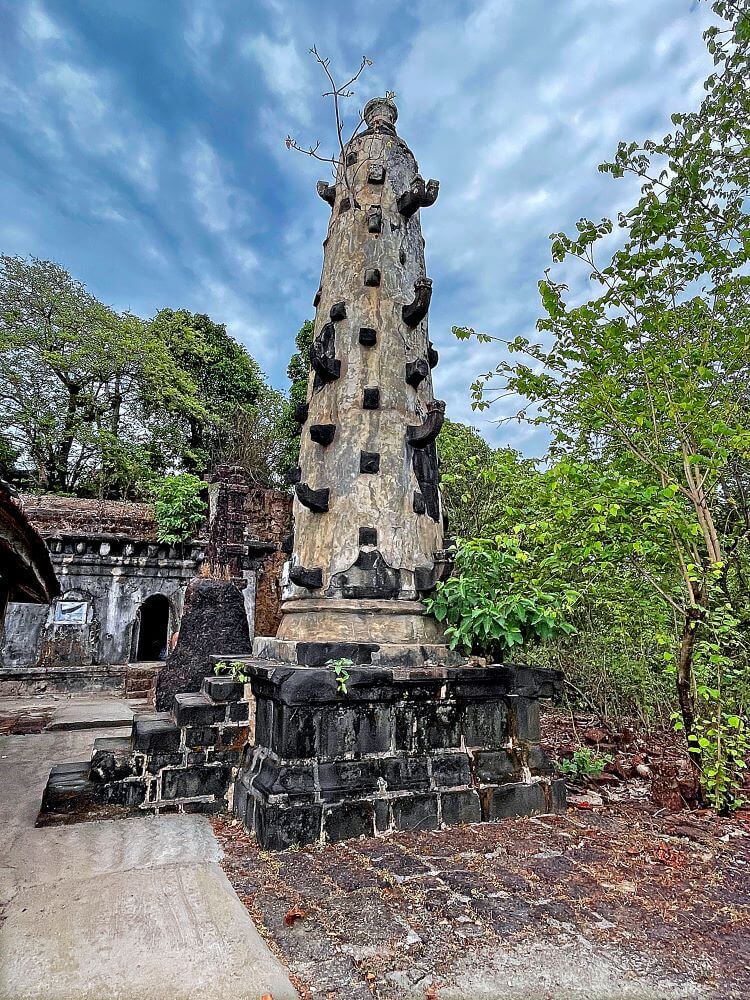
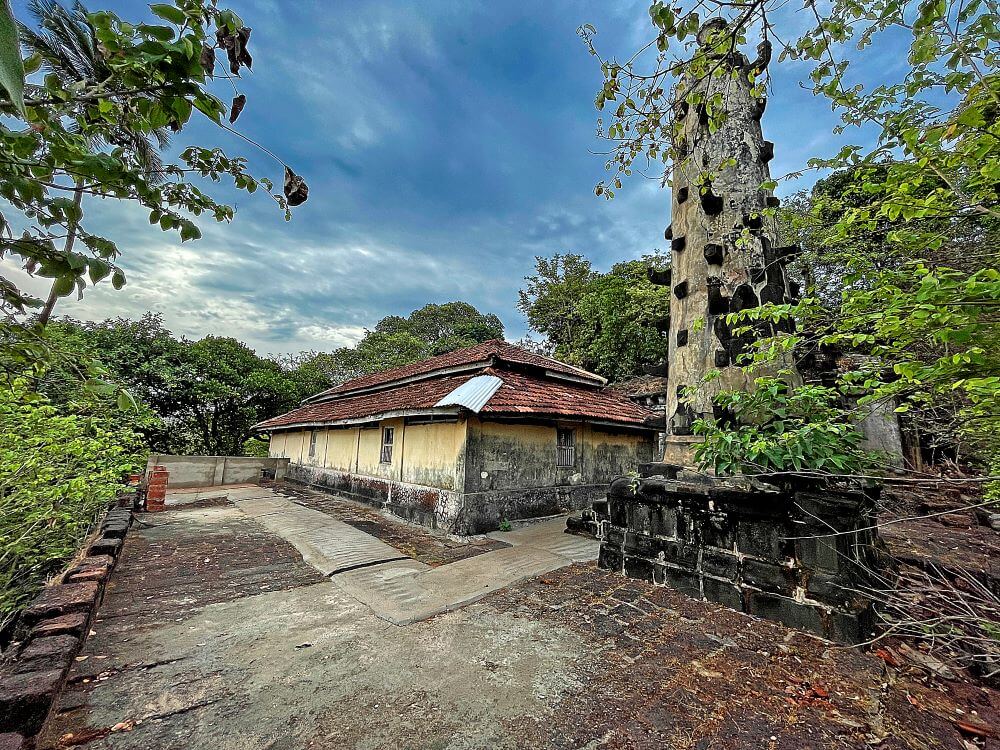
One must descend a few laterite steps through an archway to enter the temple. On the way to the temple, one passes an Audumbar tree and a small Ganesha temple. The temple houses a marble idol of Ganesha. After descending the steps near the Ganesha temple, one enters the courtyard of the Karhateshwar Temple. In front of the main temple, there are three ancient stone *Deepmalas* (lamp towers). Near these stands a new *Deepmala* built in 1970.
The temple structure consists of a *Sabhamandap* (assembly hall), *Antarala* (vestibule), and *Garbhagriha*. The wooden doors and other construction elements bear marks of antiquity. The temple floor is paved with stone. The upper parts of the pillars in the wooden *Sabhamandap* feature intricate carvings. In the *Antarala*, near the left wall adjacent to the *Garbhagriha*, there are five brass serpent idols and three Shiva idols, one of which depicts the *Tandava* dance. The *Garbhagriha* contains the *Swayambhu* Shiva Linga, topped with a serpent hood canopy. The *Garbhagriha* has a domed ceiling and a *Shikhara* (spire) designed with stacked squares.
The temple sees a large influx of devotees during Mahashivratri and on Mondays in the month of Shravan. Devotees can perform various rituals and pujas such as *Abhishek*, annual *Abhishek*, *Rudra Ekadashini*, Mahashivratri Puja, Shravan Puja, and *Laghurudra* by paying a fee. (Contact: Karhateshwar Puja Vyavastha Mandal, Mob: 9975171756)
To the east of the temple, one can see the Jaigad Fort and the mouth of the Shastri River. On the right side of the temple, there are 100 feet of laterite steps leading down to the shore. Descending slightly, one can see the freshwater spring flowing from a *Gomukh* along the path. The perennial water from here is collected in two tanks, and bathing in them is considered sacred. The presence of seawater on one side and a freshwater spring right in front of it is considered a miracle of nature. It is said that when Karhateshwar manifested here, a loud sound occurred, and water began to flow. During the Yadava period, the Ganga is said to have descended here on *Kartik Vadya Pratipada*. It was known as ‘Bebhati Ganga’. In 1922, when the rocks were blasted to widen the area around the temple, the spring disappeared.
In Nandivade village, besides the Karhateshwar Temple, there are other temples such as Jogeshwari, Chandika, and Lakshminarayan. Since the sea at Jaigad is at the edge of a mountain, there is no sand or beach; it is directly the deep sea. Therefore, one can take in the view of the vast sea from the heights. Karhateshwar can be visited daily from 7:00 AM to 1:00 PM and from 4:00 PM to 8:00 PM.
This sacred temple stands as a testament to deep spiritual devotion, ancient architectural grandeur, and rich local cultural traditions.
The sanctum sanctorum houses the divine idol consecrated according to ancient Vedic traditions, surrounded by serene courtyards and traditional temple architecture.
Navratri, Maha Shivratri, Annual Temple Jatra & Deepotsav
Compare and book flights, secure top-rated local hotels near the temple, hire reliable guides, and rent cars instantly.
Extend your pilgrimage by visiting other highly sacred temples located nearby.


Add ₹999 more to unlock FREE SHIPPING!
Your sacred cart is currently empty.
Shop Photo FramesFill in your delivery details below to place your order.
Add comment