
Add ₹999 more to unlock FREE SHIPPING!
Your sacred cart is currently empty.
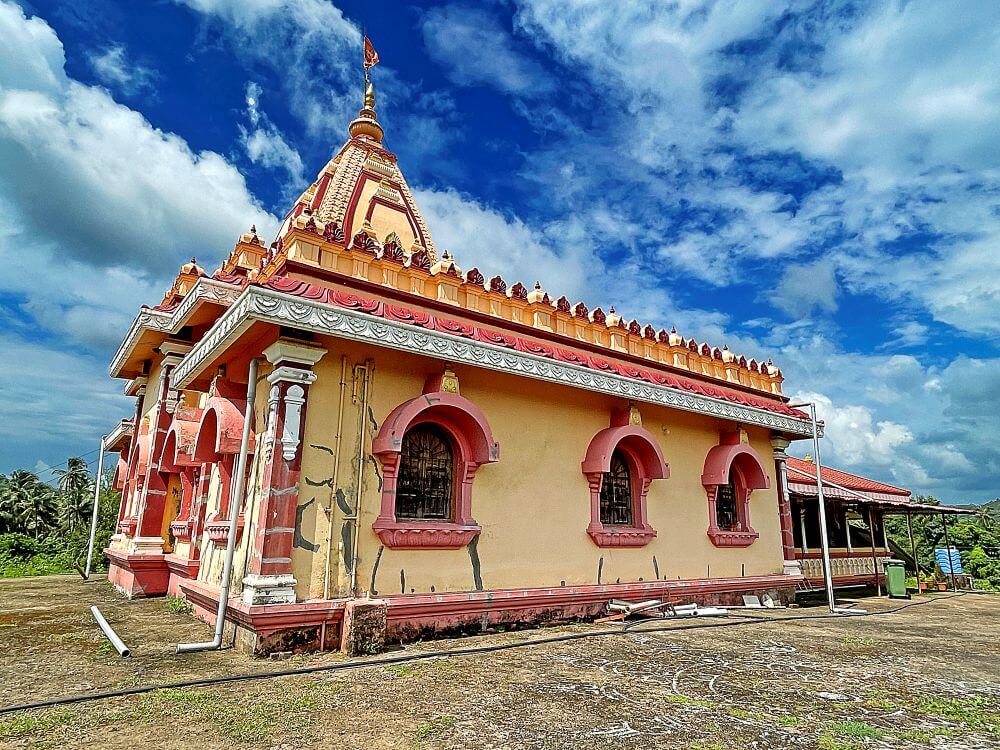
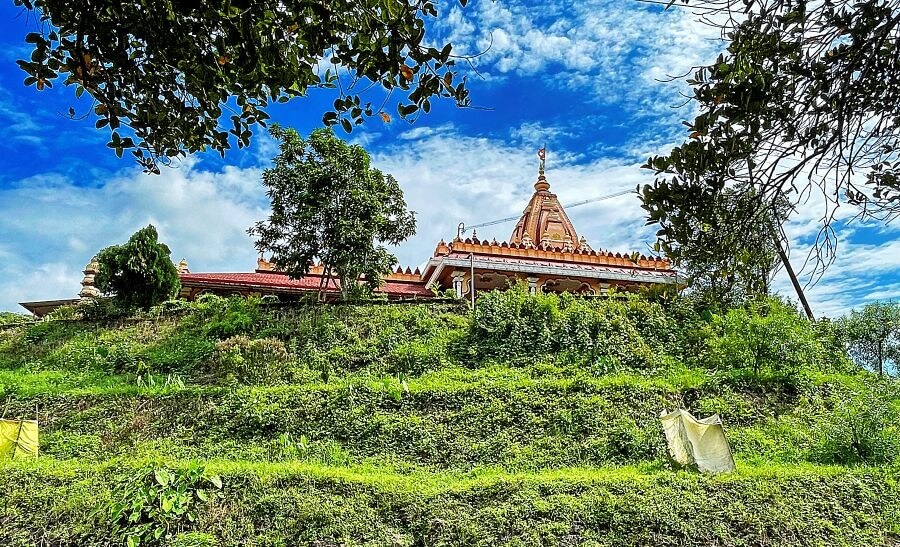
Shop Photo FramesThe Khajanadevi Temple is situated on a small hill amidst the dense coconut and areca nut groves along the banks of the Mochemad River in Vengurla Taluka. Surrounded by paddy fields, this circular hill appears as if it has sprouted from the flat land. A panoramic view of this hill and the temple atop it, when seen from the sky, resembles a Shiva Linga. Devotees believe that this temple is a *Jagrut Sthan* (an awakened abode) of Khajanadevi. This Goddess, who is known to fulfill the vows of her devotees and is the presiding deity of the 360 *Chalyas*, is the village deity of Pal and the *Kuladevata* (family deity) of many families here.
In the past, to protect the deities from foreign invaders, idols were hidden in safe places. It is said that this idol of the Goddess was hidden in a creek (khajan) for safety, and that is how the Goddess came to be known as Khajanadevi. Regarding this, there is a legend that once, a fisherman was fishing as usual. His net caught plenty of fish and a heavy object. It was an idol of the Goddess. After having the darshan of the Goddess, he placed the idol to one side. That night, the Goddess appeared to the fisherman in a dream and gave him a divine vision. She said, “Do not inform anyone else about my existence. After a certain period, I will continue to rise higher and higher from the place where you have kept me, but ensure that no one else learns of this. If you tell anyone else, I will manifest at the very height I am at then.” However, the fisherman could not keep such a significant secret to himself. He could not refrain from telling his wife. He told her about the Goddess’s vision. Immediately, the Goddess stopped rising and remained at the height she had reached.
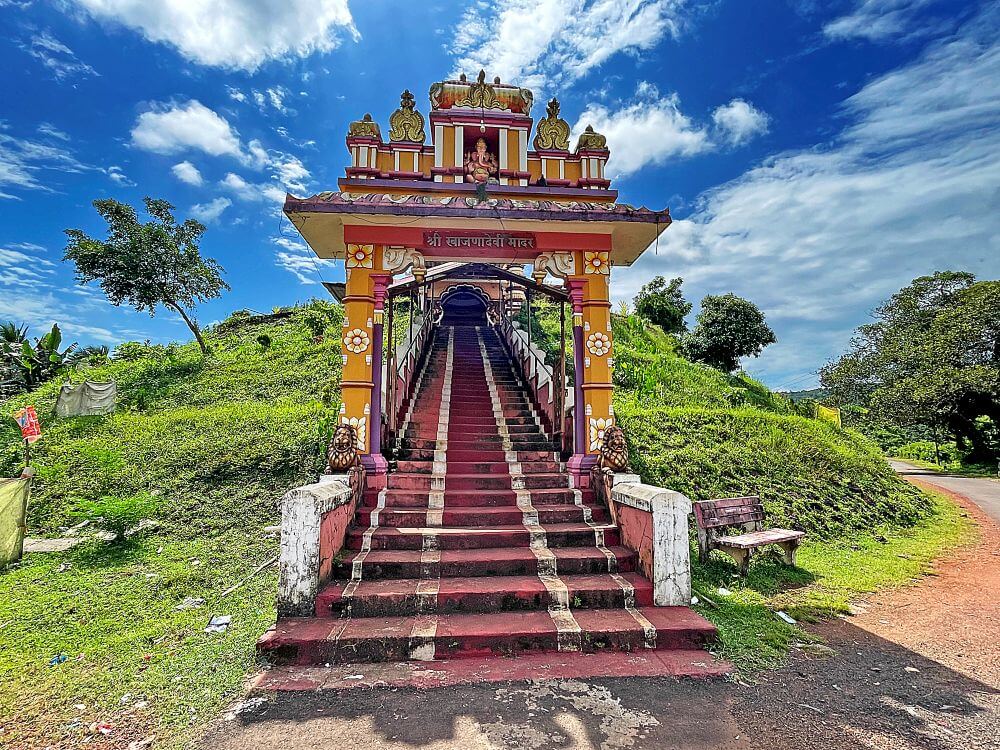
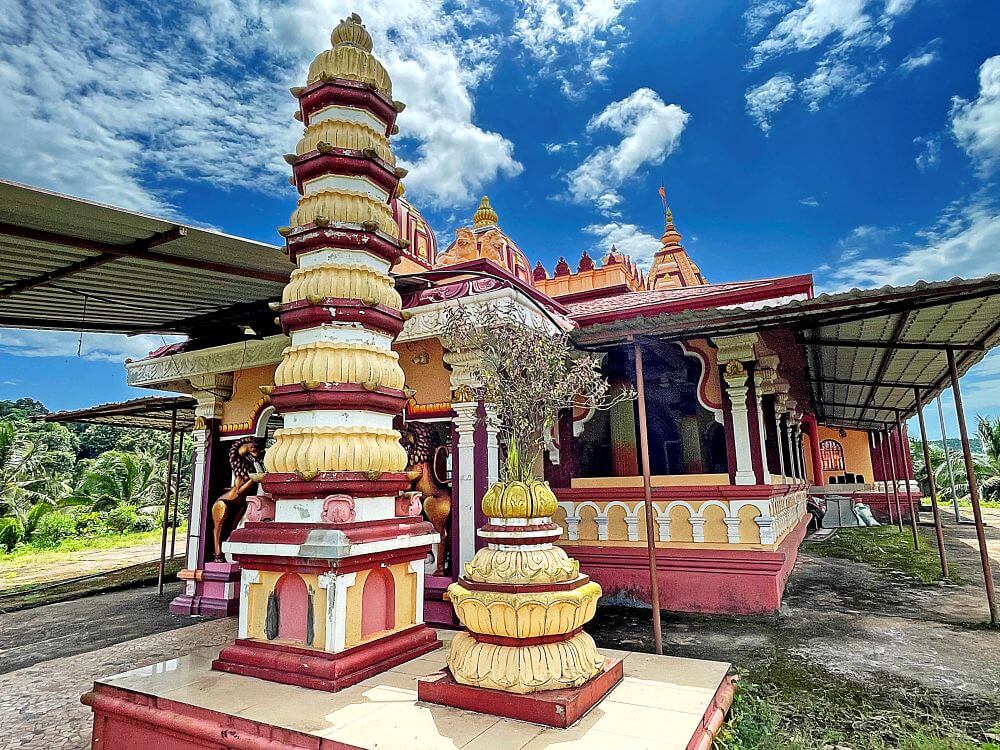
At the foothills of the Khajanadevi temple hill, along the asphalt road, stands the grand entrance gate of the temple. At the base of both its pillars are seated lion statues. Above, in the center of the roof, there is a small niche containing an idol of Lord Ganesha. This entrance is adorned with intricate carvings. From the entrance, there are many built steps leading up the hill. To protect devotees from the sun and rain, a corrugated metal roof has been constructed over these steps. As you reach the top of the steps, on the right side, there is a large platform featuring a seven-tiered lamp pillar (Deepmal) and a Tulsi Vrindavan beside it. The design of both the Deepmal and the Vrindavan extensively incorporates the ‘Ghatapallava’ (vase and foliage) motif.
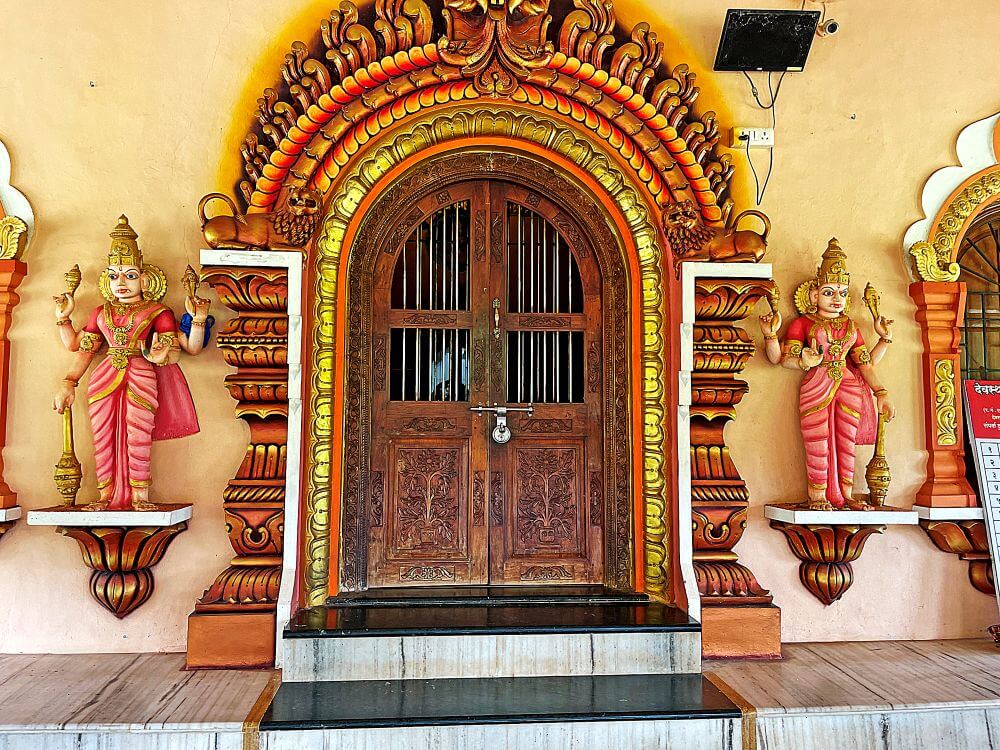
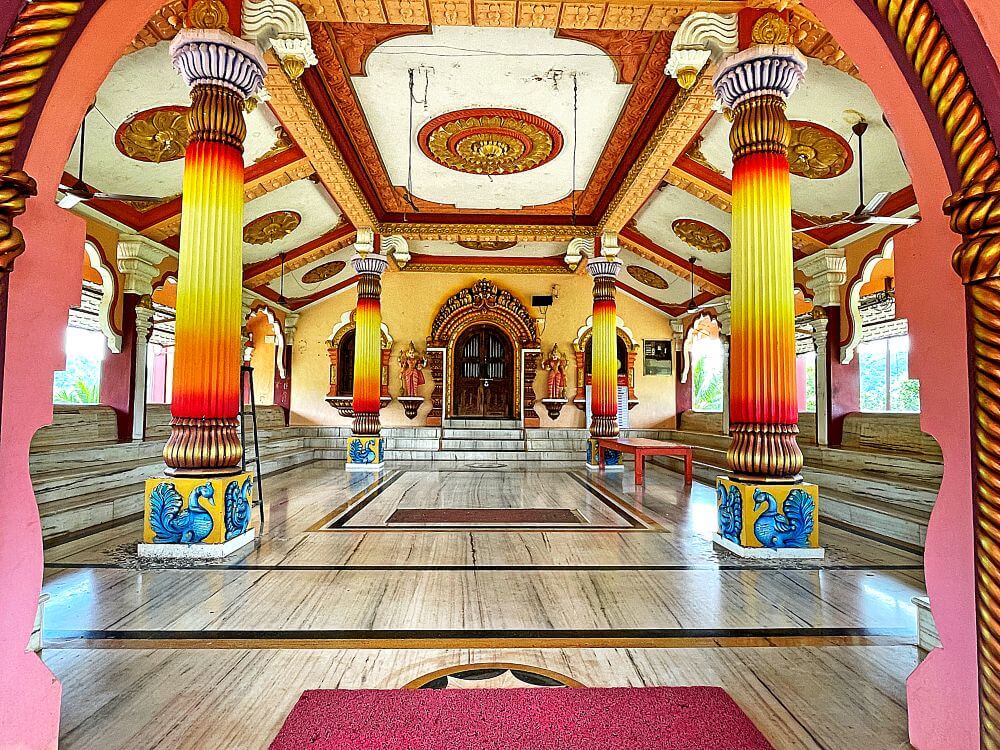
The main entrance of the temple is an arched gateway. Flanking it on both sides are tall statues of lions standing on two pedestals. Directly in front of this main entrance is the arched doorway of the Sabha Mandapa (assembly hall). This doorway is also adorned with beautiful carvings, featuring a Yaksha sculpture on the Lalatabimba (lintel). One enters the Sabha Mandapa by climbing three steps from there. In this semi-open Sabha Mandapa, there are four circular pillars placed at intervals in the center, supporting a flat ceiling. The roof slopes down on three sides. The interior walls of the ceiling are decorated with circular motifs. The pillars of the Sabha Mandapa are erected on small square platforms. The relief sculptures of peacocks on these platforms are eye-catching. The circular pillars are shaped like a Ghatapallava (vase and foliage) at the top. Where the pillars meet the ceiling, there are ornate Kapota (cornice) carvings. On the outer side of the Sabha Mandapa, there are three-stepped Kakshasanas (stone benches). These feature pillars connected by arched gateways. The design ensures ample natural light and ventilation.
Ascending four steps from the Sabha Mandapa (assembly hall), one enters the Antarala (vestibule). Above the entrance of the Antarala, there is a beautiful semi-circular carving. At the Lalatabimba (the central decorative motif above the door frame) sits a Yaksha figure. Where the semi-circular carving begins on the door frame, there are lion sculptures on both sides. A unique feature here is the statues of female door guardians (Dwarapalas) installed on the walls of the Antarala. These figures hold maces and weapons in their hands. Items required for the annual festival are kept in the Antarala. A large chandelier has been installed there. In the center of the Antarala is the Garbhagriha (sanctum sanctorum) of the Goddess, surrounded by a circumambulatory path (Pradakshina Path). The door of the Garbhagriha is also adorned with intricate carvings. On its Lalatabimba Above the Yaksha figure, in the center of the wall, there is a circular niche containing a four-armed idol of the Goddess. At the top of the two pillars on either side of the sanctum sanctorum’s facade, lion figures are carved.
In the sanctum sanctorum (Garbhagriha), the standing, fierce-faced idol of the Goddess, carved from black stone, is placed on a stone pedestal atop a small platform. The Goddess holds a trident and is depicted slaying the buffalo demon. She has been adorned with light green eyes. Beside the idol is an arch made of black stone, intricately carved with floral and leaf motifs. Adjacent to the Goddess’s idol are the shrines of several ancient deities. These idols, also carved from black stone, are worshipped with due rituals. The walls of the sanctum sanctorum and the antarala (vestibule) feature large windows with arched tops on the exterior. Above the sanctum is a pyramid-shaped shikhara, topped with an amalaka and a pointed kalasha. The shikhara is also adorned with intricate carvings.
Outside this temple, on the platform, there are two linga sculptures. One of them is upright and rectangular, while the other is cylindrical. Nearby, there are three idols of Bhairoba mounted on horses, as well as an idol of a deity holding a shield and sword. At this location, there are padukas (footprints) carved onto a stone shalunka. Adjacent to them is a unique virgal (hero stone). In this upright, rectangular virgal, which is slightly rounded at the top, the image of a reclining hero is carved at the bottom. In the center, there is a large image of a buffalo, while in the upper section, there is an image of the sun in one corner and the moon in the other. Such a type of virgal is rarely seen elsewhere.
In ancient times, a buffalo was sacrificed to Goddess Khajanadevi. Over the course of time, this practice was discontinued. A grand fair is held for the Goddess on Vaishakh Krishna Trayodashi. It is famous as the ‘Redya Jatra’ (Buffalo Fair). During the Navratri festival, the temple is crowded with devotees. The area becomes bustling with various shops at that time. Since the temple is situated on a height, the fields below and the surrounding hills look beautiful. Because of this, along with devotees, tourists also visit here in large numbers.
This sacred temple stands as a testament to deep spiritual devotion, ancient architectural grandeur, and rich local cultural traditions.
The sanctum sanctorum houses the divine idol consecrated according to ancient Vedic traditions, surrounded by serene courtyards and traditional temple architecture.
Navratri, Maha Shivratri, Annual Temple Jatra & Deepotsav
Compare and book flights, secure top-rated local hotels near the temple, hire reliable guides, and rent cars instantly.
Extend your pilgrimage by visiting other highly sacred temples located nearby.


Add ₹999 more to unlock FREE SHIPPING!
Your sacred cart is currently empty.
Shop Photo FramesFill in your delivery details below to place your order.
Add comment