
Add ₹999 more to unlock FREE SHIPPING!
Your sacred cart is currently empty.
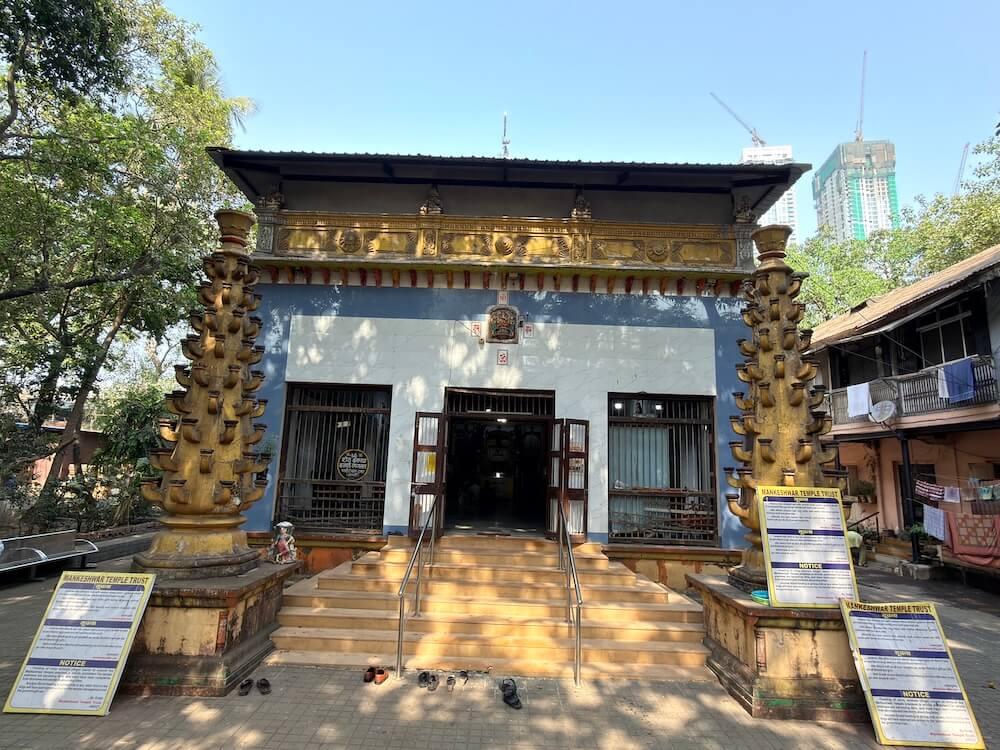
Shop Photo FramesByculla is one of the first-grade heritage railway stations in Mumbai. Situated here is the Mankeshwar Mahadev Temple, which is as old as the Mumbai railway itself and serves as a place of faith for many devotees of Lord Shiva. Built at that time at a cost of approximately 50,000 rupees, this Shiva temple stands even today, preserving the legacy of historical temple architecture. The temple’s attractions include a ‘Jagrut’ (awakened) Shiva Linga, a large statue of Nandi carved from black stone, two lamp towers (Deepmalas) in the Maratha architectural style, and a tall spire (Shikhara).
There are several theories regarding how this area came to be named Byculla. The ‘Gazetteer of Greater Bombay District’ notes that the name is related to the Bahava or Bhava (Cassia fistula) tree. The gazetteer authors suggest that the name Byculla might have been formed by combining the two words ‘Bahava’ and ‘Khale’. In his Marathi book ‘Mumbai Shahar Gazetteer’, ‘Kalnirnay’ creator Jayraj Salgaonkar states that this place was a threshing floor (Khale) for grain, and its owner’s name was Bhaya. The name Byculla came into existence as ‘Bhaya-che Khale’ (Bhaya’s threshing floor). Dr. Arun Tikekar mentions in his book ‘Sthal-Kaal’ that this etymology was first provided by Rao Bahadur P. B. Joshi. In old English books about Mumbai, Byculla is described as a place where cattle grazed.
In the book ‘Mumbai-che Varnan’, published five years after the 1857 rebellion, Govind Narayan Madgaonkar stated, “Previously, Nagpada and Byculla were considered insignificant places. These were desolate spots where cowherds lived and cattle grazed. Today, they have become places worthy of residence for royalty.” Based on this, some scholars believe the ‘Bhaya-che Khale’ etymology is inappropriate.
The Mankeshwar Mahadev Temple stands in the quiet Hansraj Lane area. The history of this temple runs parallel to the history of the railways in Mumbai. The laying of railway tracks in Mumbai began on 31 October 1850 at Sion. It is said that the construction of this temple in Byculla began around the same time. This temple was built by a wealthy merchant, Seth Hansraj Karamshi Ratansi, at a cost of 50,000 rupees, and the lane here is named after him. The first train on the Mumbai to Thane route ran on 16 April 1853. Within a year of this, Krishnashastri Bhatwadekar wrote the book ‘Lokhandi Rastyache Sankshipta Varnan’. This book, which was a translation of the text from Lardner’s ‘Railway Economy’, was “printed at Ganpat Krishnaji’s press in 1854 by the order of the society publishing books in the Southern language.” In this book, there is a picture titled ‘Lokhandi Rastyache Thane on Byculla’ drawn by artist Anandrao Raghunathji. A temple spire is visible in it. According to Mumbai history scholars, this is the Mankeshwar temple, and the original Byculla railway station was located to the south of the current station, near the Mankeshwar temple. Some scholars believe that Amelia Cary (Lady Falkland), wife of Mumbai Governor Lucius Cary (Lord Falkland), mentioned in her memoirs that this temple was adjacent to Byculla station. The engine used for the first Mumbai-Thane rail journey was named after Lord Falkland. Lady Falkland herself participated in this journey. She wrote the book ‘Chow-Chow’ (Hurst and Blackett Publishers, London, 1857) based on her stay in India, Egypt, and Syria, which mentions some temples in Maharashtra. Although the Mankeshwar temple is not included in it, it is clear that this temple was built during the construction of the first railway line.
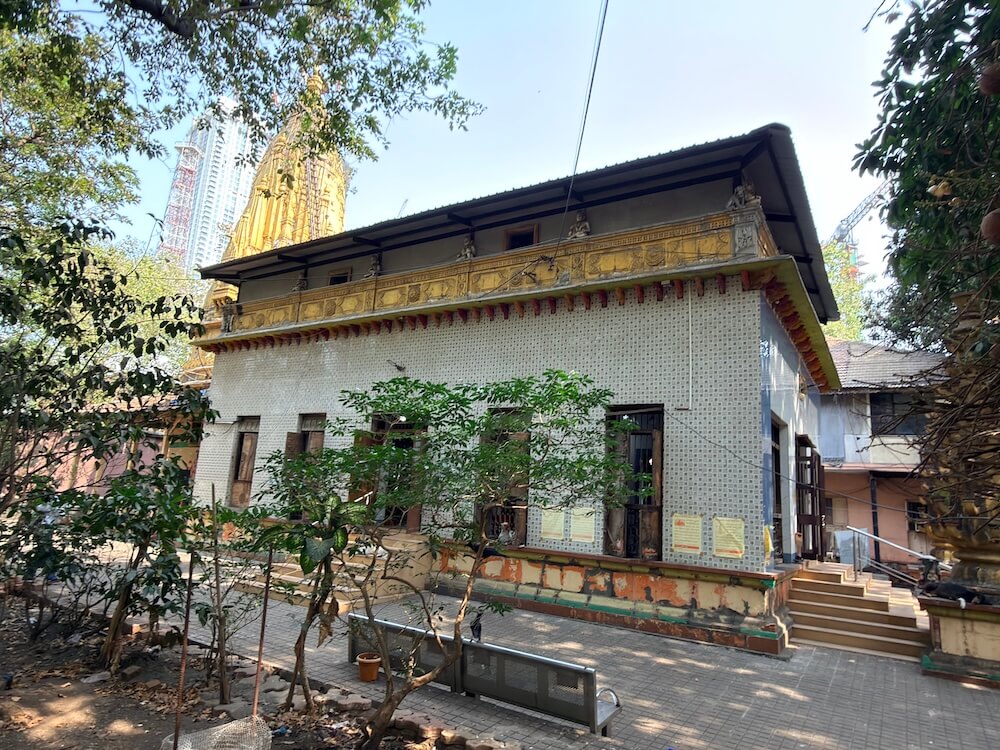
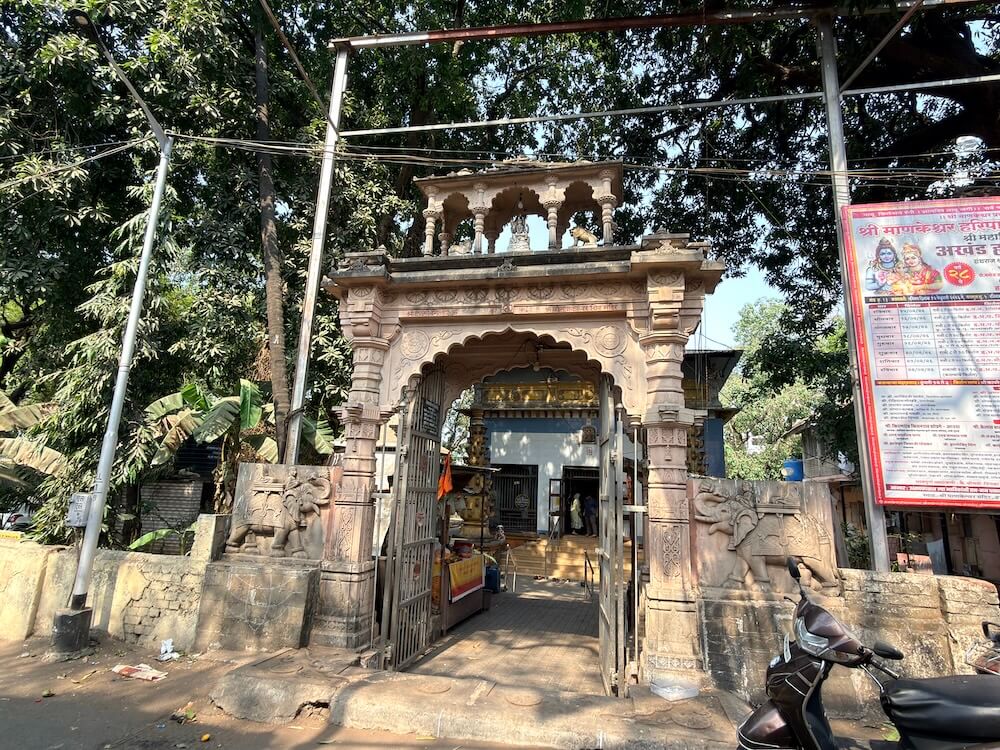
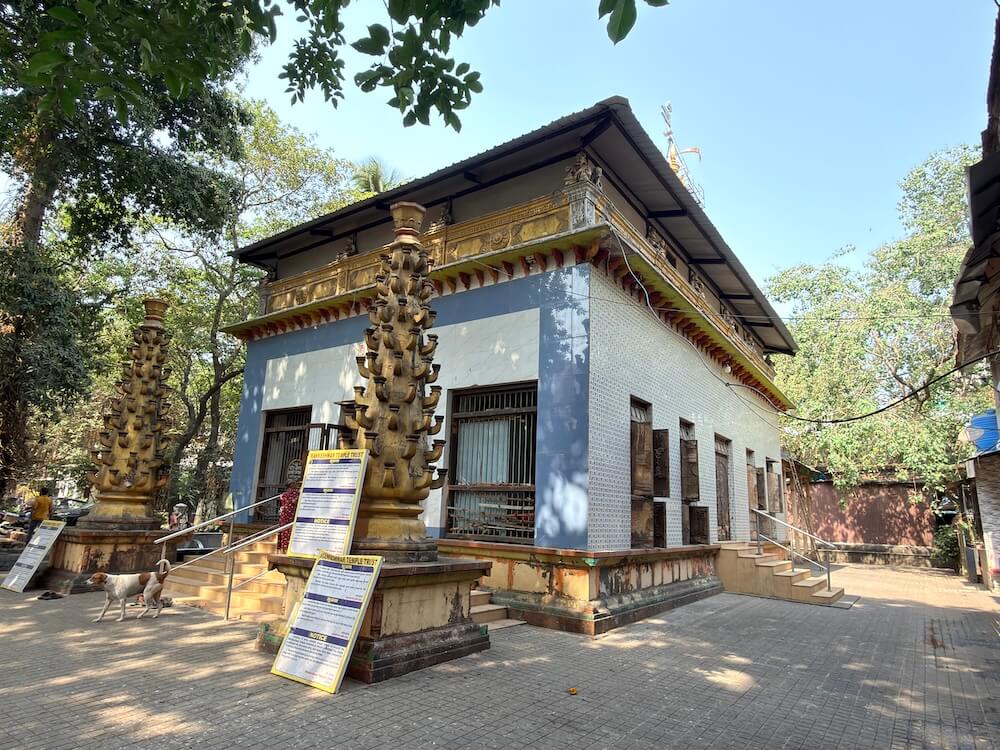
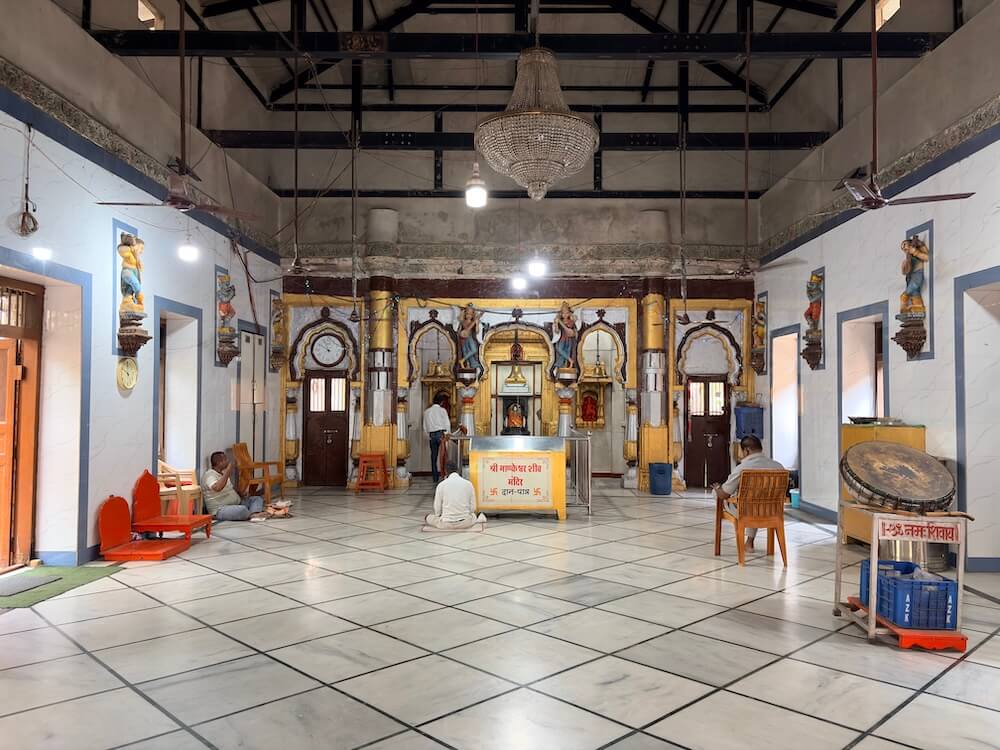
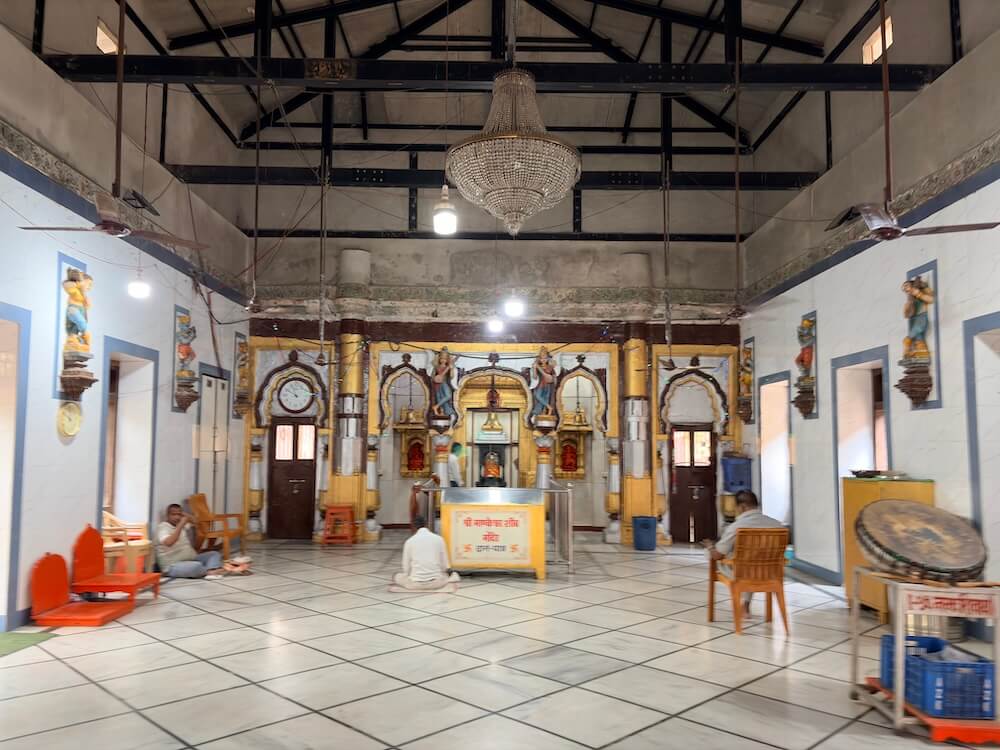
The temple is situated in a large courtyard a short distance from the Byculla police station. The temple premises have a large entrance gate built in recent times. The entrance features ornate pillars, an arched gateway, relief sculptures of elephants on both sides of the pillars, and a horizontal canopy (Chhatri) at the top. In the upper canopy, there is an idol of Lord Shiva. On one side of it is an idol of Nandi, and on the other, an idol of a lion. The magnificent temple stands in the center of the temple courtyard, which is paved with paver blocks. In front of it, on two sides, are two tall lamp towers. The temple structure consists of a Sabha Mandap (assembly hall), Antarala (vestibule), and Garbhagriha (sanctum sanctorum), and it is built on a high plinth (Jagati).One enters the Sabha Mandap by climbing seven steps. The Sabha Mandap is spacious and about two stories high. Its upper part has a beautifully carved railing, and Shaiva images are seated on this railing. The Sabha Mandap has five entrances—from the front, sides, and back—as well as many high windows. On the walls of this marble-floored Sabha Mandap, there are relief sculptures of Surasundaris (celestial beauties) in the upper section. A large crystal chandelier hangs from the ceiling.
In front of the temple’s Antarala, there is a large and elegant statue of Nandi carved in black stone. In front of that is a Kurma (tortoise) sculpture in black stone. The carved pillars at the front of the Antarala are connected by an arched gateway. Above the two middle pillars are two tall sculptures of Veena-playing Surasundaris. In the niches on the right and left of the Antarala are idols of Hanuman and Ganesha, respectively. The Garbhagriha has a three-branched stone doorway bearing the imprint of the Maratha architectural style.
On its lintel (Lalatbimba) is a sculpture of Ganesha. On the threshold of the doorway are a crescent moon stone and Kirtimukhas. Inside the Garbhagriha, a stone Shiva Linga is seated on the floor within a silver-ornamented Shalunka (base). Above this Shiva Linga is a silver serpent hood (Nagphana), and above that is a silver Galantika (water vessel). In a niche on the back wall of the Garbhagriha, an idol of Mother Parvati is seated. To the left of this niche, in the upper part, a silver mask of Shiva is kept. On special occasions like festivals, this mask is placed on the Shiva Linga. Above the Garbhagriha is a tall spire of the Urushringa type in the Nagara architectural style.
Devotees can visit the temple for Darshan from 5:30 AM to 12:00 PM and from 3:00 PM to 9:30 PM. Aarti is performed in the temple three times daily: at 6:15 AM, 11:30 AM, and 7:30 PM. There is a large crowd of devotees at this temple every Monday. Maha Shivratri is the biggest festival celebrated at this temple.
For the past 28 years, an Akhand Harinam Saptah has been organized here on the occasion of Mahashivratri. During this period, Kirtan is held daily from 8 to 10 at night. On the eighth day, a Kalyaache Kirtan is organized at 10 in the morning, followed by Mahaprasad from 12 to 3 in the afternoon. Apart from this, various Hindu festivals and celebrations are also observed with great enthusiasm at the temple.
This sacred temple stands as a testament to deep spiritual devotion, ancient architectural grandeur, and rich local cultural traditions.
The sanctum sanctorum houses the divine idol consecrated according to ancient Vedic traditions, surrounded by serene courtyards and traditional temple architecture.
Navratri, Maha Shivratri, Annual Temple Jatra & Deepotsav
Compare and book flights, secure top-rated local hotels near the temple, hire reliable guides, and rent cars instantly.
Extend your pilgrimage by visiting other highly sacred temples located nearby.


Add ₹999 more to unlock FREE SHIPPING!
Your sacred cart is currently empty.
Shop Photo FramesFill in your delivery details below to place your order.
Add comment