
Add ₹999 more to unlock FREE SHIPPING!
Your sacred cart is currently empty.
Shop Photo FramesThe temple of Mahaganpati at Titwala, who brought about the reunion of Dushyant and Shakuntala, is one of the premier Ganesha temples in the state. Many devotees have deep faith that if one prays wholeheartedly to this wish-fulfilling Ganesha, marriages are solemnized, and childless couples are blessed with progeny. Therefore, this Ganesha is also known as ‘Vivah Vinayak’. References to this temple are found in ancient scriptures and literature. Every Tuesday, Sankashti Chaturthi, Angaraki Chaturthi, Ganesh Chaturthi, Ganesh Jayanti, as well as on New Year’s Day, thousands of devotees come to have the darshan of this Ganesha.
The legend regarding the temple is that Sage Kanva, who composed the Rigveda, Angirasa, and other Vedas, resided here having built his hermitage in this area. Shakuntala, born from the union of Sage Vishwamitra and Menaka, was abandoned by her biological parents, after which Sage Kanva adopted and raised her. Once, King Dushyant of Gandhara country was passing through this area and met the beautiful Shakuntala. In this meeting, they both fell in love with each other and also married according to the Gandharva rite. After living together for a few days, Dushyant had to return to his kingdom. At that time, as a memento, he gave a ring to Shakuntala and also promised that he would soon return and take her along with him. Once, the short-tempered sage Durvasa Muni arrived at the hermitage of Sage Kanva. At that time, Shakuntala, who was lost in the thoughts of Dushyant, failed to welcome him properly, which enraged him. He cursed Shakuntala that the very Dushyant, absorbed in whose thoughts you did not welcome me properly, will forget you. Events unfolded just as Durvasa Muni’s curse had foretold. Seeing Shakuntala plunged in grief, Sage Kanva gave her a Ganesha idol and told her to worship it. Shakuntala’s penance bore fruit, Dushyant remembered her, and he came and took her along with him. The Ganesha who brought about this auspicious union is none other than this Mahaganpati of Titwala.
During the Peshwa period, the Peshwas had their camp at Vasundri near Titwala. Once, due to a drought in the area, to ensure the availability of water, the Peshwas instructed their administrator रामचंद्र मेहेंदळे to carry out excavation for a pond here. During the excavation, Mehendale found an idol of Ganesha. At that time, the Peshwa, who was in Pune, had a divine vision the previous night regarding the idol. He learned from Mehendale that they had found the idol. This idol was exactly as it had appeared in the vision. Therefore, the Peshwas built a small temple right next to the pond and consecrated the idol. The responsibility for the daily worship of the idol was entrusted to a priest named Joshi. To this day, the responsibility for the worship in this temple rests with the Joshi family.
Later, after conquering the Vasai Fort, Chimaji Appa built a large temple at this site and re-installed the idol in it. At the same time, a wooden sabhamandap (assembly hall) was also erected in front of the temple. The Peshwas had donated three acres of land for this temple. After some time, the temple priest Joshi expanded the temple by donating his thirteen acres of land. Over the course of time, due to the dilapidation of the temple and the sabhamandap becoming too small, the temple was renovated in 1965-66. In 1995-96, the sabhamandap here was renovated.
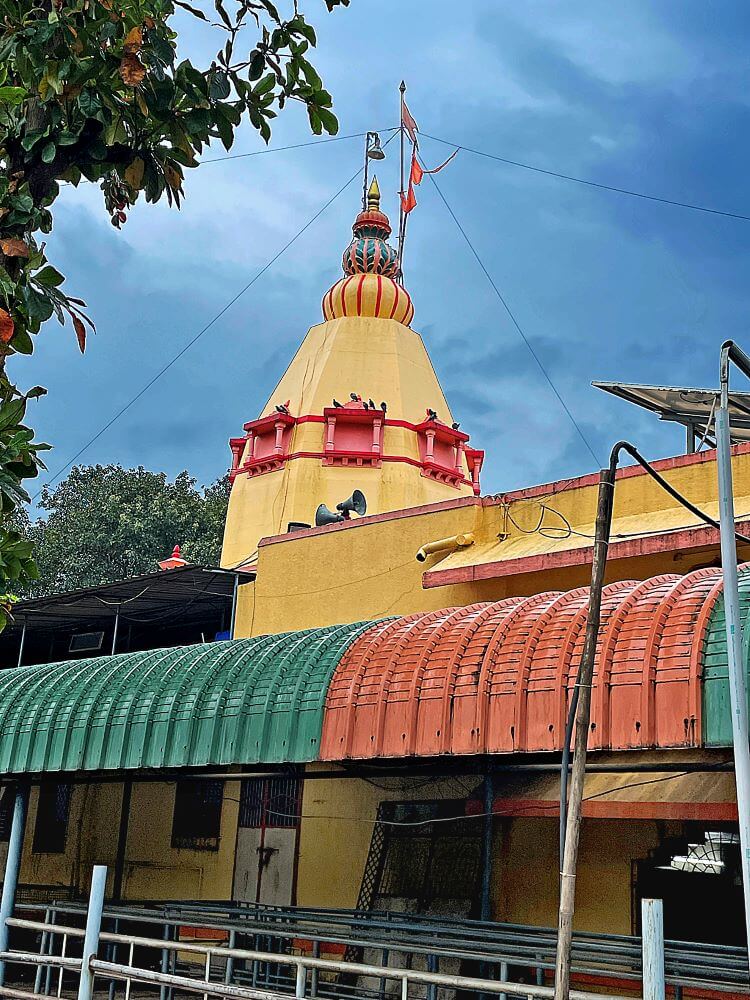
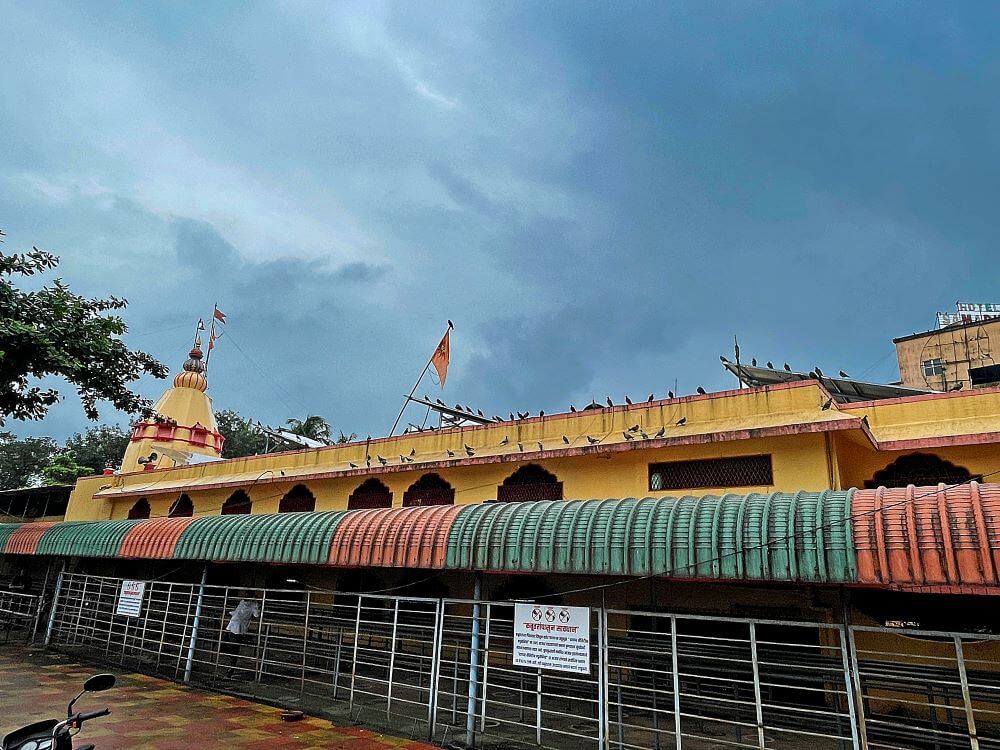
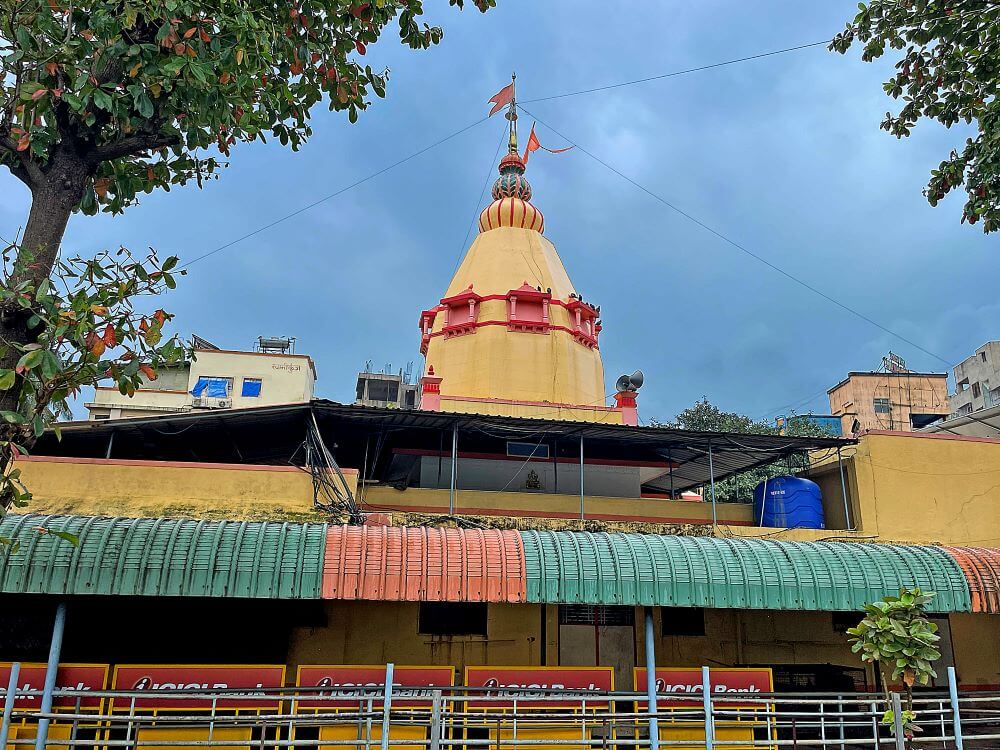
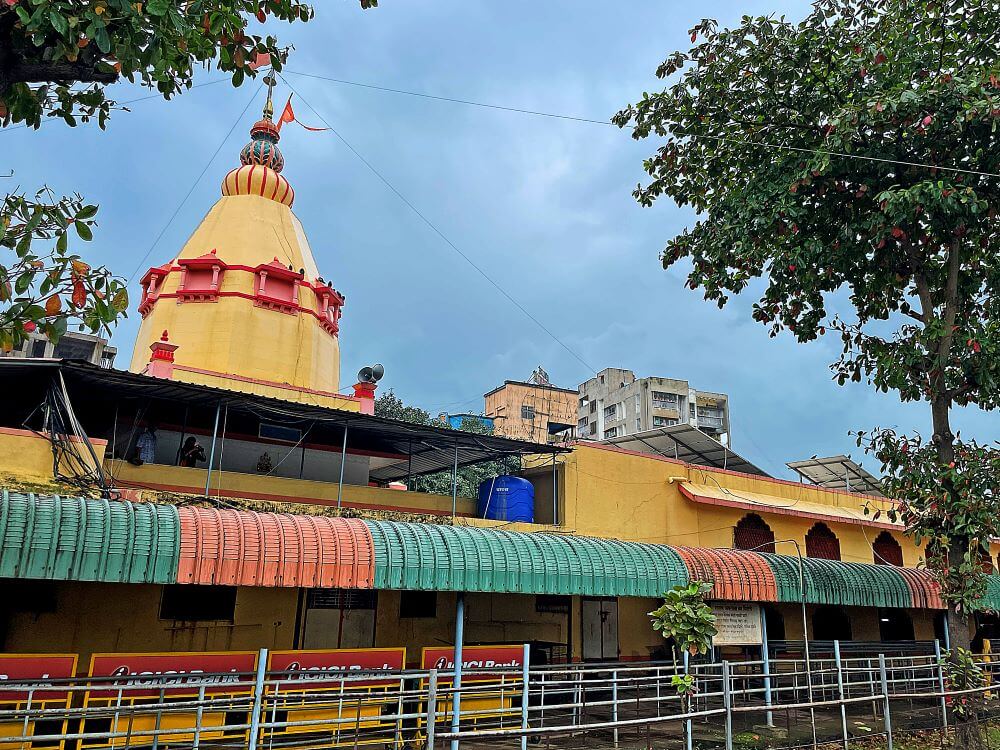
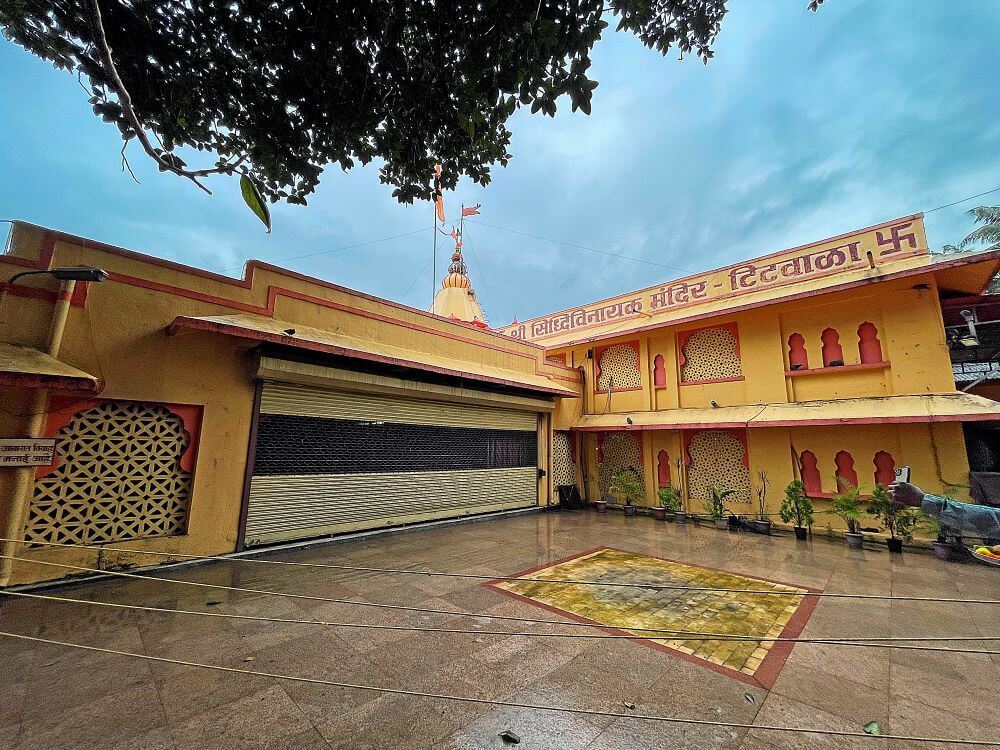
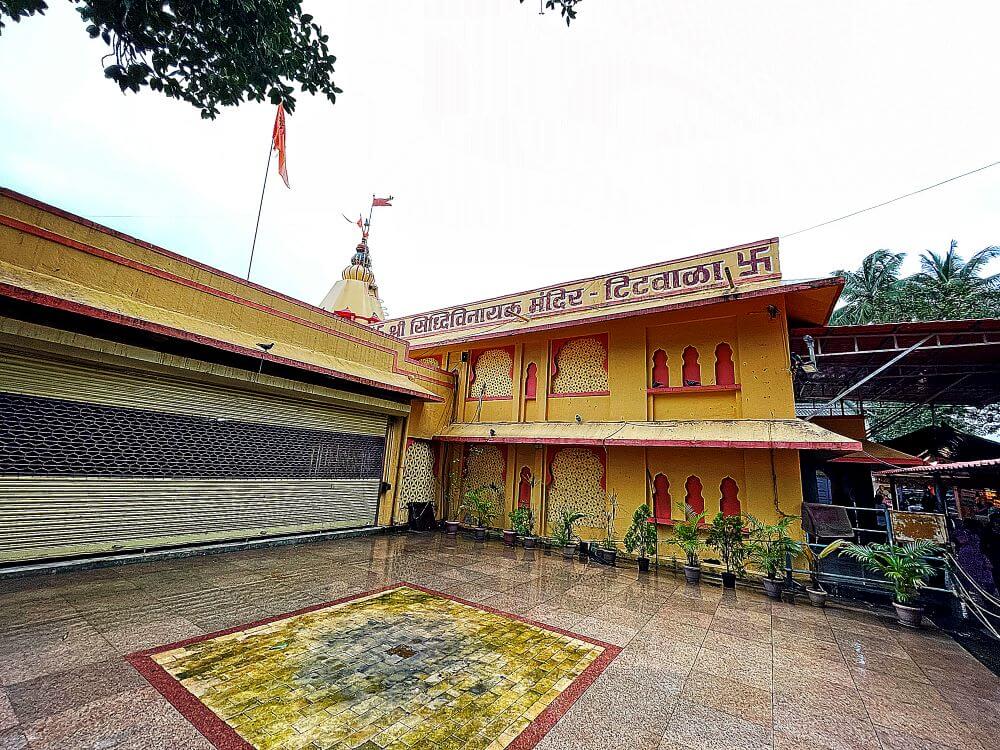
The Siddhivinayak Ganesha Temple is located in the central part of Titwala city near a large pond. Upon entering through the temple arch, about 60 to 70 shops selling worship materials and prasad can be seen. Built in the traditional Maharashtrian style, the temple premises feature a deepmal (lamp tower) where lamps are lit every evening. Taking into consideration the daily crowds of devotees, necessary security measures have been put in place here. One can enter the sanctum sanctorum by passing through a door fitted with a metal detector and going through a long darshan queue.
In the sanctum sanctorum, one gets the darshan of a three-and-a-half-foot-tall, vermilion-anointed idol of Ganesha with His trunk turned to the left. This idol is seated on a platform about four feet in height. Enthroned, this idol is four-armed (chhaturbhuj); in the upper right hand of the idol is an axe (parashu), in the lower hand is a rosary (rudrakshamala), in the upper left hand is a mace (gada) and a lotus, while in the lower hand is a bowl of modaks (ladupatra). The features of the idol include long ears, a broken right tusk, the trunk touching the modak bowl, a large belly, the left leg folded in a seated posture while the right leg is bent in a slanting position, a sacred thread (yajnopavita) and a serpent around the neck, as well as a serpent coiled around the belly. The idol has a silver crown and a silver canopy above it. There are rubies in the eyes and navel. Near the feet of the idol are Yakshas and Gandharvas, and on the left and right sides are Riddhi and Siddhi. This idol is regularly adorned with a yellow silk garment (pitambar). The shrine frame (devhara) is exquisitely crafted. Beautiful floral decorations are arranged here daily. Vermilion is applied to this idol on every Sankashti Chaturthi and Vinayaki Chaturthi.
The sanctum sanctorum and the sabhamandap have been separated using a mesh screen. After exiting through the door on the other side of the sanctum sanctorum, one enters the sabhamandap. From the moment one enters the sanctum sanctorum until exiting the sabhamandap, the darshan of this Ganesha idol is continuously visible. In front of the sanctum sanctorum is a silver idol of Mushaka, the vehicle of Ganesha. It is the belief of devotees that if one speaks their wish in their heart and whispers the garland directly into the ear of the rat, the wish is fulfilled. Thousands of devotees can be seated simultaneously in the spacious sabhamandap. The darshan of the Ganesha idol can also be had from the gallery located above the sabhamandap.
To the right in the sabhamandap is a Shivalinga and an idol of Nandi. In the left corner is the samadhi (memorial shrine) of the Ganesha devotee Vengurlekar Joshi. It is related that Mahadev Moreshwar Joshi (Vengurlekar) was employed in a high-ranking position in the forest department. He did not have faith in God and religion. A friend firmly brought him to this temple. Upon coming here, such a transformation occurred in him that he abandoned household life and adopted the path of spirituality. He performed penance for Ganesha by consuming only neem leaves for one year, just one fruit daily for one year, and observing complete silence for one year. Pleased with his devotion, Ganesha blessed him with the boon of speech realization (vachasiddhi). He used to live in the temple itself. Around 1910, he attained samadhi here.
In this temple, devotees can have the Darshan of Lord Mahaganapati daily from early morning 5:00 AM to 9:00 PM. On every Sankashti Chaturthi and Angaraki Chaturthi, the timing is extended from 4:00 AM to 11:00 PM. On Ganesh Chaturthi and Ganesh Jayanti, the timing is from 4:00 AM to 10:00 PM. Aartis are performed daily at 5:00 AM, 12:00 PM, and 6:45 PM. On Sankashti Chaturthi and Angaraki, Aartis are held at 4:00 AM, 12:00 PM, and at the time of Moonrise at night. On Ganesh Chaturthi, Aartis take place at 4:00 AM, 12:00 PM, and 6:45 PM. Devotees can perform various rituals and pujas in this temple by paying a nominal fee, which include Abhishek, early morning Mahapuja, self-seated Abhishek, annual Abhishek, Sahastravartan, Satyanarayan Puja, Satyavinayak Puja, Laghurudra, Ganahoma, Ganesh Yaga, Sankashti Chaturthi Udyapan, vehicle puja, and Brahmin Bhojan. (Contact: Temple Committee Office: Mobile 9920570571). The lake situated near the temple is also known as ‘Amritkund’. Visitors can enjoy boating here by paying a nominal fee. Accommodation facilities (Bhakta Niwas) are available in the temple premises.
This sacred temple stands as a testament to deep spiritual devotion, ancient architectural grandeur, and rich local cultural traditions.
The sanctum sanctorum houses the divine idol consecrated according to ancient Vedic traditions, surrounded by serene courtyards and traditional temple architecture.
Navratri, Maha Shivratri, Annual Temple Jatra & Deepotsav
Compare and book flights, secure top-rated local hotels near the temple, hire reliable guides, and rent cars instantly.
Extend your pilgrimage by visiting other highly sacred temples located nearby.


Add ₹999 more to unlock FREE SHIPPING!
Your sacred cart is currently empty.
Shop Photo FramesFill in your delivery details below to place your order.
Add comment