
Add ₹999 more to unlock FREE SHIPPING!
Your sacred cart is currently empty.
Shop Photo FramesThe village of Dhav is known as the Pandharpur of Vidarbha. The temple of Nath Nange Maharaj, who is considered an avatar of the Adi Nath Matsyendranath, also known as Macchindranath of the Nath tradition, is situated in Dhav. This temple, also known as the ‘Vishwa Mandir’ (Universal Temple), is a sacred pilgrimage site for countless devotees, not only from Malegaon taluka but from the entire district. The Samadhi temple of Vishwanath Baba, the chief disciple of Nath Nange Maharaj, is also located here. A massive crowd gathers at this Vishwa Mandir for the fair held on Ratha Saptami. On this occasion, a grand Mahaprasad is organized.
Nath Nange Maharaj was a Yogi of the Nath Panth. The Nath tradition emerged in India between the eighth and twelfth centuries. Matsyendranath is considered the first person of this tradition. Various names and forms of Matsyendranath, such as Macchindranath, Macchendrapada, Macchaghnapada, and Minapada, are found in various texts. The origin of Matsyendranath is unknown. According to the great researcher Dr. Ra. Chin. Dhere, the period of Matsyendranath is before 1015 AD. Texts such as ‘Kaulajnana-nirnaya’, ‘Akulaviratantram’, ‘Kulanandatantram’, ‘Jnana-karika’, as well as ‘Yoga-vishaya’ and ‘Matsyendra-samhita’ are attributed to him. The first four of these are texts of the Kaula sect. Nath Nange Maharaj is considered an avatar of Matsyendranath. The early history of Nath Nange Maharaj is unknown. It is the belief of his devotees that he was Ayonija (not born of a womb).
The legend regarding him is that about 100 years ago, villagers saw an unknown elderly person sitting in a naked state on the Hanuman platform (Par) in Dhav village. Before coming to this area, he used to live at the Auliya Sansthan in the village of Jaulka in Malegaon taluka. With a lean body, blind in both eyes, lame in his legs, and of dark complexion, this 75-year-old gentleman was in a naked state, so the villagers initially addressed him by the name ‘Nangya’. He usually resided on the Hanuman platform itself. He had lit a Dhuni (sacred fire) there. Through the ash of that Dhuni, he performed miracles such as curing the ailments of the sick, finding lost cows or items, making the mute speak, and curing leprosy. Due to this, people realized that he was a self-realized soul. Gradually, his followers began to increase. Vishwanath Maharaj was his chief disciple. It is said that for about 12 years, Nath Nange Maharaj tested Vishwanath Maharaj on all counts. After that, he announced the end of his avatar and took Samadhi accordingly. It is also said that he entered the body of Vishwanath Maharaj. Since this Parakaya Pravesh (entering another’s body) took place on the day of Ratha Saptami, a grand fair has been held at Dhav on Ratha Saptami ever since. This fair lasts for a total of seven days.
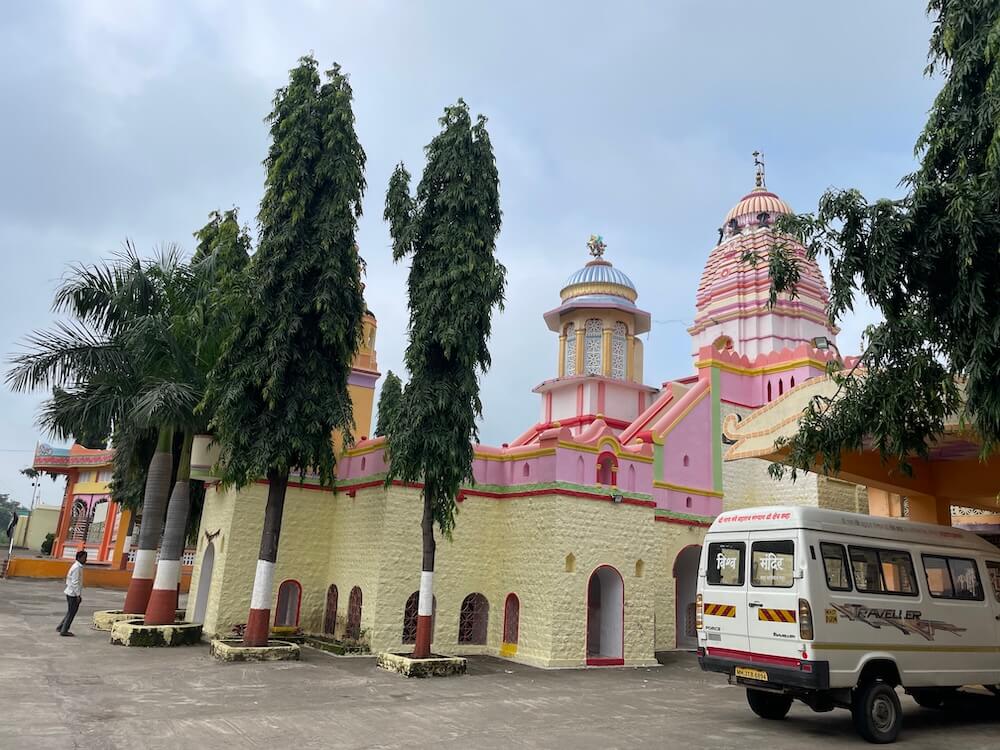
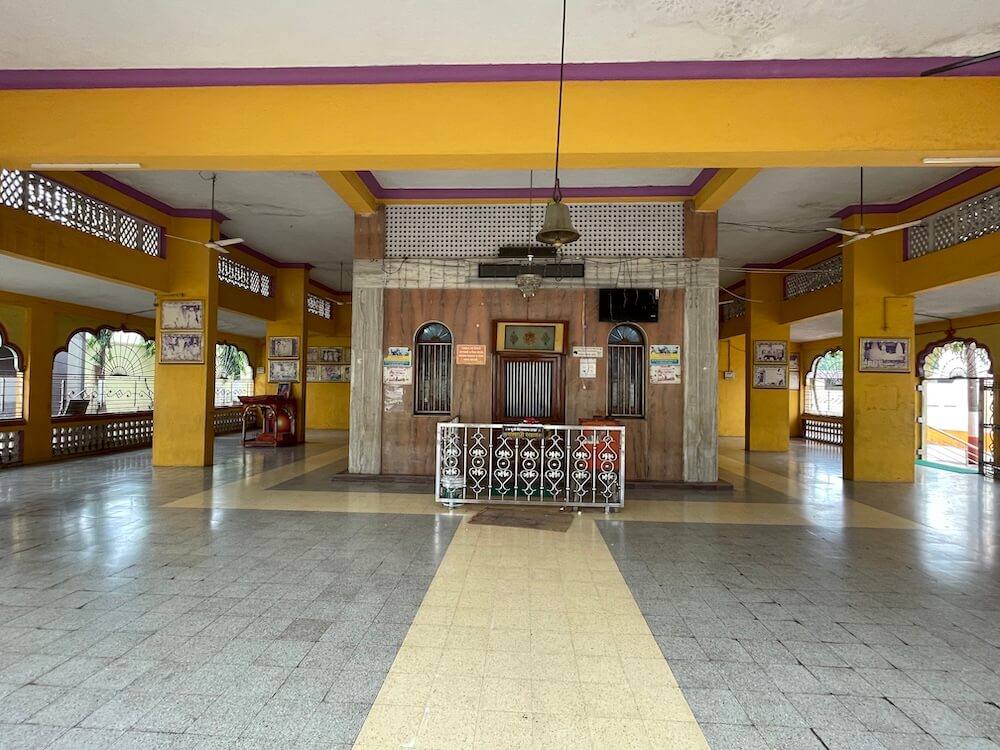
The Nath Nange Maharaj Sansthan is situated in a sprawling courtyard in Dhav village. Upon entering this courtyard, the Samadhi temple of Vishwanath Baba is on the left side. This temple is built using modern construction materials. The Sabha Mandap (assembly hall) of the temple is spacious. Directly in front is the Garbhagriha (sanctum sanctorum). There is a circumambulation path from the Sabha Mandap. Many old photographs are displayed on the pillars and walls of the Sabha Mandap. These include photographs from the time of the temple’s construction, visits by Rashtrasant Tukdoji Maharaj and other important personalities after the completion of the temple, and the festivals celebrated. In the back of the Sabha Mandap, there is a photograph of Vishwanath Maharaj’s mother, Mayabai, in a small niche. In the Garbhagriha, the idol of Vishwanath Maharaj is installed on a high marble pedestal on a silver base. There is a silver crown on the head of the idol. Behind it is a silver Prabhaval (halo) with intricate carvings. In front of the idol are the silver Padukas (footprints) of the Maharaj. Behind this, a photograph of Vishwanath Maharaj is placed on the wall. Above the Garbhagriha of the temple is a circular Shikhara (spire) that tapers towards the top.
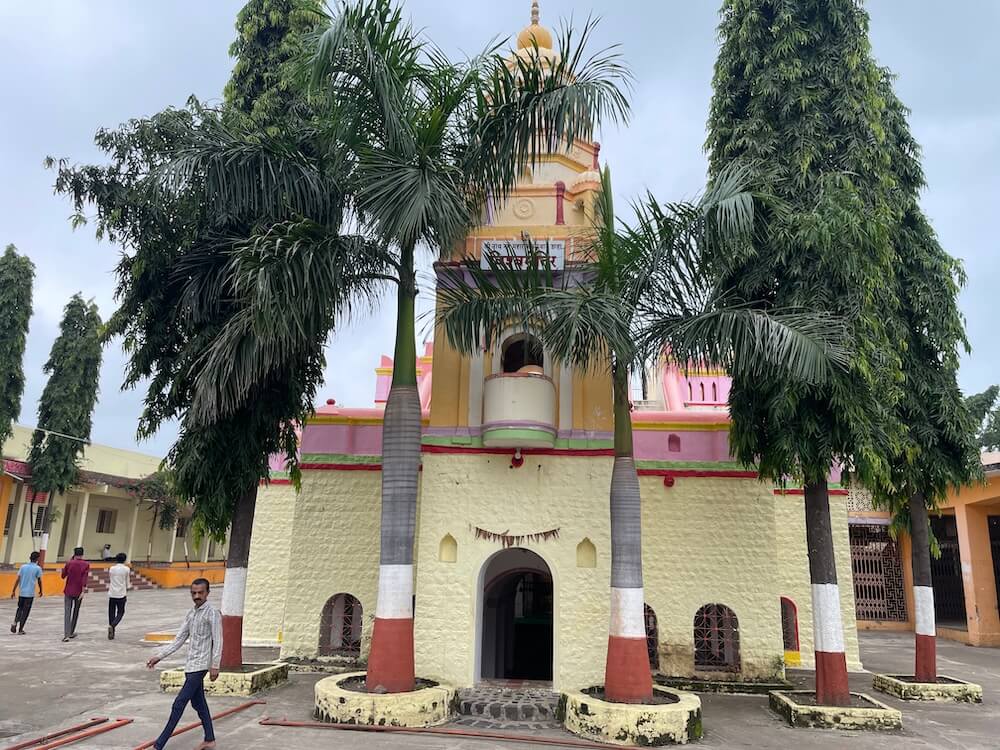
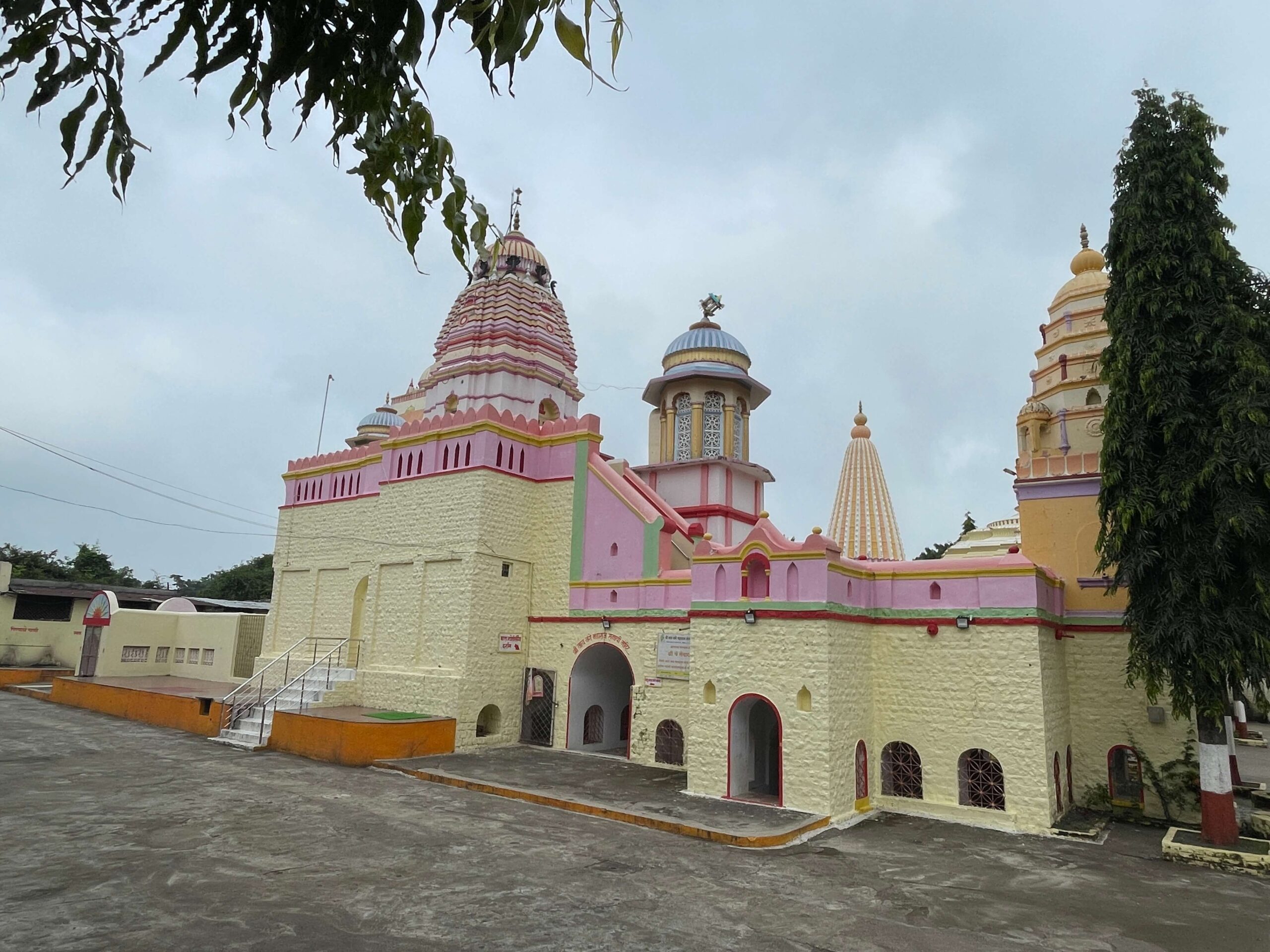
At some distance from this temple stands the large structure of Nath Nange Maharaj’s Samadhi temple. Known as the Vishwa Mandir, this temple is old and built of stone. The temple has a small arched entrance. From here, one enters the Sabha Mandap. The Sabha Mandap has wide square pillars; they are connected to each other by large arches. Moving forward from here, after climbing four or five steps, is the entrance to the Samadhi site of Nath Nange Maharaj. At the lintel of this entrance, there is a relief sculpture of Hanuman holding the Dronagiri mountain in one hand and a mace in the other. Images of the moon and sun are drawn on both sides of it.
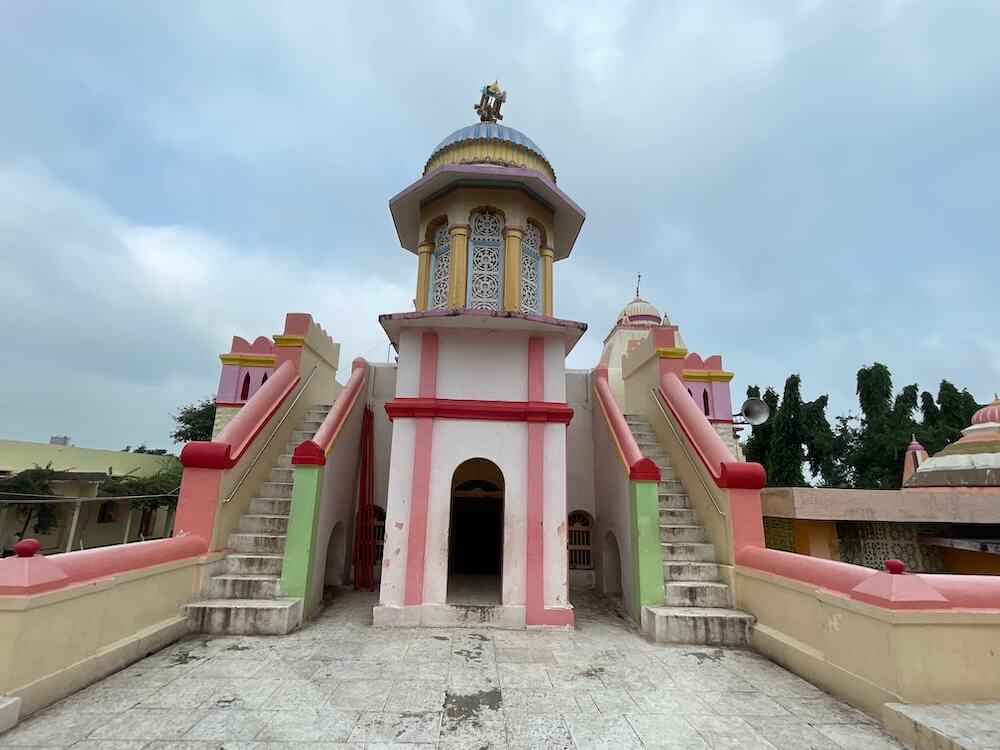
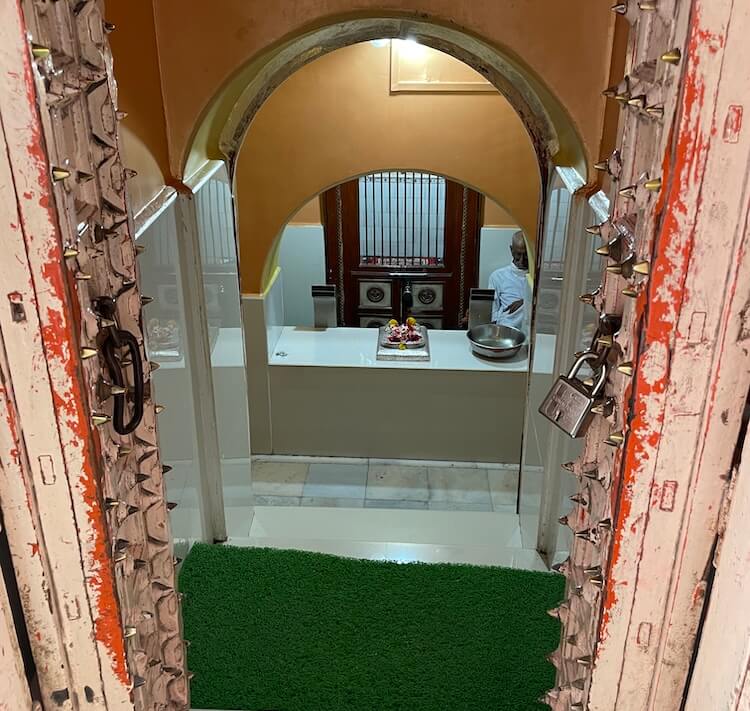
The entrance to the Samadhi site has rare, old-style wooden doors. From here, one enters the inner sanctum of the Samadhi site. Directly in front is the place of Nath Nange Maharaj’s silver Padukas. Further ahead in the sanctum, on a high pedestal with silver carvings, is the radiant idol of Nath Nange Maharaj carved in black stone. On his head is an ornate silver crown, and above it is a silver umbrella. There is a circumambulation path around the Samadhi temple. There are many large niches in the walls of this path. In one of these niches, an idol of Shani in black stone is seated. There is a high Shikhara on the main porch of this ancient temple. The upper part of the Sabha Mandap is built like a turret, while the Garbhagriha has a Shikhara in the Nagara architectural style. There are many Naga (serpent) idols on the lower side of the Amalaka of this Shikhara. The impression is created that the Amalaka is being supported on the hoods of these Naga idols. There is a high Kalash on the Amalaka.
There is a staircase to go to the upper side from the Samadhi temple of Nath Nange Maharaj. Here is the temple of Trimukhi Dattatreya. There are also the Padukas of Datta here. Directly in front of this temple is the Ganesha temple. The Kalash of this temple, which is open on all four sides, is in the Nagara style. This part is open like a terrace. After climbing the stairs here and going to the upper part, one reaches the Nandi temple. In front of this is the Mahadeva temple. In this temple, there is an idol of Mahadeva in a niche. There are Padukas on the outer side of the Garbhagriha. Adjacent to the Vishwa Mandir are also temples of Brahmadeva, as well as Saint Namdev and Kalika Mata. There is a Yajna Mandap in the temple premises. During the fair, a Homa-Havan is performed here. Adjacent to this Yajna Mandap is an ancient Hanuman temple. Nath Nange Maharaj used to perform penance in this very temple. His seat (Gadi) and one of his photographs have been kept in this temple. The idol of Hanuman in the temple is made of stone and smeared with vermilion.
Within the spacious premises of the temple, there is a dispensary run by the trust. A large hall has been constructed here for the recitation of the ‘Vishwajeevan’ scripture written by Vishwanath Maharaj and for organizing other programs. During the pilgrimage period, the palanquin is kept there. Near the trust office, there is a thirty-foot-tall brass flagstaff. The wedding hall is also located in this area. Accommodation facilities for devotees are available here.
A seven-day annual pilgrimage festival is held at this trust. It concludes on Ratha Saptami. During this period, programs such as Gayatri Japa, Abhisheka-Havana, Bhagavata reading, Harinam Saptah, and Vishwajeevan scripture reading are conducted. On the day of Ratha Saptami, an Abhisheka is performed on the idols of Nath Nange Maharaj and Vishwanath Maharaj at sunrise. Thereafter, following the Aarti, a procession of the palanquins of both Maharajs is taken through the village. Thousands of devotees participate in this procession. Following this, a grand Mahaprasada event takes place here. The dining rows are so large that one and a half to two thousand volunteers and tractor-trolleys have to be arranged to serve the food. Every year, one hundred thousand devotees partake in this Mahaprasada. One hundred fifty to two hundred quintals of Mahaprasada are prepared for the devotees.
This sacred temple stands as a testament to deep spiritual devotion, ancient architectural grandeur, and rich local cultural traditions.
The sanctum sanctorum houses the divine idol consecrated according to ancient Vedic traditions, surrounded by serene courtyards and traditional temple architecture.
Navratri, Maha Shivratri, Annual Temple Jatra & Deepotsav
Compare and book flights, secure top-rated local hotels near the temple, hire reliable guides, and rent cars instantly.
Extend your pilgrimage by visiting other highly sacred temples located nearby.


Add ₹999 more to unlock FREE SHIPPING!
Your sacred cart is currently empty.
Shop Photo FramesFill in your delivery details below to place your order.
Add comment