
Add ₹999 more to unlock FREE SHIPPING!
Your sacred cart is currently empty.
Shop Photo FramesSadhus, saints, renunciates, ascetics, and yogis spend their lives for the welfare of society. Their teachings bring extraordinary changes to the lives of common people. To ensure that the teachings which dispel sorrow, poverty, and ignorance from life remain remembered forever, Samadhi temples of such great souls are built. Sant Goroba Kumbhar was one such great saint. He gave spiritual guidance to Sant Namdev. He was a contemporary of Sant Dnyaneshwar. He took the initiative to organize the Saint Assembly in the thirteenth century at Ter. Devotees believe that by having the darshan of his Samadhi, one receives the direct blessings of Lord Pandurang.
Sant Goroba Kaka was born in the year ১২৬৭. His father was a devoted follower of Kaleshwar Mahadev here. The spiritual authority of the Vitthal-devotee Goroba Kaka was such that at the Saint Assembly in Ter, Muktabai entrusted him with the task of testing the saints. He advised Namdev himself, saying, “Namya, your pot is unbaked; seek a Guru.” He concluded his earthly journey on ২০ April ১৩১৭. The Samadhi temple of Goroba Kaka was built in the fourteenth century by his devotee, Bapuji Patil, after his passing. The beauty of this six-hundred-year-old Samadhi temple remains intact even today.
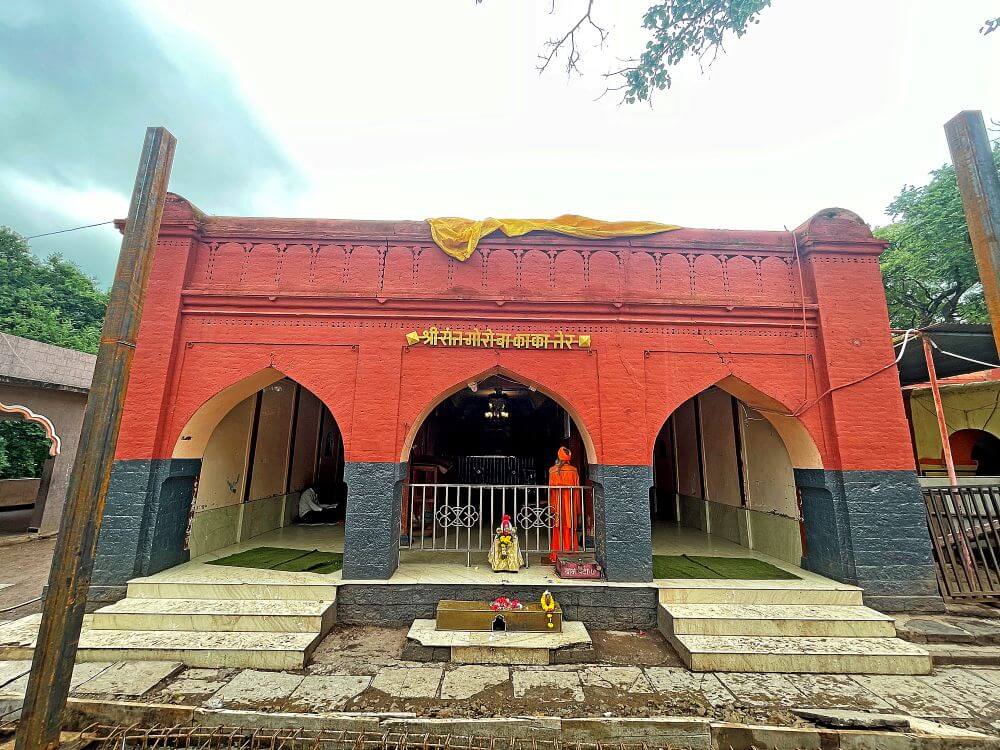
Goroba Kaka’s Samadhi temple is located in the courtyard of the Kaleshwar Mahadev temple. The temple structure consists of a Sabhamandap (assembly hall) and an Antaral (vestibule). The enclosed Sabhamandap has an open front. The entrance is designed with four square pillars supporting three semi-circular arches. At the entrance, there is an idol and stone footprints of Bapuji Patil, the supreme devotee of Goroba Kaka. The Sabhamandap has four rows of ten square wooden pillars each. In the enclosed Sabhamandap, the outer pillars are embedded in the walls. Further ahead is the Garbhagriha (sanctum sanctorum), with doors on both sides leading out from the Sabhamandap.
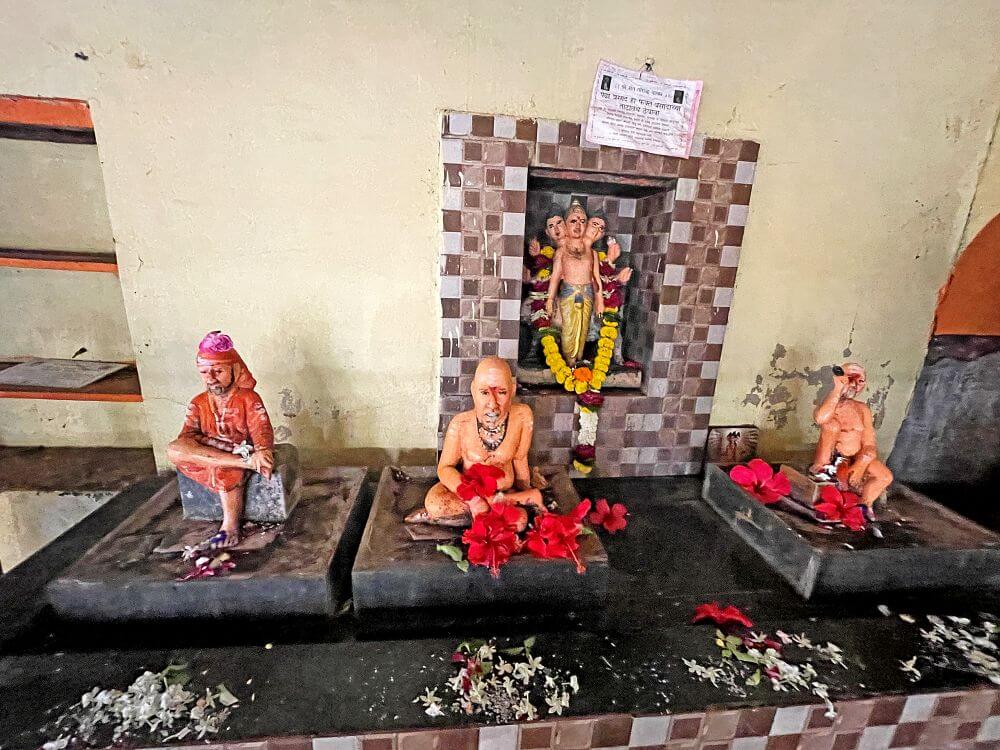
On the front wall of the Garbhagriha, near the ceiling, there are floral carvings, with the face of Goroba Kaka sculpted in the center. The entrance to the Garbhagriha has a brass covering, and the door frames are adorned with leaf and vine carvings. A lotus flower is sculpted on the lintel. In the center of the Garbhagriha lies the Samadhi of Goroba Kaka, topped with his idol. Near the back wall of the Garbhagriha, there are idols of Vitthal-Rukmini placed in a shrine on a Vajrapitha. The roof of the Garbhagriha features a Bhumija-style Shikhara (spire), with a railing on all four sides. There are half-pillars at the four corners of the railing. On the Shikhara, around the Amalaka, there are smaller spires, topped with an Amalaka and a Kalash. The annual fair of the Samadhi temple is celebrated on Chaitra Vadya Trayodashi to mark the death anniversary of Goroba Kumbhar. At this time, thousands of devotees from states like Maharashtra, Karnataka, and Andhra Pradesh arrive with Saint-Dindis (processions) for the darshan of Goroba Kaka.
Near the Goroba Kaka temple, there are three ancient temples: Trivikram, Uttareshwar, and Kaleshwar. The Kaleshwar temple is located on the banks of the river to the north of the village. It is said that this temple dates back to the seventh century. Madhavbuva, the father of Goroba Kumbhar, was a staunch devotee of Kaleshwar. When his first seven children were born dead, he made a vow to Kaleshwar, and the eighth child, Goroba, survived. It is said that Sant Goroba Kaka himself used to perform the daily ritual bathing of the deity in the Kaleshwar temple using the water of the Terna River.
The temple has a strong fortification. One must climb ২০ steps from the ground to reach the entrance gate within this fortification. This ancient entrance has ornate wooden shutters and a vaulted arch at the top. On both sides of the arch, paintings of Vaishnava gatekeepers are depicted. Through the entrance, one enters the temple courtyard. A roof has been erected in the courtyard to protect devotees from the sun and rain. There is an idol of Maruti in a small temple on the platform of a great tree in the courtyard. The courtyard features stone-built cloisters, which are used as pilgrim lodgings, Dharmashalas, and for food distribution.
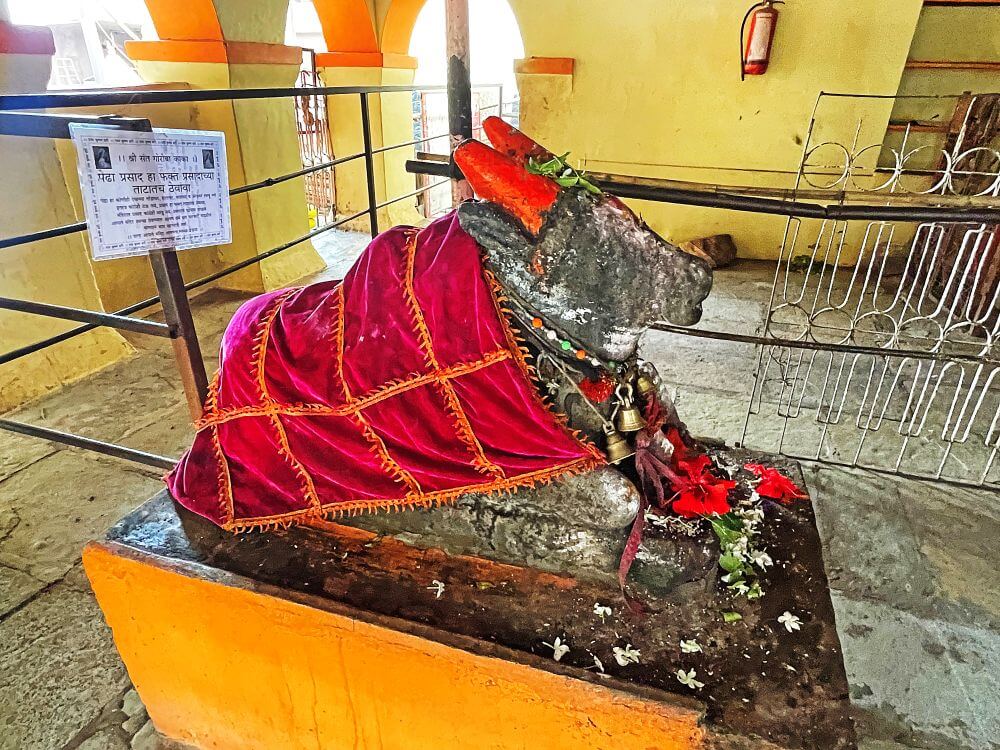
The temple structure consists of a Sabhamandap, Antaral, and Garbhagriha. On the front wall of the Sabhamandap, on both sides of the entrance, a battle scene between an elephant and a lion is carved. The sculpture depicts the lion defeating the elephant, which signifies a change of power after a war between two kings. In the center of the enclosed Sabhamandap, there is an idol of Nandi made of black stone on a pedestal. On the middle pillar of the Sabhamandap, a four-armed Bhairava-gatekeeper sculpture is carved. Above this on the same pillar, a battle scene between Vali and Sugriva is carved. There are other war sculptures carved in stone on the walls of the Sabhamandap. The Sabhamandap also houses a four-armed, vermilion-smeared idol of Ganesha.
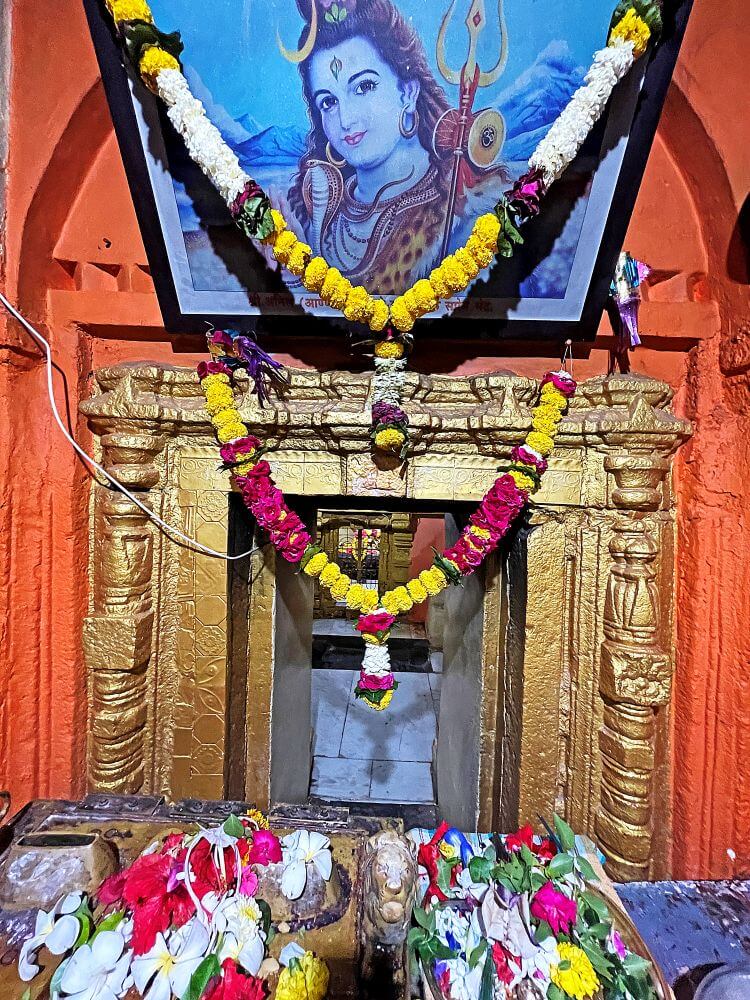
The door frames of the Antaral are decorated with vines and pillar carvings, and there is a Chandrashila at the threshold. The door frames of the Garbhagriha feature four-armed gatekeeper sculptures on both sides and pillar carvings above. There is a Garuda sculpture on the lintel. Although there is currently a Shiva Linga in the Garbhagriha, scholars believe this was originally a Vishnu temple. The roof of the Garbhagriha features a Bhumija-style Shikhara. There are niches on all four sides of the Shikhara. At the top of the Shikhara is an Amalaka, followed by a Kalash.
The temple courtyard contains many Shiva Lingas and some Samadhi sites. Next to the Kaleshwar temple are the Neelkantheshwar Mahadev temple and the Sant Goroba Kaka Samadhi temple. Mahashivratri and the month of Shravan are the main annual festivals at the Kaleshwar temple. A large number of devotees visit during this time. Devotees coming for the Goroba Kaka festival also make it a point to visit the Kaleshwar temple. Devotees can have darshan of the Goroba Kaka Samadhi in this temple every day from ৫:০০ AM to ১১:০০ PM.
This sacred temple stands as a testament to deep spiritual devotion, ancient architectural grandeur, and rich local cultural traditions.
The sanctum sanctorum houses the divine idol consecrated according to ancient Vedic traditions, surrounded by serene courtyards and traditional temple architecture.
Navratri, Maha Shivratri, Annual Temple Jatra & Deepotsav
Compare and book flights, secure top-rated local hotels near the temple, hire reliable guides, and rent cars instantly.
Extend your pilgrimage by visiting other highly sacred temples located nearby.


Add ₹999 more to unlock FREE SHIPPING!
Your sacred cart is currently empty.
Shop Photo FramesFill in your delivery details below to place your order.
Add comment