
Add ₹999 more to unlock FREE SHIPPING!
Your sacred cart is currently empty.
Shop Photo FramesIndia is known across the world as the land of sages, seers, yogis, ascetics, saints, and holy men. For this reason, there are numerous ashrams and maths (monasteries) of saints and sages from Kashmir to Kanyakumari. Various activities such as yoga, spirituality, satsang, philosophy, preaching, tantra, mantra, renunciation, and contemplation are conducted through these ashrams. Ashrams serve the purpose of continuing the work of saints and sages uninterruptedly even after their passing. The Jangaleshwar Maharaj Math at Ter is one such place. Devotees believe that the presence of Jangaleshwar Maharaj is still felt in the ashram today, and through his blessings, various difficulties in life are resolved.
The Jangaleshwar Ashram is situated on the banks of a river. According to information provided by the villagers, it is about 125 years old. The founder of this math, Jangaleshwar Maharaj, was a great yogi. His devotees recount that he performed many miracles during his lifetime. A legend associated with this math is that there is an ancient banyan tree in the courtyard. It was growing rapidly. While Jangaleshwar Maharaj was meditating under this tree, the aerial roots of the banyan began to grow and reach his head. Due to the rapid growth of the roots, the space for the Maharaj to sit for his meditation became insufficient. At that moment, the Maharaj commanded the banyan tree, “Do not grow any further.” It is said that due to the Maharaj’s command, the banyan tree has not grown a single bit and remains in the same state even today. The Maharaj attained Samadhi here on Vaishakh Shuddha Chaturthi in the year 1900.
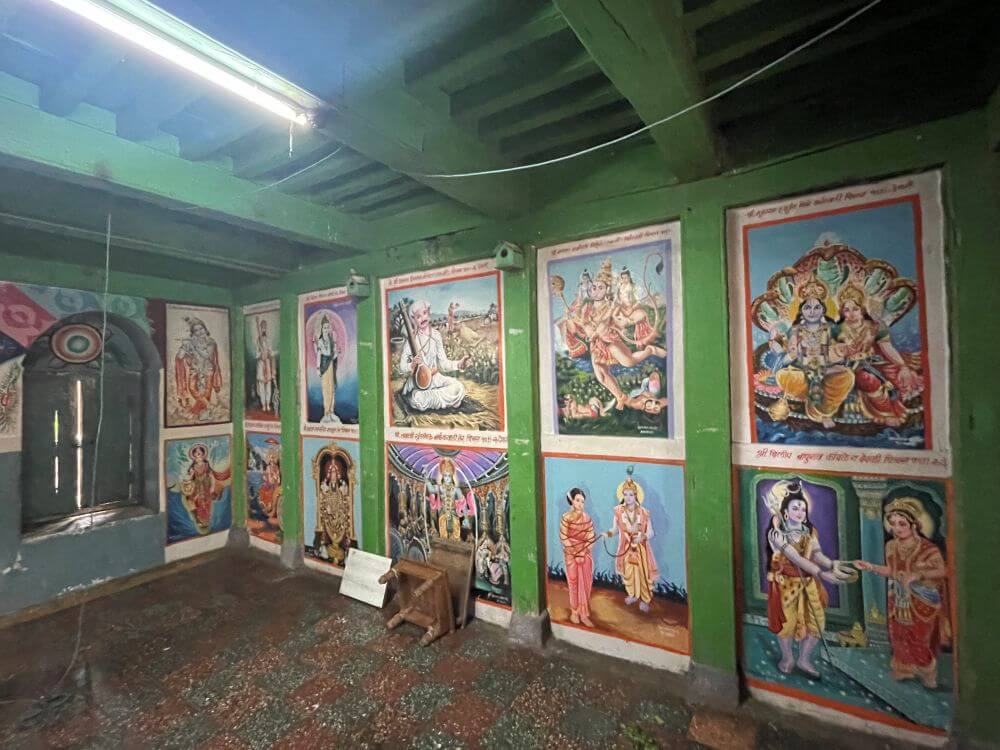
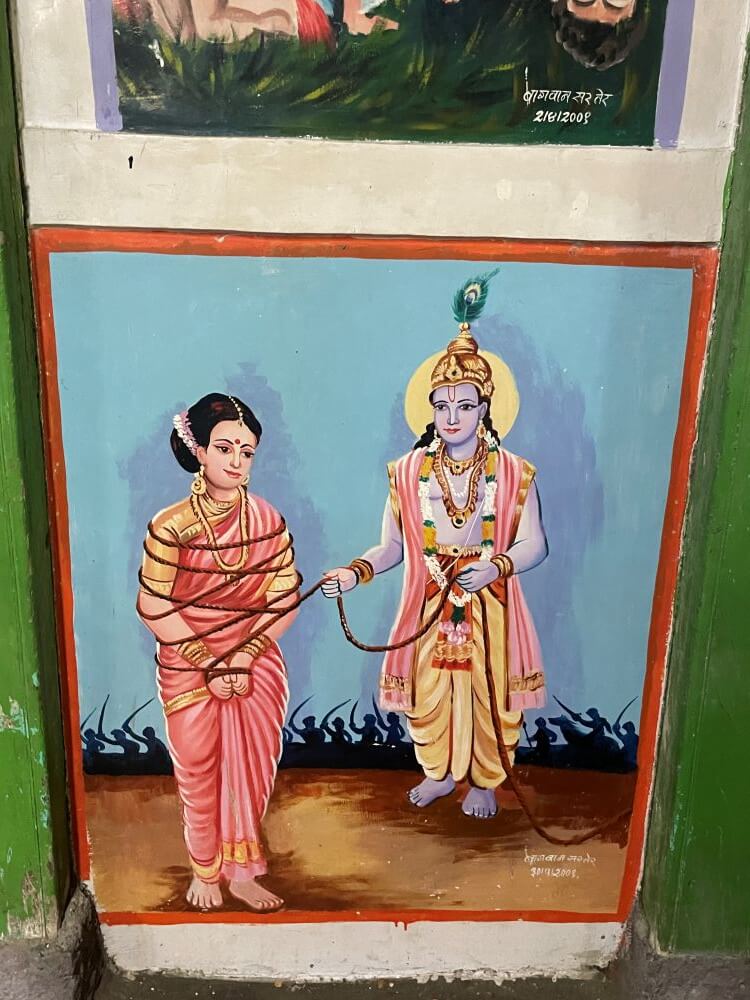
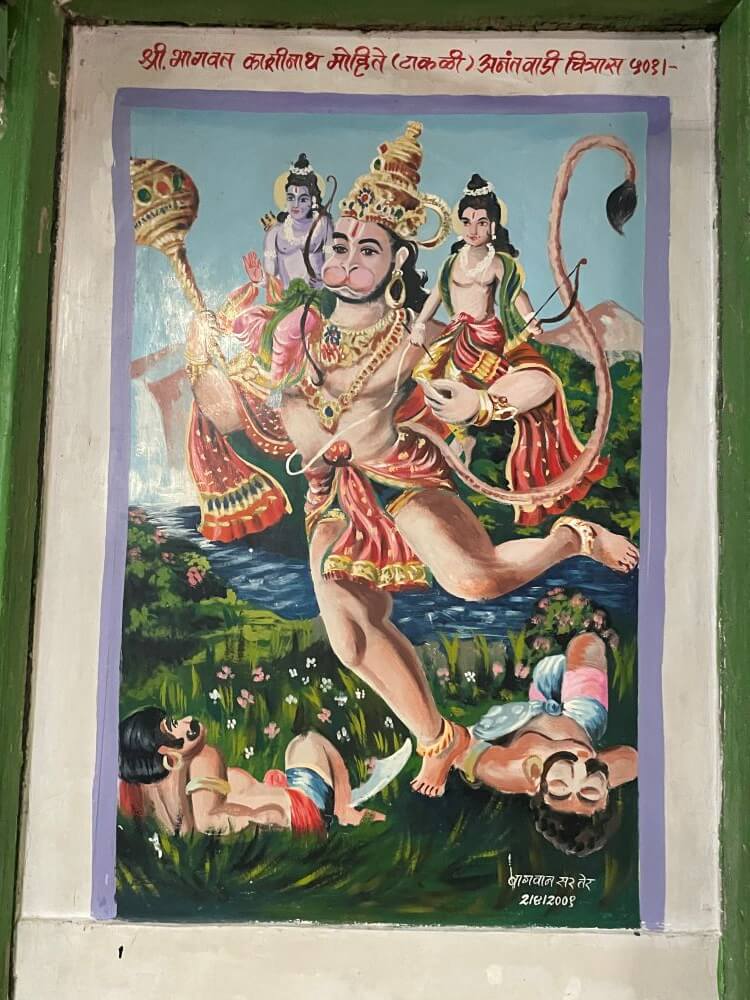
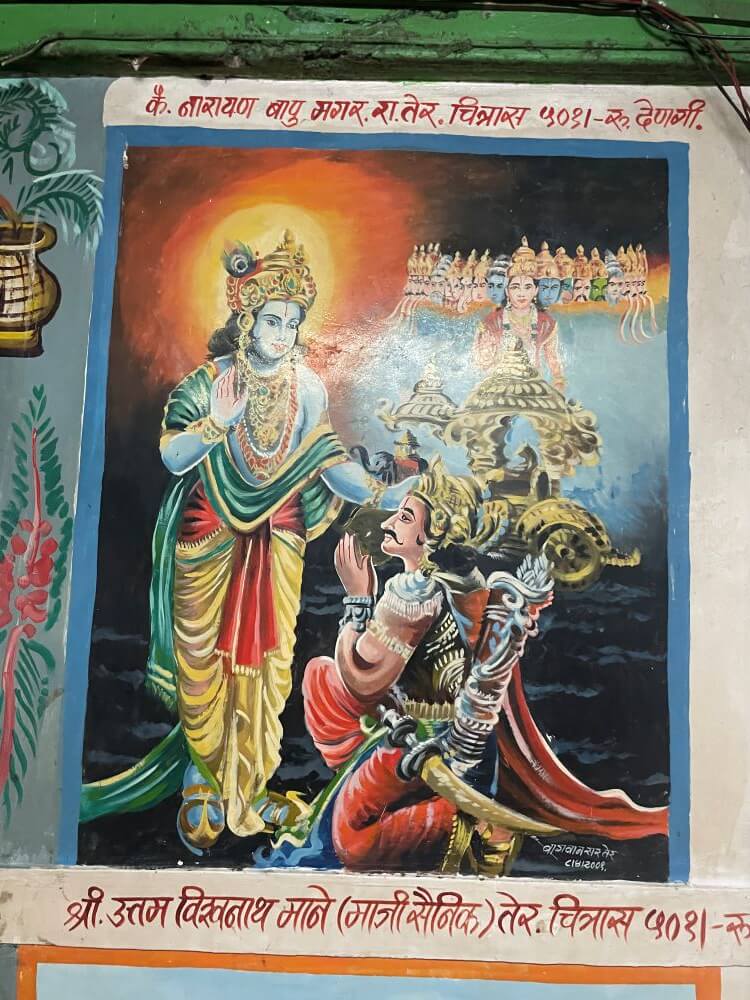
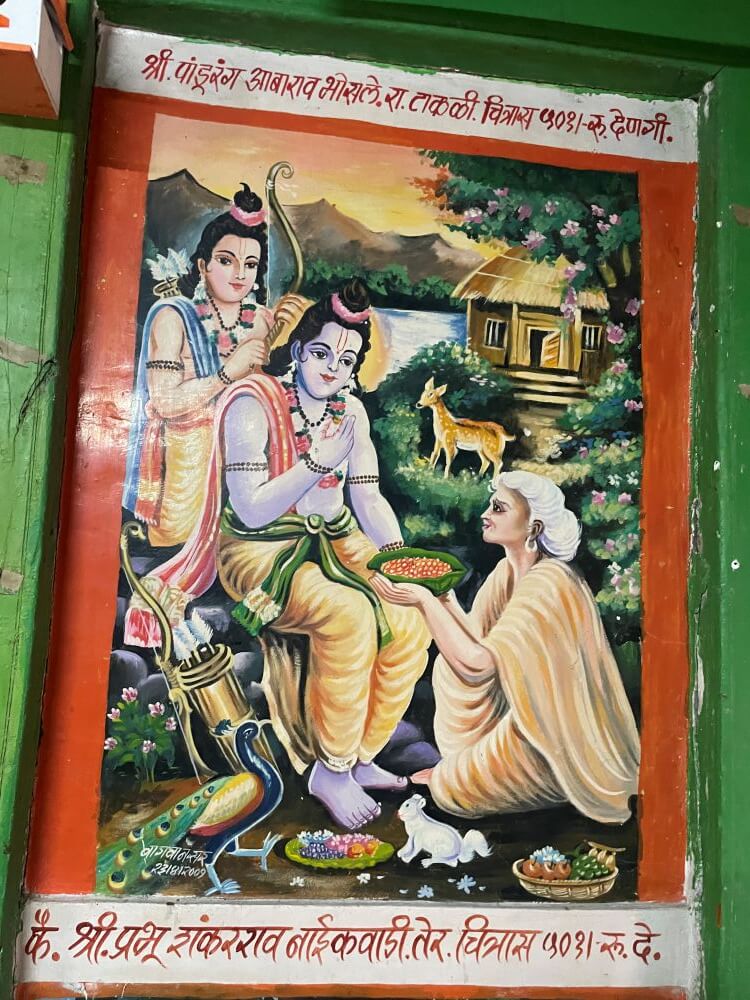
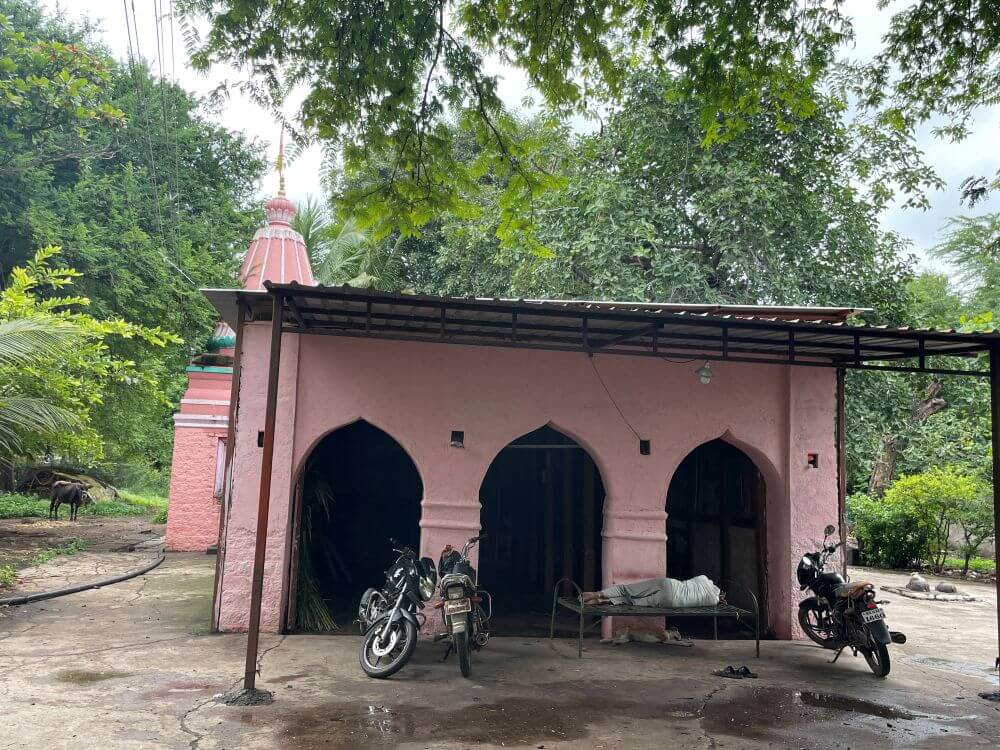
There is a simple welcoming arch in the boundary wall surrounding the temple. In the courtyard, there are seats for devotees and many trees. In the courtyard, there is a circular deep well built using baked bricks. It is said that the water in this well never dries up. There are Nandi sculptures in front of the temple. The temple consists of a Sabhamandap (assembly hall), Antaral (vestibule), and Garbhagriha (sanctum sanctorum). The enclosed Sabhamandap has entrances on the east and north sides. In the Sabhamandap, there are ornate wooden pillars standing on stone bases, all of which are intricately carved. Paintings of various deities and saints are drawn on the walls of the Sabhamandap. Half of the floor in the Sabhamandap is elevated, where various belongings of Jangaleshwar Maharaj are kept.
Further ahead is the entrance to the Antaral. On both sides of the ornate entrance, paintings of gatekeepers (Dwarpalas) are depicted, topped with lotus motifs. On the door frames, there are lotus motifs at the bottom, and above them are leaf vines, floral vines, and pillar carvings. There is an image of Lord Ganesha on the lintel and an image of the Sun on the arch above the entrance. The Antaral has four rows of six ornate pillars each. In the Antaral, the floor between the middle pillars is sunken, and on both sides, there are platforms about two feet high. All pillars stand on stone bases on these platforms. Images of various deities and saints are also drawn on the walls here. In the Antaral, above the entrance to the Garbhagriha, is an image of Jangaleshwar Maharaj.
Further ahead is the narrow and low-height entrance to the Garbhagriha. On the right side of the entrance, there is a painting of Shri Ram, and on the left, one of Shri Krishna. The Garbhagriha houses the Samadhi of Jangaleshwar Maharaj, and in front of the Samadhi are his Paduka (footwear) and a Shiva Linga. Outside the Garbhagriha, there is a chamber. In this chamber, the Sadguru’s seat (Gadi), the Maharaj’s brass mask, and items of daily use are kept. There is an image of the Maharaj on the seat. Above the entrance of this chamber, near the Shikhara (spire), is an idol of Maruti (Hanuman). The roof of the Garbhagriha has a tall, tapering circular Shikhara. At the base of the Shikhara, there is a ring of lotus petal carvings, and above it are vertical ridge carvings. At the top of the Shikhara is the Amalaka, followed by the Kalash and a flag.
Vaishakh Shuddha Chaturthi is celebrated here as an annual festival on the death anniversary of Jangaleshwar Maharaj. Special festivals are also celebrated in the temple on Dattatreya Jayanti and Guru Purnima. During all festivals, programs such as Bhajans, Kirtans, and scripture recitations are organized in the temple. On these occasions, thousands of devotees come to seek the blessings of Jangaleshwar Maharaj. A large number of devotees also visit for Darshan on Thursdays and Purnima (full moon days).
This sacred temple stands as a testament to deep spiritual devotion, ancient architectural grandeur, and rich local cultural traditions.
The sanctum sanctorum houses the divine idol consecrated according to ancient Vedic traditions, surrounded by serene courtyards and traditional temple architecture.
Navratri, Maha Shivratri, Annual Temple Jatra & Deepotsav
Compare and book flights, secure top-rated local hotels near the temple, hire reliable guides, and rent cars instantly.
Extend your pilgrimage by visiting other highly sacred temples located nearby.


Add ₹999 more to unlock FREE SHIPPING!
Your sacred cart is currently empty.
Shop Photo FramesFill in your delivery details below to place your order.
Add comment