
Add ₹999 more to unlock FREE SHIPPING!
Your sacred cart is currently empty.
Shop Photo FramesIn many temples, the idols of Shankara and Parvati are enshrined together in forms such as Sukhasana, Umasahita, or Uma-Maheshwara. The unique feature of the Shiva-Parvati temple in the village of Vitholi is that, unlike the combined idols in Pandharpur’s Vitthal-Rukmini temple, Shankara and Parvati have separate temples here. It is said that both these temples are at least 800 years old. Based on their Hemadpanti architectural style and the sculptures within, scholars believe these temples date back to the Yadava period. According to local legend, the Mahadeva here is seated separately, having moved away after being angry with his consort.
In Vitholi, there is a cluster of three temples dedicated to Shiva-Parvati and their son Ganesha. Generally, the Shiva Linga in a Shiva temple faces west. However, here, the Shiva Linga faces east. The legend behind this is associated with the dice game played by Shankara and Parvati. It is said that this game of Chausar (dice board) was being played in Mother Parvati’s chamber. Mahadeva was on the verge of winning, but his dice fell in such a way that the entire course of the game changed. He ended up losing a game he was winning to Parvati. Parvati was delighted by her victory. As Mahadeva is quick-tempered, he could not accept this defeat. In a fit of anger, he left Mother Parvati’s chamber and sat at his current location, facing east. This is why the Shiva Linga in the Vitholi temple faces east.
The exact history of when and by whom these temples were established is unavailable. In ancient times, Washim was famous as Vatsagulma. It is mentioned in texts such as the Mahabharata, Vatsyayana’s Kamasutra, and the Padma Purana. Vatsagulma became Vacchagumma in Prakrit, and from that, it came to be called Washim during Muslim rule. The Vakataka dynasty of the Vatsagulma branch ruled here from 330 to 550 CE. Washim was the capital of the Vakatakas. Following this, the Rashtrakutas ruled for some years, and the Yadava rule was established between 1210 and 1218 CE. Based on the structure and sculpture of the Shiva-Parvati temples in Vitholi, scholars estimate that this temple was built in the thirteenth or fourteenth century CE.
This temple complex stands in a spacious area near Vitholi village. The temple premises feature a large entrance gate built in the year 2022. Inside, to the right, is the temple of Parvati; to its left, slightly behind, is the temple of Shankara; and in the middle, towards the back, is a small temple of Ganesha established more recently. The villagers have meticulously preserved both these ancient temples. They have carried out repairs while keeping the original structure intact and have added modern construction in front of them. The front portion of the Shiva temple was similarly extended during the renovation. On both sides of its wide entrance are two semi-circular pillars. On both sides of these, there are sculptures of Dvarapalas (gatekeepers) in the walls. Above the entrance, there is a large picture of Shankara in a frame. From here, one enters the Sabha Mandapa (assembly hall) of the temple.
In the center of the Sabha Mandapa, an idol of Nandi is seated on a high stone pedestal. Images of the twelve Jyotirlingas are placed in the niches of the walls of the Sabha Mandapa. From here, the original temple structure begins. The current original temple consists of an Antarala (vestibule) and a Garbhagriha (sanctum sanctorum). At the entrance of the Antarala, there are two large square pillars. These pillars, as well as the stone beam above them, are devoid of carvings. However, the entrance to the Garbhagriha is adorned with beautiful carvings. The inner and outer door jambs of this three-branched entrance are flat, with a pillar branch in the middle. At the base of the door jambs are Tribhanga sculptures of Ganga, Yamuna, and Dvarapalas. The Mandara (threshold) is shaped squarely. There is a small idol of Ganesha on the Lalatabimba (lintel) of the door frame. In the upper part, there are two notable elephant sculptures. The Garbhagriha is small, and inside, on the floor, is the east-facing Shiva Linga. There is a large Abhishek vessel on the ancient black stone Shiva Linga. The ceiling of the Garbhagriha is square-shaped. In the back wall of the sanctum, there is a carved circular stone vessel.
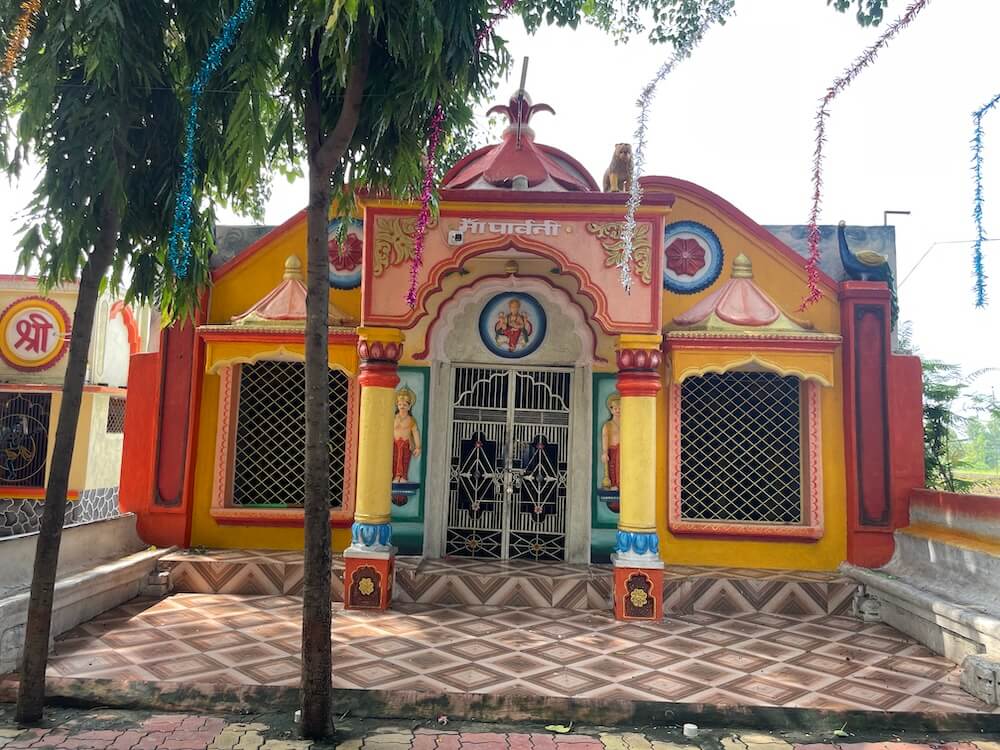
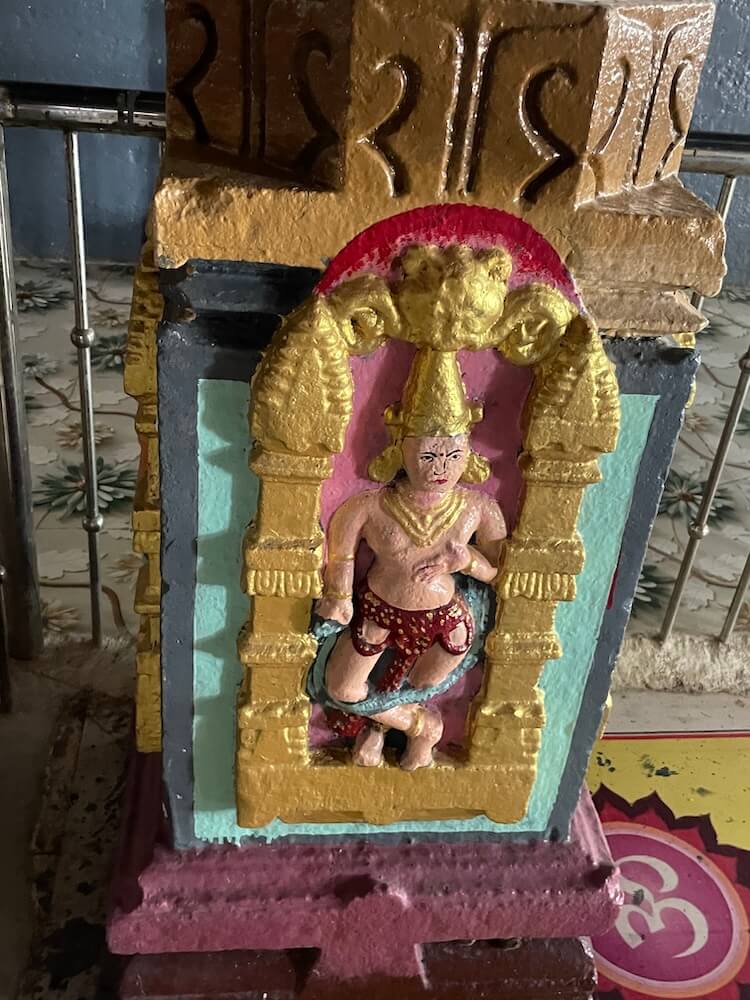
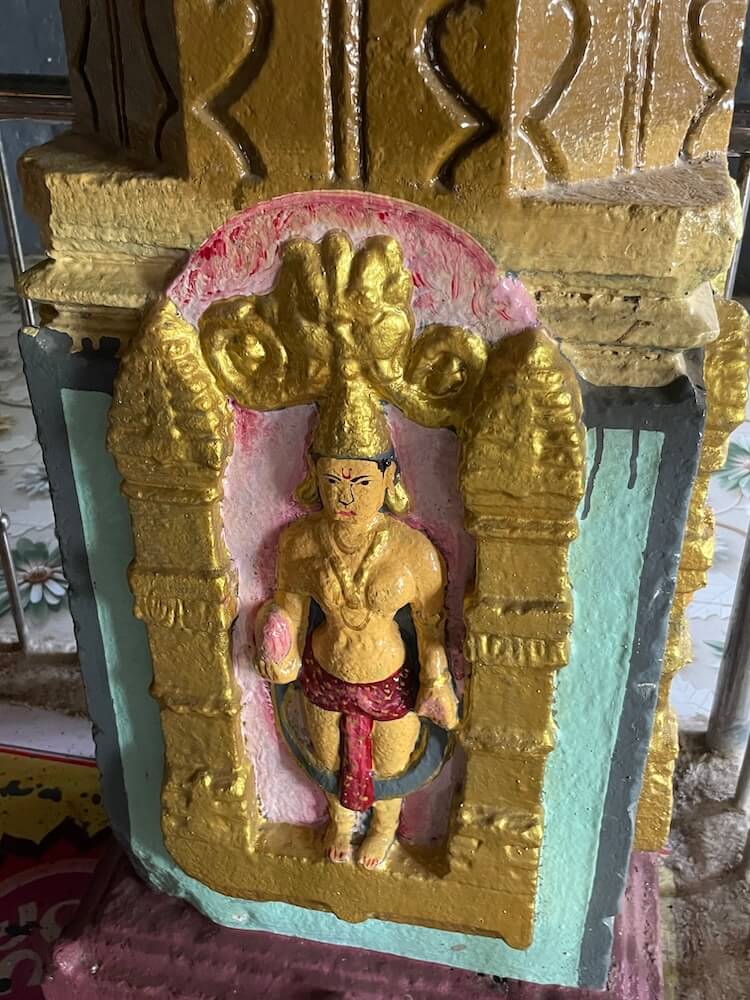
A large entrance arch has been built in front of the Parvati temple, which is located next to the Shiva temple. Two lion idols are seated on the arch. The entrance to the temple features an arched doorway. Above it is a large relief sculpture of Parvati’s son, Ganesha. On the pillars on both sides of the door frame, sculptures of Dvarapalas are carved. There are two large windows on both sides of the entrance. This is all modern construction. Upon entering from here, one sees the Sabha Mandapa of the original ancient temple. The structure of this Sabha Mandapa consists of stone walls on the sides and a square formed by four stone pillars in the middle, leaving some distance from the walls. These pillars are designed in three parts: the base, the shaft, and the capital. The bases are square. On them, sculptures of divine attendants are carved, and in one place, there is a sculpture of Ganesha. The attire of these sculptures is noteworthy. Their upper bodies are bare, while they wear a lower garment. It is an ‘Ardhoruka’, meaning a short dhoti. This was a popular style of attire during the Satavahana period. In this, the long pleats of the Ardhoruka are left in front. This is called the Hastishundaka (elephant trunk) style.
In the square formed by these four pillars, a large Chausar or dice board is laid out. Two indoor games originated in ancient India. One is Chaturanga, which is chess. There is a Sanskrit text titled ‘Chaturangadipika’ by Acharya Shulpani on this; the other is Chausar, which is a game like today’s ‘Ludo’. Traditionally, Shankara is considered the originator of gambling in India. In one of the caves at Ellora, a sculpture is carved showing Lord Shankara and Parvati playing Chausar. There is a legend that a game of Chausar was played here as well, and this board is placed here in its memory.
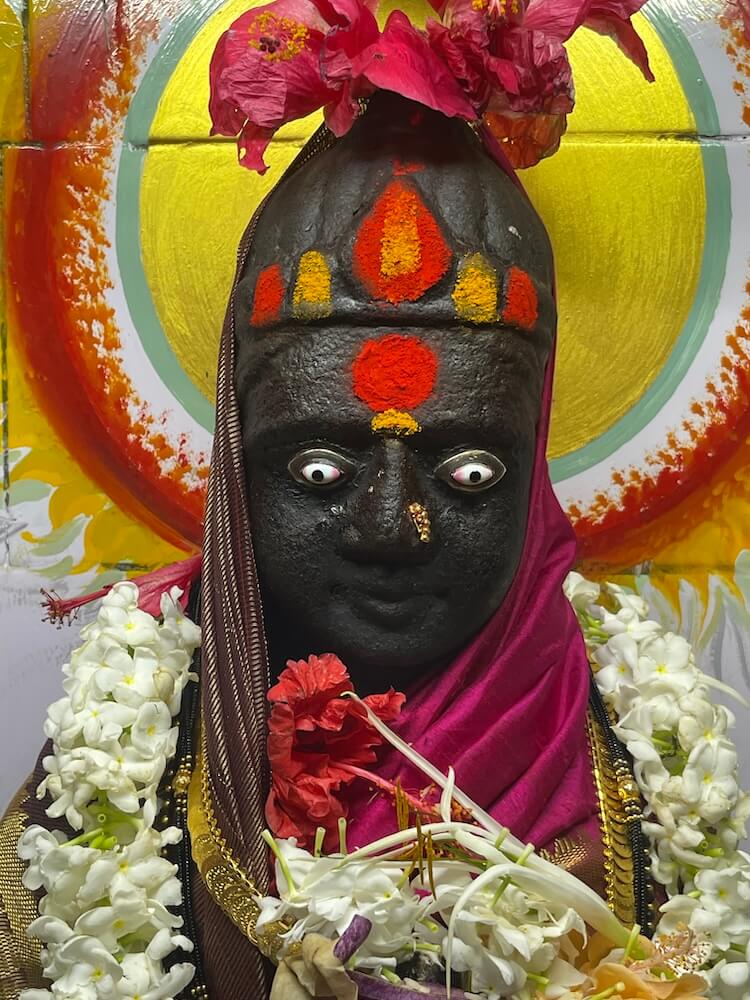
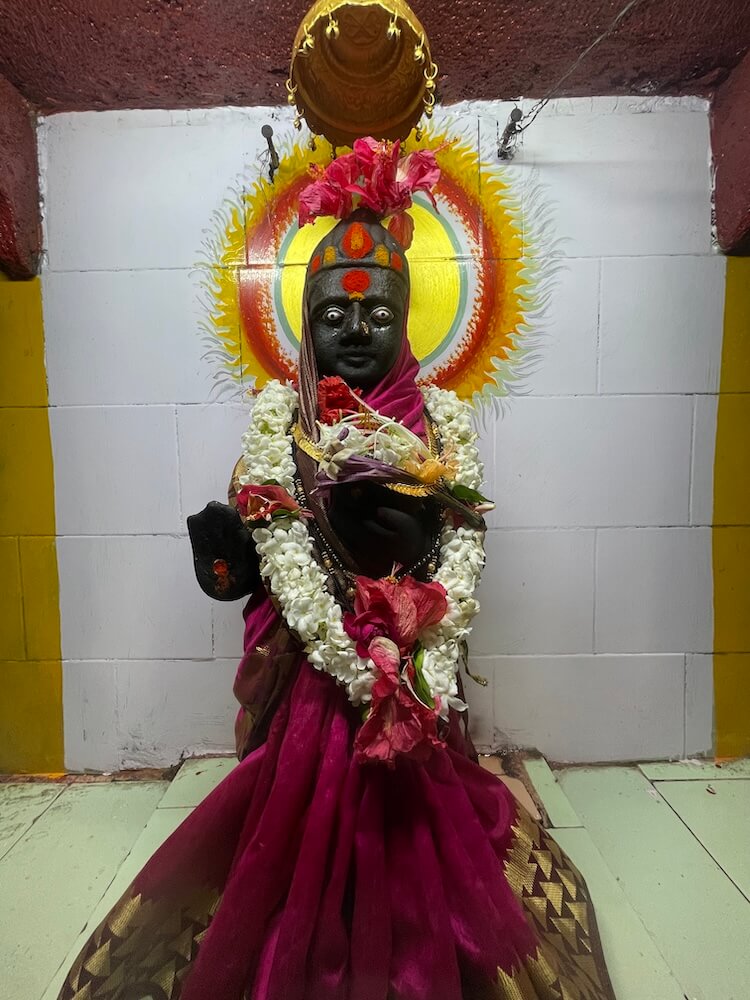
Beyond this point is the antarala (vestibule). There are niches for deities on both sides of the antarala. The entrance to the garbhagriha (sanctum sanctorum) here is an excellent example of intricate carvings. This entrance is of the panchashakhiya (five-fold) style. In its center is a beautifully carved pillar section. In the base section of the pillars, as per the tradition of that era, sculptures of dwarapalas (gatekeepers), dwarasevikas (attendants), Ganga, and Yamuna are carved. Some sculptures are also visible, albeit faintly, in the lower part of these carvings. The lintel of the door is also adorned with carvings. At the lalata-bimba (center of the lintel), Lord Ganapati is depicted, and in the shikhara structure above the lintel, sculptures of animals such as elephants, lions, and swans are visible. One enters the garbhagriha of the temple after crossing the high threshold. Marble tiles have been installed on the walls and floor of the garbhagriha of this Hemadpanti temple. Resting against the back wall of the garbhagriha, in a stone shrine set upon a high pedestal, stands the black stone idol of Goddess Parvati. The idol is adorned with garments, ornaments, and garlands of flowers. The face of the idol radiates a serene expression. The idol has cowrie shells for eyes. She wears a nose ring and a crown on her head. This idol was consecrated on 4 February 1972. During the renovation, the upper part of the shrine housing the pedestal was newly constructed; however, the ancient pedestal of the idol is still visible in the lower section. In the center of that section, a sculpture is carved within a stone niche-like area. This sculpture has suffered significant erosion. However, it is evident that it depicts a person sitting with their legs folded at the knees. The ceiling of the garbhagriha is also crafted with geometric patterns.
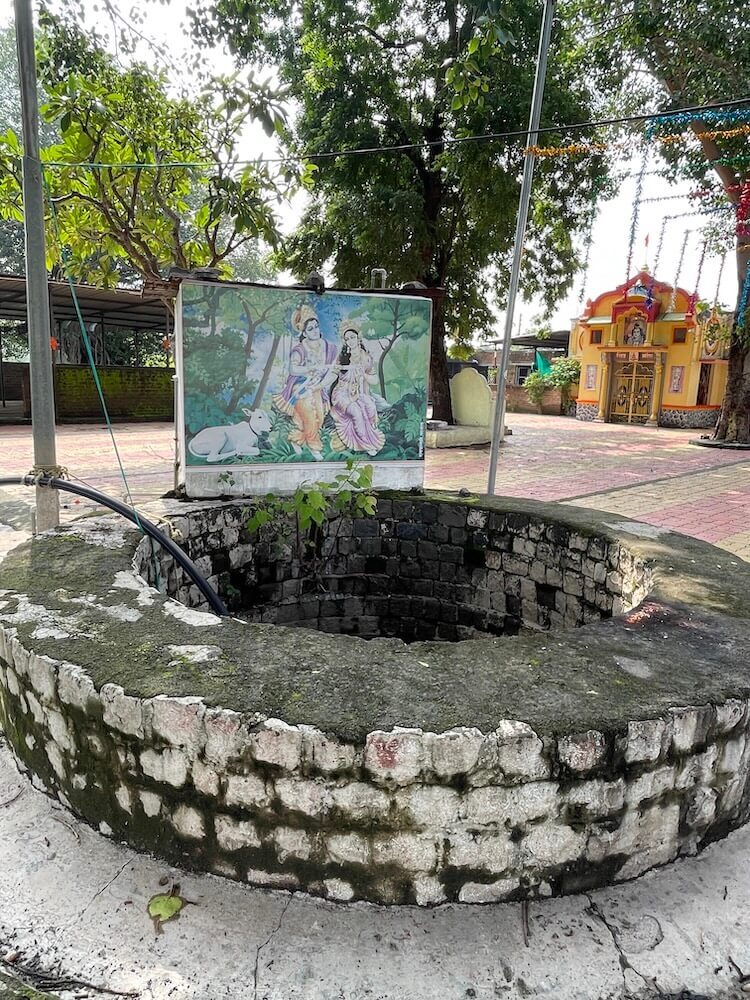
Between the two ancient main temples, the Shiva temple and the Parvati temple, there is a small temple of Lord Ganesha built in recent times. This temple, which has marble flooring, features a small shikhara. Inside, on a high platform, the idol of Lord Ganapati is seated on a lotus throne. Below the idol, on the platform, is the figure of a mouse (Mushaka). There are many old trees in the premises of these temples. In one place, there is a Tulsi Vrindavan and some padukas (footprints) and samadhi sites. There is also an old well here. Under a Peepal tree, there is a small temple of Dnyaneshwar Maharaj. Here, there is an idol of Dnyandev Maharaj sitting in a meditative posture in Padmasana. A short distance in front of this temple is a small shrine containing the idol of Tyagilal alias Birju Maharaj.
In this Shiva-Parvati Sansthan, festivals like Shravani Mondays and Mahashivratri are celebrated with great enthusiasm. Along with various festive days, many devotees come here for darshan every Monday. As this is a well-known ancient temple in the Washim district, it is said that temple scholars also visit here to study the sculptures.
This sacred temple stands as a testament to deep spiritual devotion, ancient architectural grandeur, and rich local cultural traditions.
The sanctum sanctorum houses the divine idol consecrated according to ancient Vedic traditions, surrounded by serene courtyards and traditional temple architecture.
Navratri, Maha Shivratri, Annual Temple Jatra & Deepotsav
Compare and book flights, secure top-rated local hotels near the temple, hire reliable guides, and rent cars instantly.
Extend your pilgrimage by visiting other highly sacred temples located nearby.


Add ₹999 more to unlock FREE SHIPPING!
Your sacred cart is currently empty.
Shop Photo FramesFill in your delivery details below to place your order.
Add comment