
Add ₹999 more to unlock FREE SHIPPING!
Your sacred cart is currently empty.
Shop Photo FramesPandharpur is the capital of Lord Vitthal, the ‘Baparakhumadevivaru’ whom saints have called ‘Chovishavegala’ (the one distinct from the twenty-four incarnations of Vishnu). For twenty-eight yugas, this Vithoba Mauli of the saints has stood there with hands resting on the hips. A strong bond has been forged between the temple there and Gomantak (Goa) due to this Vitthal Temple in Sankhali. According to a legend, the Utsavamurti (processional deity) that was once in the Pandharpur temple is enshrined in this temple. This temple of Vithoba, the family deity of the Rane Sardesai family, is considered the Prati-Pandharpur (the second Pandharpur) of Goa. The unique feature of this temple is that the idols of Vitthal along with Rukmini and Satyabhama are present in the same sanctum sanctorum.
The legend of the founding of this temple is that during the time of the Vijayanagara Empire in Goa, a saintly person named Dulba Rane lived in the Rane Sardesai family. He was a devotee of Vitthal of Pandhari. Every year, he would faithfully perform the Wari to Pandhari. With old age, his body grew weary, and it became difficult for him to go on the pilgrimage. Once, while in Pandhari, he pleaded before the idol of Vitthal and took a final farewell from the Lord. That very night, he had a divine vision. Pandurang told him, ‘So that you do not have to bear the pain of separation from me, I am ready to come with you. Take my Utsavamurti and depart from here quickly at dawn.’ Following the vision, Dulba Rane rushed toward the Vitthal temple in the darkness of the night.
Upon arriving, he found the temple doors wide open. He went inside, bowed before the Utsavamurti of the Lord, and departed with the idols of Vitthal, Rukmini, and Satyabhama. An immense enthusiasm surged through his aged body. In that fervor, he covered a great distance in a short time. Meanwhile, as soon as the Badves realized at dawn that the Utsavamurti had disappeared from the temple, they began a search. Suspecting the saintly man because he was from the north, the Badves sent men toward the north of Pandharpur. However, in the meantime, Dulba Rane met some pilgrims from the Sankhali Mahal of Goa and began his journey south with them. After a few days, they arrived in Sankhali via the Belgaum Chorla Ghat route. This legend is given in the book ‘Devbhumi Gomantak’ (१९८८) by historian Vinayak Narayan Shenvi Dhume. According to the information in this book, after arriving in Sankhali, these idols remained in the forest for some years. Later, in the year १४८८, a small temple of Vitthal was built here at a fort-like site.
Some time after this, the temple was expanded. The legend regarding this is that there was a merchant named Parab in this region. His ship was caught in a storm at sea. At that time, he prayed to Vitthal and vowed that if the ship reached the shore safely, he would build a large temple here. After the ship arrived safely, the merchant met the then-administrators of the Rane family and donated money for the construction of the temple. The idols were installed in this temple on the auspicious occasion of Chaitra Shukla Dashami. This temple also has a close connection with the Shinde royal family of Gwalior.
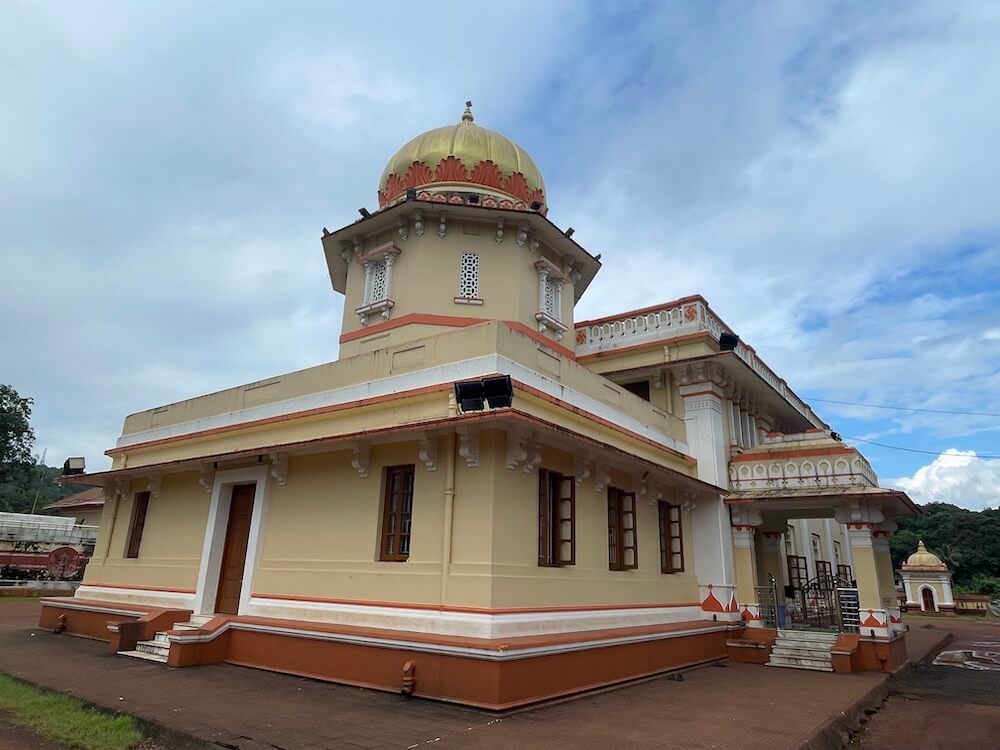
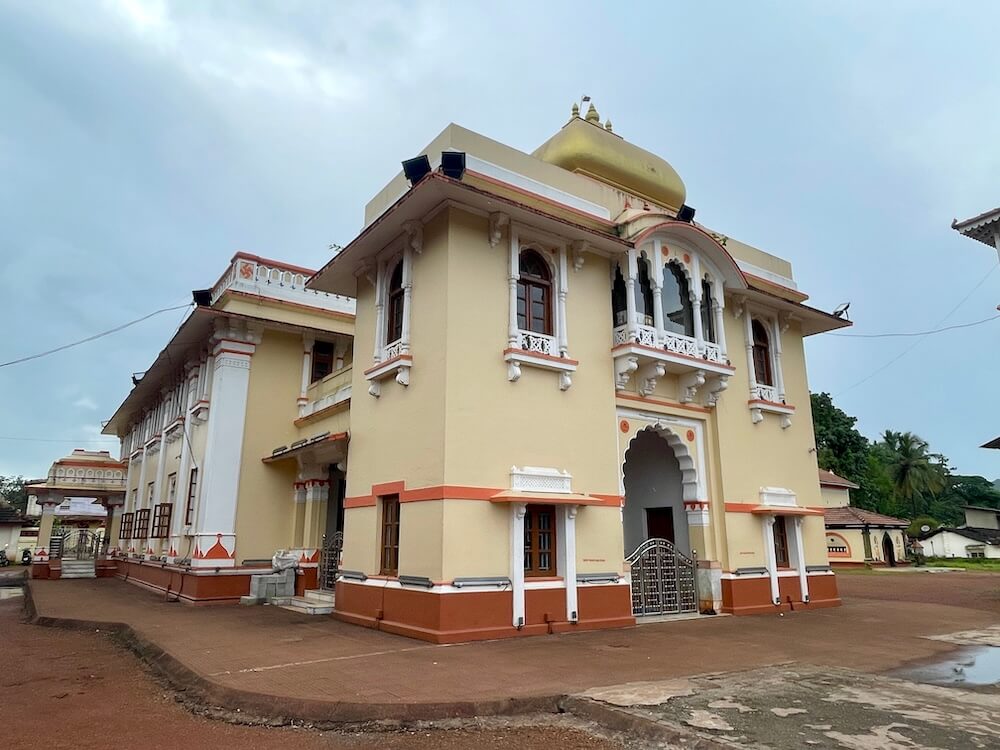
Salubai, the daughter of Satrojirao Vitthalrao Rane of the influential Rane Sardesai family in the Sattari region of Goa, was married to Maharaja Madhavrao Shinde (I) (reign १८७६ to १९२५) of the Gwalior princely state. She was known as Maharani Gajararaje. She had deep faith in the family deity of her paternal home, and out of that devotion, she renovated the Vitthal temple in Sankhali around १९३०-३५. She was the paternal aunt of former Goa Chief Minister Pratapsingh Rane and the mother of the last Maharaja of Gwalior, Jivajirao Shinde. She passed away in Mumbai on १३ January १९४३. In २०२४, Vijaya Devi Rane, the wife of Pratapsingh Rane, published a book titled ‘Makers of Modern Goa: Untold Story of Pratapsingh Rane’. According to the information provided by her, ‘When Gajararaje was the Rajmata of Gwalior, she rebuilt the Vitthal temple in Sankhali. For this, she sent architects and structural experts from Gwalior.’ Because of this, instead of the typical architectural style of Gomantak, this temple is influenced by the North Indian architectural style. This is considered the only temple of this style in Gomantak. At that time, Gajararaje Shinde offered a gold and silver-plated palanquin, Abdagiri (ceremonial umbrella), and Chhatra-Chamars (royal fans) for the Pandurang here. She also sent cloth embroidered with gold threads bearing the royal emblem of the Shinde dynasty. Even today, this cloth is placed in Vitthal’s palanquin during festival periods.
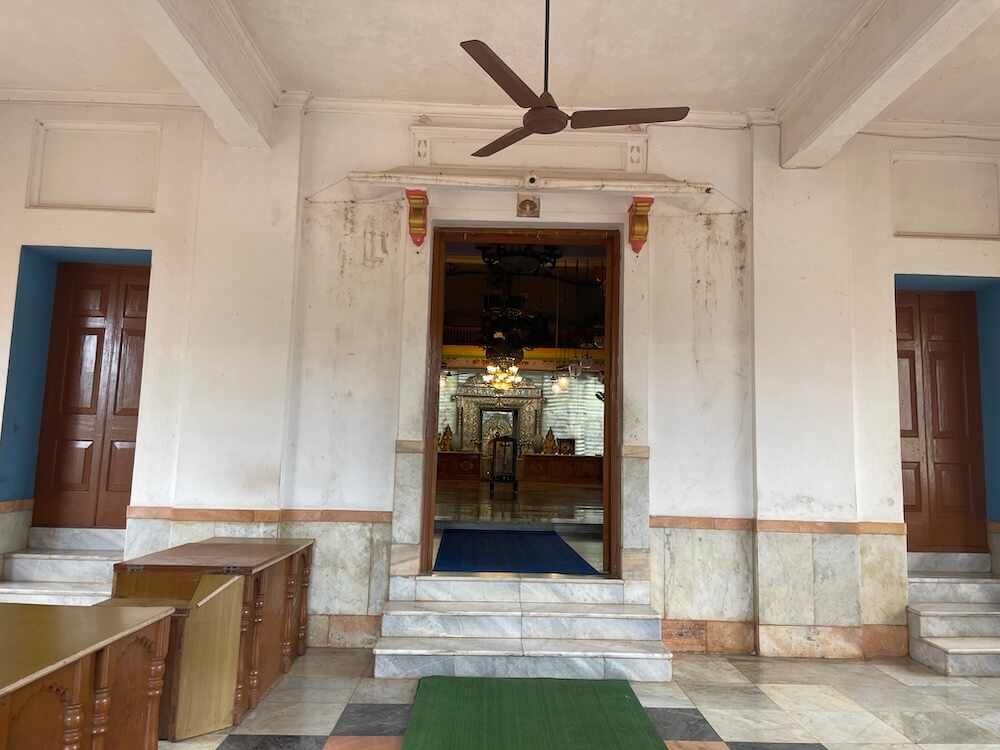
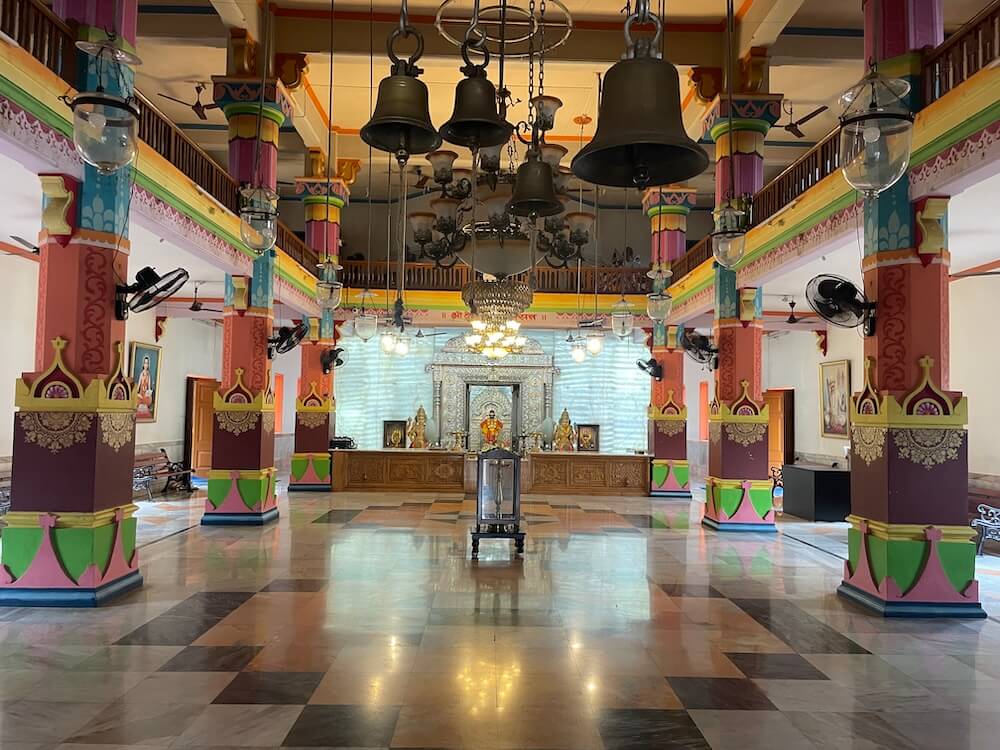
The temple stands in a spacious courtyard on a high hill-like site near the main road leading to Sankhali village. The structure of the temple consists of a Naubatkhana (drum house), Ardhamandapa, Mahamandapa, and Garbhagriha (sanctum sanctorum). There is a large Tulsi Vrindavan at some distance in front of the temple. Similarly, there are small shrines of Garuda, Hanuman, and Mahadeva here. One enters the temple complex through an arched gateway that has a two-storied Naubatkhana. Above this gateway is an eye-catching balcony with three windows and a semi-circular roof. There are three kalashas on the horizontal elliptical structure on the roof. The Mahamandapa of the temple is also two-storied. In the Mahamandapa, there are square pillars at the bottom and octagonal pillars at the top. The balcony supported by these pillars, decorated with colorful carvings, has wooden railings. Large brass bells, glass lanterns, and crystal chandeliers are hung from the ceiling. In the center of the Mahamandapa, there is a glass-enclosed Samai (lamp stand), which is a characteristic of Goan temples.
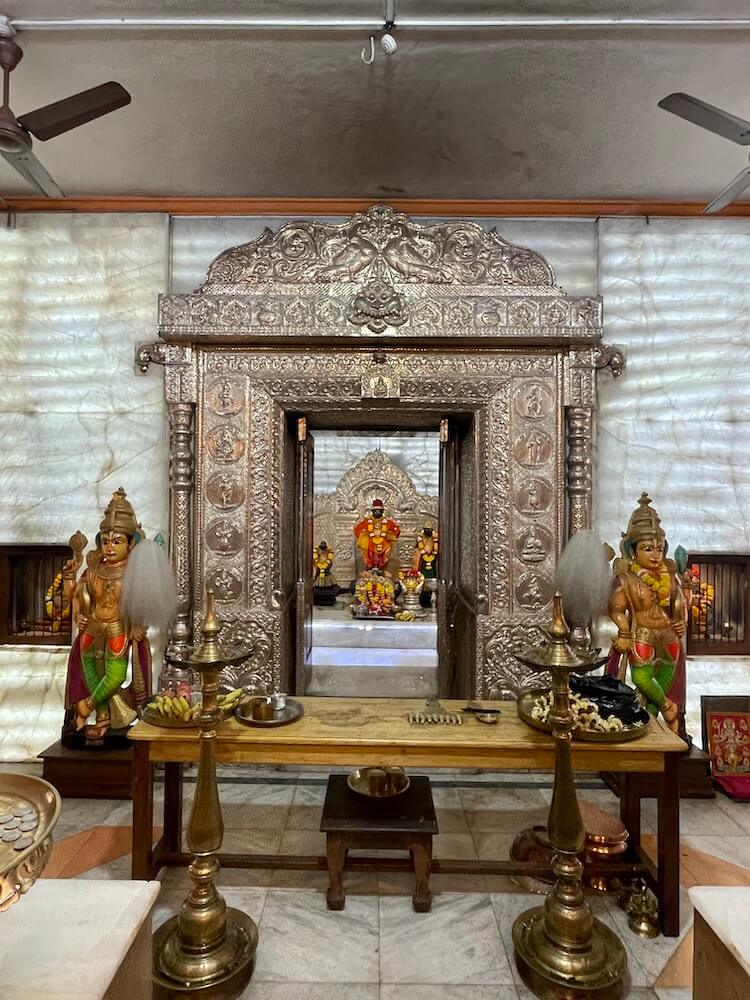
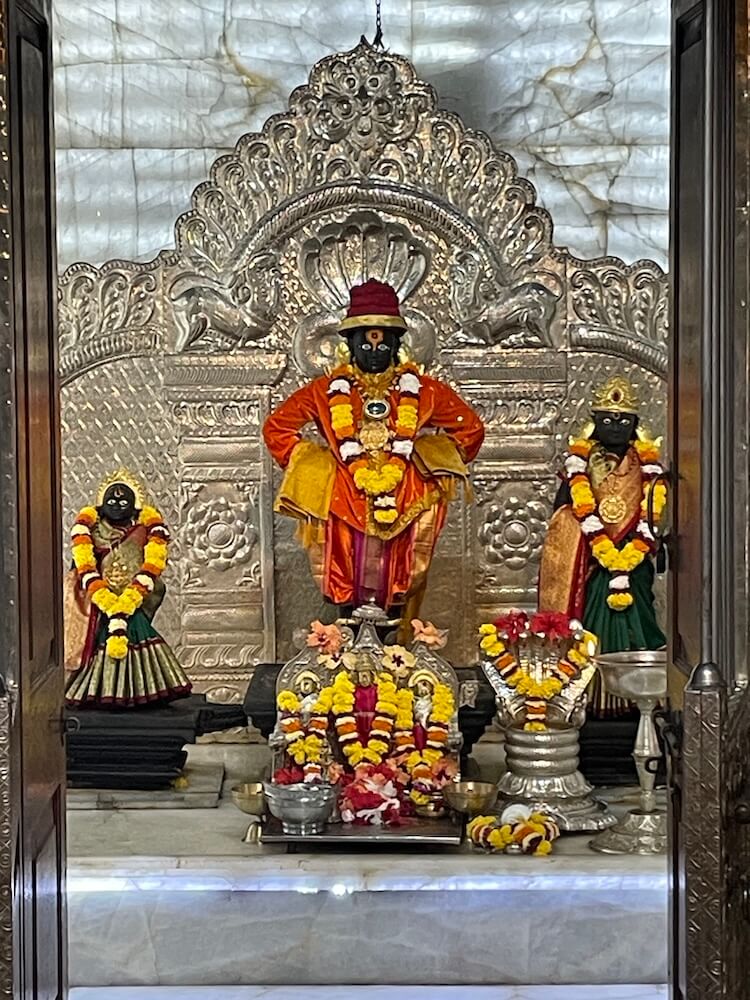
The entrance to the temple’s Garbhagriha is adorned with intricate silver plating. On the door frame, there are relief sculptures of the Dashavatara (ten incarnations of Vishnu) on both sides. An image of Ganesha is at the Lalatabimba (lintel center), and above it, in the upper section, a Kirtimukha and various auspicious symbols are carved. On both sides of the entrance are idols of Vaishnava Dwarapalas (gatekeepers). In the niches on the front wall of the Garbhagriha, idols of Ganesha and Lakshmi are enshrined. In the Garbhagriha, on a high marble pedestal, the idol of Vitthal, carved in black stone, is enshrined in the center on a base resembling a Shalunka. The square Shalunka here is not related to a Shiva Linga but is designed as an arrangement for the drainage of Abhisheka water. This idol of Vitthal stands with both hands on the hips in the Samapada posture. Like the Vitthal idols in Pandharpur and Madha, Maharashtra, the head is adorned with a headpiece shaped like an inverted cup. The upper part of the idol tapers upwards on all four sides. This crown structure resembles the head of the four-armed Vitthal idol at Taklibhan in Maharashtra. Stone idols of Rahi and Rakhumai are enshrined on both sides of this Vitthal idol. All these idols are adorned with silver eyes and decorated with garments, ornaments, and flower garlands. On different occasions, Vitthal is adorned with various headpieces, sometimes a turban and at other times a cap resembling that of the Koli community. Behind these idols is a large silver arch (Prabhaval). This arch features images of Vyala, Nagas, and a Kirtimukh. In the front part of the pedestal, there is a silver Utsavmurti (processional idol). Beside it stands a tall Naga-hood and a silver lamp (Samai). The structure of the spire (Shikhara) above the sanctum sanctorum is in the Goan architectural style. This spire consists of an octagonal base topped with a dome and a finial.
A few feet from the entrance of the Vitthal temple, there is a large two-story building where kindergarten classes are held. To the right of the temple is a Hanuman temple. Right behind it is a large chariot house, which contains two large chariots. One of these chariots is three-tiered, with a large wooden idol of Balakrishna enshrined on the third level. The second four-wheeled chariot is attached to three large and elegant wooden horses. In the charioteer’s seat, there is an idol of Lord Shri Krishna.
The administration of this temple is managed by the ‘Shri Dev Vitthal Panchayatan Sansthan’, presided over by former Chief Minister of Goa, Pratapsingh Rane Sardesai. Various festivals such as Gudi Padwa, Ram Navami, Ghatasthapana, Harijagar, Tripuri Purnima, and Gopalakala are celebrated in the temple throughout the year. On the day of Ashadhi Ekadashi, many Dindis (processions) from the surrounding five villages arrive here. Countless Warkaris who are unable to travel to Pandharpur come to this ‘Prati-Pandharpur’ (replica Pandharpur) to seek the blessings of Vithoba. Religious rituals begin here from four o’clock in the morning. The idols were consecrated in this temple on Chaitra Purnima; therefore, that day is celebrated here with great enthusiasm as the temple foundation day. During this time, a grand fair is held. The premises bustle with Palkhi (palanquin) processions, Bhajans, Kirtans, and Dashavatar plays.
This sacred temple stands as a testament to deep spiritual devotion, ancient architectural grandeur, and rich local cultural traditions.
The sanctum sanctorum houses the divine idol consecrated according to ancient Vedic traditions, surrounded by serene courtyards and traditional temple architecture.
Navratri, Maha Shivratri, Annual Temple Jatra & Deepotsav
Compare and book flights, secure top-rated local hotels near the temple, hire reliable guides, and rent cars instantly.
Extend your pilgrimage by visiting other highly sacred temples located nearby.


Add ₹999 more to unlock FREE SHIPPING!
Your sacred cart is currently empty.
Shop Photo FramesFill in your delivery details below to place your order.
Add comment