
Add ₹999 more to unlock FREE SHIPPING!
Your sacred cart is currently empty.
Shop Photo FramesThe Marutiraya Temple in the Mala area of Panaji, the capital of Goa, stands as a symbol of the struggle and the resilient spirit of the Hindu community that suffered under the religious persecution of the Portuguese. Established in the twentieth century, this temple is one of the five major temples in Goa. Built in a style vastly different from traditional Goan temple architecture, this beautiful temple is situated on a high hill. It is the only temple in Panaji that hosts a Jatra (fair). Due to the presence of Marutiraya, the unique style of the temple, and the panoramic view of the eastern part of Panaji from here, it is a place of constant activity for both devotees and tourists alike.
Maruti means the son of Maruta (the Wind God). Worshipped under various names such as Hanumanta, Hanuman, Bajrangbali, Anjaneya, Pawanputra, Mahabali, and Mahavir, this originally folk deity is considered an ideal of strength, devotion, and wisdom. According to religious belief, Maruti is one of the seven Chiranjivis (immortals). In the ‘Hanuman Chalisa’ hymn composed by Saint Tulsidas in the sixteenth century, Hanuman is described with words like ‘Gyan Gunasagar’ (Ocean of Wisdom and Virtues), ‘Mahavir’ (Great Warrior), and ‘Tej Pratap’ (Radiant Glory). He stated that Hanuman is the deity who liberates one from all troubles. In the seventeenth century, Samarth Ramdas Swami brought about a religious revolution in society by making Lord Shriram and Hanuman his objects of worship. In his ‘Hanuman Stotra’, Ramdas Swami described him in the forms of ‘Bhimrupi’ and ‘Mahabali’. Physical training (Balopasana) was an important part of the worship in his Samarth Sampradaya.
During the rule of the bigoted Portuguese, many struggled greatly to preserve their religion. Eventually, the religious policy of the Portuguese became more moderate. In the period that followed, new temples began to be established here. The Marutiraya temple in Panaji is one of them. The history of this temple is that in the first half of the twentieth century, some community leaders in Panaji felt there should be a temple of Maruti here. Nanu Tarkar (Bablo) Pednekar and Jano Rama Redkar were among the prominent gentlemen of Panaji. One day, they held a meeting at the small Vitthal-Rukhumai temple in the Mala area and decided to build a Maruti temple there. For this temple, Jano Redkar obtained the land on the hill in Mala on a lease from the Portuguese. He also expressed his readiness to bear the major expenses for the temple. The construction of this temple began in the year 1931. On 25 January 1934, on the auspicious occasion of Magh Shuddha Saptami, the idol of Marutiraya was consecrated in this temple. This date is recorded in the inscription on the entrance gate of the temple premises. It is said that the idol of Marutiraya here was brought from Rajasthan by the then-prominent Panaji merchant, Ramdas Gokuldas Shete Gujar. The temple was renovated in the 90s.
This Marutiraya temple is situated in the eastern part of Altinho Hill in Panaji. In Portuguese, ‘Alto’ means high. From this, the hill got the name Altinho. This is considered a very scenic and elite area of Panaji. The official residence of the Chief Minister of Goa is located in this hill area. Apart from this, there are buildings such as the Portuguese Consulate, All India Radio station, and the headquarters of the Public Works Department. The area where the Marutiraya temple is located is called Marutigad.
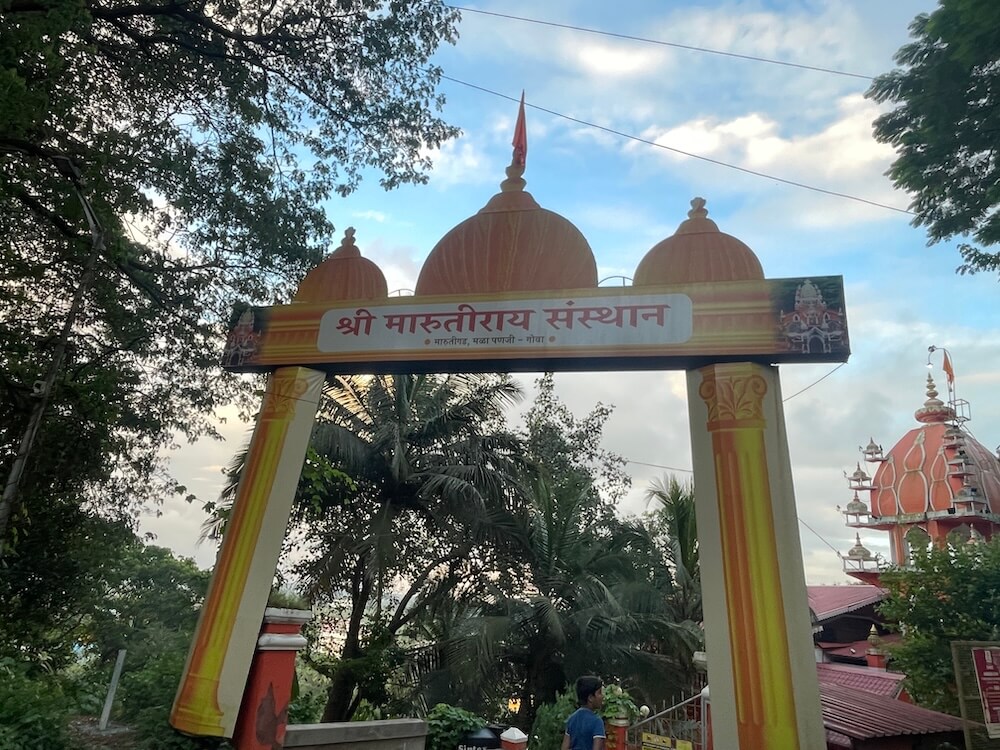
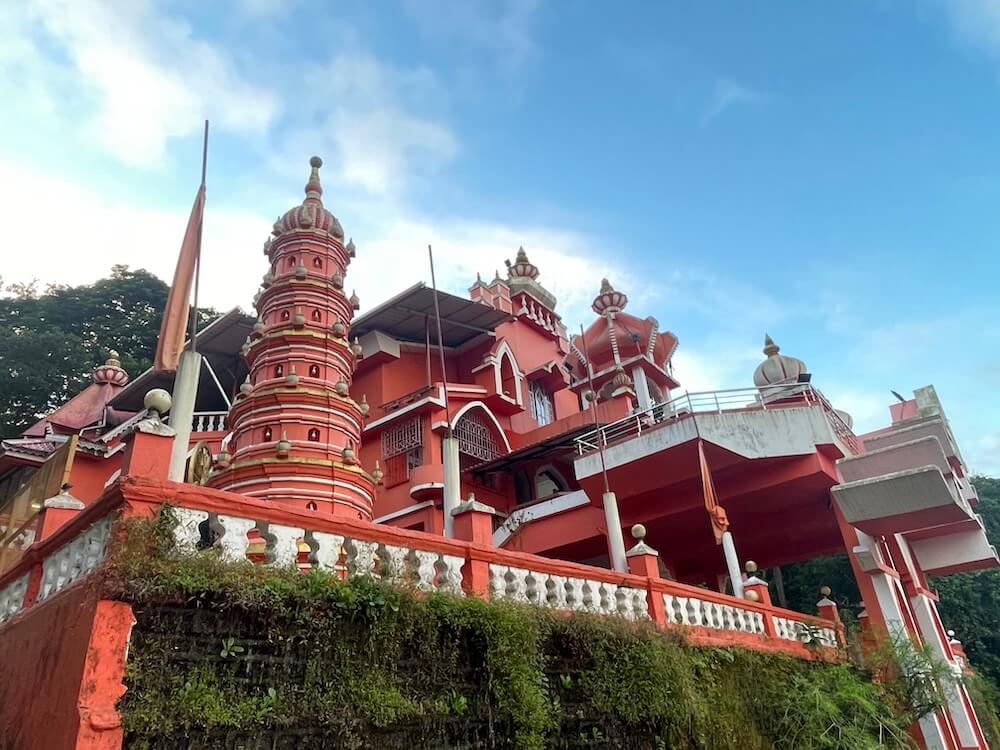
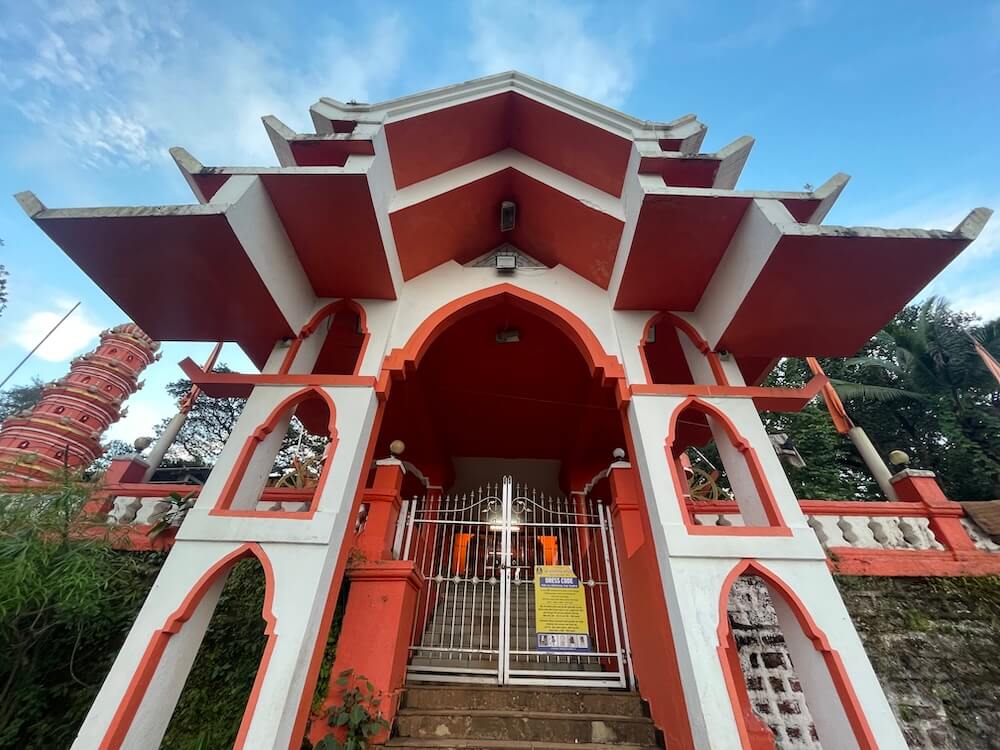
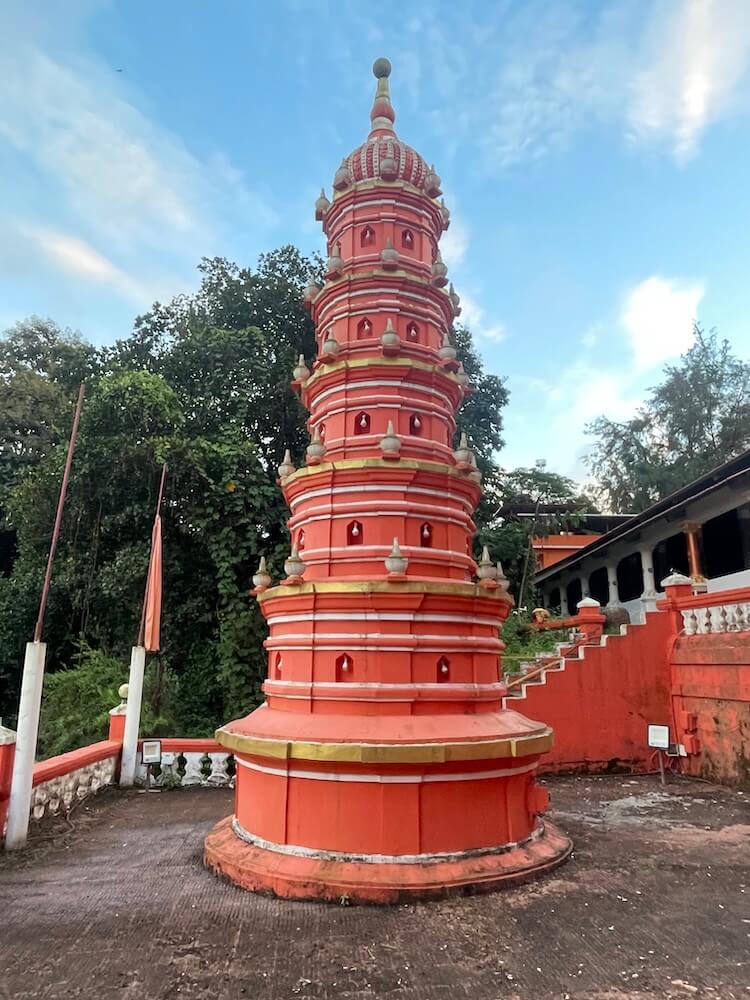
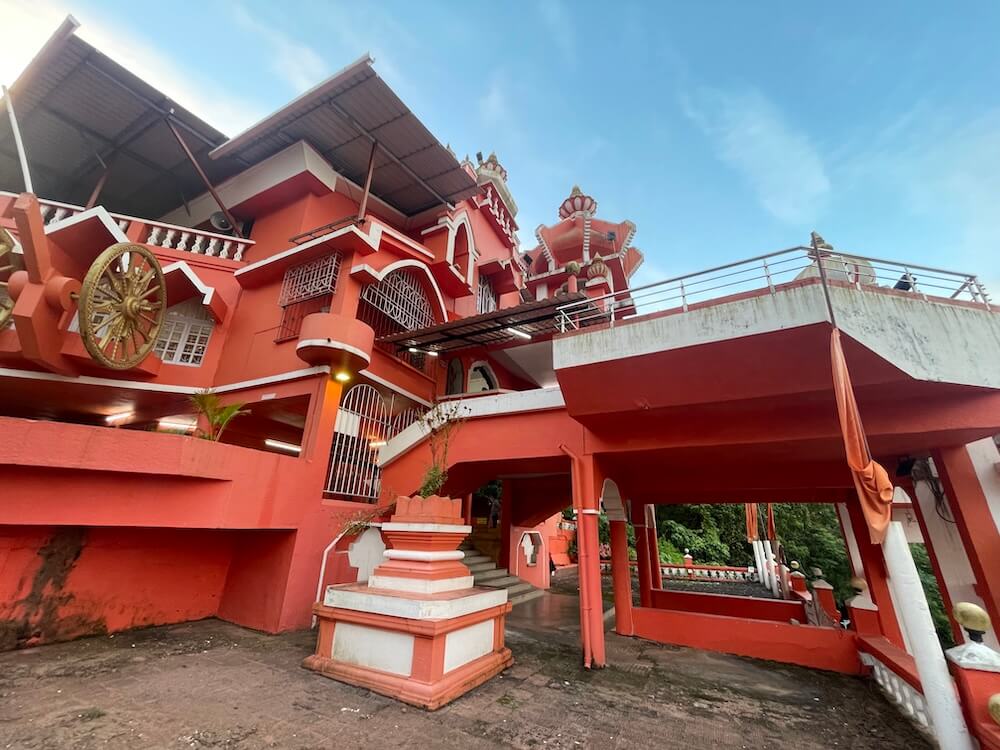
Below Marutigad, along the road, there is an ornate entrance arch painted in orange. There is a path with many steps to reach the temple premises from here. Upon reaching the top, one sees the grand and equally unique structure of the orange-colored Maruti temple. This temple is not built on a single flat surface but is constructed in three levels. After climbing the steps from below the hill, there is an open space the size of a small road, with railings built on one side. From there, more steps are built to enter the temple. Here is the main entrance to the temple premises. The design of this entrance consists of square cement pillars, an arch in the center, and a roof sloping on both sides. After climbing a few more steps from here, there is open space on both sides. To the left is the Tulsi Vrindavan and the temple’s grand six-tiered lamp tower (Deepastambha). There is a large Kalash on top of it. Large Kalash-shaped lamps are placed on the lamp-arms of these pillars, while small electric bulbs are fitted in the small niches on the pillars. After climbing a few more steps from here, one enters the second level of the temple courtyard. Here, in a hall, a stone idol of Hanuman holding a mace and in the Abhaya Mudra (gesture of fearlessness) is seated on a high pedestal. Hanuman is considered the deity of desires. It is the belief of the devotees that performing Tailabhishek (anointing with oil) to Hanuman removes the afflictions of Shani (Saturn). Tailabhishek is performed on the stone idol of Hanuman in this temple. There are steps on both sides of this Hanuman shrine to go to the upper level. Marble tiles are installed everywhere in this spacious area. Two canopies (Meghadambaris) are erected on the side here. On this level is the main sanctum of Marutiraya. A cement shed has been erected in front of this sanctum. From here, one enters the Mahamandapa of the temple.
The Mahamandapa has a marble entrance with an arched doorway. There are large glass windows on both sides of it. The Mahamandapa is very spacious and two-storied. Here, a balcony-like structure is built on circular pillars. In its wooden niches are idols of various deities. In the front part of this hall, in front of the sanctum sanctorum, a semi-open pavilion with wooden pillars has been erected. In the wooden niche on the ceiling of this beautifully carved pavilion, there are wooden idols of Shriram-Lakshman-Sita and Hanuman in a bowing posture in the center. To the left of these idols is an idol of Hanuman absorbed in Bhajan, and to the right is an idol of Panchmukhi Hanuman. In the niche to the left of this shrine is a colored idol of Hanuman, and to the right is one of Ganesha.
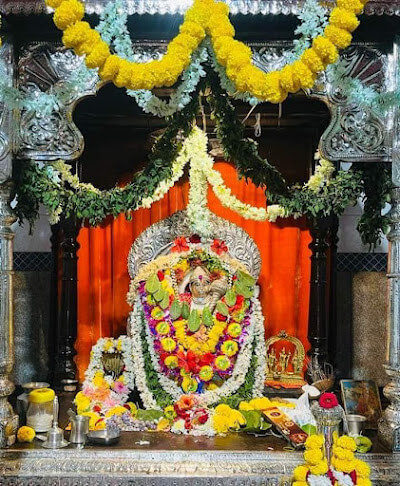
The sanctum sanctorum’s viewing wall and the surrounding pillars are adorned with intricate gold-leaf work. On both sides of the sanctum’s entrance, there are idols of Vaishnava Dwarapalas (gatekeepers) placed in niches. Inside, the golden idol of Lord Maruti is enshrined on a silver throne within a silver shrine, set upon a high silver dais. This idol was crafted at a total cost of 12,343,509 rupees. The idol features a golden mask, a mace (gada), and a hand in the gesture of granting boons (varadahasta), for which a total of 2,758,523 rupees was spent. Additionally, 88,350 rupees worth of silver was used for the shrine and the throne. This expenditure was met through donations given by devotees. Above the sanctum sanctorum, the temple features a unique three-tiered shikhara (spire). Its lower two sections are hexagonal, and the top tier tapers upwards on all four sides. It is crowned with an amalaka and a kalasha. Small pavilions (meghadambaris) are installed on all four corners of this shikhara. This is an extremely rare type of spire.
Devotees can have darshan at this temple from Sunday to Friday between 7:00 AM and 12:30 PM and from 4:00 PM to 8:00 PM, and every Saturday from 6:30 AM to 9:30 PM. There is a large crowd of devotees here every Saturday. Since 1935, festivals such as Ram Navami, Hanuman Jayanti, Vijayadashami, Ganesh Chaturthi, and Shravani Saturdays have been celebrated with great enthusiasm. On the day of Hanuman Jayanti, Mahaprasad is distributed to the devotees here. Another unique feature of this temple is that it is the only temple in Panaji that hosts a Jatrotsav (annual fair). This four-day festival begins on Magh Shuddha Dashami. On this evening, a procession of Lord Maruti is taken out in a palanquin. The procession starts from the Pandurang temple in Mala, where the idea of establishing the Maruti temple was first conceived. For the next three days, the palanquin is carried through the temple premises every night. On all three days, along with various religious rituals, plays are performed at night.
This sacred temple stands as a testament to deep spiritual devotion, ancient architectural grandeur, and rich local cultural traditions.
The sanctum sanctorum houses the divine idol consecrated according to ancient Vedic traditions, surrounded by serene courtyards and traditional temple architecture.
Navratri, Maha Shivratri, Annual Temple Jatra & Deepotsav
Compare and book flights, secure top-rated local hotels near the temple, hire reliable guides, and rent cars instantly.
Extend your pilgrimage by visiting other highly sacred temples located nearby.


Add ₹999 more to unlock FREE SHIPPING!
Your sacred cart is currently empty.
Shop Photo FramesFill in your delivery details below to place your order.
Add comment