
Add ₹999 more to unlock FREE SHIPPING!
Your sacred cart is currently empty.
Shop Photo FramesIn the nature-rich village of Andurle in Kudal Taluka, there is a magnificent temple of Chamundeshwari Devi. Chamundeshwari is believed to be a form of Adishakti Parvati. This Goddess is the embodiment of Shakti. According to mythological legends, she is the deity who fought against tyrannical rule to liberate people from slavery. Chamundeshwari of Andurle is the family deity (Kuldevata) of the Patil, Patkar, and Dalvi families here. Devotees believe that this Goddess rushes to answer the calls of her worshippers. The seat of the Goddess here is considered strict and awakened (Jagrut). Villagers state that it is approximately 600 years old.
According to the ‘Devikosha’, Chamunda Devi is a deity with a fierce face, who bears a sword, a noose, a strange khatvanga (staff), and a garland of human skulls, wears an elephant hide, has blood-red eyes, and fills the ten directions with the sound of a conch shell. A popular story states that she came to be known as Chamunda because she destroyed the demons Chanda and Munda. In the ‘Bharatiya Sanskriti Kosha’, information about this Goddess states that in ancient times, Mahishasura fought a continuous war with Indra for 100 years and usurped his throne. Upon learning this, Brahma, Vishnu, and Mahesh created a radiant deity from the brilliance of their faces. All the gods gave her weapons, and the Himalayas gave her a throne. She fought and killed Mahishasura. She is the same Chamunda Devi. This deity is the family deity of the Mysore royal family. She is also addressed as Bherunda Devi. There is a temple of Chamunda Devi on a high hill in Mysore. Here, there is also a magnificent statue of the king Mahishasura, holding a sword in one hand and a serpent hood in the other.
Although the Chamundeshwari in the temple at Andurle is a sword-bearer, she is not in the form of one with a fierce face or a wearer of human skulls. Her form is that of a guardian deity. The history of the temple here is told as follows: the village heads (Gramadhipati) of the nearby village of Pat were the Patil and Patkar families. About six hundred years ago, the people of the Patil and Patkar families residing here and in the surrounding five villages consecrated the deity Chamundeshwari at this site. Over the course of time, the temple fell into a dilapidated state. In the year ۱۹۲۷, Krishnaji Shivaji Patkar and Ramchandra Krishnaji Patkar visited this temple. At that time, they noticed that the idol had developed cracks. They then decided to reconstruct the temple and install a new idol there. Accordingly, everyone came together to build a new temple here. On the auspicious occasion of Magh Shukla Shashthi, on ۱۵ February ۱۹۲۹, the consecration of the Goddess’s idol was performed. Shrimant Rajebahadur Bapusaheb Sardesai, the then King of the Sawantwadi State, was also present at this ceremony. Information regarding this was published in the newspaper named ‘Garjana’ at that time. According to that information, the height of the temple’s sanctum sanctorum was twelve feet and it had a dome on top. The main pillars of the temple’s pavilion were nine feet high and one and a half feet wide, while the twelve outer pillars of the temple were seven and a half feet high and one and a quarter feet wide. Fifty-one years later, in ۱۹۷۸, this temple was renovated.
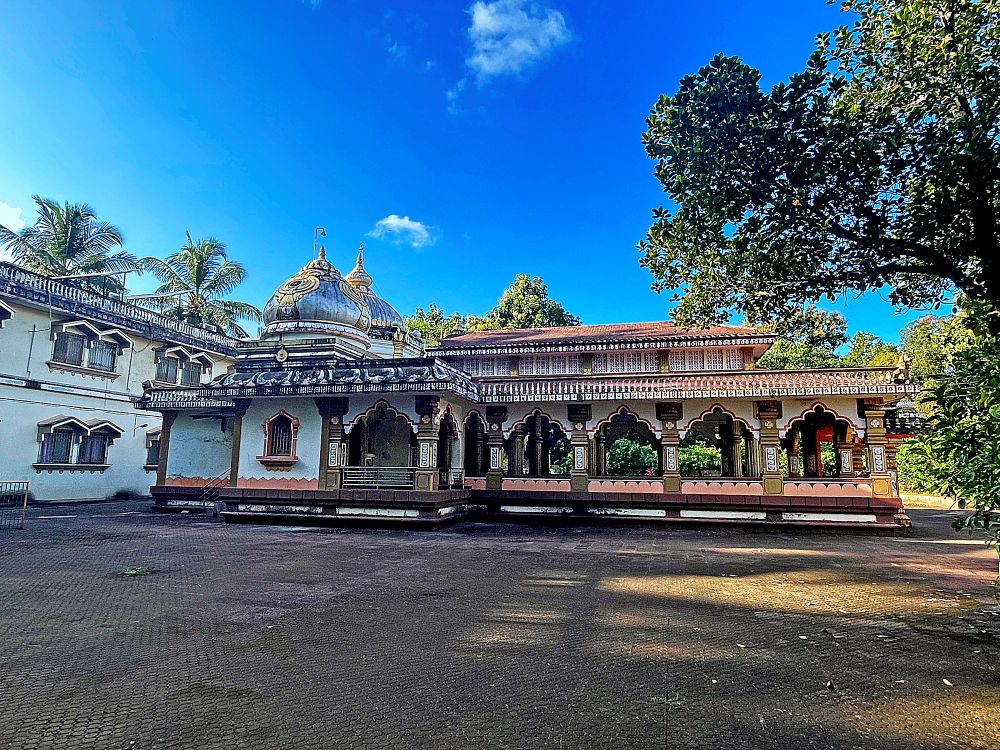
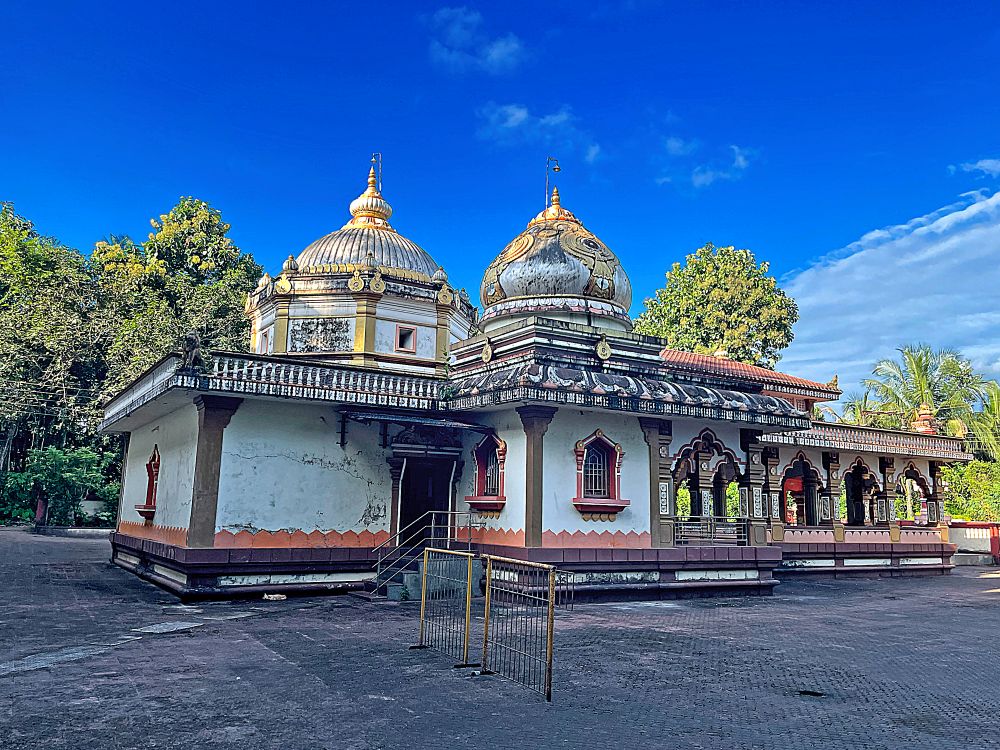
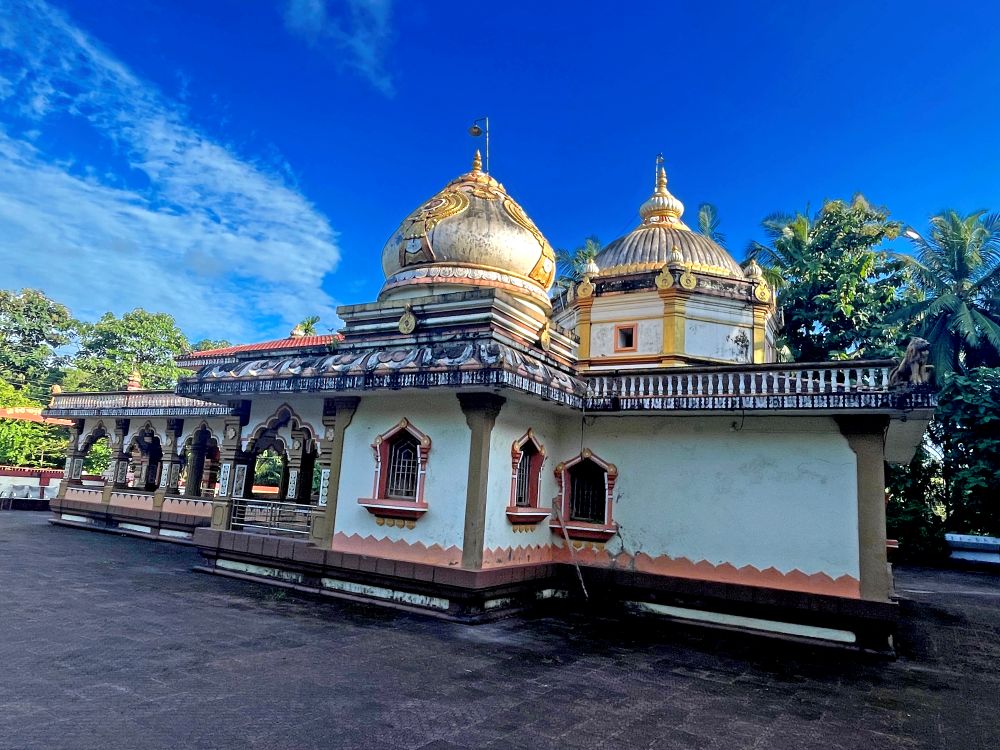
The premises of this temple in Andurle are spacious. Directly in front of the temple is the Goddess Chamundeshwari Garden. The construction of the temple bears some influence of the Konkani architectural style. The structure of this temple consists of a front pavilion, a main assembly hall, an intermediate chamber, and a sanctum sanctorum. In the Konkani architectural style, the roof of a temple is usually sloping and tiled. However, the roof of this temple is flat. There are three spires on the temple. The main spire is hexagonal at the base and has a dome on top. On this dome, there is an Amalaka and a Kalash. On both sides of the main spire, there are two urn-shaped spires. They are smaller in comparison to the main spire. There are also two small spires on both sides of the roof of the temple’s small front pavilion.
In front of the temple, there is a tall lamp pillar on a raised platform. The assembly hall of the temple is rectangular, two-storied, and spacious. On both outer sides of this semi-open mandapa, there are kakshasanas (stone benches). These feature square-shaped pillars. These pillars are connected to each other at the top by arched motifs. At some distance inward from the kakshasanas, there are five tall, circular pillars on both sides. The ceiling section above these pillars is triangular in shape, adorned with beautiful carvings.
The entrance to the antarala (vestibule) features gilded, intricately carved pillars. The upper part of this frame is triangular. Above the lalata-bimba (lintel block), on the front wall of the antarala, an image of Gajalakshmi is carved. In this front wall, on both sides of the entrance, there are windows. The frames of these windows are replicas of the entrance itself. By ascending three steps at this entrance, one enters the pragriva, which is a small-sized vestibule. From the antarala, there is a circumambulatory path around the garbhagriha (sanctum sanctorum). Because of this, it is known as a sandhara pradakshina path, meaning a covered circumambulatory path.
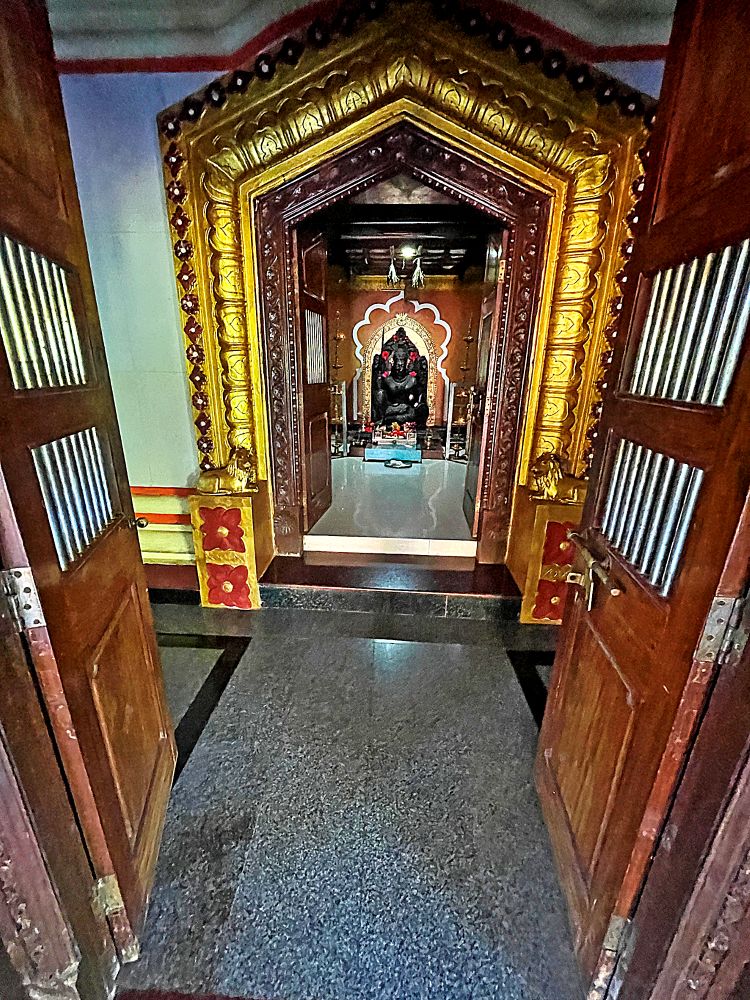
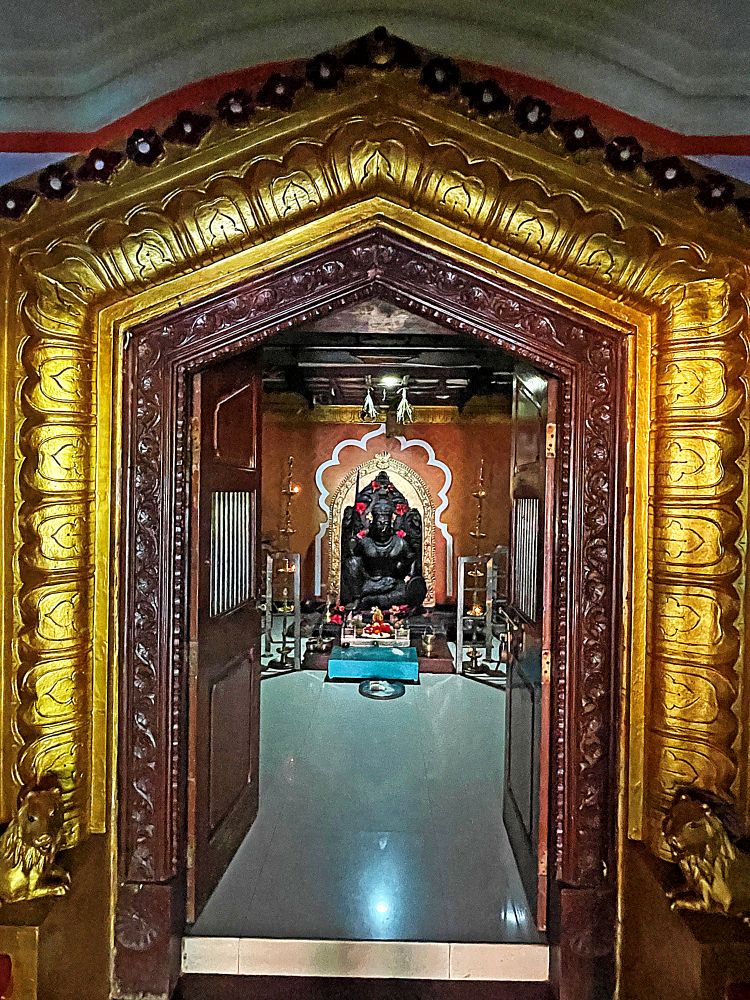
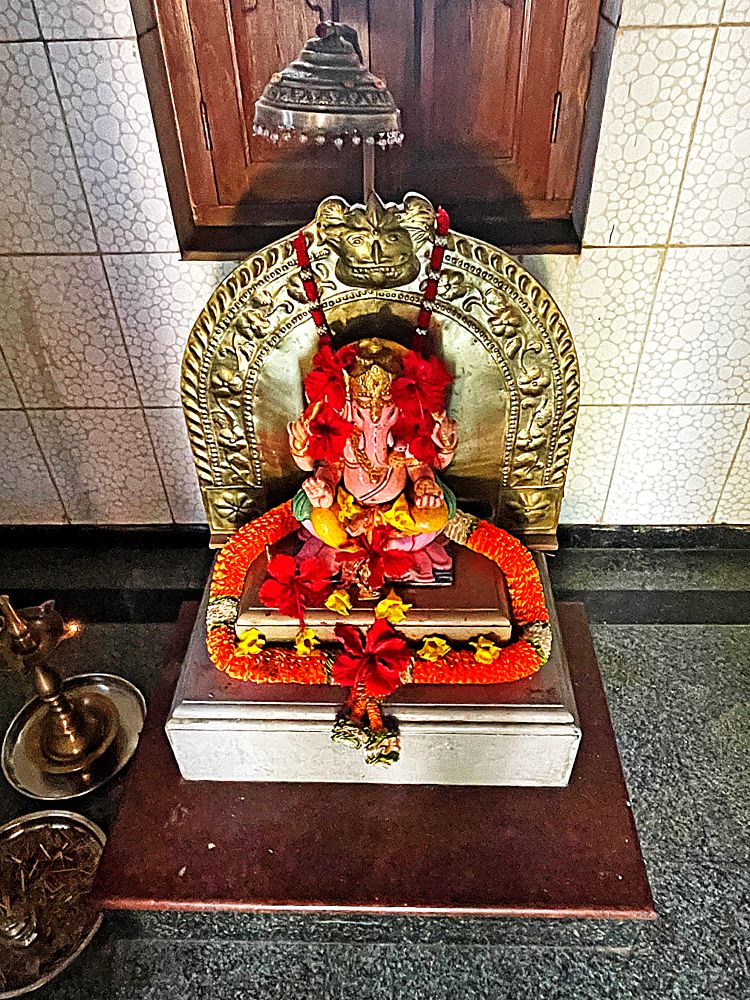
Directly ahead is the entrance to the garbhagriha. This entrance consists of a carved wooden frame surrounded by gilded pillars. On both sides at the base of these pillars, there are gilded lion statues placed on small pedestals. Inside, the idol of Goddess Chamundeshwari is seated on a stone vajrapitha resembling a square shalunka. The Goddess Chamundeshwari is depicted in a seated posture with one leg folded and the other knee bent and raised, holding a sword in her right hand and a shield in her left, wearing a crown on her head, a nose ring, and a garland of small human skulls around her neck. On the backrest of the idol, carved lion figures are depicted in an ornamental style. This idol of the Goddess was crafted in the year 1929 by Bala Babu Kunkavlekar (Mistri) from Kunkavle. The Kolthar stone found in Kunkavle was used for the idol. Within the temple premises, there are also temples dedicated to Lord Ganesha and the ancestral deity of the Patil-Patkar lineage.
The temple anniversary, Ashwin Navratri, and Vijayadashami festivals are celebrated here with great grandeur and in a devotional atmosphere. The current idol was installed in the temple in the year 1929. In its memory, the anniversary festival is celebrated every year on the two days of Magh Shukla Panchami and Shashthi. On that day, Homa-Havan and Navchandi Yajna are organized here. On the occasion of this festival, thousands of devotees gather here.
This sacred temple stands as a testament to deep spiritual devotion, ancient architectural grandeur, and rich local cultural traditions.
The sanctum sanctorum houses the divine idol consecrated according to ancient Vedic traditions, surrounded by serene courtyards and traditional temple architecture.
Navratri, Maha Shivratri, Annual Temple Jatra & Deepotsav
Compare and book flights, secure top-rated local hotels near the temple, hire reliable guides, and rent cars instantly.
Extend your pilgrimage by visiting other highly sacred temples located nearby.


Add ₹999 more to unlock FREE SHIPPING!
Your sacred cart is currently empty.
Shop Photo FramesFill in your delivery details below to place your order.
Add comment