
Add ₹999 more to unlock FREE SHIPPING!
Your sacred cart is currently empty.
Shop Photo FramesNear this village, in the forest area, is the famous shrine of Chandikadevi (Patnadevi). This temple, believed to be the sister of Saptashringi Devi of Vani, dates back to the twelfth century. Within the temple complex, Bhaskaracharya’s grandson, Changdev, had a school for mathematical education.
The Chandikadevi (Patnadevi) temple is nestled on the banks of the Dongri River, within the Gautala Autramghat Wildlife Sanctuary, situated on the border of Chhatrapati Sambhajinagar and Jalgaon districts. According to Puranic legends, Devi Sati was the daughter of King Daksha Prajapati and the wife of Mahadev. Once, King Daksha organized a Yajna and invited all the Devas except Mahadev. When Sati learned of this, she went to her father to question him. At that time, Daksha slandered Mahadev. Hearing those insulting remarks about her husband, Sati became enraged, and in that fury, she sacrificed her life in the ongoing Yajna. When Shankara learned of this, He became immensely furious. He came to the Yajna site and pulled Sati’s lifeless body out of the Yajna. Holding it in His hands, He wandered here and there in sorrow and rage.
Assuming the form of Rudra, Shankara began the Tandava dance. Fearing that this could lead to the destruction of the Earth, all the Devas became anxious. Then Vishnu, with His Sudarshan Chakra, dismembered Sati’s body. The places where parts of Sati’s body and her ornaments fell became Devi’s Shakti Peethas. It is said that among these, Sati’s palm fell on the hill near the Patnadevi temple, creating a Shakti Peetha there. It is known as Varadahasta Shakti Peetha. There are fifty-one such Shakti Peethas of Devi in India, Pakistan, Bangladesh, Nepal, and Tibet. According to mentions in the Devi Bhagavata, there are one hundred and eight such Shakti Peethas.
Regarding the incarnation of Chamunda Devi, the seventh chapter of the ‘Devi Mahatmya’ in the ‘Markandeya Purana’ narrates a story where the demons Shumbha and Nishumbha conquered the kingdom of the three worlds from Devendra. Then the Devas appealed to Adishakti Bhagavati. While they were praying to Bhagavati, Devi Parvati arrived there. From her body-sheath, Devi Ambika manifested. Chanda and Munda were servants of Shumbha and Nishumbha. They saw Ambika and described her beauty to Shumbha. Shumbha sent a message to Ambika asking her to become his wife. Ambika rejected him. Then Shumbha and Nishumbha sent Chanda and Munda to capture her. At that time, Kali, who emerged from Ambika’s body, slew Chanda and Munda. Because Kali Devi slew Chanda and Munda, Ambika named her Chandika.
According to local legend, the original abode of Chandika Devi is on the hill here. A gentleman named Govind Swami was a devotee of this Chandika Devi. In his old age, it became difficult for him to constantly go up the hill to worship the Devi. Therefore, he requested the Devi to come down with him. The Devi accepted her beloved devotee’s request and agreed to come down. This is that very shrine. Being situated in the village of Patan, this Devi is famous as Patnadevi.
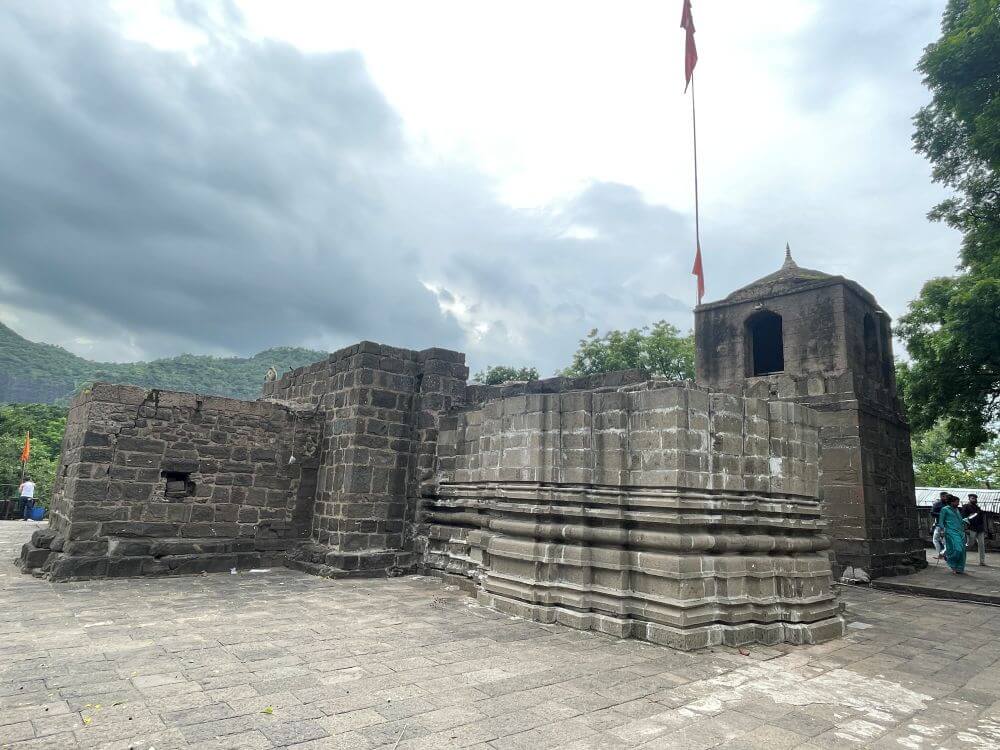
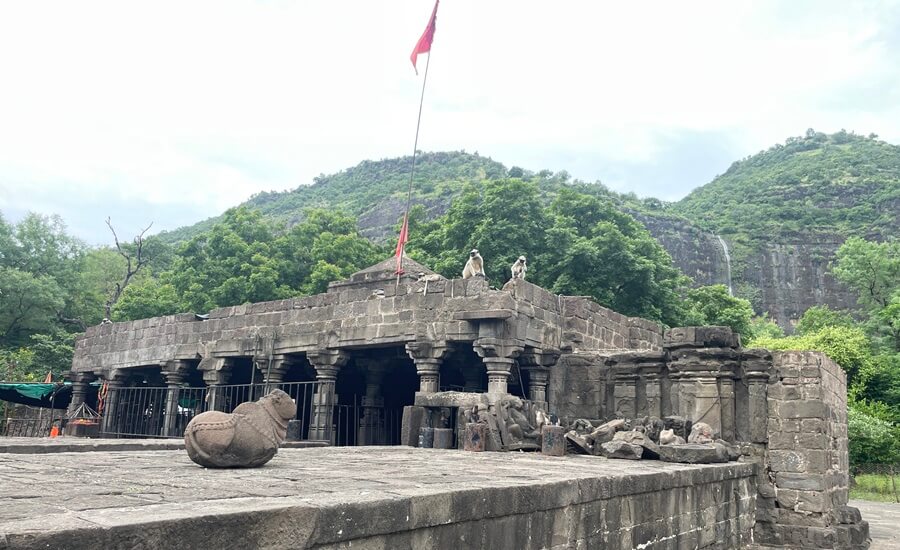
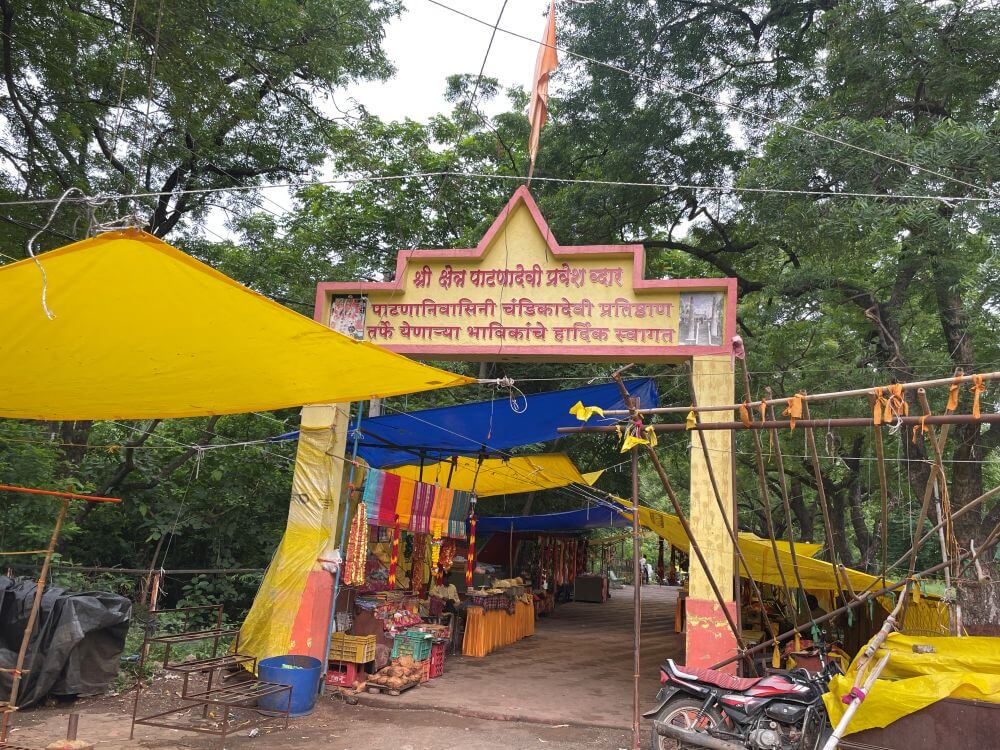
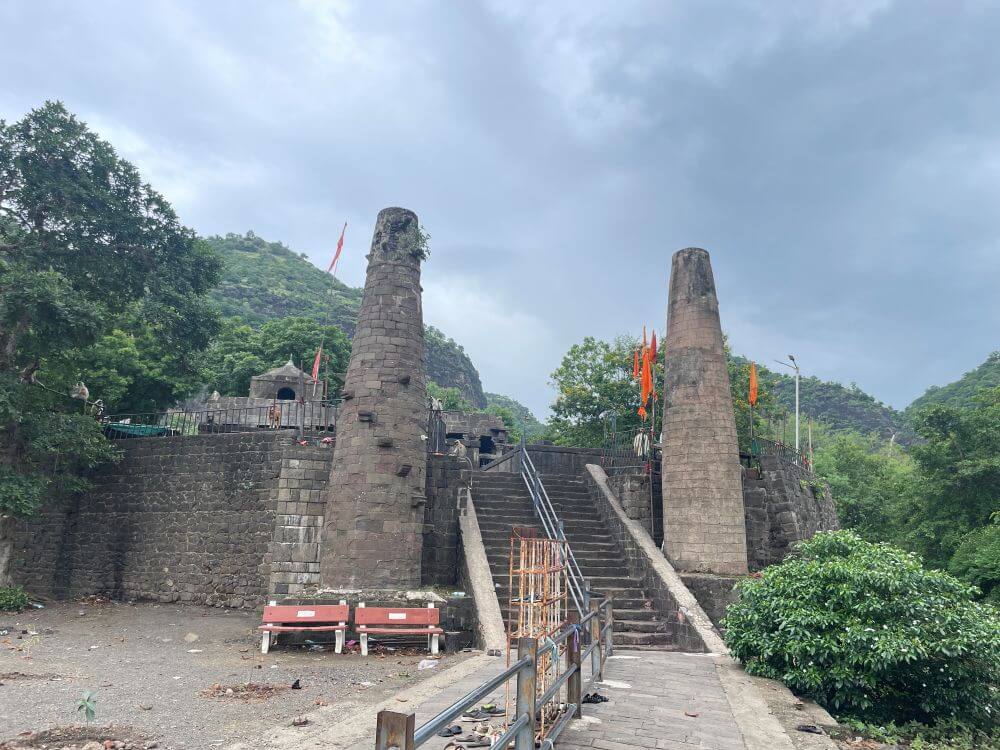
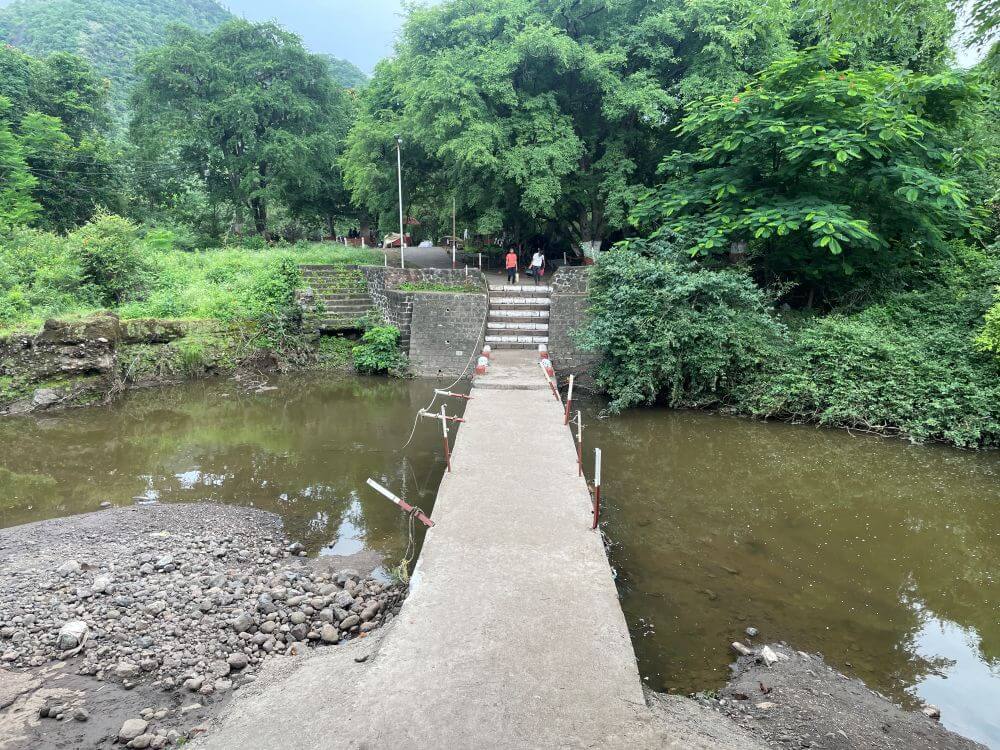
Devotees are allowed to visit this temple after registering at the entrance of the Gautala Sanctuary. From here, one can travel about two kilometres on a somewhat unpaved road to reach the temple’s parking lot. The temple is approximately five hundred metres from the parking lot. Upon entering through the archway, there are many shops selling puja materials and prasad. From there, the path crosses a small bridge over the Dongri River to reach the temple. In front of this temple, which is situated slightly elevated from the riverbed, stand two ancient lamp pillars, approximately forty-five to fifty feet tall. Through these lamp pillars, one ascends about twenty steps to enter the temple courtyard. In this courtyard, there are large stone platforms on both sides, and stone steps leading into the temple from between them. On the left platform is the samadhi of Devi’s devotee, Govind Swami. On the right platform is a stone Nandi. This Hemadpanti style temple is seventy-five feet long, thirty-six feet wide, and eighteen feet high. On the outer walls of the temple, there are many ancient idols and sculptures.
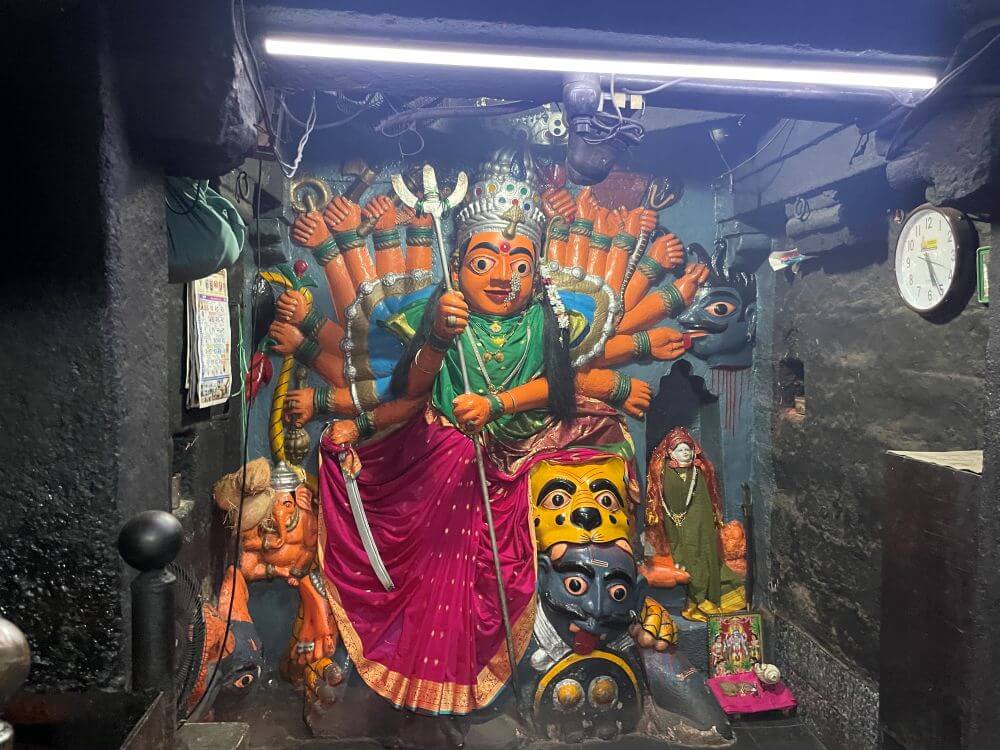
The temple’s structure includes a sabhamandap (assembly hall) and the main sanctum of the Devi, along with two subsidiary sanctums. There are many stone pillars in the sabhamandap. Upon entering the sabhamandap, one first finds a Shivling in the centre of one subsidiary sanctum, with Ganesha and Riddhi-Siddhi in front of it, while in the other subsidiary sanctum, there is an idol of Vishnu. In the main sanctum, on a Vajra Peetha, is a nine-foot-tall idol of Chandikadevi seated on a tiger. This idol has eighteen arms. Many of these arms hold weapons. On one side of this idol is Ganesha, and on the other side is the original idol of the Devi. To the left of the main temple is another small temple. It contains an idol of Kalika Devi. This idol is grand and similar to Chandikamata. The Sharadiya Navaratri festival is celebrated here with great enthusiasm. The Vasantika Utsav and the Mahapuja of Patnadevi are performed every Purnima. During the festival, Mahaprasad is arranged for devotees here.
In the year एक हजार आठशे चौसष्ट, the great social reformer and historian, डॉक्टर भाऊ दाजी लाड, visited this sacred shrine of पाटणादेवी. During his visit, he discovered an inscription within the temple precincts. He deciphered it and published a research paper on it in the ‘जर्नल ऑफ द रॉयल एशियाटिक सोसायटी, न्यू सिरिज, व्हॉल्यूम एक’. Subsequently, in एक हजार आठशे ब्याण्णव, प्रोफेसर एफ. किलहॉर्न penned an extensive article on it in ‘इपिग्राफिका इंडिका, खंड एक’. This inscription mentions that चंगदेव, the royal astrologer of the यादव monarch सिंघण, established a मठ for the study of his grandfather भास्कराचार्य’s ‘सिद्धांतशिरोमणि’ and other revered texts. It also records that सोइदेव and हेमाडीदेव of the निकुंभ dynasty permanently endowed this मठ with land and other sources of income. This inscription dates back to श्रावण पौर्णिमा, the day of a lunar eclipse, in the प्रभव संवत्सर, शक संवत एक हजार एकशे अठ्ठावीस (गुरुवार, नऊ ऑगस्ट एक हजार दोनशे सात). It also provides the lineage of चंगदेव. This discovery shed new light on the history of the great mathematician भास्कराचार्य द्वितीय. भास्कराचार्य himself had recorded his birthplace as विज्जलवीड. This inscription corroborates the belief that this village is none other than पाटण itself. Presently, the ‘भास्कराचार्य निसर्ग शिक्षण केंद्र’ has been established here by the State Forest Department. It is open to pilgrims and visitors from सकाळी दहा ते सायंकाळी पाच वाजेपर्यंत.
This sacred temple stands as a testament to deep spiritual devotion, ancient architectural grandeur, and rich local cultural traditions.
The sanctum sanctorum houses the divine idol consecrated according to ancient Vedic traditions, surrounded by serene courtyards and traditional temple architecture.
Navratri, Maha Shivratri, Annual Temple Jatra & Deepotsav
Compare and book flights, secure top-rated local hotels near the temple, hire reliable guides, and rent cars instantly.
Extend your pilgrimage by visiting other highly sacred temples located nearby.


Add ₹999 more to unlock FREE SHIPPING!
Your sacred cart is currently empty.
Shop Photo FramesFill in your delivery details below to place your order.
Add comment