
Add ₹999 more to unlock FREE SHIPPING!
Your sacred cart is currently empty.
Shop Photo FramesThe Chintamani Mandir, nestled beside the sacred Godavari River in Gangakhed, Parbhani district, is the principal village deity of this town. Devotees in this historic region, renowned as ‘Dakshin Kashi’, commence all auspicious undertakings only after seeking the darshan of Shri Chintamani here. This shrine is celebrated throughout the entire region as an exceptionally potent and wish-fulfilling Ganesha temple. Throughout the year, the temple witnesses a throng of devotees. Particularly during the Ganesh Utsav in the month of Bhadrapada, all idols of public Ganeshotsav mandals in the village are first brought to this temple before their installation, and only thereafter are they enshrined in their respective mandaps.
The village of Gangakhed has been known as ‘Dakshin Kashi’ since ancient times. Its numerous temples and the picturesque environs of the Godavari River have bestowed upon this village significant historical and religious importance. During the Nizam era, Gangakhed was the principal seat of the jagir of Raja Raghootamrao, a valiant Sardar of the Nizam. Raja Raghootamrao rendered great service in the Nizam’s court during the latter half of the eighteenth century. As this was a jagir village, remnants of the old fortifications built around the village for security can still be seen in some places today. The main palace here is constructed of stone and is considered an exact replica of the ‘Shaniwar Wada’ in Pune. This historic village is home to many temples, including the Balaji Mandir, Chintamani and Koteshwar Mandir, Saint Janabai’s memorial temple, Shani Maruti Mandir, and Narsimha Mandir. Among these, the Ganesha residing in this Chintamani Mandir is the principal village deity.
Many legends are famous regarding the origin and nature of Chintamani Ganesha, who is enshrined in this temple. According to the ‘Shiv Purana’, Parvati is the principal consort of Shivshankar, and Ganga is considered His second consort as Shivshankar gave her a place in His matted locks. Once, upon seeing Ganga at Parli Vaijnath Kshetra in Beed district, child Ganesha loudly exclaimed, “Mother, your co-wife has arrived!” Due to this historic incident, the Ganesha temple located to the right beyond the Shiva temple at Parli Vaijnath came to be known as ‘Dakshinmukhi Bomblya Ganesh Mandir’. Hearing Ganesha’s cry, Mother Parvati, who arrived there, said to Ganesha, “You remove the obstacles of the entire world, therefore, you must also remove this obstacle that has come upon me in the form of a co-wife.” Accepting His mother’s command, Ganesha manifested in Gangakhed. From here, the Godavari River was to proceed straight through the village to meet Shivshankar, but it was impossible for her to cross Ganesha, who had appeared before her. For this reason, the Godavari took a large bend in her riverbed here and proceeded further. As she went, she said to Ganesha, “I had an intense desire to meet Mahadev, but because you appeared before me, this wish remained unfulfilled.”
To this, Ganesha replied, “You too can easily have the darshan of Mahadev, but for that, you will have to go secretly to the Shiva shrine on the mountain at Makhani.” According to these references, it is said that the Godavari River went secretly to Makhani, and there, after Ganesha invoked Shivshankar, the Godavari River and Shivshankar met, as mentioned in the scriptures ‘Goda Mahatmya’ and ‘Ganesha Purana’.
Another local legend is told about the origin of the temple. According to it, in ancient times, there was a large hill in this entire area, and so the villagers would bring their cattle here to graze. One day, while the cattle were grazing, a person heard a loud sound at some distance. He immediately went to that spot and saw an idol of Ganesha. When he informed all the other villagers about this, they all gathered there. At that time, everyone noticed that the idol was slowly rising from the ground. After the idol had fully emerged from the ground, the villagers ritually installed it at the same spot, and in due course, a temple was built there. In the beginning, this idol was small in size, but it is said that due to the application of sindoor paste over the years, the size of this idol has continuously increased.
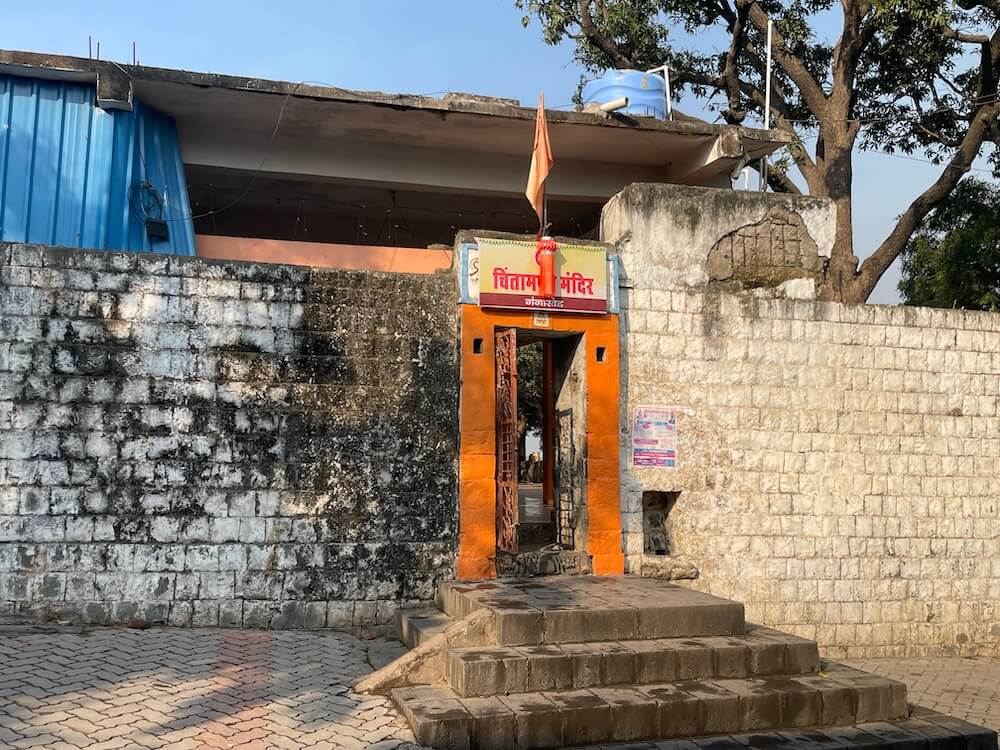
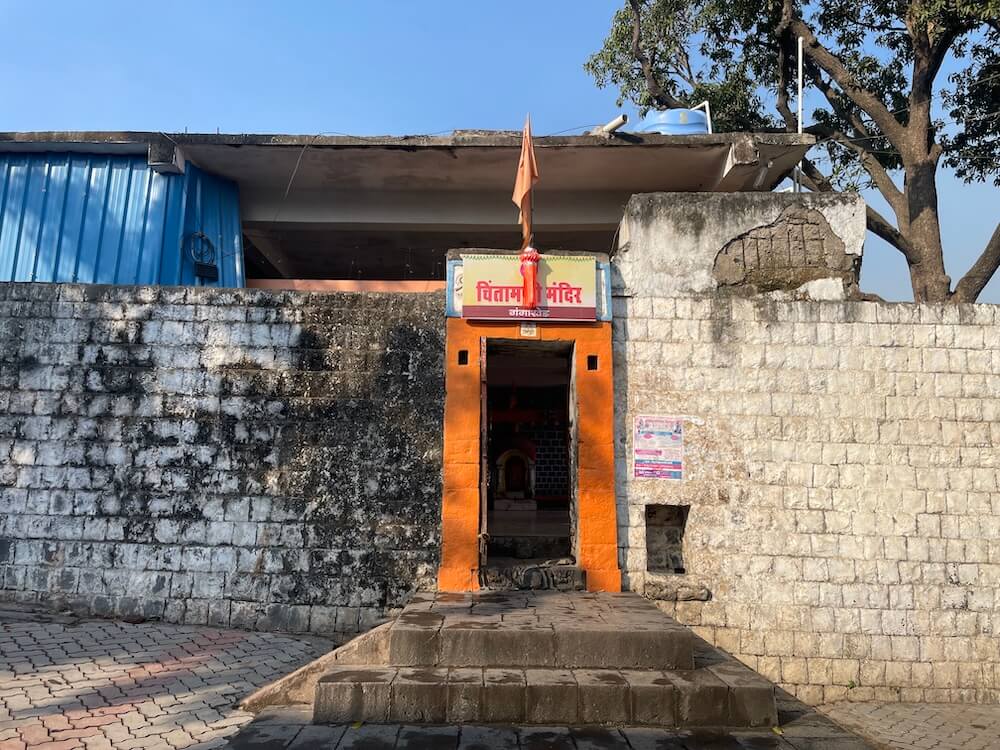
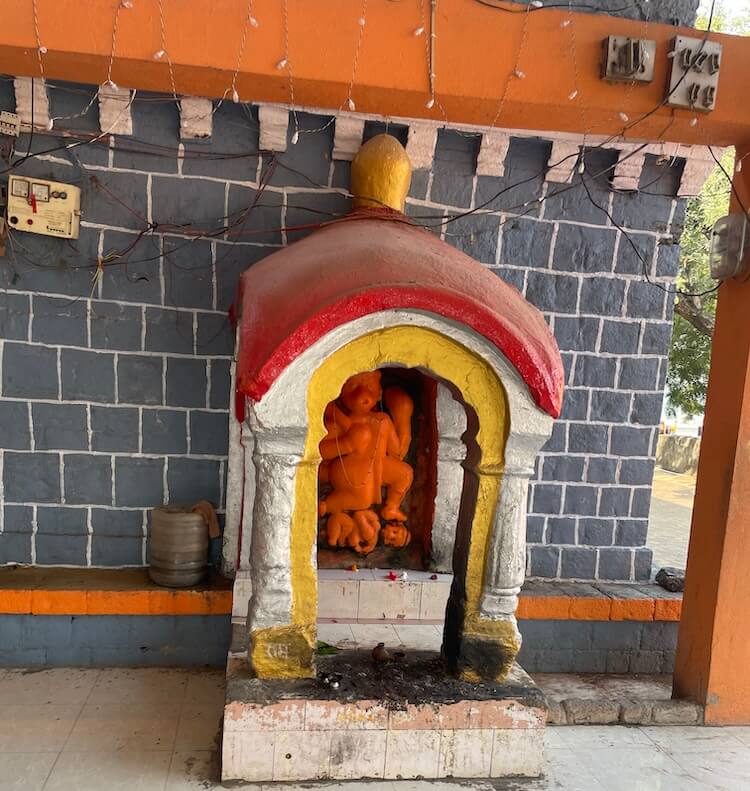
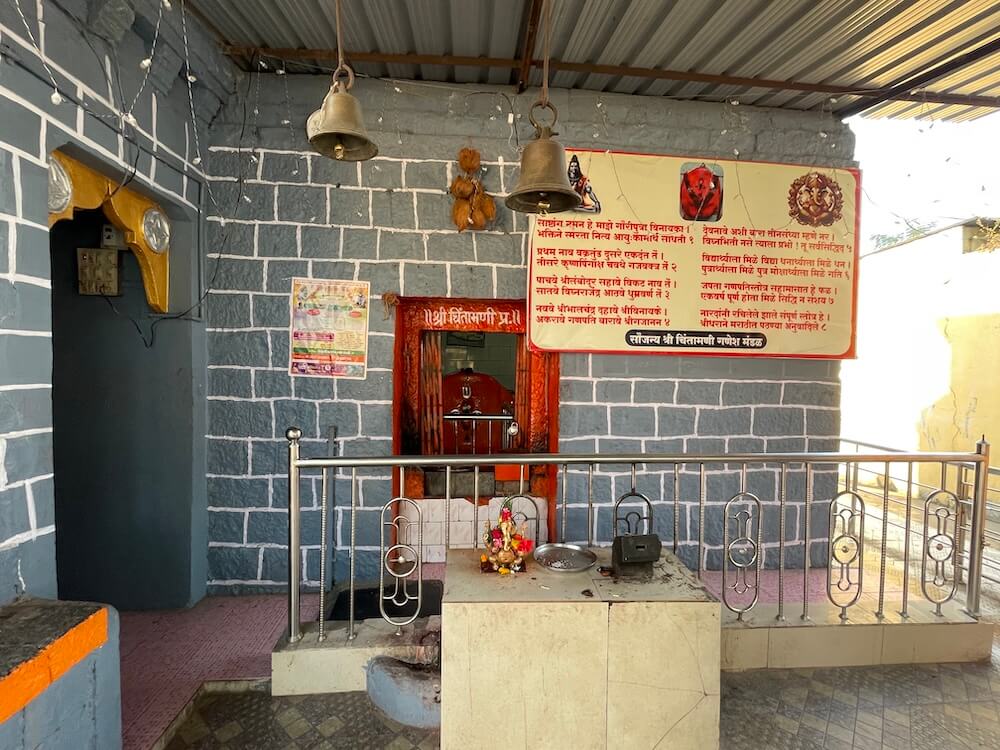
To enter this Chintamani Mandir, located near the banks of the Godavari River, devotees must ascend a few steps. The entire temple is fortified, and on its facade, there are two bastions on either side. Upon entering through the main temple gateway, one comes to a courtyard. In the courtyard, at the very beginning, in a newly constructed mandap, one can have the darshan of a sindoor-anointed idol of Hanuman. From here, devotees must take a slight detour and then the main Chintamani Mandir appears before them. On a platform in front of this temple, a metal idol of Ganesha is installed.
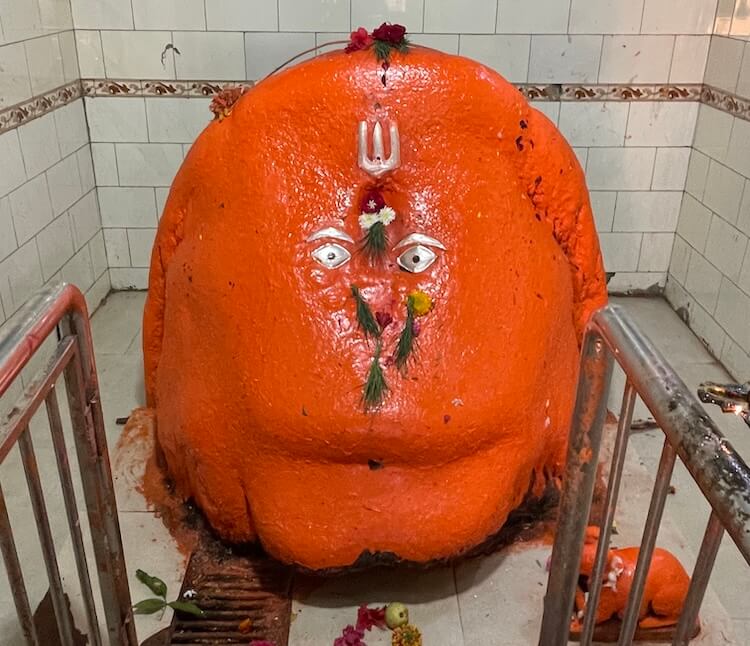
In the sanctum sanctorum of the temple, the sindoor-anointed idol of Chintamani Ganesha is enshrined, and eyes are carved on this idol. The ceiling of the sanctum sanctorum is adorned with glasswork. Above the sanctum sanctorum, a tall shikhara, tapering upwards, has been built. It features a stone amalaka and a golden kalasha.
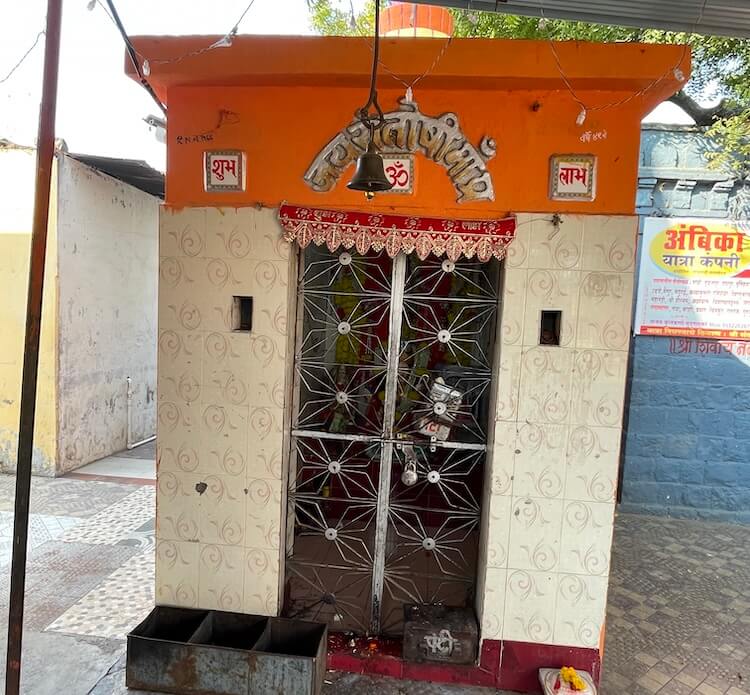
Directly opposite the main temple is the Santoshi Mata Mandir. Behind the main idol of Santoshi Mata in this temple, another small idol is carved. A few steps from here is the ancient Koteshwar Mahadev Mandir.
This Shiva temple is designed in two traditional parts: the sabhamandap and the garbhagriha. In the sabhamandap here, an idol of Nandi is enshrined, and in the main garbhagriha, a Shivling is consecrated within a large shaalunka. Very close to this temple is a Bael tree.
All the people of the village have immense faith in Chintamani Ganesha here, and therefore, there is always a bustling crowd of devotees. Any auspicious work in the village is commenced only after having the darshan of Chintamani here. Every Tuesday, as well as on Sankashti Chaturthi, many devotees come here for darshan and offer modak as naivedya to Chintamani. On Angarki Chaturthi as well as Vinayak Chaturthi, a huge crowd of devotees gathers here.
Every day in this temple, an abhishek is performed on the deity in the morning, and a maha-aarti is performed every night around eight o’clock. During the Ganesh Utsav in the month of Bhadrapada, the office bearers of all public Ganesha mandals in the village first bring their mandal’s idols to this temple before their installation.
After the sacred murtis are kept here for some time, they are then formally consecrated in the main mandapams. Similarly, during the immersion procession, it is only after receiving the final darshan and blessings of Lord Chintamani here that the immersion of all the Ganesh murtis in the village commences. Devotees can have darshan at this temple daily from early dawn until late at night.
This sacred temple stands as a testament to deep spiritual devotion, ancient architectural grandeur, and rich local cultural traditions.
The sanctum sanctorum houses the divine idol consecrated according to ancient Vedic traditions, surrounded by serene courtyards and traditional temple architecture.
Navratri, Maha Shivratri, Annual Temple Jatra & Deepotsav
Compare and book flights, secure top-rated local hotels near the temple, hire reliable guides, and rent cars instantly.
Extend your pilgrimage by visiting other highly sacred temples located nearby.


Add ₹999 more to unlock FREE SHIPPING!
Your sacred cart is currently empty.
Shop Photo FramesFill in your delivery details below to place your order.
Add comment