
Add ₹999 more to unlock FREE SHIPPING!
Your sacred cart is currently empty.
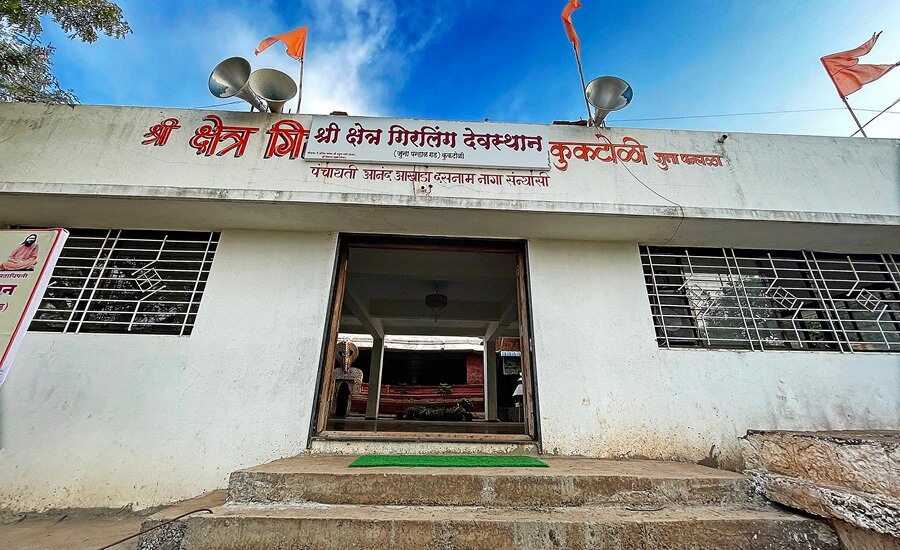
Shop Photo FramesJust as the Panhala Fort in Kolhapur is associated with many historical events, it is also linked to numerous mythological legends. Similarly, the Girling Hill in the Sangli district, known as the ‘Old Panhala’, is also associated with many mythological tales. There is an ancient temple of Lord Mahadeva on this hill in Kukatoli. Because the Lord resides on the hill, He is known as Girilingeshwar Mahadeva. This site is also considered a center of the Nath Sampradaya. Furthermore, the Samadhi of Sage Parashara, the grandson of Sage Vashistha and the father of Maharishi Vyasa, is also located here.
Regions such as Sangli, Satara, and Kolhapur were known as Kuntal in ancient times. There is a legend that Sage Parashara resided in this Kuntal region. According to the references in the ‘Karveer Mahatmya’, Sage Parashara lived on the Panhala fort in Kolhapur along with his wife Satyavati and his disciples. Due to the penance of Parashara, the netherworld (Patal-lok) became heated. At that time, the Nagas residing there [interrupted/confronted] him Attempts were made to disturb his penance. Enraged by this, Sage Parashara cast darbha grass charged with powerful mantras, killing many serpents. The remaining ones surrendered to him. Parashara then granted them refuge and declared that this place would be known by their name, naming the site ‘Pannagalaya’, meaning the abode of serpents. It is said that this later evolved into ‘Parnalak’ and eventually became known as Panhala.
Sage Parashara also resided in Narsinhpur (Kole), located in the Walwa taluka of Sangli district. It was here, on the banks of the Krishna River, that he performed penance to Lord Narasimha. It is said that, much like in Panhala, Sage Parashara also had an ashram on Girling Hill—the site of the old Panhala—where he attained Samadhi. The shrine of Girlingeshwar Mahadeva is situated on this very Girling Hill.
This temple, situated in a mountain crevice, is said to have been built in the Hemadpanthi architectural style around the twelfth century. During this period, the Shilahara kings held power in this region. From the foothills of the mountains, the mountain There is an unpaved road leading up to the temple situated on the hilltop. Private vehicles can be driven along this road directly to the parking area in front of the temple. The temple courtyard features various trees and several ancient samadhis (memorial shrines). It is said that one of these samadhis belongs to Sage Parashara. There is also a water tank located within this courtyard.
The temple structure consists of a Sabhamandapa (assembly hall), Antarala (vestibule), and Garbhagriha (sanctum sanctorum). Above the arched entrance of the Sabhamandapa, there is a sculpture of a hooded serpent. The Sabhamandapa features 14 intricately carved pillars. Standing on square bases, these pillars transition into various geometric shapes, including squares, hexagons, octagons, and circles. At the top of the pillars are brackets (kani) and above them are the capitals (hasta). Beams rest upon these capitals, supporting the ceiling, from which brass bells are suspended. In the semi-open Sabhamandapa, there are stone benches (kakshasana) for devotees to sit. The outer pillars of the Sabhamandapa are integrated into the walls and the stone benches. Inside the Sabhamandapa, to the left of the entrance to the Antarala, there is a sculpture of a pair of Nagas (serpents) housed in a niche (devakoshta). Next to the window (vatayana) there, stands an idol of Maruti. To the right of the entrance, adjacent to the window, is an idol of Mahishasuramardini. There is a Shiva Pindi in the devakoshta (niche) in front of the idol.
The entrance to the sanctum has five doorjambs. The first and last two doorjambs are adorned with intricate vine carvings, while the central doorjamb features pillar carvings. On the lalatabimba (lintel) is an image of Lord Ganesha, and the torana (arch) above it is decorated with floral and shikhara motifs. The mandarka (threshold) features a chandrashila (moonstone) flanked by lotus flower carvings on both sides.
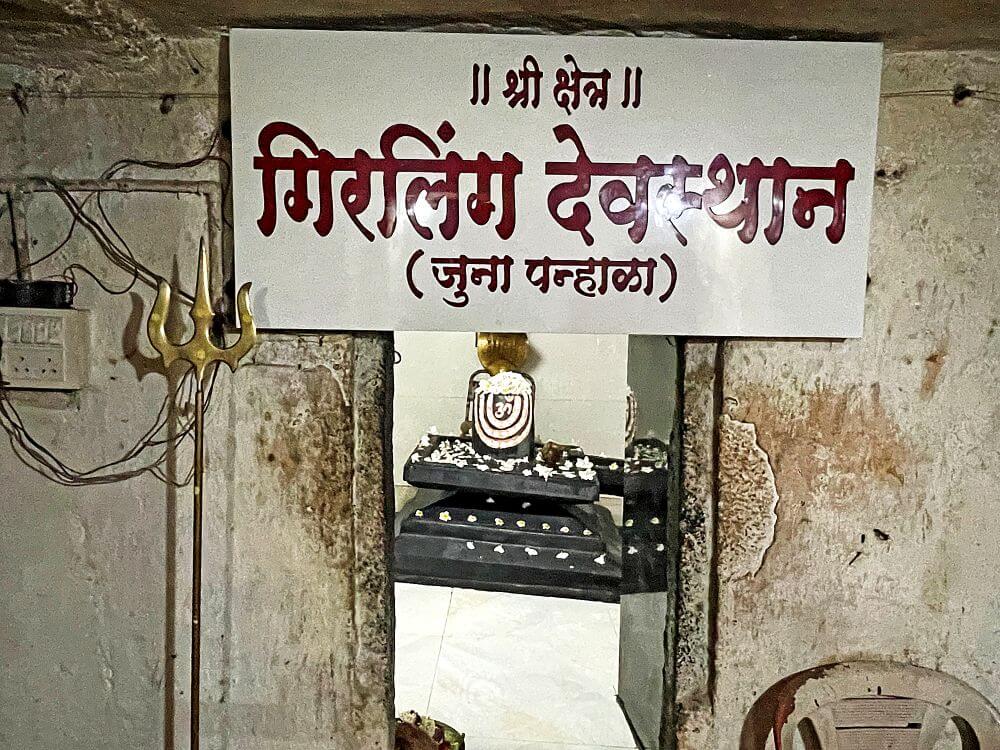
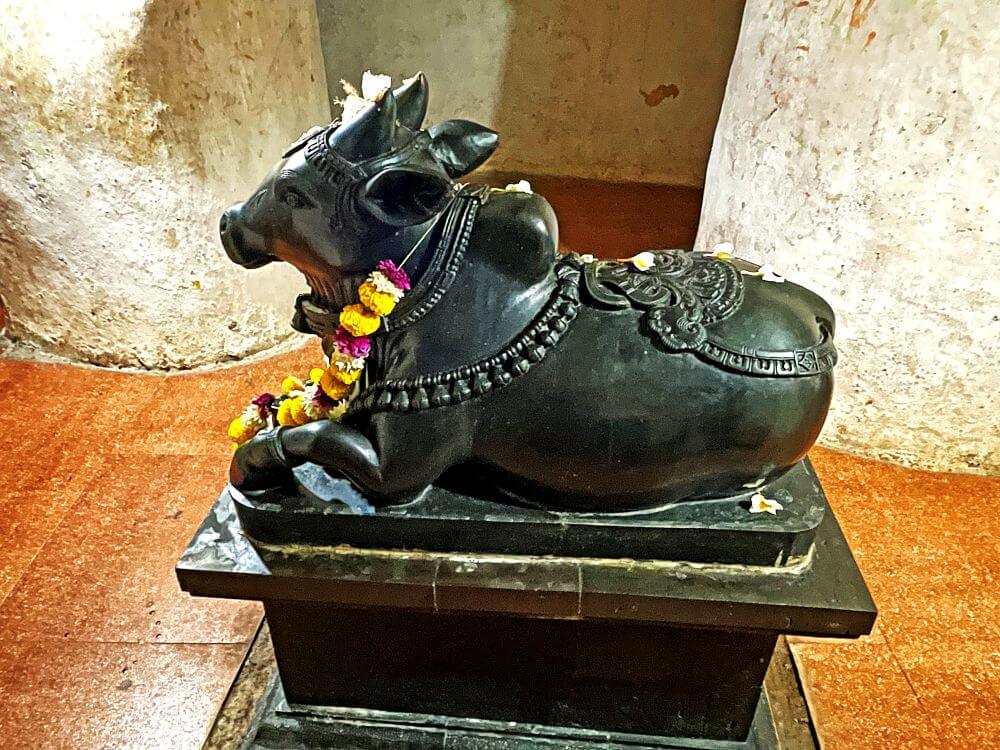
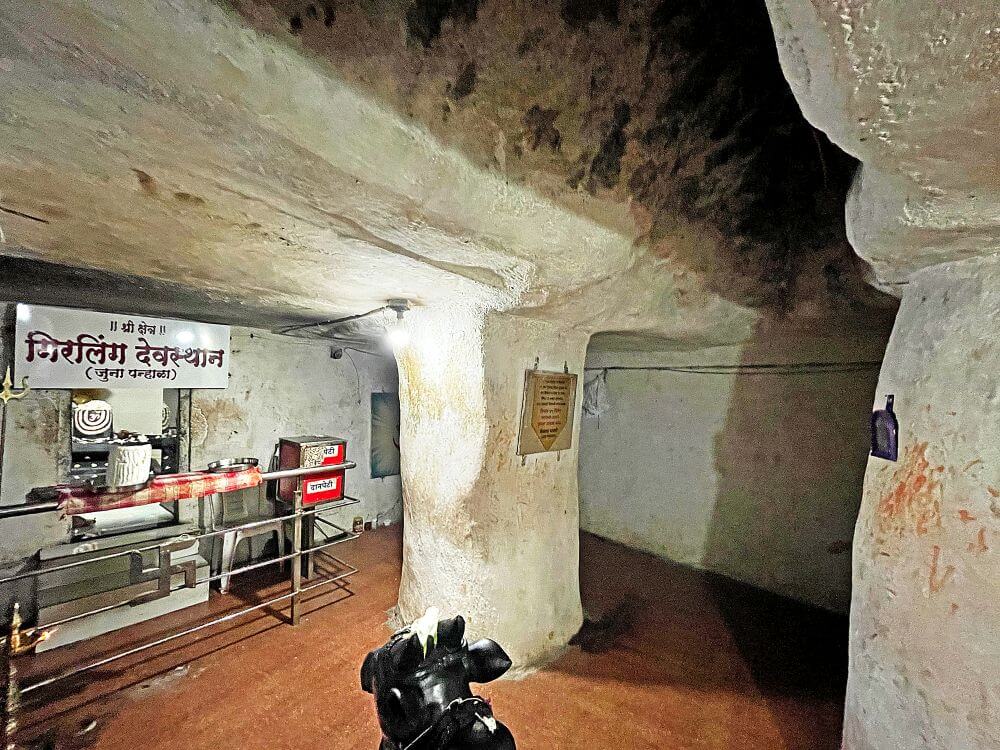
The four pillars in the antarala (vestibule) are carved into the laterite rock within the mountain crevice. In recent times, they appear to have been plastered with cement. In the center of the antarala, on a pedestal, stands an idol of Nandi made of black stone. There are niches for lamps (deepakoshthakas) in the walls of the antarala, and windows (gavakshas) to allow for ventilation. Devotees must have the darshan of Girilingeshwara from the entrance of the garbhagriha (sanctum sanctorum). The door frames of the garbhagriha are adorned with intricate vine carvings. Inside the garbhagriha, in the center of the floor, is a large Shiva Linga with a square shalunka (base), topped by a brass serpent with a canopy.
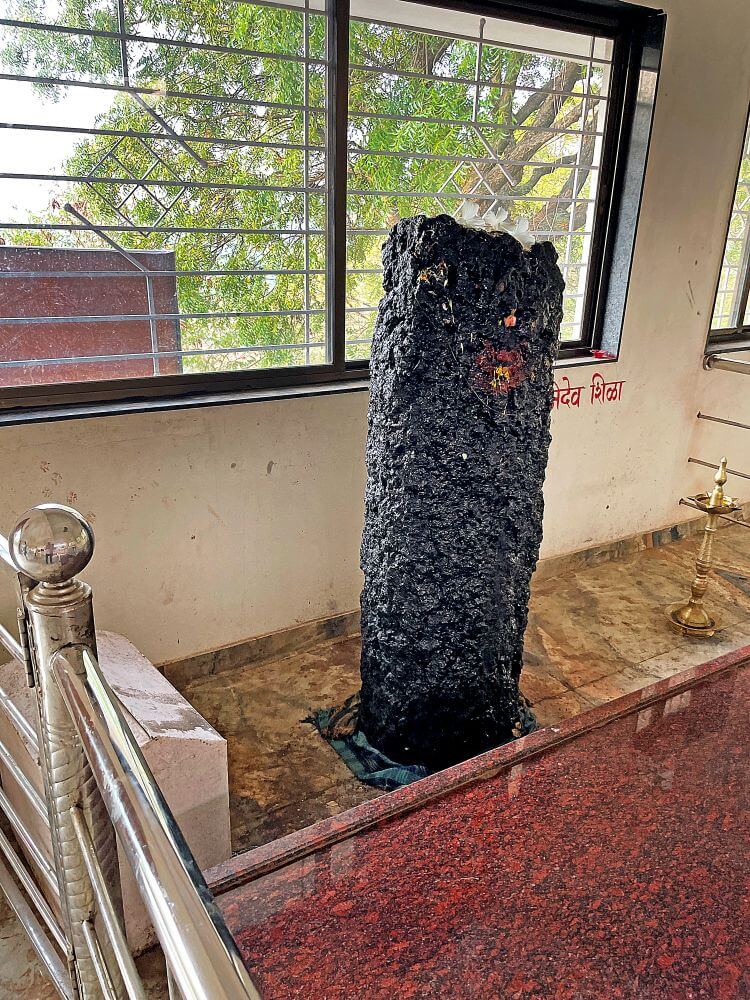
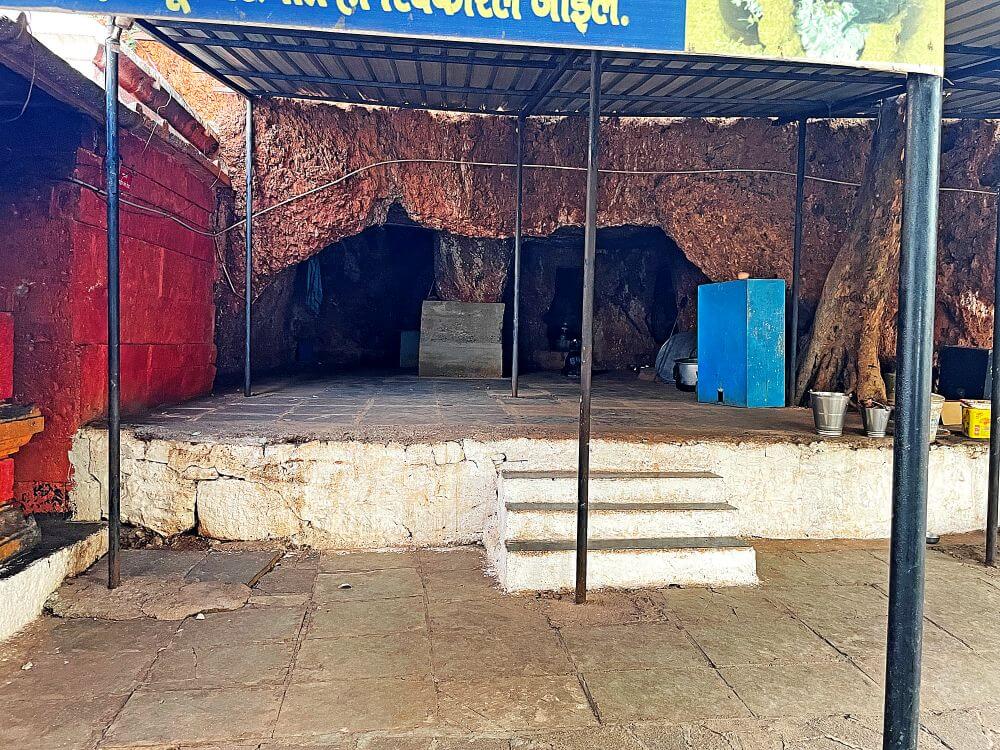
The temple roof features a square, stepped, pyramid-like shikhara. At the apex of the shikhara, there are two amalakas placed one above the other, crowned by a kalash and a dhwajapataka. On both sides of the temple, there are fifteen steps carved into the mountain to reach the vast plateau behind. On the rear side of the plateau, within the mountain cliff, are the Tighai caves. A Shivling is also present there, which is said to have been consecrated twelve hundred years ago. The temple’s main jatrotsav is celebrated on the second Monday of Shravan, and the annual seven-day festival of Mahashivratri is also observed. During both festivals, thousands of devotees arrive here for the darshan of the deity and to fulfill their vows. Mahaprasad is organized for the devotees during all festivals. The temple experiences a special influx of crowds every Monday, Thursday, on Purnima, and on Amavasya.
This sacred temple stands as a testament to deep spiritual devotion, ancient architectural grandeur, and rich local cultural traditions.
The sanctum sanctorum houses the divine idol consecrated according to ancient Vedic traditions, surrounded by serene courtyards and traditional temple architecture.
Navratri, Maha Shivratri, Annual Temple Jatra & Deepotsav
Compare and book flights, secure top-rated local hotels near the temple, hire reliable guides, and rent cars instantly.
Extend your pilgrimage by visiting other highly sacred temples located nearby.


Add ₹999 more to unlock FREE SHIPPING!
Your sacred cart is currently empty.
Shop Photo FramesFill in your delivery details below to place your order.
Add comment