
Add ₹999 more to unlock FREE SHIPPING!
Your sacred cart is currently empty.
Shop Photo FramesNavaladevi is renowned as the presiding deity (Gramadevata) of Nadhavade, a village in Sindhudurg district famous as the ‘Village of Springs’ (Umalyache Gaon). These springs are natural bubbles of water emerging from the earth, which flow throughout all twelve months of the year. The Gothana River originates from these springs. Because a spiritually awakened (Jagrut) Mahadeva resides on the banks of this river, the river is referred to as the Ganga of Nadhavade. Nadhavade is a village of twelve hamlets and houses twelve temples. The temple of Navaladevi is situated slightly away from the residential area, with the Nageshwar Temple located behind it.
According to local socio-history, Navaladevi, the village deity, is considered the ‘Purvasatta’ (original authority) deity of this region. The village administration (Gavarhati) encompasses the rules governing the community, village affairs, culture, and traditions. Those who held authority over this Gavarhati in the past are referred to as Purvasatta, and Navaladevi is revered as such. In the Konkan region, at places like Anganewadi, it is customary to hunt a wild boar after seeking the Goddess’s divine consent (Kaul). Following the hunt, the boar is brought to the temple amidst music and celebrations. Married women perform an auspicious ritual (Oti) for the hunters, and the boar is also worshipped. The animal is then sacrificed at a specific spot near the temple known as Patoli. A unique feature of the Navaladevi shrine in Nadhavade is that the Goddess has strictly forbidden the hunting of not only wild boars but any animals within the village boundaries. There is a dry well in the temple premises; if a wild boar happens to fall into it, its meat is distributed throughout the village as the Goddess’s Prasad.
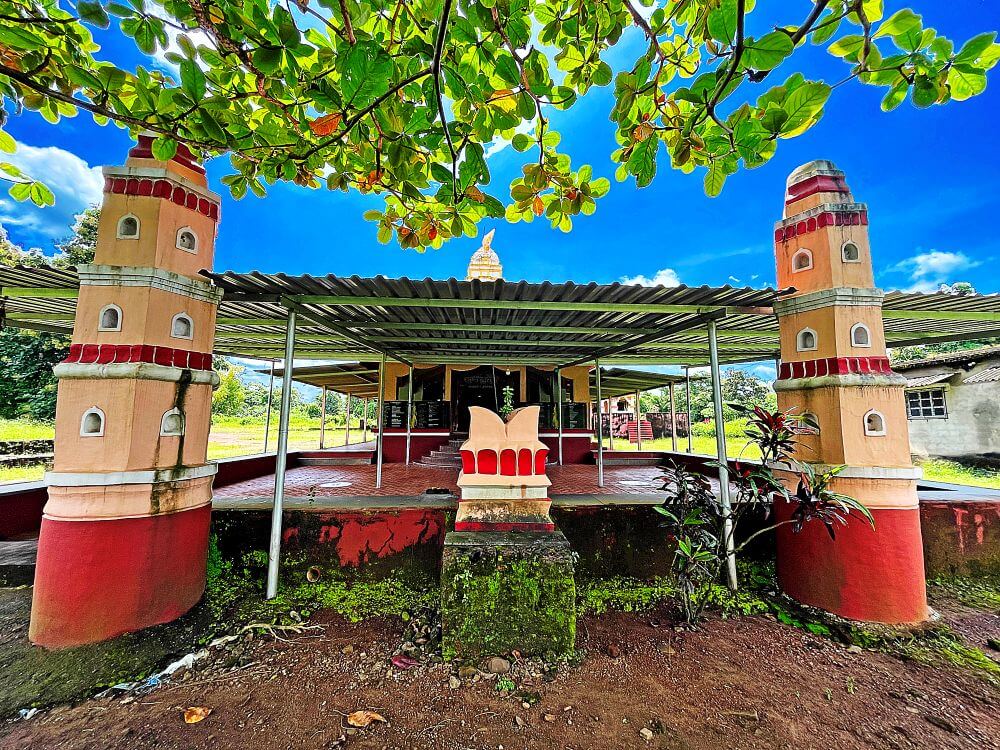
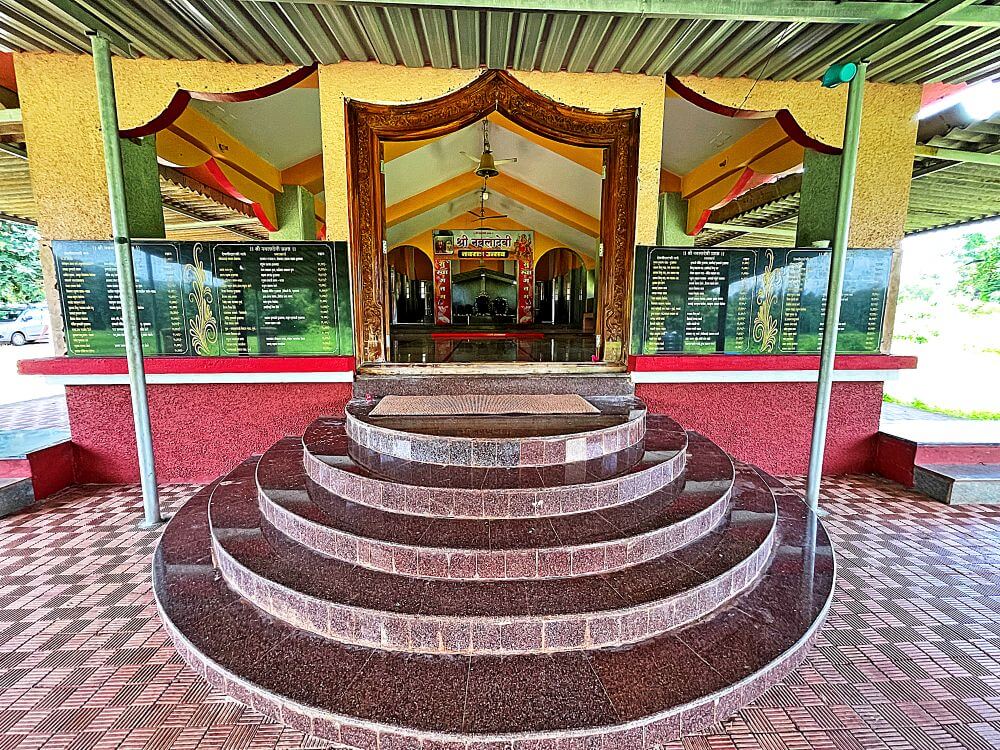
This temple of Navaladevi is located near the banks of the gently flowing Gothana River. The ancient temple was renovated in the year 2011. The temple structure consists of a Sabhamandapa (assembly hall) built on a high plinth, an Antarala (vestibule), and a Garbhagriha (sanctum sanctorum). On the front side of the temple, to the right and left, metal sheds have been erected for the convenience of devotees. There are two lamp towers (Deepmala) in front of the Sabhamandapa. These five-tiered lamp towers resemble small replicas of a four-storied square building. On the middle three levels, there are niches on all four sides where lamps are lit.
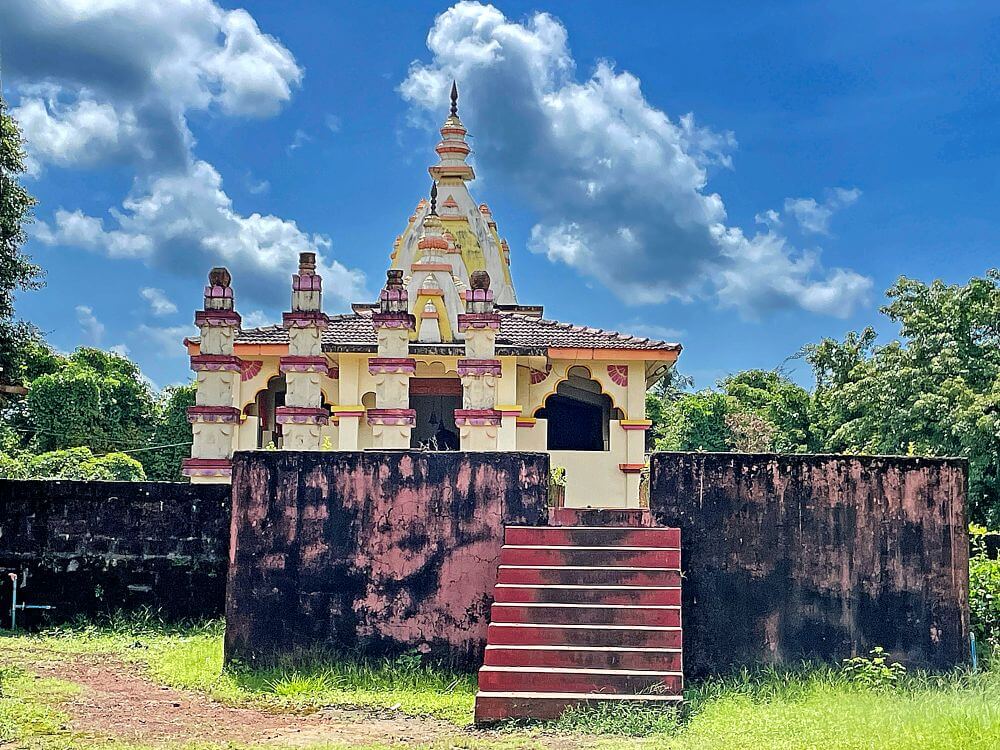
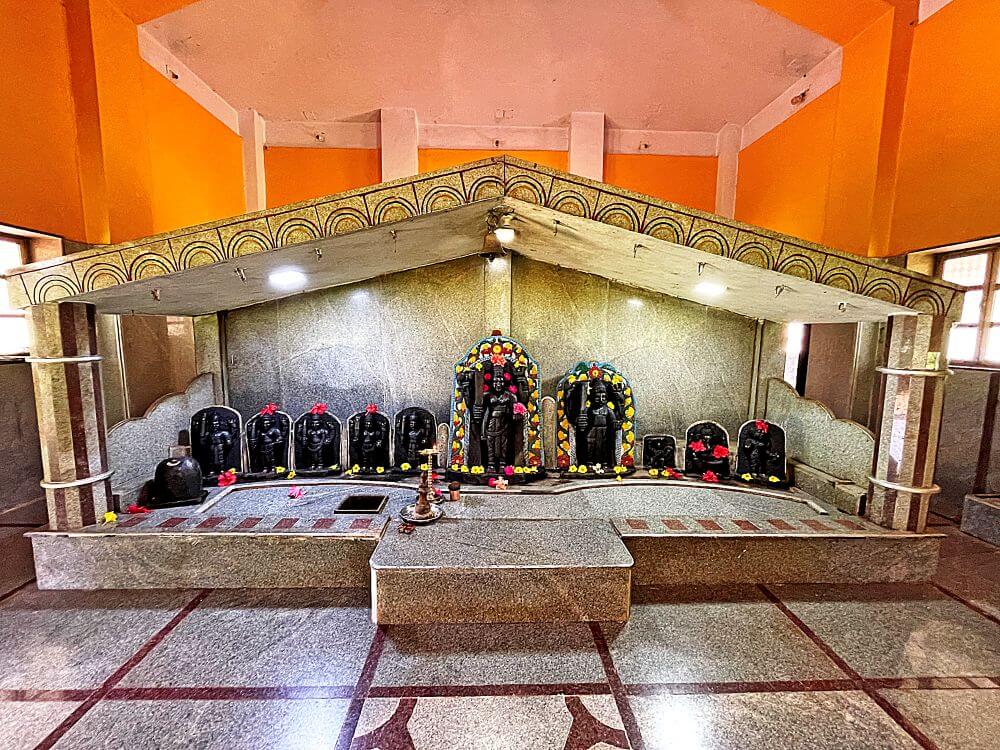
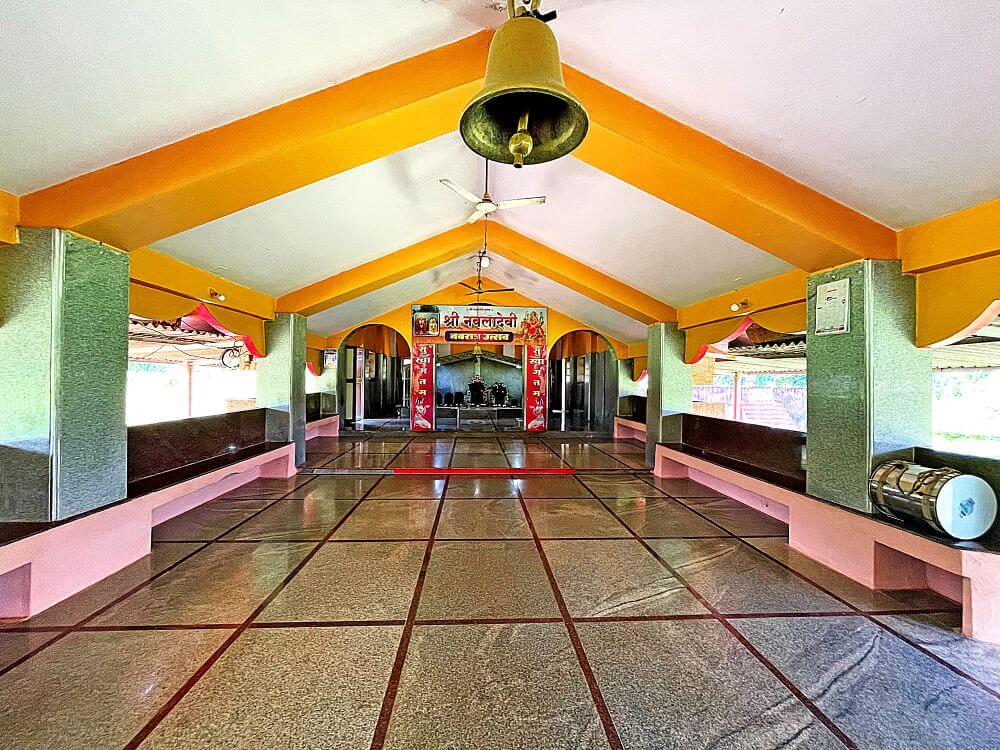
One enters the main Sabhamandapa by climbing six semi-circular steps. This rectangular Sabhamandapa is an open-style structure. The floor is paved with marble, and there are stone benches along the walls. In the Antarala, on the left side, the Goddess’s palanquin (Palkhi) is placed on a stone platform. During festivals, this palanquin is carried in a procession through the village. Beside the palanquin, four ceremonial poles (Khambakathi) are kept. Leaving a path for circumambulation (Pradakshina), the Garbhagriha is located in the center. Inside the Garbhagriha, on a Vajrapitha (throne), stands the elegant idol of Navaladevi. Carved from black stone, this idol is four-armed (Chaturbhuj) and stands in a balanced posture (Sampada). She holds a sword in one hand and a trident in the other. Beside Navaladevi is the idol of Ravalnath, holding a battle-axe, trident, and sword. Ravalnath is a principal deity of the Konkan region and is considered a manifestation of Shiva. Since the Goddess is the primordial energy (Adishakti/Adimaya), Shiva is always by her side; here, he is in the form of Ravalnath. On the Vajrapitha, beside the Goddess, there are also idols of eight other deities, including Ganesha. Although the temple is tiled, the Sabhamandapa and Garbhagriha feature distinct, tall spires (Shikhara). These spires are adorned with auspicious pots (Mangalkalash) and smaller replicas of the spires themselves.
A royal court (Raj Darbar) is held at the Navaladevi temple every Tuesday. Devotees from the surrounding five villages come to present their grievances and seek the Goddess’s blessings. The Holi festival is celebrated here on a grand scale, during which the Goddess’s palanquin is taken to every home with great fanfare. Navaratri and Dev-Diwali are also celebrated with immense enthusiasm. On the first day of the annual fair (Yatrotsav) held on Mahashivratri, the palanquin of Navaladevi, along with the ceremonial poles, standards, and royal umbrellas, is carried through the village in a grand procession.
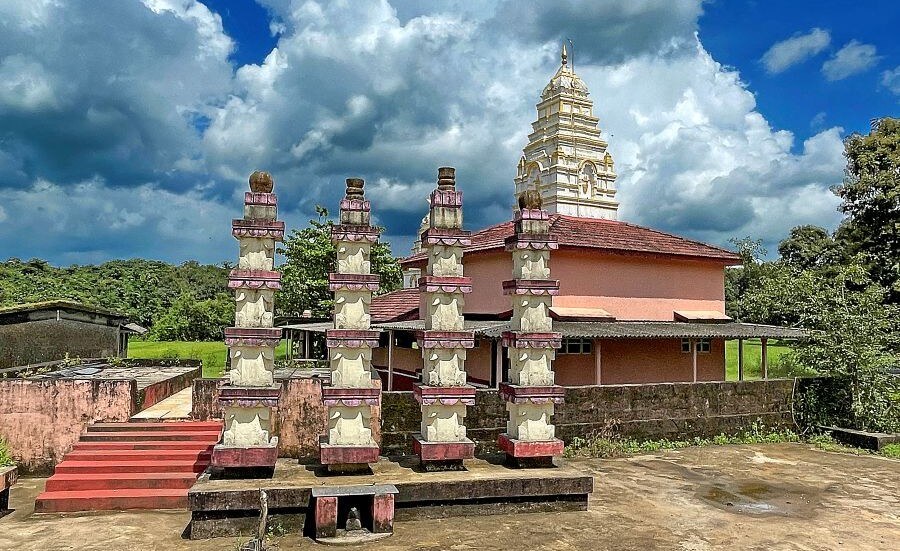
Behind the Navaladevi temple, on a high plinth, stands the large temple of Nageshwar Mahadeva. One can reach this temple by exiting through the Antarala of the Navaladevi temple. One enters the courtyard of the Nageshwar temple after climbing 10 steps from the ground. In front of the temple, there are four lamp pillars on a rectangular platform. Beside it, on another platform, is a Tulsi Vrindavan. The temple is designed with a Darshan Mandapa, Sabhamandapa, and Garbhagriha. Entering the Darshan Mandapa requires climbing four steps. As one moves forward from the Darshan Mandapa, the wooden carved entrance of the Sabhamandapa comes into view, featuring exquisite craftsmanship. An idol of Ganesha is carved into the wood on the lintel of the doorway. The Sabhamandapa here is open-style. In its center, on a small platform, is an idol of Nandi made of black stone. In front of it is a white marble idol of a tortoise. The entrance to the Garbhagriha is also wooden and features attractive carvings, similar to the main entrance. On small platforms on both sides of the entrance, there are white marble idols of Ganpati and Shri Krishna. In the center of the Garbhagriha is a Shiva Linga (Patal-lingi Shivpindi) carved from a single piece of stone. Like the Navaladevi temple, this temple is also tiled and features spires over the Darshan Mandapa and Garbhagriha. Every Monday, Abhishek and Mahanaivedya are performed at the Nageshwar temple. (Contact: Priest, Janardan Gurav (Lingayat), Mobile: 9923351498)
This sacred temple stands as a testament to deep spiritual devotion, ancient architectural grandeur, and rich local cultural traditions.
The sanctum sanctorum houses the divine idol consecrated according to ancient Vedic traditions, surrounded by serene courtyards and traditional temple architecture.
Navratri, Maha Shivratri, Annual Temple Jatra & Deepotsav
Compare and book flights, secure top-rated local hotels near the temple, hire reliable guides, and rent cars instantly.
Extend your pilgrimage by visiting other highly sacred temples located nearby.


Add ₹999 more to unlock FREE SHIPPING!
Your sacred cart is currently empty.
Shop Photo FramesFill in your delivery details below to place your order.
Add comment