
Add ₹999 more to unlock FREE SHIPPING!
Your sacred cart is currently empty.
Shop Photo FramesAmong the ten avatars of Lord Vishnu—Matsya, Kurma, Varaha, Narasimha, Vamana, Parashurama, Rama, Krishna, Buddha, and Kalki—Maryada Purushottam Shri Ram is considered the seventh avatar and is worshipped accordingly. However, many scriptures mention that Shri Ram himself performed daily worship of Lord Shiva. This is why one often finds a Shiva Linga in Ram temples or Ram idols in Shiva temples. One such Ram temple containing a Shiva Pindi is located in the village of Karagani in Atpadi Taluka. Devotees hold a deep faith that the deity in this temple is ‘Jagrut’ (awakened) and grants the wishes of those who pray with sincerity.
The legend regarding the temple states that while Shri Ram, Lakshman, and Sita were in exile, they resided here. At that time, Shambari, the son of Ravana’s sister Shurpanakha, was performing penance in this area to obtain a divine weapon called ‘Kaalkhadga’ from the Sun God. Pleased with his penance, the Sun God sent the Kaalkhadga weapon from the sky for him. At that very moment, Lakshman had come to this place to collect flowers. He caught this divine weapon as it descended from the sky and, to test its sharpness, struck it against a nearby bamboo thicket.
Lakshman’s action not only completely severed the bamboo thicket but also killed Shambari, who was performing penance in that forest. As Shambari’s head was severed, streams of blood began to flow. Lakshman feared that he had committed the sin of killing a meditating Brahmin. To seek liberation from this sin, he worshipped Lord Shiva. Lord Mahadev then appeared and told Lakshman that the one who died was not an innocent soul but the wicked demon Shambari. Mahadev had orchestrated this event to prevent the divine weapon from falling into the demon’s hands. Subsequently, a Shiva Linga appeared there. It is said that the Shiva Linga currently in the temple is the same one. The village was named ‘Khadgani’ after the Kaalkhadga weapon that fell into Lakshman’s hands, which later evolved into the name ‘Karagani’ .
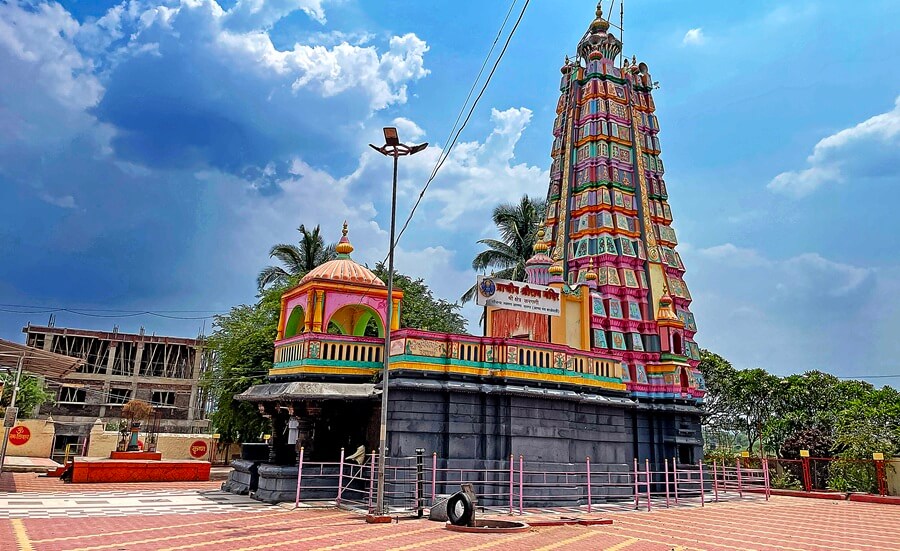
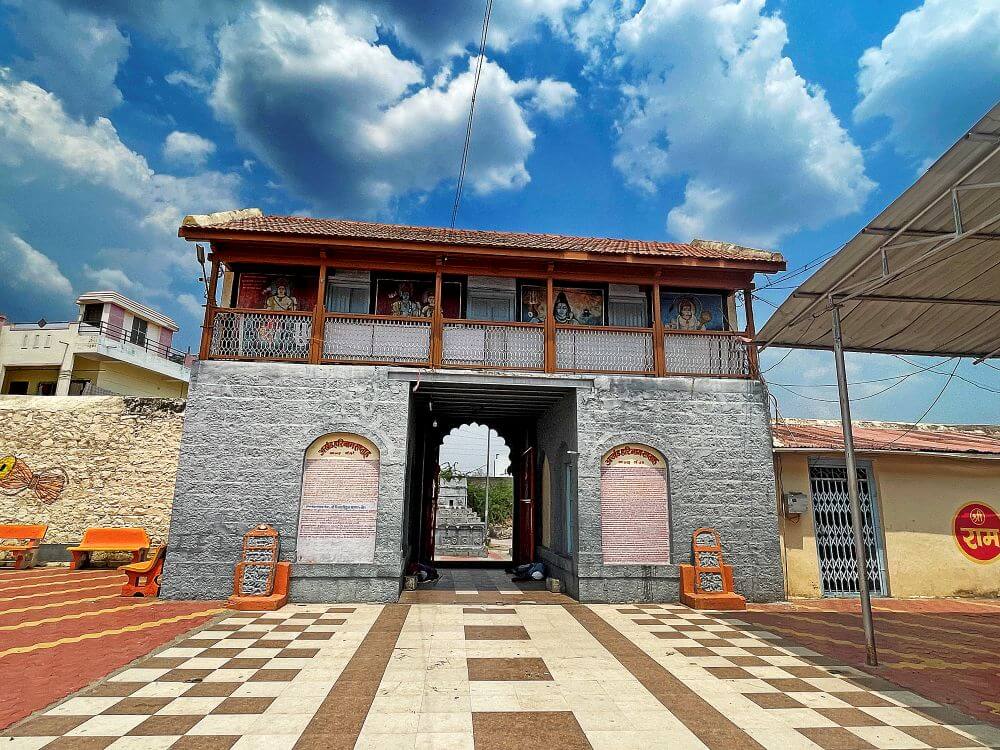
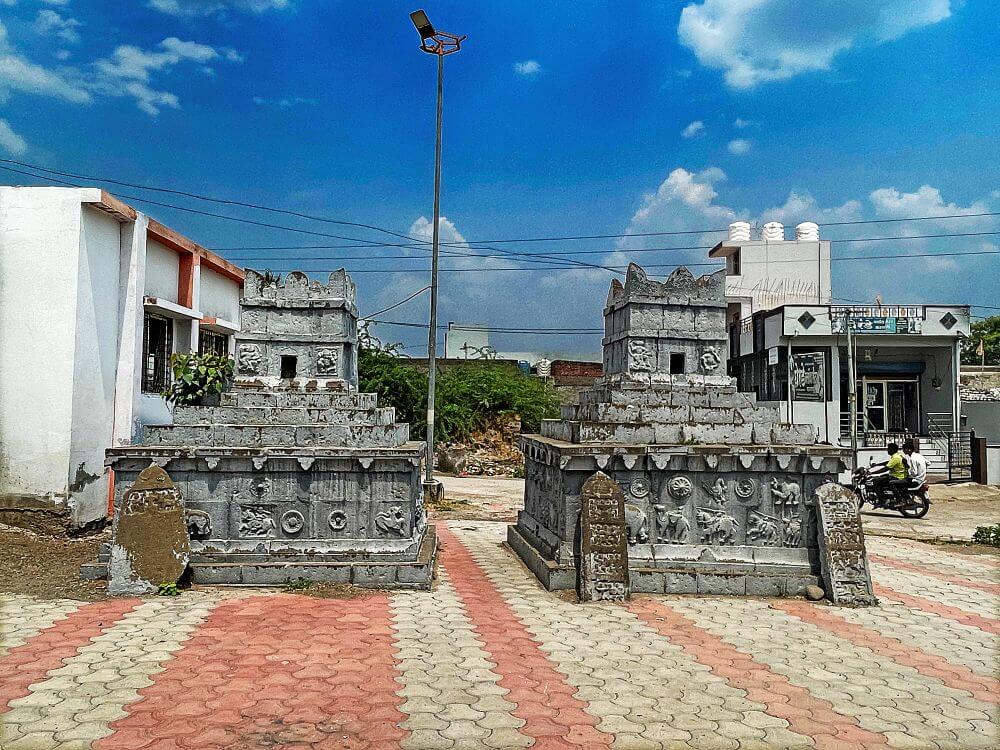
This temple is said to be approximately eight hundred to nine hundred years old. The temple is surrounded by a stone fortification about twelve feet high. The fortification features a grand and sturdy two-story main entrance. There are pillars on both sides of the entrance, with beams above and a roof over them. There is a ‘Nagarkhana’ (drum house) on the roof. A large clock is embedded in the front wall of the Nagarkhana. An inscription here mentions, “The cost of the renovation of the Shri Ram entrance gate is thirty thousand Rupees, year १९५८.” The entrance features an arched gateway with a lotus flower carving in the center. Among the seven brackets on the entrance, a small chandelier is carved on the middle one. There is one Kirtimukh sculpture on the beam and two on the lintel of the entrance. Inside the entrance, on both sides, there are guard rooms with wooden shutters. There is a staircase leading from the guard room to the temple’s Nagarkhana. The Nagarkhana has a tiled roof. Two ‘Veergals’ (hero stones) are placed against the wall of the guard room. There are two more entrances in the temple’s fortification on the left and right sides. To enter the courtyard from the elevated entrance on the right , one must descend seven steps. This entrance has pillars on both sides and an arch with a balcony above. There are two ‘Samadhis’ (memorial shrines) near the fortification here. The stone walls of the Samadhis feature carvings of camels, elephants, horses, peacocks, and mythical beasts (Vyala) in the lower layer, and idols of Maruti and Ganpati in the upper layer. There are also some Veergals near the Samadhis.
The temple courtyard is paved with paver blocks. In the courtyard, next to the temple, there is a Tulsi Vrindavan on a raised platform. Near this platform, there is a Naga stone. The temple structure consists of a Mukhamandapa (front hall), Sabhamandapa (assembly hall), Antarala (vestibule), and Garbhagriha (sanctum sanctorum). The Mukhamandapa has two ornate pillars. These pillars are shaped in various geometric forms such as circles, squares, hexagons, and octagons. At their tops are square capitals, and beams rest upon the brackets above them. There is a roof over the beams. Stone benches are provided in the Mukhamandapa for devotees to sit. The pillars, walls, and ceiling of the Mukhamandapa are adorned with various carvings of Surasundaris (celestial beauties), Yaksha figures, and floral patterns. Further ahead is the entrance to the Sabhamandapa. The door frames feature vertical carvings, and there is an idol of Ganesha on the lintel. There is a ‘Chandrashila’ (moonstone) at the threshold and Kirtimukhas on both sides. The entrance is flanked by pillars, and the architrave above features carvings of Yakshas and a Shikhar (spire) design.
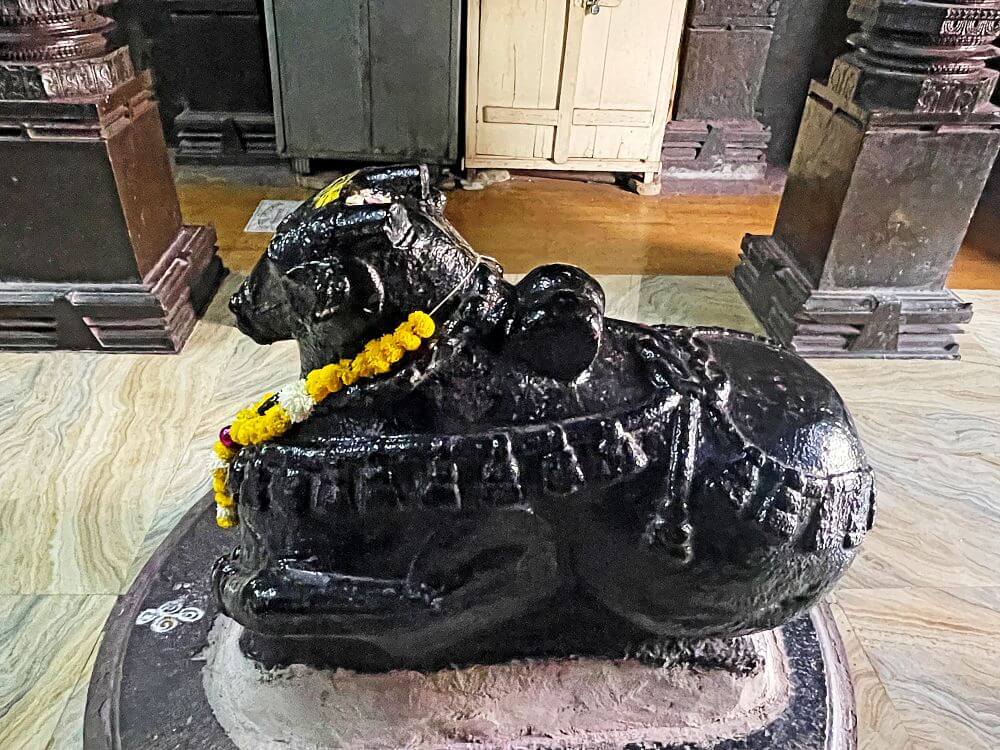
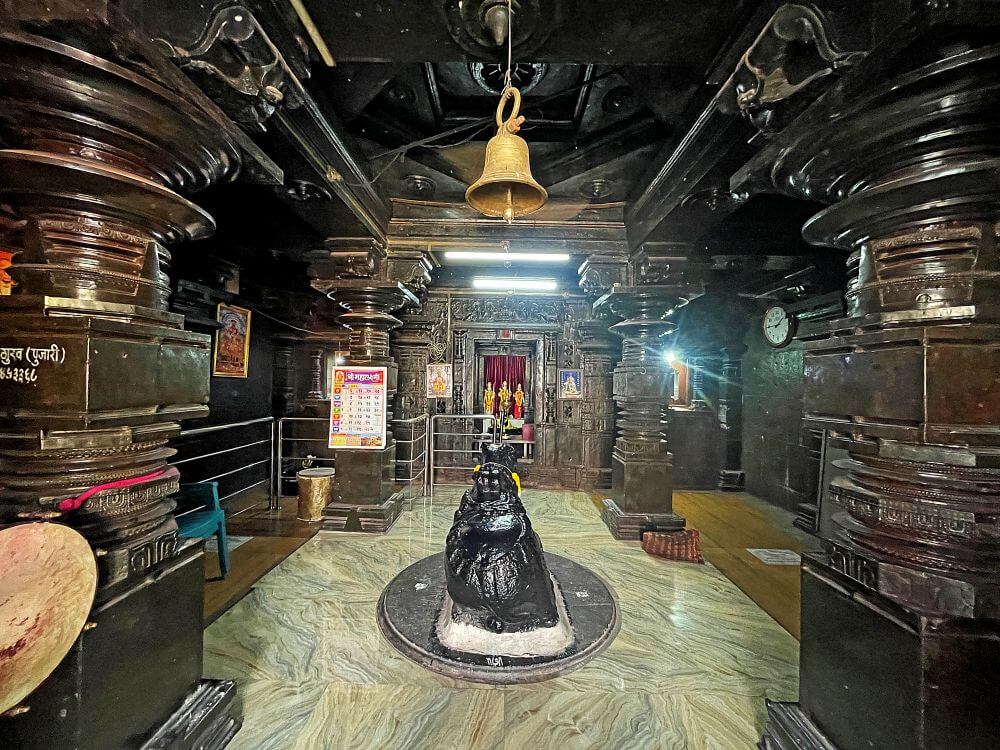
The enclosed Sabhamandapa (Gudhamandapa) has four rows of four ornate pillars each. The outer pillars are embedded in the walls. The pillar bases are wider than the pillars themselves. One of these pillars features a carving of a pair of peacocks, while another features an eight-armed Mahishasuramardini. On the floor of the Sabhamandapa, there is a Shiva Pindi, a tortoise, and an idol of Nandi made of black stone on a nearby platform. Additionally, there are idols of Shri Krishna in the left chamber and Shri Dattatreya on the right. Further ahead is the entrance to the Antarala. The door frames have vertical carvings, and there is an idol of Ganpati on the lintel. Above the lintel, in the arch, are the idols of Goddesses Lakshmi, Saraswati, and Parvati , along with Vyala sculptures and Kirtimukhas. The threshold has a Chandrashila in the center and Kirtimukhas on both sides. On both sides of the entrance, there are latticed windows with floral carvings.
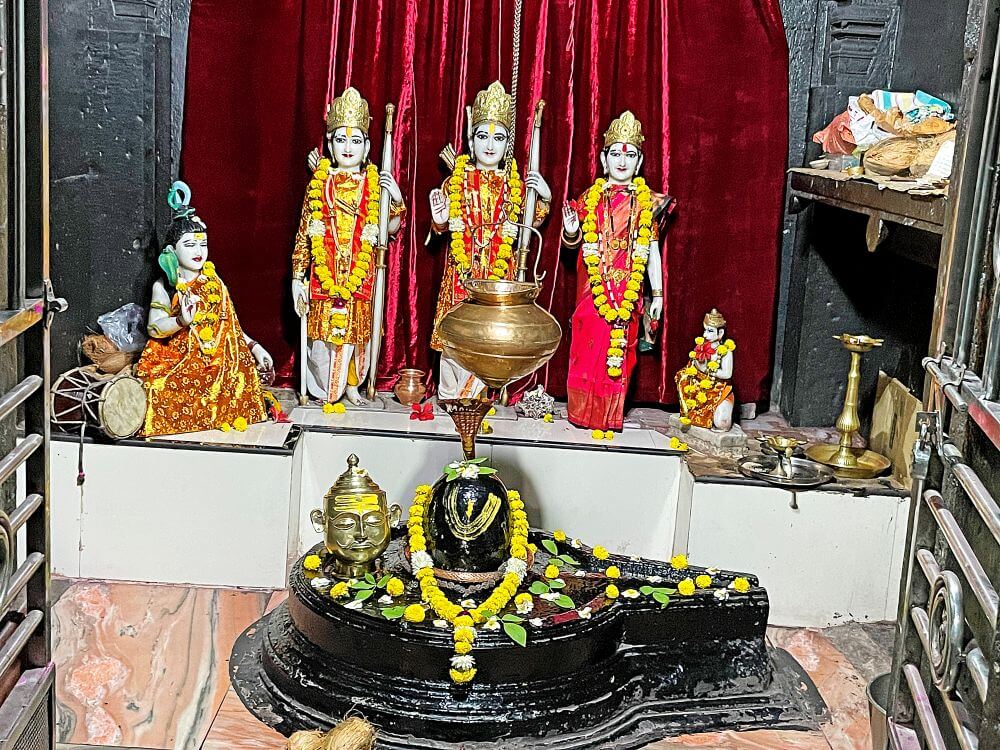
The walls of the Antarala feature various sculptures, geometric figures, and floral designs. The squares on the ceiling contain various carvings, with chandeliers depicted on all four sides. Further ahead is the entrance to the Garbhagriha. The door frames feature vertical carvings, a Ganesha sculpture on the lintel, and various figures carved in the arch above the lintel. Inside the Garbhagriha, there are idols of Shri Ram, Lakshman, and Sita on a Vajrapitha (throne). On the Vajrapitha, to the left, is an idol of Shiva, and to the right is an idol of Maruti. All idols are adorned with fine garments and ornaments. In front of the Vajrapitha on the floor, there is a Shiva Pindi, a brass five-hooded serpent holding an umbrella over it, and a mask.
There is a safety railing around the temple roof. On the roof of the Mukhamandapa, there is a ‘Meghadambari’ (canopy) topped with a dome-shaped Shikhar. At the apex of the Shikhar is an Amalaka and It is crowned with a kalash. On the ceiling of the antarala, there is a rectangular canopy, topped with four small shikhara at the four corners, an amalaka, and a kalash above it. In the center, there is a dome-shaped shikhara with a kalash atop its amalaka. Above the ceiling of the garbhagriha, there is a twelve-layered square shikhara. In the lower two layers of the shikhara, there are niches on all three sides, with a kalash atop the shikhara above them. Each layer of the shikhara features twenty-four relief sculptures and intricate carvings. On all four walls of the shikhara, there are decorative bands running from bottom to top in the central section. At the apex of the shikhara, there are four sub-shikharas at the corners, each topped with a kalash, and in the center, two amalakas stacked one above the other. There is a kalash atop the amalaka. The parapet and shikhara on the temple roof were constructed in the year 1975.
There are niches on the exterior of the temple’s garbhagriha. There is a circumambulation path around the temple. Near the circumambulation path, there is an ancient stone vessel. Additionally, there are Naga stones near the platform of the Audumbar tree in the courtyard. Mahashivratri is the main annual fair celebrated here. A large market for Khillar bulls is held on the occasion of the fair. Shri Ram Jayanti festival is also celebrated here on a grand scale. During this time, grand wrestling matches are organized. Many wrestlers and pehlwans from the entire district participate in these matches. On the day of Makar Sankranti, a huge crowd of women bringing offerings gathers at the temple, giving the premises the appearance of a fair. In the month of Shravan, an eight-day continuous Harinam Saptah is organized. On this occasion, the recitation of the Dnyaneshwari scripture and Mahaprasad are arranged. During all annual festivals, thousands of devotees visit the temple for the darshan of the deity and to fulfill their vows.
This sacred temple stands as a testament to deep spiritual devotion, ancient architectural grandeur, and rich local cultural traditions.
The sanctum sanctorum houses the divine idol consecrated according to ancient Vedic traditions, surrounded by serene courtyards and traditional temple architecture.
Navratri, Maha Shivratri, Annual Temple Jatra & Deepotsav
Compare and book flights, secure top-rated local hotels near the temple, hire reliable guides, and rent cars instantly.
Extend your pilgrimage by visiting other highly sacred temples located nearby.


Add ₹999 more to unlock FREE SHIPPING!
Your sacred cart is currently empty.
Shop Photo FramesFill in your delivery details below to place your order.
Add comment