
Add ₹999 more to unlock FREE SHIPPING!
Your sacred cart is currently empty.
Shop Photo FramesThere is a unique bond between Lord Shri Ramchandra and the region of Goa-Konkan. According to mythological legend, Parashurama, the creator of the seven Konkans, tested the prowess of Lord Shri Ram and gifted Him his bow. At the time of this gifting of the bow, Parashurama transferred his radiance to Rama. It is in this land of Parashurama that one finds many temples of Shri Ram. One such beautiful temple is situated in the town of Colvale, which boasts the second-longest beach in Goa. This temple of the Shri Ram Panchayatan is a place of faith for thousands of devotees in Goa.
Lord Shri Ram is considered an avatar of Lord Vishnu. Records indicate that the Vaishnava sect, which worships Vishnu, spread in Goa in the first century BCE. Consequently, the worship of Narayana is seen to be widespread in Goa. There are many temples of Narayana in North Goa. Temples of Vishnu in forms such as Keshav, Madhav, Vaman, Damodar, and Narasimha also exist in Goa. According to the Bharatiya Sanskriti Kosh, the Vaishnava sect gained great strength during the Gupta period, that is, the fourth century CE, and it was during this time that the Rama-bhakti branch of the Vaishnava sect also flourished. The sectarian forms of Rama developed during the Gupta period itself. After the worship of Rama became popular everywhere in the eleventh century, temples of Shri Ram were also built in Goa. Among them, this Shri Ram Panchayatan temple in Colvale is of recent origin, having been built 85 years ago.
The village of Colvale also has a connection to the history of Chhatrapati Shivaji Maharaj. In the year 1635, under the orders of the then Portuguese Viceroy, Dom Miguel de Noronha, Count of Linhares, a fort was built at Colvale. In the year 1667, Shivaji Maharaj invaded this region to bring the rebellious Desais of the Bardez area to heel. The Desais took refuge with the Portuguese. Maharaj then attacked the Portuguese as well and put many to the sword. To defeat the Portuguese who were fighting from the shelter of the Colvale fort, Maharaj laid siege to it. He captured this fort on 20 November 1667. During this period, Maharaj stayed in this village for three consecutive days. After some time, this fort went back into the hands of the Portuguese. Later, in 1683, Chhatrapati Sambhaji Maharaj also won this fort from the Portuguese. In this village, which is a witness to the valor of the Marathas, the temple of Shri Ram, the ideal of heroism, was established on 15 March 1940, on the auspicious occasion of Phalguna Shukla Shashthi.
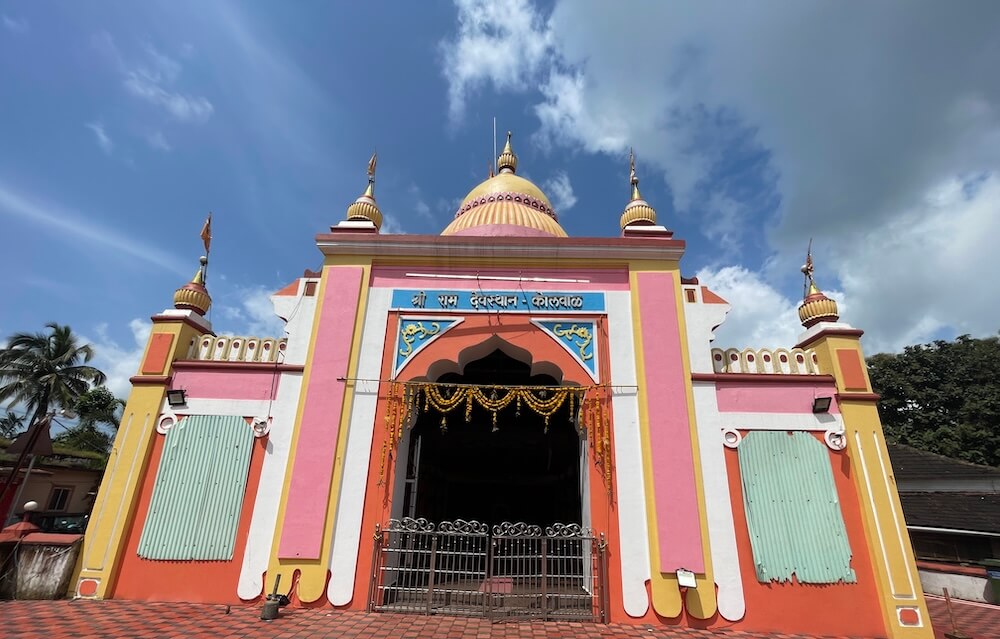
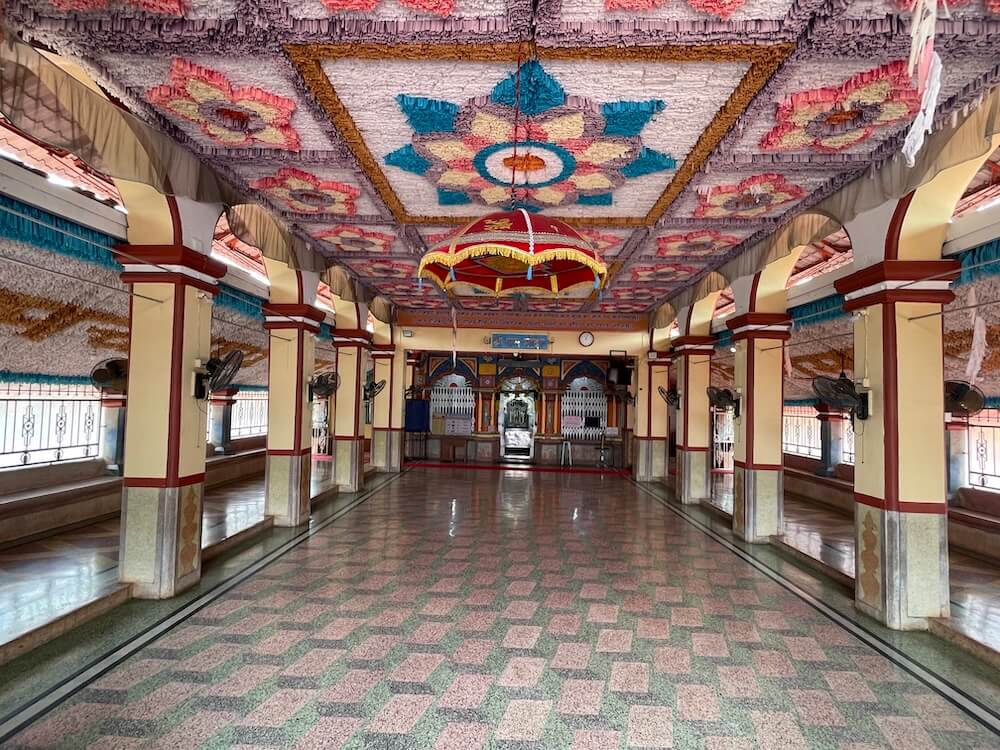
The temple stands in a spacious courtyard in a lush green area rich in coconut and areca nut plantations. In the temple courtyard, there is a large hall built by the villagers for various religious and cultural programs. In front of it, on a platform, is a Tulsi Vrindavan. A short distance ahead stands the tall and magnificent temple of Shri Ram. Built in the Goan architectural style, this temple has a tall entrance with an arched gateway. On both corners of the temple’s front wall, as well as on both sides of the entrance, there are four tall, tower-like pillars topped with kalashas. Above the entrance, on the roof, is a large dome-shaped shikhara with a tall kalasha atop it. Like other temples in Goa, this temple has a spacious rectangular sabhamandapa. This semi-open sabhamandapa has stone benches (kakshasanas) on both sides and windows in its upper section. From here, there are rows of pillars on both sides, leaving some space. On the ceiling of the sabhamandapa, there is a spectacular rangoli made with paper streamers on the inside. A large red-colored canopy is hung in the center here.
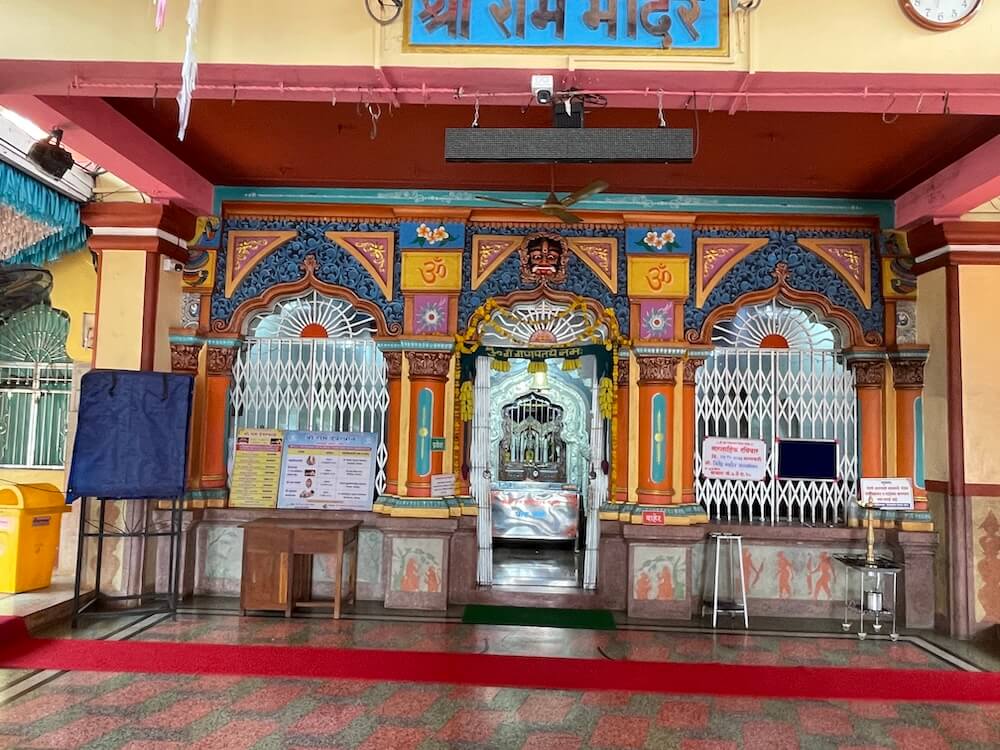
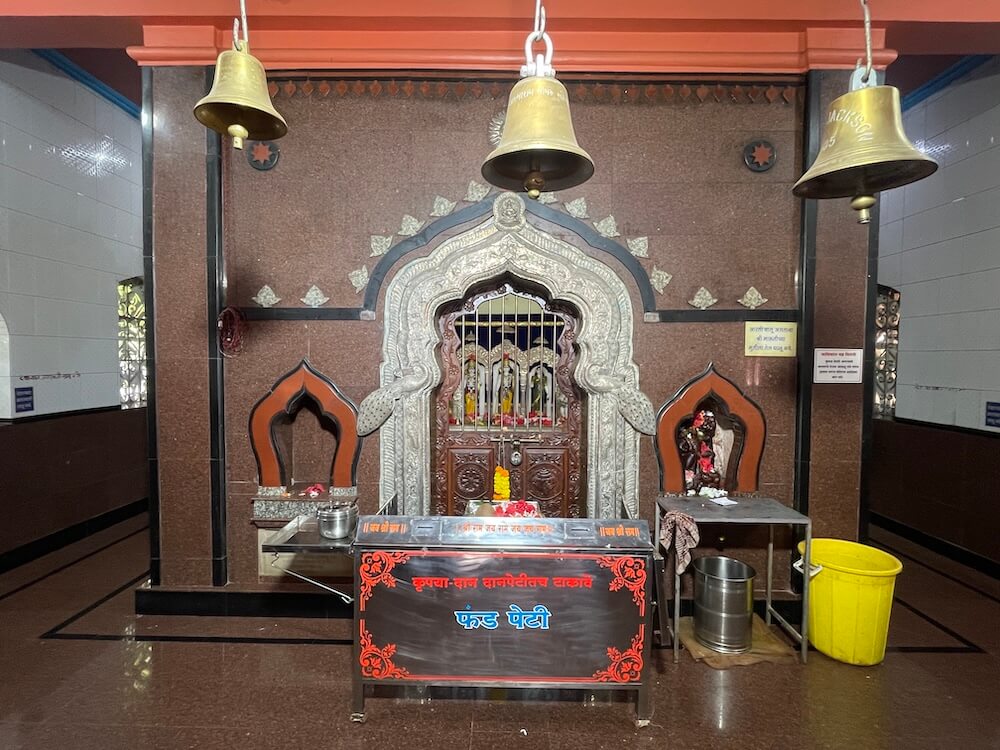
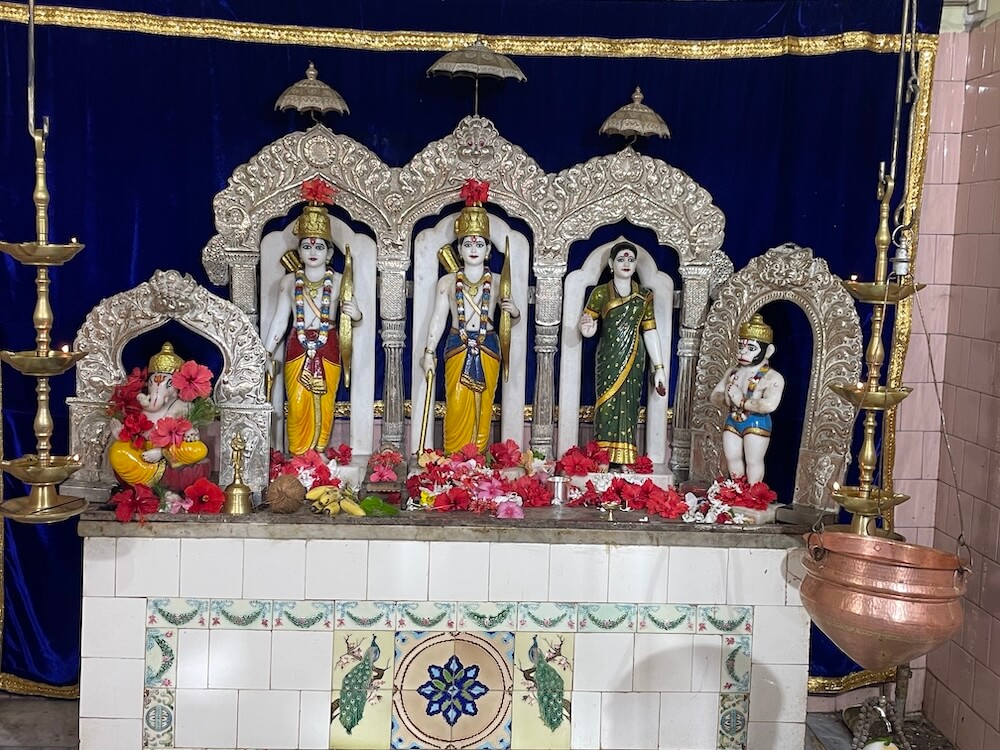
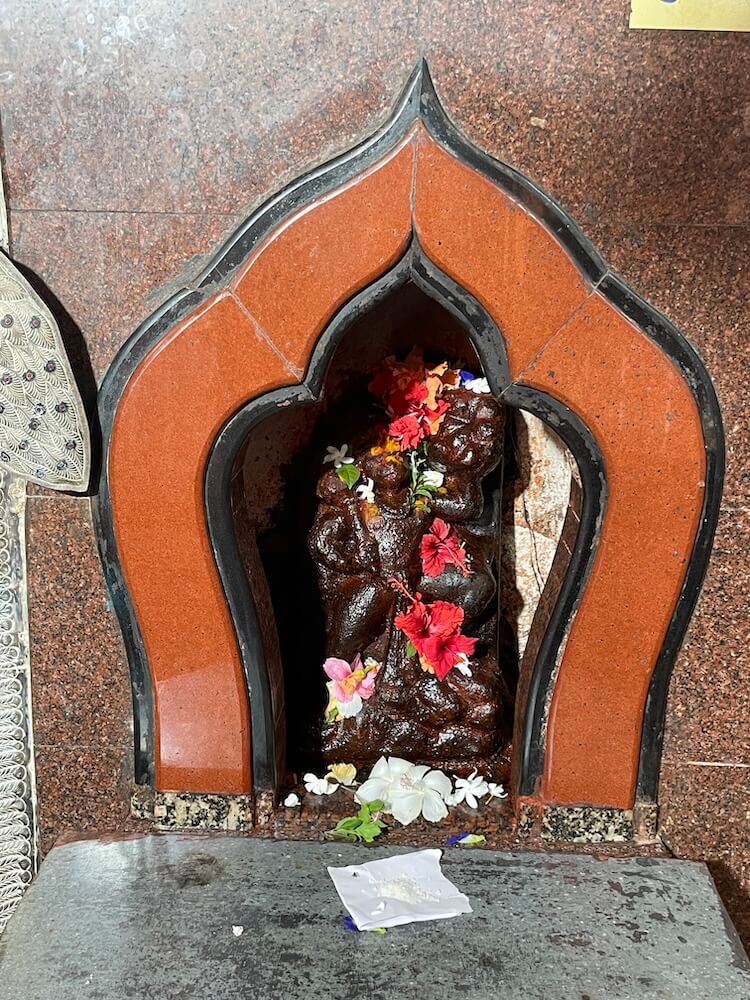
Directly in front is the ardhamandapa of the temple. On both sides of the entrance in its front wall are two large arched windows. Below them, some episodes from the Ramayana are depicted. Above the entrance is a Kirtimukha. Leaving a circumambulation path (pradakshina marg) on the sides of the ardhamandapa, the sanctum sanctorum (garbhagriha) of the temple is in the center. The entrance to this sanctum, decorated with marble tiles, is covered with silver plating featuring intricate carvings. On its door pillars, beautiful peacock figures are carved in the center, while a carved idol of Ganesha is seated at the lintel (lalatabimba). On both sides of the entrance are two niches. In the niche on the right is a stone idol of Hanuman. Devotees offer oil to this idol. Inside, on a marble platform, are the idols of Lord Shri Ramchandra, Lakshmana, and Sita in silver shrines (makharas). These idols, crafted in marble stone, are adorned with garments and ornaments. A unique feature of the idol of Mother Sita here is that she is wearing a saree in a modern style. In the shrine to the left of these idols is an idol of Ganesha, and in the shrine to the right is an idol of Hanuman in a salutation posture.
In this temple of Shri Ram, Ram Navami is the biggest festival, celebrated with great pomp every year. A huge crowd of devotees gathers here during this festival. Apart from this, Maha Shivaratri and Hanuman Janmotsav are also celebrated on a large scale. Phalguna Shukla Shashthi is the foundation day of the Shri Ram temple. Various religious and cultural programs are organized here on this auspicious day as well.
This sacred temple stands as a testament to deep spiritual devotion, ancient architectural grandeur, and rich local cultural traditions.
The sanctum sanctorum houses the divine idol consecrated according to ancient Vedic traditions, surrounded by serene courtyards and traditional temple architecture.
Navratri, Maha Shivratri, Annual Temple Jatra & Deepotsav
Compare and book flights, secure top-rated local hotels near the temple, hire reliable guides, and rent cars instantly.
Extend your pilgrimage by visiting other highly sacred temples located nearby.


Add ₹999 more to unlock FREE SHIPPING!
Your sacred cart is currently empty.
Shop Photo FramesFill in your delivery details below to place your order.
Add comment