
Add ₹999 more to unlock FREE SHIPPING!
Your sacred cart is currently empty.
Shop Photo FramesIn the 17th century, two great saints of Maharashtra envisioned the ideal reign of Ramrajya (the divine kingdom of Lord Ram). Saint Tukaram Maharaj envisioned it saying, “Jhale Ramrajya kay une amhasee” (With the arrival of Ramrajya, what could we possibly lack?), while Samarth Ramdas Swami sang the glory of Lord Ram with the words, “Kari durjanancha sanghar, bhakta janansi aadhar” (He who destroys the evil and shelters the devotees). These saints presented the ideal of Maryada Purushottam (the supreme embodiment of righteousness) before the contemporary Maratha rulers. Inspired by this, many kings and chieftains built grand temples dedicated to Lord Ram. One such Shri Ram Temple is located in Kagal town of Kolhapur district. Situated on the site of the erstwhile Ghatge Palace, this magnificent temple is also known as the Ghatge Ram Temple. Thousands of devotees visit here to admire the temple and to seek the blessed Darshan of Lord Ram.
The Ghatge dynasty is the ancestral family line of Chhatrapati Rajarshi Shahu Maharaj. This royal family has continuously preserved the legacy of Shahu Maharaj’s social work. Located near Kolhapur city in Kagal, the Shri Ram Temple is the revered family deity (Aaradhya Daivat) of this royal family. The site where the temple stands today was formerly the grand palace of the Ghatge family. Within this palace, there was a small shrine of Lord Ram; however, being ancient, it had fallen into dilapidation over time. Raje Vikramsinh Ghatge
, the descendant of this royal lineage, took a sacred vow (Sankalpa) to construct a grand Ram temple on the entire site of the ancient palace. For this, he decided to build the temple in the architectural style of the Akshardham temples in Delhi and Ahmedabad. Accordingly, the foundation stone laying ceremony took place in 2007, and the temple was opened to devotees in 2016.
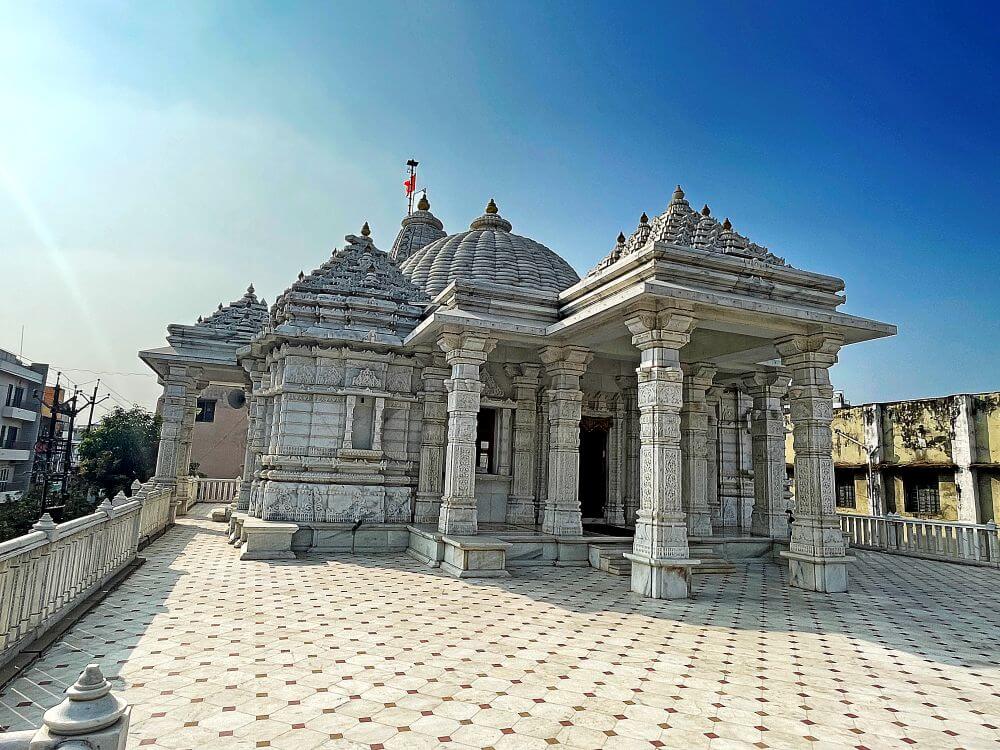
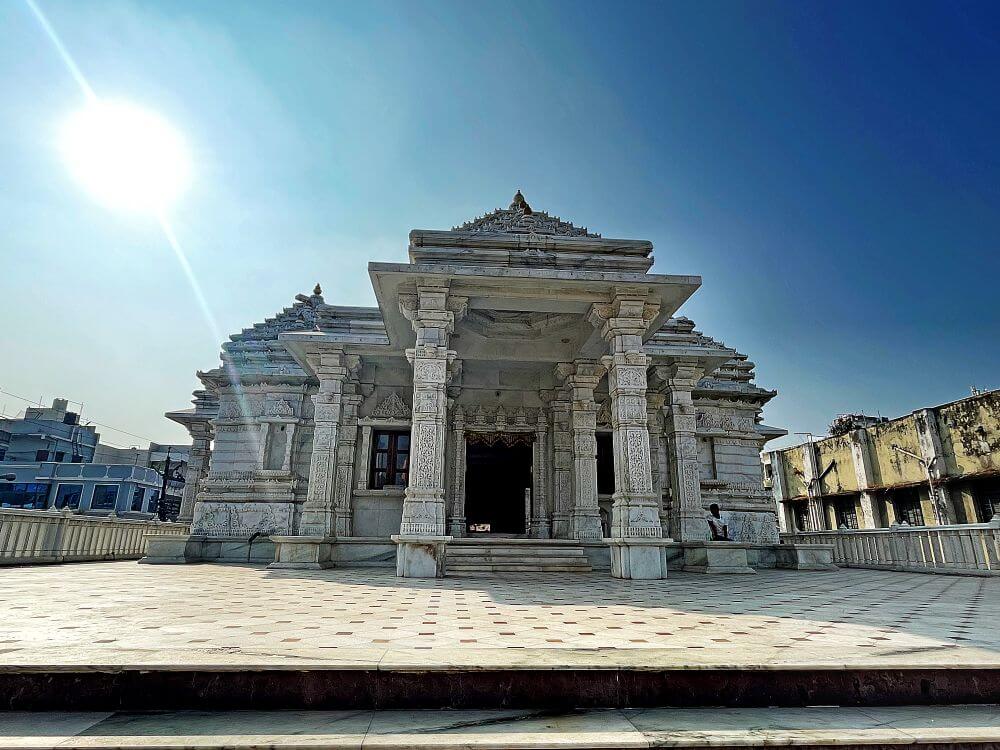
The temple is constructed from pure white Makrana marble sourced from Rajasthan, the same stone used in the construction of the Taj Mahal in Agra. This two-storied temple features twenty steps leading to the upper floor. The structure of the temple comprises a courtyard (Prangan), front porches (Mukhamandapa), an assembly hall (Sabhamandapa), and a sanctum sanctorum (Garbhagriha). The courtyard in front of the temple features marble flooring and is enclosed by outer walls on all sides. The temple has three front porches—at the front, left, and right—leading to the entryways of the Sabhamandapa. The porch near the main entrance features six intricately carved pillars. The base of these pillars is wider, topped with capital moldings, brackets (Hasta), and beams. These pillars are decorated with various carvings such as lotus flowers, leaf creepers, floral vines, and peacock motifs. The brackets feature carved chandeliers shaped like banana blossoms. A decorative carved dome adorns the ceiling of the Mukhamandapa.
Intricately crafted figures adorn the doorframes (Dwarasakha) of the Sabhamandapa. Sculptures of Lord Ram, Mata Sita, Lakshman, and Hanuman grace the lintel center (Lalatabimba). The lintel panel (Lalatapatti) is embellished with floral and leaf carvings. Inside the assembly hall, on the carved pillars to the right behind the entrance, sculptures of Lord Ram and Lakshman are carved amidst leaves and flowers, while the pillars on the left depict Bharat and Shatrughna. Furthermore, the pillars on either side near the sanctum sanctorum feature sculptures of Sage Valmiki, Lord Ram, Lakshman, Mata Sita, and Hanuman.
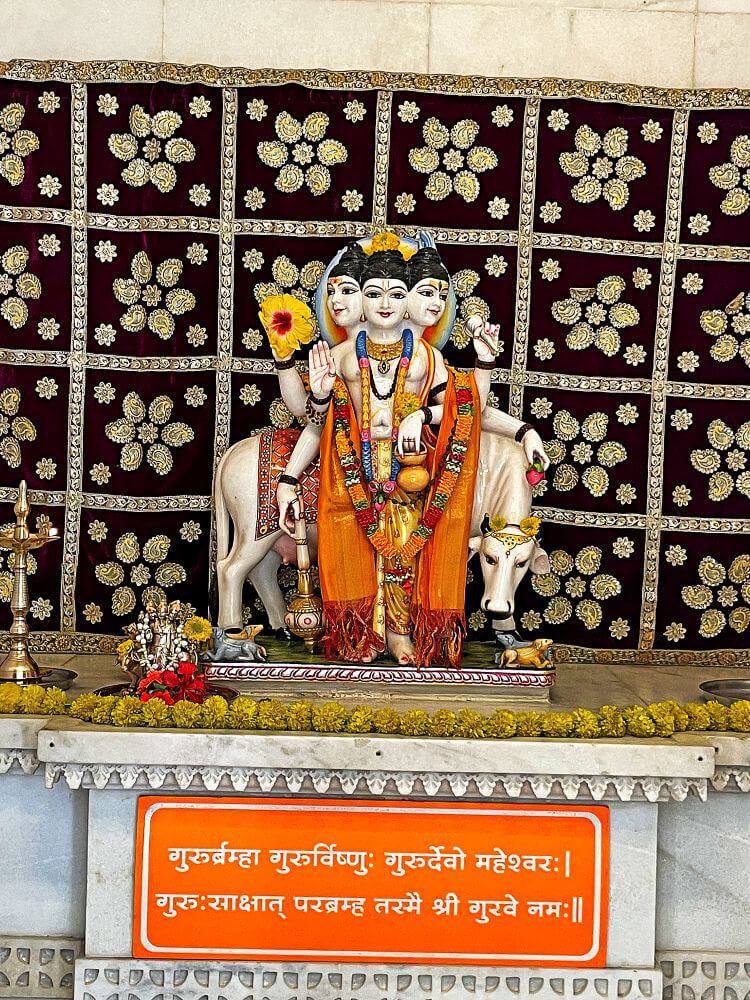
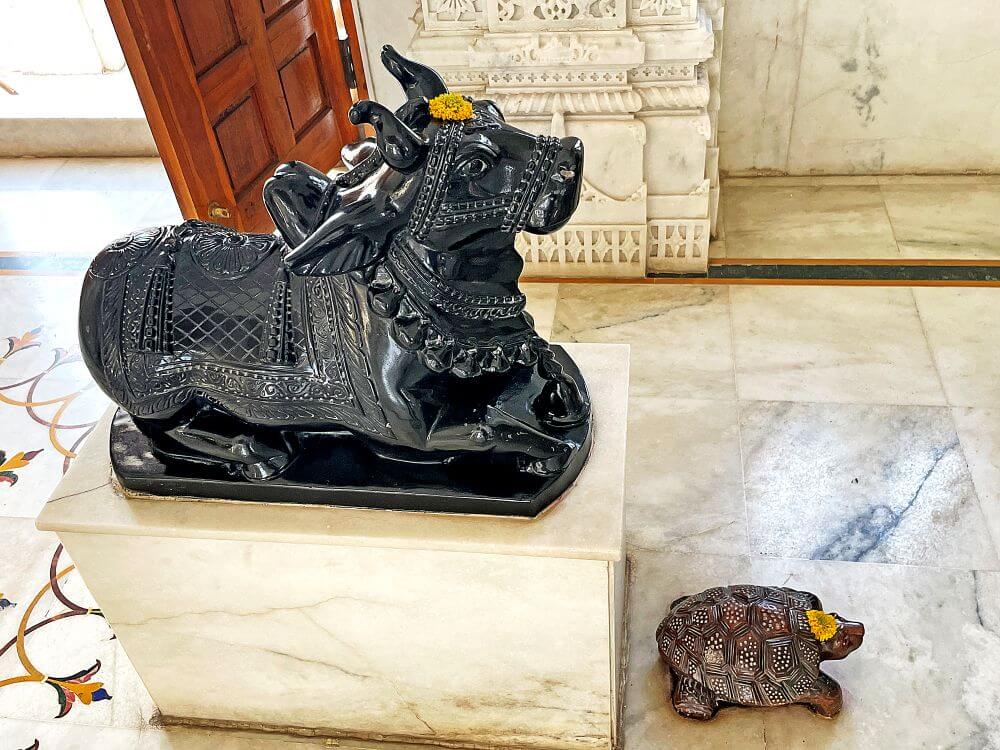
Along with the main sanctum sanctorum, the Sabhamandapa contains four sub-sanctums. On the two pillars to the right of the assembly hall, various forms of Lord Ganesha along with Riddhi and Siddhi are depicted. In the adjacent sub-sanctum, a four-armed marble idol of Lord Ganesha is enshrined on a raised pedestal (Vajrapeetha). On the two pillars to the left in the assembly hall, images of Lord Dattatreya, Lord Vishnu, Lord Ram, and Lord Krishna are carved. The sub-sanctum here houses an idol of Lord Dattatreya. Two more sub-sanctums are located to the right and left of the main sanctum sanctorum: one enshrines an idol of Goddess Mahalaxmi, and the other is dedicated to Lord Shiva and Goddess Parvati. Outside this sub-sanctum stands a Nandi idol carved from black stone. At the center of this sanctum is a Shivling, with an idol of Mata Parvati enshrined behind it.
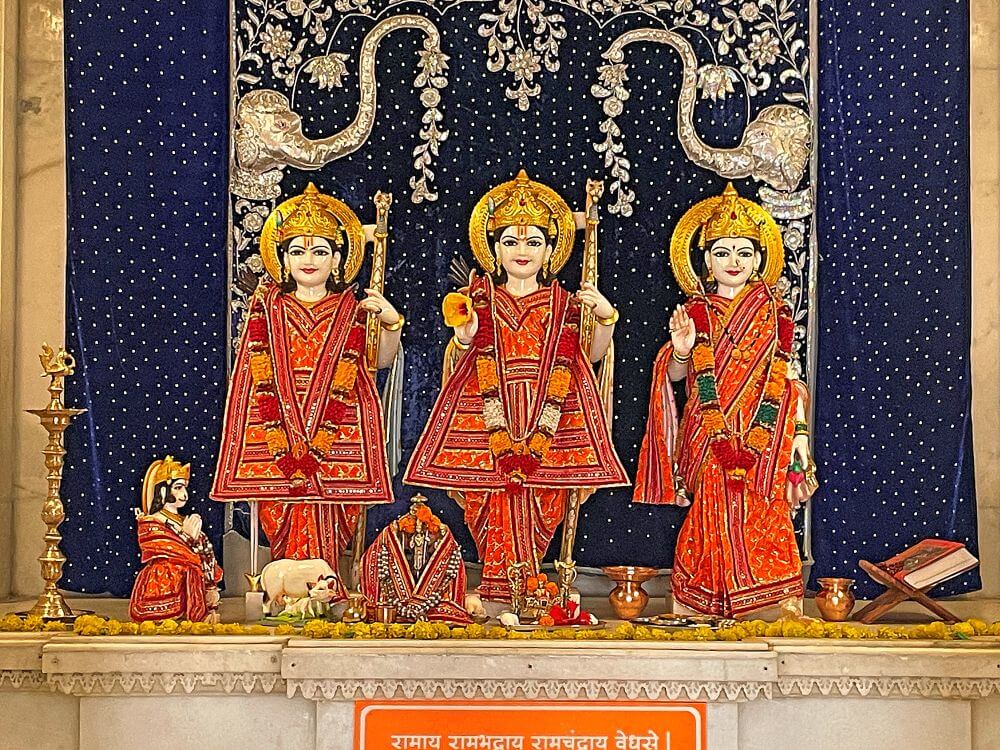
Two intricately carved pillars flank both sides of the main sanctum’s entrance. One pillar features sculptures of Lord Ram’s parents, Queen Kaushalya and King Dasharatha, while the other pillar depicts His sons, Luv and Kush. The doorframes of the sanctum are decorated with floral motifs, and Garuda is seated upon the lintel center (Lalatabimba). Above the lintel, sculptures depict nine of the ten avatars of Lord Vishnu: Matsya, Kurma, Varaha, Narasimha, Vamana, Parashurama, Krishna, Buddha, and Kalki. Characters from the Ramayana are artistically rendered on the doorway jambs. The threshold (Mandaraka) also features ornate carvings, accompanied by a semicircular moonstone step (Ardhachandrashila). Upon the raised pedestal (Vajrapeetha) inside this sanctum stand the majestic white marble idols of Lord Ram, Mata Sita, and Lakshman. In the background decorations behind the deities, royal elephants (Gajaraj) are depicted showering flowers. Here, near Lakshman’s feet, sits an idol of Lord Hanuman (Maruti).
The temple roof features nine spires (Shikharas). Square miniature spires, topped with Aamalaka (ribbed stone disks) and Kalash (finials), adorn the three front porches and the four sub-sanctums. Above the Sabhamandapa roof sits a dome-shaped spire topped with an Aamalaka and Kalash. Above the sanctum sanctorum, a tall, tapering square spire is surrounded on all four side walls by cascading tiers of miniature spire replicas. At the apex of the main spire rests an Aamalaka and a golden finial (Kalash). In the basement of the temple, there is a hall and meditation hall (Dhyan Mandir) spanning approximately 4,000 square feet.
Ram Navami and Vijayadashami are the main annual festivals celebrated at the temple. In addition, festivals like Shardiya Navratri, Gudi Padwa (Chaitra Padwa), Mahashivratri, Datta Jayanti, and Ganesh Jayanti are celebrated with grand enthusiasm. Thousands of devotees arrive to seek divine Darshan during all major annual festivals. On these auspicious occasions, various devotional and cultural programs such as Bhajans, Kirtans, Pravachans (spiritual discourses), and devotional music are organized. Situated at Khardekar Chowk, this temple is renowned as an outstanding masterpiece of architectural and artistic excellence. Consequently, thousands of tourists alongside devotees visit to witness this temple, which shares its architectural grandeur with the Akshardham temple style.
This sacred temple stands as a testament to deep spiritual devotion, ancient architectural grandeur, and rich local cultural traditions.
The sanctum sanctorum houses the divine idol consecrated according to ancient Vedic traditions, surrounded by serene courtyards and traditional temple architecture.

Navratri, Maha Shivratri, Annual Temple Jatra & Deepotsav
Compare and book flights, secure top-rated local hotels near the temple, hire reliable guides, and rent cars instantly.
Extend your pilgrimage by visiting other highly sacred temples located nearby.


Add ₹999 more to unlock FREE SHIPPING!
Your sacred cart is currently empty.
Shop Photo FramesFill in your delivery details below to place your order.
Add comment