
Add ₹999 more to unlock FREE SHIPPING!
Your sacred cart is currently empty.
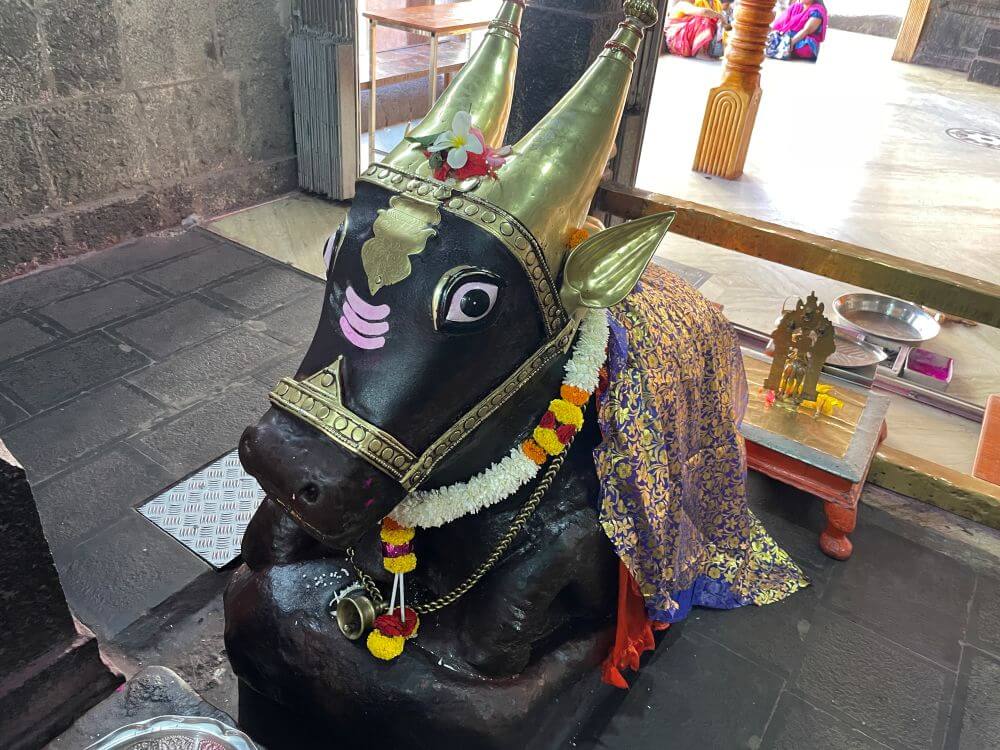
Shop Photo FramesAlthough Vaishnavism and Shaivism are two distinct sects in Hinduism, the Indian religious tradition considers Vishnu and Shiva—that is, Hari and Hara—to be one and the same. This truth is experienced at the Lakshmi-Narasimha temple in Sangavade. In this temple dedicated to Goddess Lakshmi, the consort of Vishnu, and Lord Narasimha, considered the fourth avatar of Vishnu, it is also believed that Lord Shiva resides here. Therefore, Nandi, who is usually seen in a Shiva temple, is enshrined in this temple. The local villagers state that such a temple where Vishnu and Shiva are worshipped together is rare.
The story of this fourth avatar of Lord Vishnu is given in chapters 41 to 43 of the Narasimha Purana. According to it, Prahlada, the son of the demon king Hiranyakashipu, was a staunch devotee of Lord Vishnu. Because of this, Hiranyakashipu made several attempts to kill him. When all those attempts failed by the grace of Lord Vishnu, he rushed towards Prahlada brandishing his sword named Chandrahasa. He said, “Tvayoktaṁ sa hi sarvatra kasmātstambhe na dṛśyate. Yadi paśyāmi taṁ viṣṇumadhunā stambhamadhyagam..” This means, you used to say that Vishnu is present everywhere. Then why is He not visible in this pillar? “Tarhi tvāṁ na vadhiṣyāmi bhaviṣyasi dvidhānyathā. PrahlādoSpi tathā dṛṣṭvā dadhyau taṁ parameśvaram..” If I see Vishnu in this pillar, I will not kill you. But if that does not happen, I will kill you with this sword.
As Hiranyakashipu issued this threat, the crystal-clear pillar there split into two pieces, and Lord Narasimha emerged from it. Half lion and half man, this Narasimha – ‘Sandhyakale grihadvari sthitvorou sthapyam tam ripum. Vajratulyamahoraskam Hiranyakashipum rusha. Nakhaih kisalayamiva darayatyaha so’asuraah.’ meaning, at the time of evening, placing that enemy, who possessed a chest as hard and vast as a diamond, Hiranyakashipu, angrily on His thighs, He tore him apart with His nails just as easily as a tender leaf. Taking Hiranyakashipu onto His lap, [He] began to tear him apart with His nails like a leaf of a tree. In this way, Lord Narasimha slew Hiranyakashipu. According to the Narasimha Purana, after this, Narasimha went to reside upon the Srisaila peak for the welfare of all worlds. However, according to Shaiva texts, even after the slaying of Hiranyakashipu, the anger of Narasimha did not subside. The scorching heat of that wrath began to affect the entire creation. Therefore, to calm Him, Lord Shiva stepped forward. He assumed the fierce form of Sharabha. As described in the Hindu Puranas, this is a mythological creature, partly a lion and partly a bird in form. A fierce battle took place between Sharabha and Narasimha at that time. In it, they tore off each other’s disguises. After the lion and Sharabha stepped aside, Hari and Hara became one.
Regarding the temple here, the legend is that there was a devotee of Lord Narasimha in the village of Sangwade. He used to regularly visit the temple at Kole Narasimhapur for Darshan. Due to old age, it became impossible for him to make that journey. Distressed by this condition, Lord Narasimha, along with Goddess Lakshmi, appeared to that devotee in a dream. Accordingly, the next day, Lord Narasimha appeared to him near the village in the form of a stone. Following this, a temple was built for this *tandla*-formed idol. It is said that the original temple here dates back three hundred years.
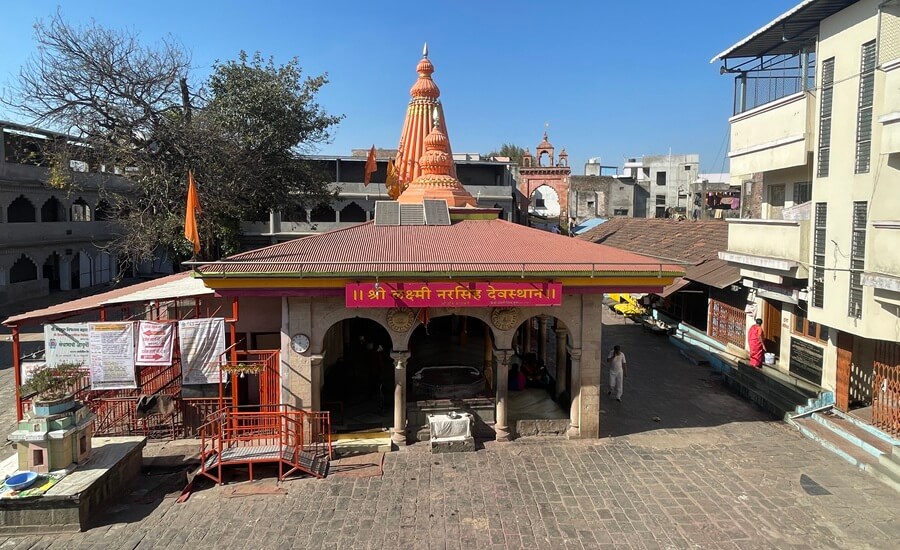
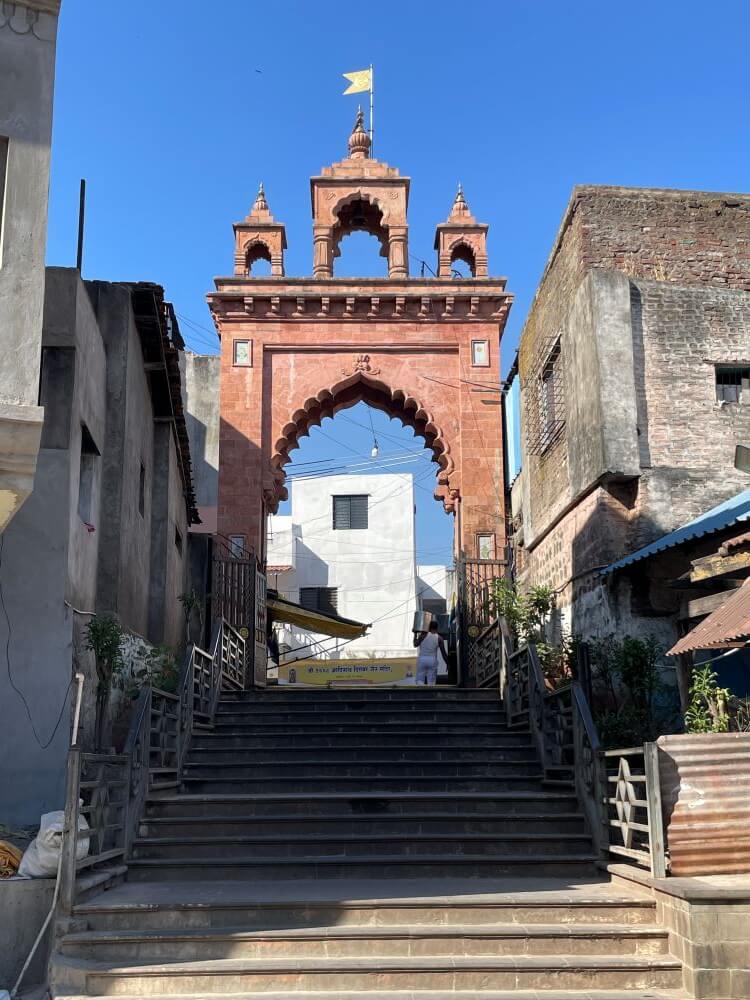
The temple is situated in a spacious courtyard. The courtyard has a tall, arched stone entrance gateway. There are three dome-like pavilions (meghadambaras) on the roof of the entrance. Descending a few steps from here, one enters the stone-paved courtyard of the temple. Right in front are two grand stone lamp towers (deepmalas) and a holy basil platform (tulsi vrindavan). To the side are a free food distribution center (annachhatralaya), shops for worship materials, and a newly constructed two-story pilgrim guest house (bhakt niwas). Along with the main temple, the complex also houses shrines dedicated to deities such as Vitthal-Rakhumai, Saint Dnyaneshwar, and Hanuman.
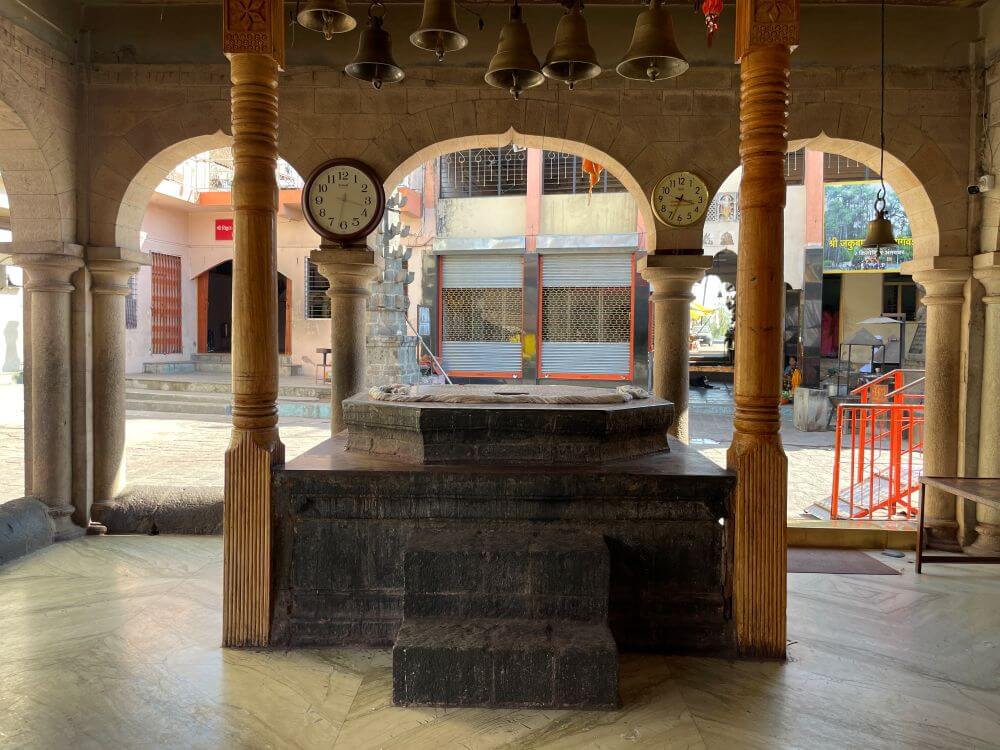
The main temple of Lakshmi Narsimha is built of stone blocks. The present structure of the temple consists of the Sabhamandapa (assembly hall), Antarala (vestibule), and Garbhagriha (sanctum sanctorum). There is a small shikhara over the Sabhamandapa, while a tall shikhara that tapers towards the top stands over the Garbhagriha. The Sabhamandapa of the temple was built recently, in 1979. This open-style Sabhamandapa has round pillars along its sides, which are connected to each other by arches. On the front side of the Sabhamandapa, right above the center of the arches, is a sculpture of a lion’s face (Simhamukha). On both sides of it are carved images of Suryanarayana. Right here, at the lower level, is a large stone platform. On this platform, which is square at the bottom and octagonal in the middle, the divine palanquin (Palkhi) of the deity is placed during the festival (Yatra) season. Many bells are suspended in the Sabhamandapa. The Antarala is enclosed in structure and features carved stone pillars and stone beams. This construction bears testimony to the antiquity of the temple. Here, there is a large idol of Nandi carved in black stone. Its special feature is that the horns as well as the ears of this idol are made of brass.
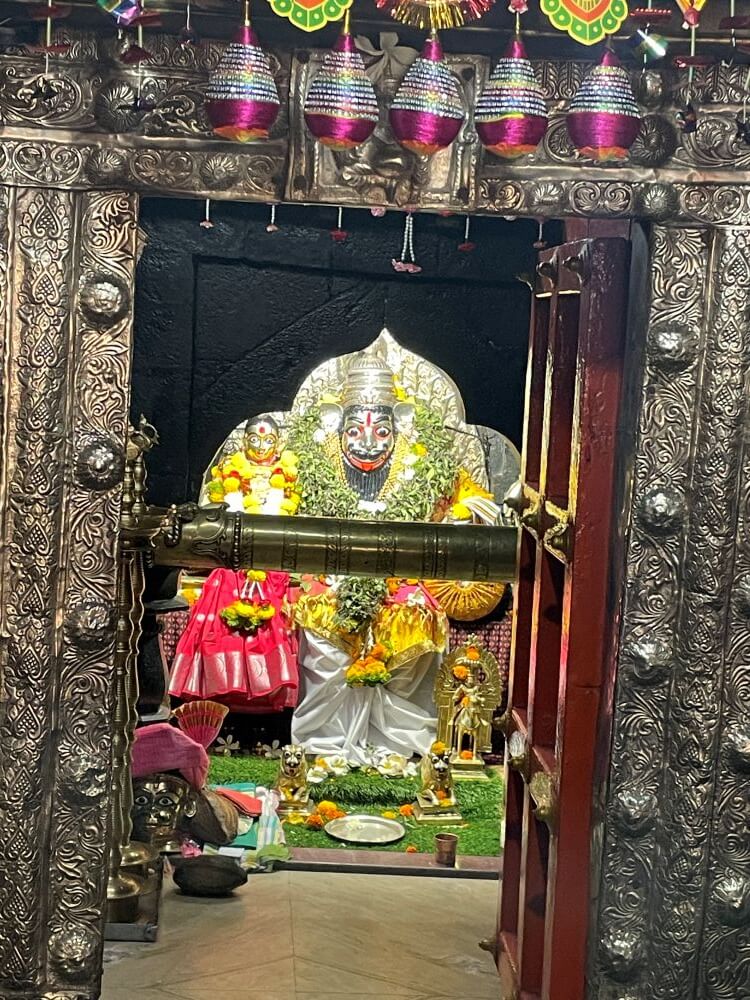
The entrance of the sanctum sanctorum has three branches and is adorned with intricate carvings. At the center of the lintel of the doorway is an idol of Lord Ganesha. Inside, on a low pedestal, is a seated idol of Lord Narasimha. This deity takes the form of a self-manifested (Swayambhu) stone symbol covered with a silver mask, adorned with a silver crown on its head. Right beside it is an idol of Goddess Lakshmi wearing a nose ring (nath) and various ornaments around her neck, featuring a brass mask. Behind the idols is an embossed silver halo with intricate carvings. In the center of this halo, directly above the Narasimha idol, is a large image of a five-headed serpent (Panchamukhi Naga), topped with a lion’s face (Simhamukha). In front of these idols, at the lower level, is a small brass idol of Narasimha in the fierce, horse-riding form of Bhairava, as well as a brass mask of Lord Hanuman wearing a turban on his head. Since the Narasimha avatar manifested during the Pradosha period, worship is performed here every evening. Saturday is considered the sacred day of Lord Narasimha and worship is primarily offered on that day. However, Monday holds great significance at this temple in Sangavade. Every Monday during the holy month of Shravana, devotees gather here in large crowds. During the ritual bathing (Abhisheka) in a Narasimha temple, the Purusha Sukta or Panchasukta is normally chanted; however, when the ritual bath is performed for the deities in this temple, the Rudra Sukta is chanted. When the palanquin procession of Lord Narasimha emerges from the temple, the devotional battle cry (lalakari) raised is “Shivahari”.
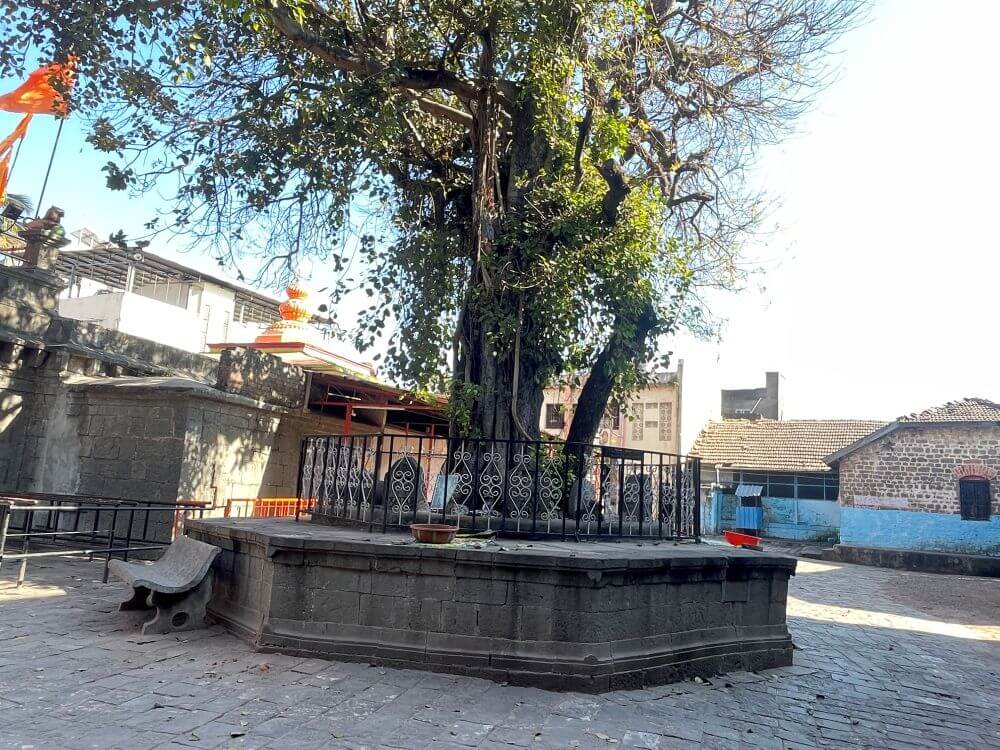
The two major festivals celebrated in this temple are Narasimha Jayanti, celebrated in the month of Vaishakha, and the Pakalani festival, held in the month of Chaitra. The word Pakalani is believed to be a corrupted form of the word Prakshalana, which means to clean both internally and externally. During this festival, the temple is thoroughly cleaned in every possible way. The inspiration behind this festival is said to be that, on this auspicious occasion, devotees should also cleanse their bodies and minds of ego, attachment, and jealousy. During this festival, traditional Sasankathas (ceremonial staffs) are danced. When the Palakhi (palanquin) proceeds, dates, dried coconut, and gulal (colored powder) are showered, and the entire surroundings reverberate with the triumphant chants of Harihara. Apart from these, devotees gather here on Mondays during the month of Shravana and on every Amavasya (new moon day). Behind the temple, there is a large banyan tree. Around the platform built beneath it, there are some ancient idols as well as Viragals (hero stones), which are collectively known as Devanchi Panchayat (the assembly of deities).
This sacred temple stands as a testament to deep spiritual devotion, ancient architectural grandeur, and rich local cultural traditions.
The sanctum sanctorum houses the divine idol consecrated according to ancient Vedic traditions, surrounded by serene courtyards and traditional temple architecture.
Navratri, Maha Shivratri, Annual Temple Jatra & Deepotsav
Compare and book flights, secure top-rated local hotels near the temple, hire reliable guides, and rent cars instantly.
Extend your pilgrimage by visiting other highly sacred temples located nearby.


Add ₹999 more to unlock FREE SHIPPING!
Your sacred cart is currently empty.
Shop Photo FramesFill in your delivery details below to place your order.
Add comment