
Add ₹999 more to unlock FREE SHIPPING!
Your sacred cart is currently empty.
Shop Photo FramesFamous both in India and abroad, the Jagannath Temple in Puri, Odisha, is a deeply revered pilgrimage site for Hindus. Every year, lakhs of devotees visit there. Just like this sacred abode of Lord Jagannath in Odisha, there is a renowned shrine located at Talandage in Kolhapur district. Dating back to the era of Rajarshi Chhatrapati Shahu Maharaj, the idol in this temple resembles the one at Jagannath Puri. Devotees travel from far and wide to witness the Rath Yatra (chariot procession) held at this divine place. Devotees hold a firm belief that this abode of Lord Jagannath is *Jagrut* (divinely active and responsive).
According to mythological legend regarding the temple at Jagannath Puri, a tribal king named Vishwavasu used to secretly worship Lord Jagannath in the form of Lord Neelamadhav. When King Indradyumna learned about this, he sent a Brahmin priest named Vidyapati to search for Him. After exhausting all efforts to locate the holy abode of Lord Neelamadhav, Vidyapati married Vishwavasu’s daughter. Later, he insisted to his father-in-law to let him see the sacred place of worship. Vishwavasu blindfolded him and took him to that place in the forest. While going there, mustard seeds were secretly dropped along the way from the hand. Over time, they germinated, revealing the path to the sacred site. Upon hearing this, King Indradyumna rushed there, but to his dismay, the divine idol had vanished.
Disappointed, the king eventually built a grand temple there on the seashore. It was then that he received a divine vision in a dream from Lord Jagannath. In the dream, Lord Jagannath told him that a wooden log would float in from the sea, which he should worship with utmost care. “Consecrate in the temple whatever form is carved from it,” the Lord instructed. Those carvings took the divine shapes of Lord Jagannath, Lord Balarama, Goddess Subhadra, and the Sudarshan Chakra, which the king devoutly consecrated in the temple. This narrative is also recorded in the book ‘Ain-i-Akbari’ written by Abul Fazl in 1598. According to historical records, this temple was built around the 12th century by the Kalinga Kings Chodaganga and Ananga Bhimadeva. According to some historians, a temple existed here even before that, likely built by the Somavamsi King Yayati II (reign 1021 to 1040 CE), which was later renovated by Chodaganga. According to the ‘Ain-i-Akbari’, Kala Pahad, a general of Sultan Sulaiman Karrani of Bengal, attacked Jagannath Puri, set fire to the idols in the temple, and threw them into the sea. The legend of King Indradyumna is also connected to this event. Kala Pahad was originally a Vaishnava Brahmin who had embraced Islam after marrying the Sultan’s daughter.
Just like the legend of Lord Jagannath’s divine vision in a dream, there is a similar legend associated with the temple in Talandage village. It is said that the Patil (village head) of this village used to travel to Puri-Jagannath every year on Kartik Purnima for *darshan*. He used to undertake that entire journey on horseback. However, after several years, as old age set in and his body could no longer support the journey, it became impossible for him to travel. Once, during the festival period of Lord Jagannath, he was blessed with a divine vision in a dream. Lord Jagannath told him, “If you cannot come to Me, I shall come to you. I am present near the lake in your village.” Waking up the next morning, he reached the lake along with prominent villagers, where they discovered the idol of Lord Jagannath. Overjoyed in his heart, the Patil decided to build a temple for Lord Jagannath. The villagers supported his noble effort, and a temple was built near the lake, where the idol was devoutly consecrated.
According to information provided by the villagers, Rajarshi Chhatrapati Shahu Maharaj of the Karveer State once came to the forest here for hunting. Feeling thirsty, he arrived at the small temple near this lake in search of water. There, a holy sage quenched his thirst. As it was afternoon, the Maharaja rested there. At that time, Lord Jagannath Himself granted him a divine vision. Consequently, Shahu Maharaj reconstructed this temple. Villagers mention that this temple originally had a wooden *sabhamandap* (assembly hall) and a stone *garbhagriha* (sanctum sanctorum) in the Hemadpanti architectural style. This very temple has now been renovated.
Talandage village is situated about 5 km west of Hupari and around 20 km southeast of Kolhapur. Similar to Hupari, which gained fame due to its Ambabai Temple and is renowned for its silver craft industry, the silver trade has taken deep roots in Talandage village as well. The economic prosperity of the village has grown significantly, and the villagers firmly believe that all this is taking place by the divine grace of Lord Jagannath.
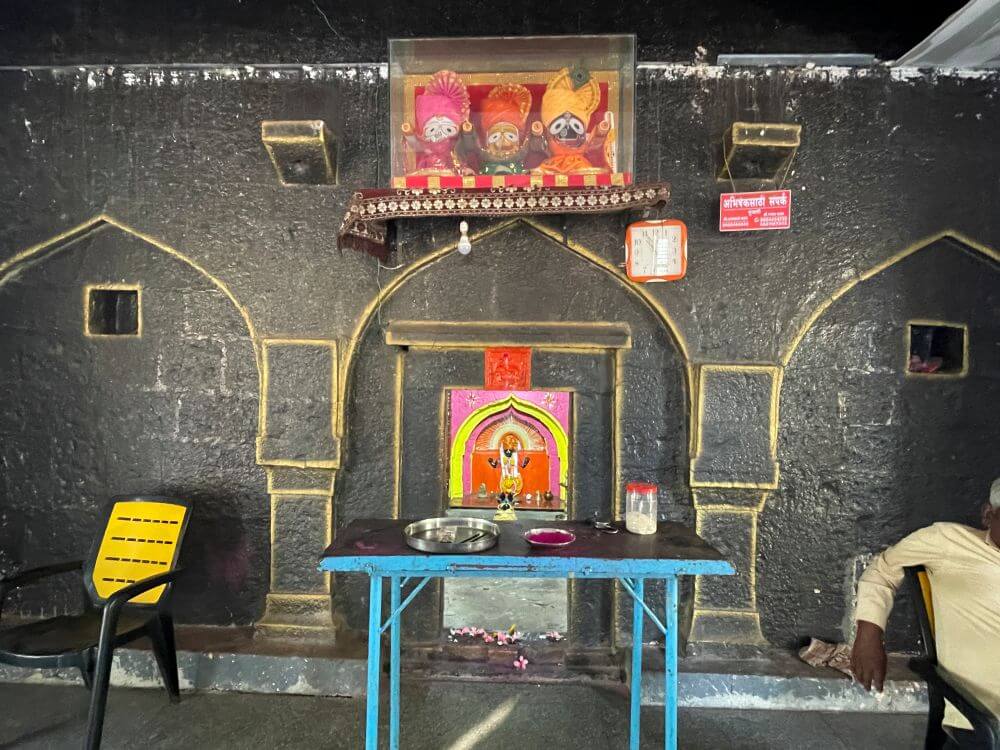
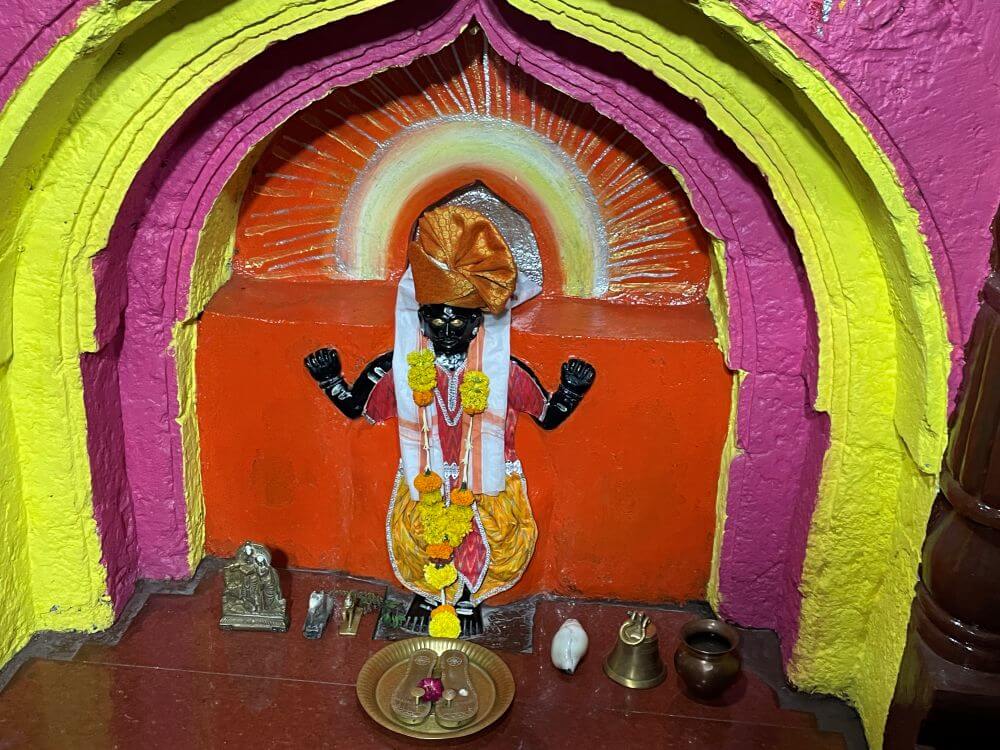
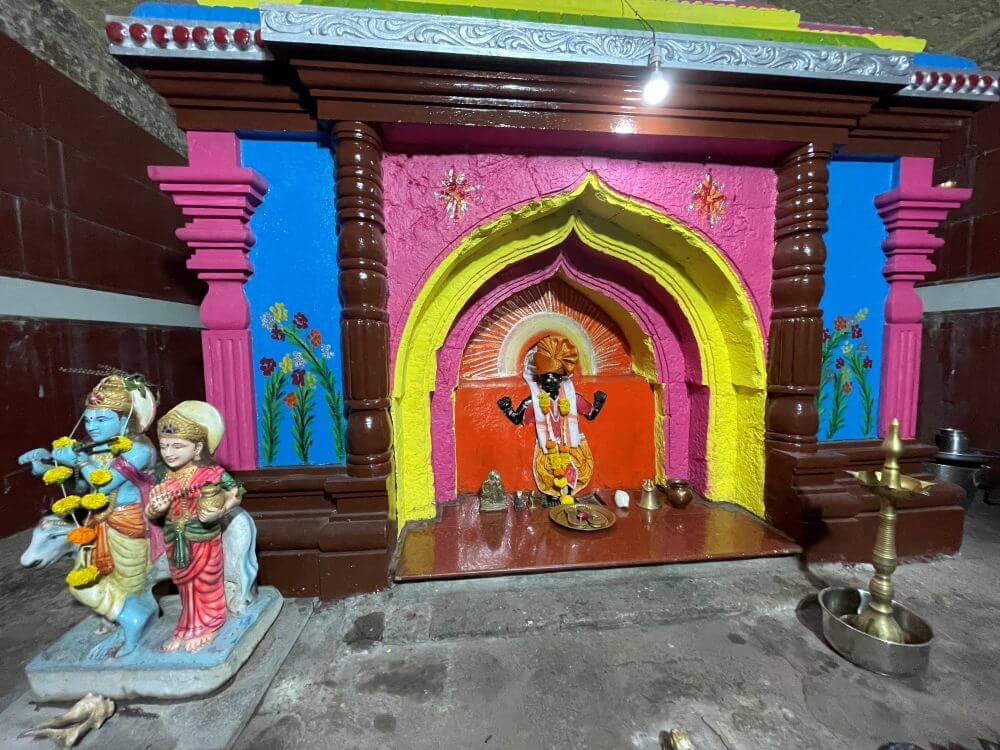
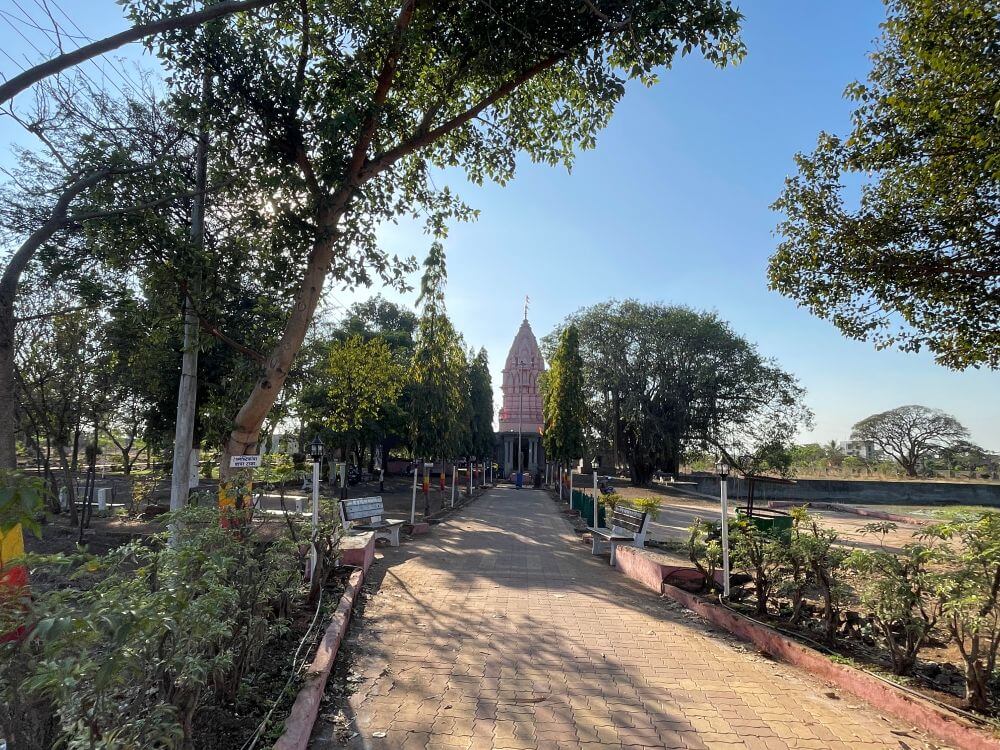
The temple is located at the southern end of the village, right at the entrance, set a short distance back from the road. The temple faces east. Its architectural layout consists of a *sabhamandap* (assembly hall), a *garbhagriha* (sanctum sanctorum), and a tall *shikhara* (spire) above it. In front of the *sabhamandap* stands a large stone *Garudastambha* (Garuda pillar). The *sabhamandap* is spacious and modern in construction. Stone has been extensively used in the construction of the *garbhagriha*. The *garbhagriha* has a doorway of modest height. On the doorframe, an idol of Lord Ganesha is seated at the *lalatabimba* (center of the lintel). Above it, on the upper lintel (*uttaranga*), are the bust sculptures of Lord Krishna, Balarama, and Goddess Subhadra. Inside the sanctum, the idol of Lord Jagannath is consecrated within a stone shrine. Formerly, there was a *Swayambhu* (self-manifested) idol of Lord Jagannath here; however, as it was damaged, the present idol was installed in its place. It is said that the old idol was preserved inside the sanctum and the new structure was constructed over it. The current idol is sculpted from black stone. Standing in stature, Lord Jagannath has both hands raised. The idol is adorned with fine garments and ornaments, with a turban (*mandil*) on the head. To the right side of the main idol are the idols of Lord Jagannath, Balarama, and Goddess Subhadra modeled after Puri.
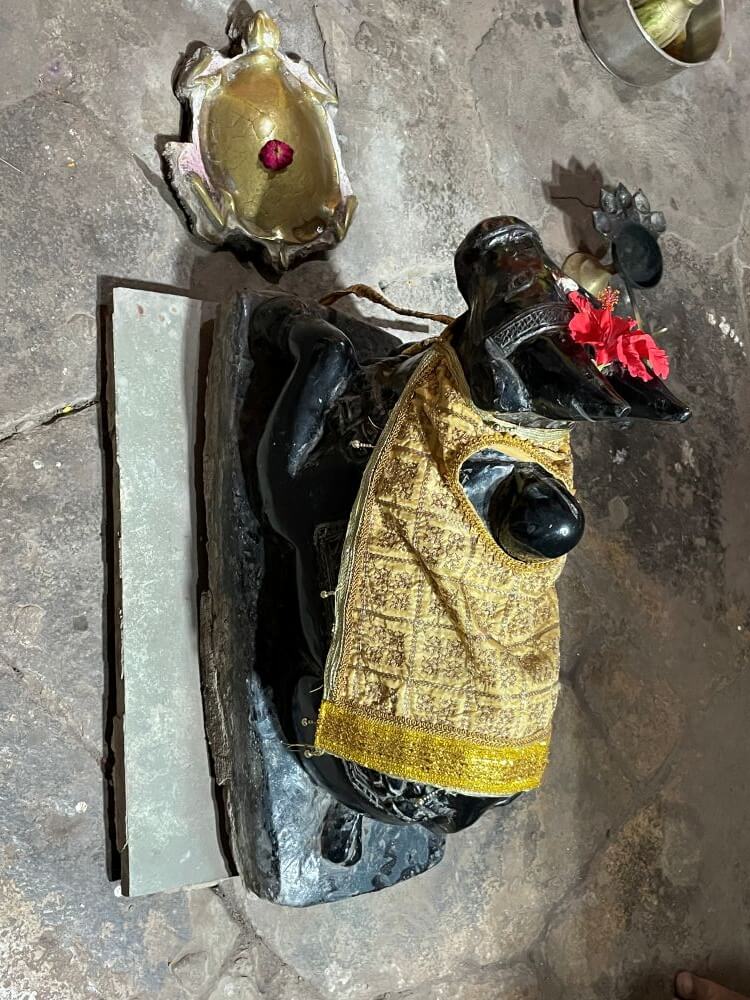
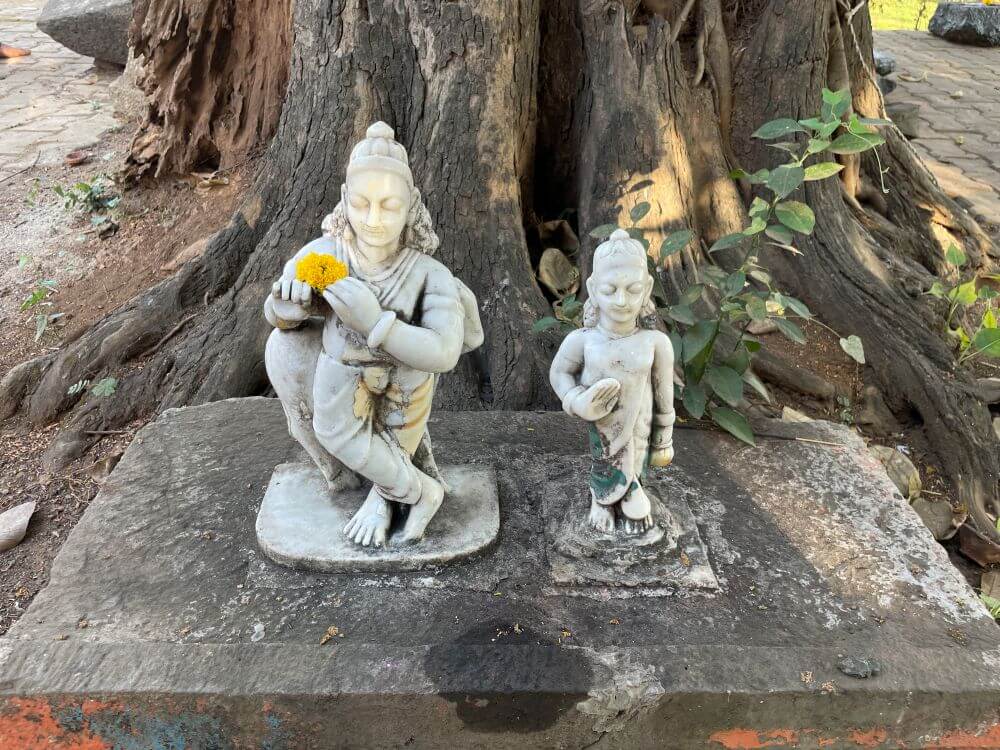
On the four corners of the *garbhagriha* roof, there are small *chhatris* (domed kiosks). The *shikhara* (spire) here is tall and of the *Urushringa* style—meaning miniature replicas of the spire are carved on all four sides along the chest of the main spire. Outside the sanctum, on the left side, stands a large wooden chariot of Lord Jagannath, similar to the chariot at the Jagannath Temple in Puri. Nearby on a raised platform (*paar*), some ruined remnants of the old temple as well as sacred idols are kept. These include Nandi, Lord Hanuman, the Sudarshan Chakra, and some carved stones. Additionally, an inscription in the Pali language is also located at this spot. To the right side of the main temple, there is said to be a small shrine of Tulja Mata; however, according to the Archaeology Department, it is understood to be dedicated to Goddess Subhadra. This idol is exceptionally exquisite and attractive. To the left side of the main temple, there is a small shrine of Radha-Krishna, featuring a beautifully crafted idol. Right beside it lies the lake.
This sacred temple stands as a testament to deep spiritual devotion, ancient architectural grandeur, and rich local cultural traditions.
The sanctum sanctorum houses the divine idol consecrated according to ancient Vedic traditions, surrounded by serene courtyards and traditional temple architecture.
Navratri, Maha Shivratri, Annual Temple Jatra & Deepotsav
Compare and book flights, secure top-rated local hotels near the temple, hire reliable guides, and rent cars instantly.
Extend your pilgrimage by visiting other highly sacred temples located nearby.


Add ₹999 more to unlock FREE SHIPPING!
Your sacred cart is currently empty.
Shop Photo FramesFill in your delivery details below to place your order.
Add comment