
Add ₹999 more to unlock FREE SHIPPING!
Your sacred cart is currently empty.
Shop Photo FramesVitthal and Malhari Martand, who have become symbols of the spiritual culture of Maharashtra, were originally the deities of the Gavli-Dhangar pastoral community. Like these two deities, Birdev is the deity of the Dhangars of South India. Vitthal is an inseparable companion of Birdev. They are referred to by the combined name Vitthal-Birappa. Pattankodoli in Kolhapur district is the primary seat of this Vitthal-Birdev. The annual fair (Yatra) of Vitthal-Birdev, held here amidst the free showering of turmeric powder (Bhandara) and the resonant sounds of Dhangari drums and cymbals, is a grand festival. Millions of devotees gather here to listen to the ‘Bhaknuk’, or prophecy, made during the fair.
Birdev, the presiding deity of the Dhangar community and a place of reverence for people of all eighteen castes, is also known by names such as Viruba, Viroba, Birappa, or Virupa and Viranna. In the preface to the book ‘Shri Vitthal Birdev Mahatmya Kathasar’, the great researcher Ra. Chin. Dhere states that many prominent royal lineages of the south emerged from the Gavli-Dhangar community. Through the initiative of these royal lineages, the glory of their original deities grew in many places. These deities took on the forms and characters of the gods of the higher-regarded social classes. Vitthal’s Vishnu-Krishna form became Shri Vitthal. Mailara’s Shiva form became Mallari, and in many places, Virabhadra became Birdev. During the influence of the Veerashaiva religion, when groups of Dhangars became Veerashaivas, their Birappa took on the form of Virabhadra, a deity in the Shiva family.
The vibrant and famous center of Virabhadra at Yadur in North Karnataka is originally a seat of Birdev, while the Virabhadra temple at Lepakshi, built during the later period of the Vijayanagara Empire and world-renowned for its architecture and sculpture, is originally a seat of Vitthal-Birappa. Pattankodoli is also considered a major seat of Vitthal-Birdev. It is located in the Hatkanangle taluka on the Maharashtra-Karnataka border. In the ‘Marathi Vishwakosh’, a legend regarding the name Hatkanangle is mentioned, stating that in the past, a person here performed a ‘Tail-Divya’ (an ordeal by fire/oil), where he dipped his hands into boiling oil to prove his innocence. From this, the village got the name Hatkanangle. The old name of the village Pattankodoli is Ingal-Kodoli. The Vitthal-Birdev temple here is ancient. The Adilshah of Bijapur had donated land to this temple. That land is known as ‘Devmala’. The water from the well in this orchard is used as holy water for the worship in the temple.
The birth story and the greatness of this Birdev are described in the book ‘Shri Vitthal Birdev Mahatmya’. Based on the legends sung in Dhangari Ovis (folk verses) titled ‘Sumbaran Mandil’, this book was composed by Birdev devotees Dattatray Borgave and Vitthal Omapujari. It contains the legend that during the Daksha Yajna, when Shiva was insulted, Dakshayani, that is, Parvati, committed self-immolation. Enraged by this, Shiva struck his matted hair, and from it, Virabhadra was born. Virabhadra severed Daksha’s head. At that time, Daksha’s wife prayed to Virabhadra for mercy. She pleaded for her husband to be brought back to life. While contemplating how to revive him, Virabhadra saw a Dhangar grazing sheep nearby. He decided to attach the head of a sheep to Daksha’s torso. At that time, the Dhangar prayed to Virabhadra, ‘Because you were born in a noble lineage, those who insult Shiva, like Daksha, consider themselves great. You should take birth in our humble lineage and destroy the Shiva-insulters and the wicked.’ Then Virabhadra told him that in the Kali Yuga, he would be born in the Dhangar lineage.
Later, Virabhadra, that is, Birdev, was born to Gangasurvanti (Ganga-Saraswati), the daughter of King Dhruvait of Naradpur. However, the son could not stay with his mother. Due to a curse from a river, he had to be kept in a cradle in the forest. The legend of that curse is that because her daughter became pregnant without being married, Gangasurvanti’s father mixed poison in her food. The unborn Birdev saved his mother from the poison, but the maid of Survanti threw the remaining food into the river, which killed the aquatic life. The river cursed her, saying, ‘Since you killed my children, your son will remain away from you once he is born.’ Therefore, Birdev was kept in a cradle in the forest. There, Ekvva and her younger sister accepted the baby as their brother and took him to Chinchali to raise him. Akka means sister, and because she became a mother, Ekvva was named Mayakka. Her temple is at Chinchali near Belgaum. Years later, Birdev married his cousin, but he did not find joy in worldly life. He performed penance and called upon Vitthal in the form of a brother. Together, they destroyed the demons who were troubling the Dhangars.
Vitthal and Birdev traveled through Enapur, Hukkeri, Vadhangol, Sadalga, Donevadi, Rendal, Hupari, Talandge, and Vasgade before arriving at Pattankodoli. They had stayed in these villages, which is why they are considered pilgrimage sites. They settled on a meadow in Pattankodoli. It is here, in a vast courtyard, that the grand temple of Vitthal-Birdev is situated.
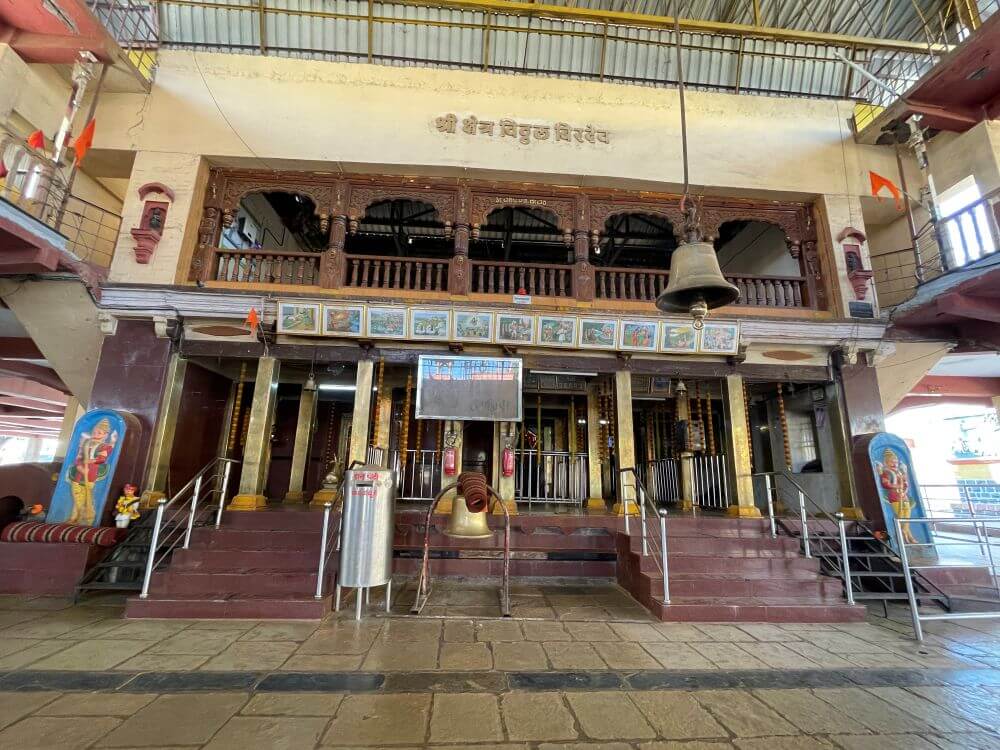
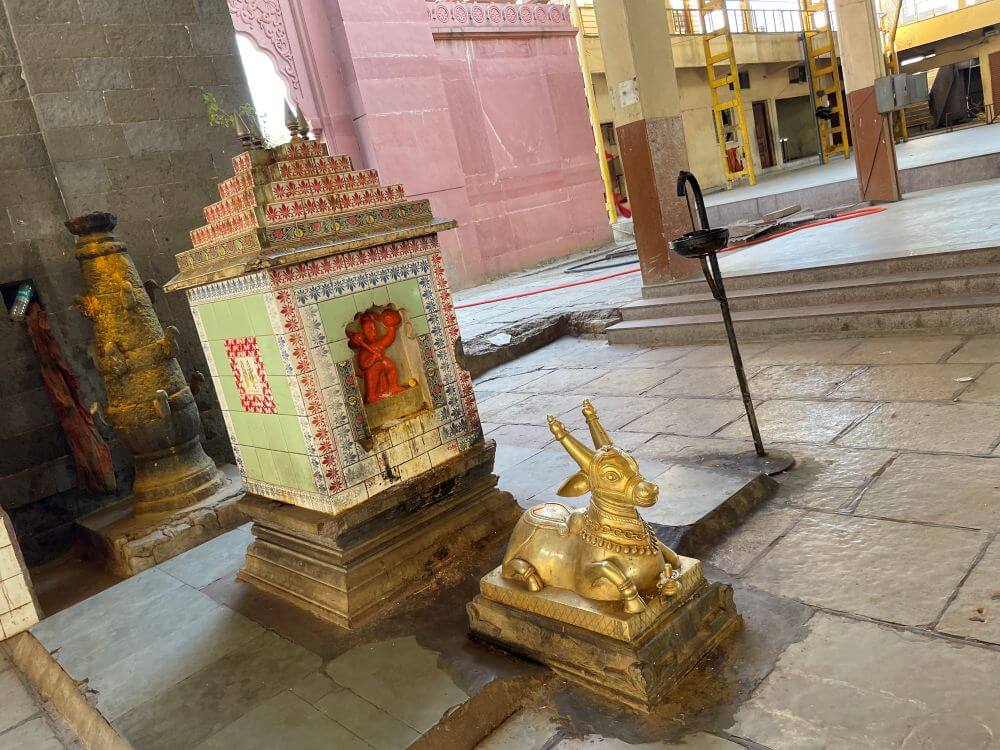
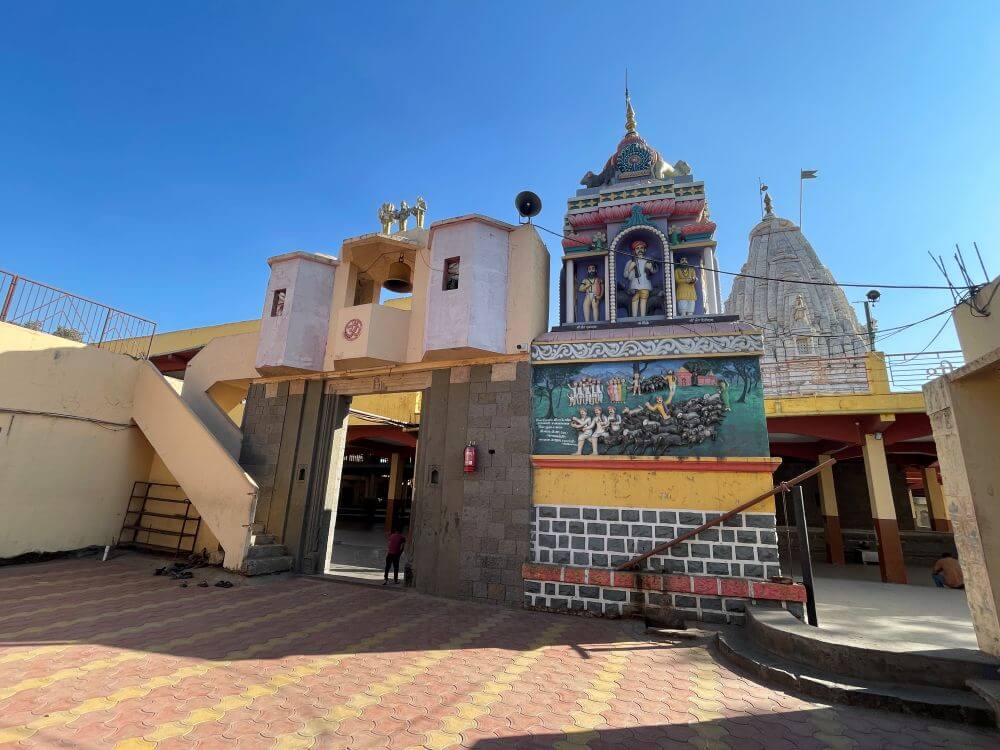
The temple is located in a large courtyard behind high perimeter walls. The main entrance of this temple is like the grand gate of a Rajasthani fort. There is a Nagarkhana (drum house) above it. As soon as one enters through this main gate built of dressed stone blocks, the grand form of this palace-like temple appears. There are cloisters and other buildings attached to the perimeter walls. These cloisters were built from funds provided by the Dhangar community from various villages. A short distance away, in the center, is the structure of the temple consisting of the Sabhamandap (assembly hall), Antaral (vestibule), and the Garbhagriha (sanctum sanctorum). Above the sanctum is a magnificent marble spire. The assembly hall is of wooden construction, with stone flooring, open-style, and two-storied. While entering the assembly hall from the main gate, one sees sculptures of sheep on high platforms on both sides. Beside them are stone lamp pillars (Deepstambhas) as tall as a man. Nearby is a small shrine of Hanuman, and in front of it is a large brass idol of Nandi.
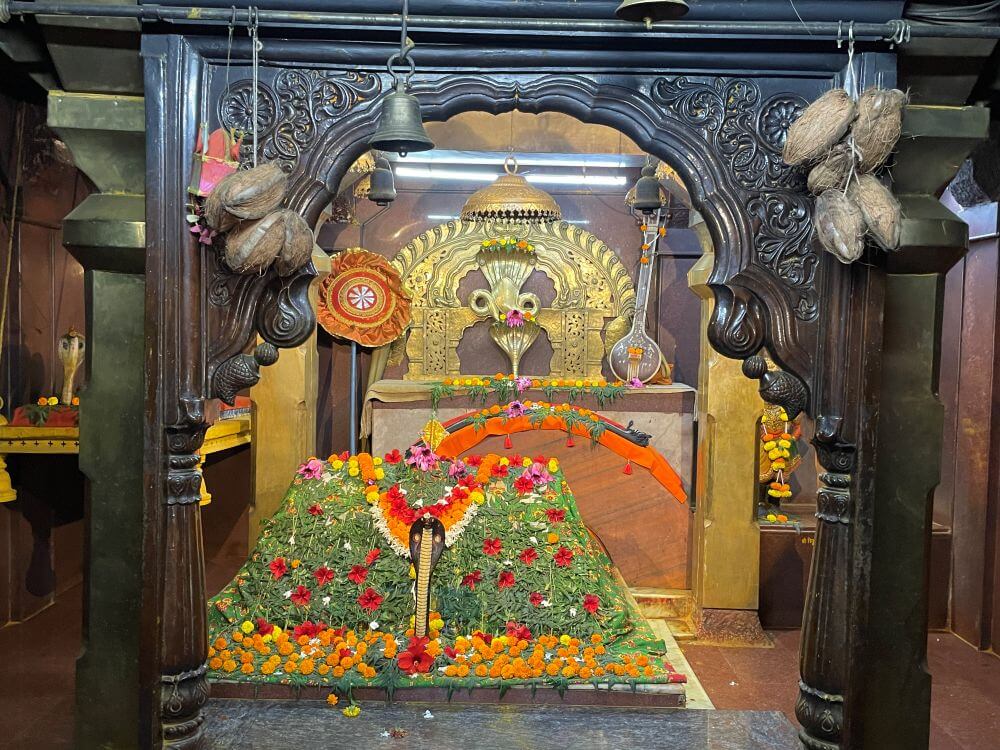
Ascending five steps from the assembly hall, one enters the inner sanctum. On both sides of these steps are sculptures of gatekeepers holding a mace, a discus, and a conch. Above, paintings depicting various mythological stories from the Vitthal-Biroba Mahatmya are displayed. This temple, a symbol of the great harmony between the Shaiva and Vaishnava traditions, houses two sanctums. In front of the sanctum on the left, there is a brass idol of Nandi placed on a high platform. Adjacent to this platform, an image of a woman performing prostration is carved into a stone slab set in the ground. The entrance to the sanctum is covered with intricately carved brass plates. At the center of the lintel of the door frame, there is a brass Kirtimukh. Inside, on a high pedestal, is the seat of Bhagirathi. Behind it is a brass arch where a serpent idol is enshrined. Bhagirathi is considered the mind-born daughter of Vitthal.
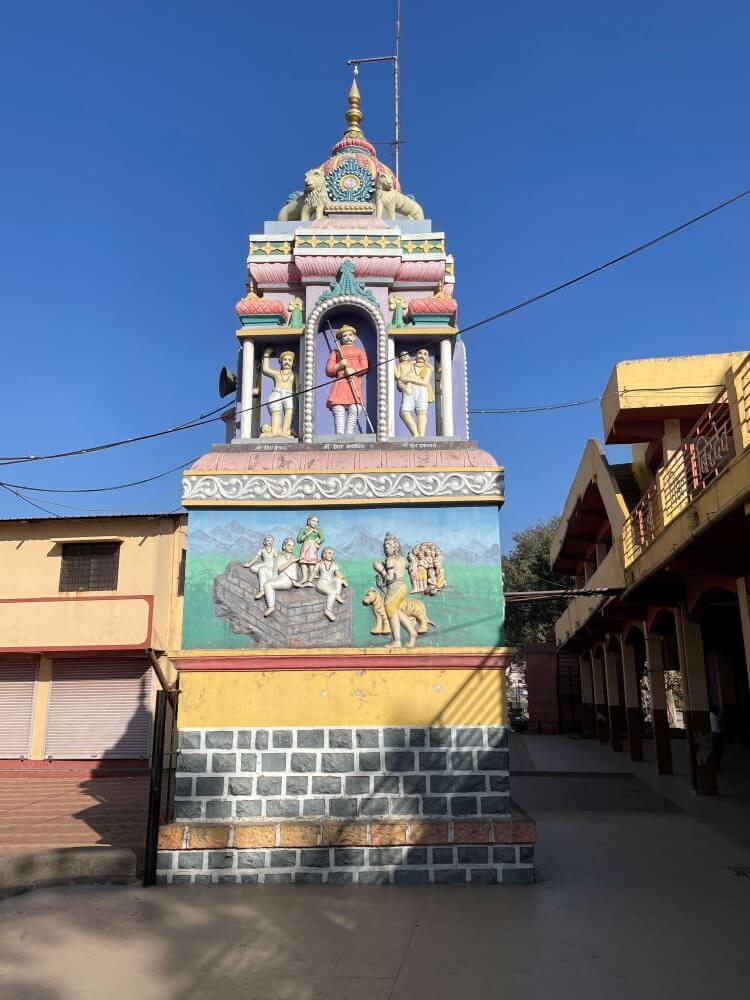
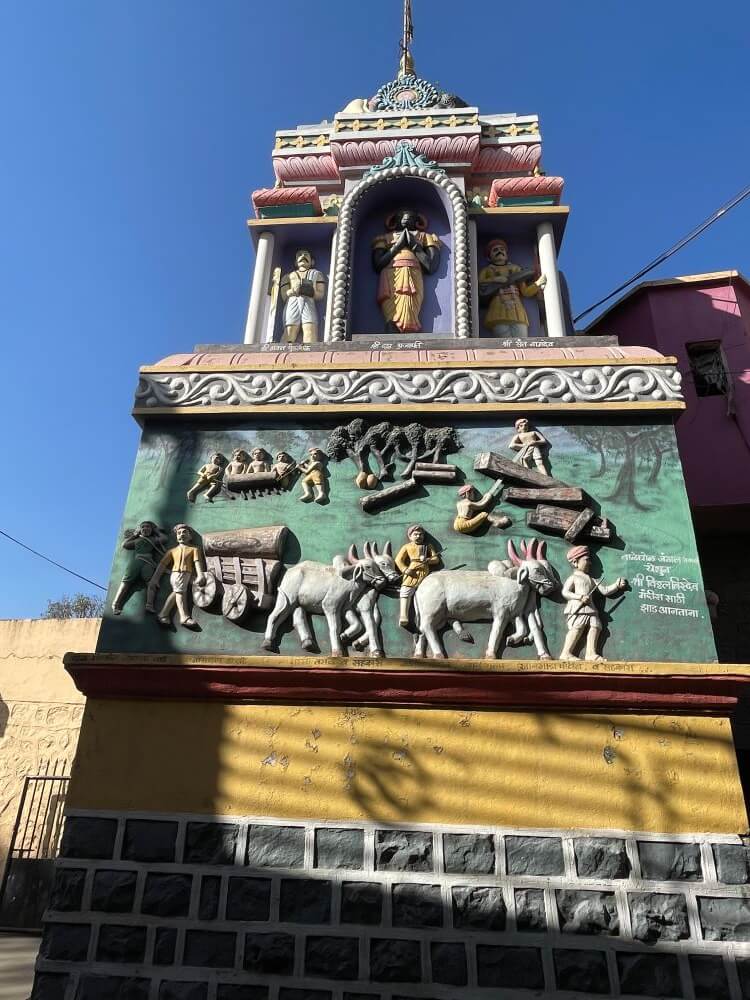
To the right is the main sanctum of the temple. The door to this sanctum is also covered with brass plates. It also features a Kirtimukh, and on both sides above the door frame, there are small brass horse idols. Inside, in a large arched wooden shrine with intricate carvings, are the stone lingas of Vitthal and Biroba. Behind these, there are idols of the horse-mounted Birdev, along with horse idols, serpent idols, a ram, and Nandi. Adjacent to the main gate on the left of this temple is a stone temple. On its walls and spire, relief sculptures of the original priest Narayan Gavade, Hegadi Pradhan, Saint Tukaram, and other saints have been installed. Similarly, scenes from the life of Vitthal-Birdev are depicted through relief sculptures on the walls of the temple courtyard.
Daily morning and evening prayers and aarti are performed in this temple. Descendants of the original priest, Narayan Gavade, perform the worship according to tradition. Various religious festivals are celebrated throughout the year. The largest of these is the grand pilgrimage (Mahayatra) held here in the month of Ashwin. This celebration begins amidst the chants of “Vitthal Birdevachya Navan Changbhala,” the generous showering of tons of turmeric powder (Bhandara), and the resounding beats of Dhangari drums and cymbals. The biggest attraction of this pilgrimage is the Bhaknuk, or prophecy. Farande Maharaj of Anjangao delivers this prophecy. He predicts various matters ranging from rainfall and disease to state and national politics and economics. At least seven to eight lakh devotees from Maharashtra, as well as Karnataka and Andhra Pradesh, visit for this pilgrimage. During this time, the entire temple premises in Pattan Kodoli resonate with Dhangari drums, folk songs (Ovi), and the chants of Changbhala. The generous showering of turmeric gives the area a golden glow. During the pilgrimage, there is a competition of Ovi singing. Drum troupes and Gaji dance troupes also perform their arts in the temple. Notably, while non-vegetarian food is common in festivals of folk deities, it is strictly prohibited during the Vitthal-Biroba pilgrimage. The largest market for traditional wool blankets (Ghongadi) in the country is held during this pilgrimage.
This sacred temple stands as a testament to deep spiritual devotion, ancient architectural grandeur, and rich local cultural traditions.
The sanctum sanctorum houses the divine idol consecrated according to ancient Vedic traditions, surrounded by serene courtyards and traditional temple architecture.
Navratri, Maha Shivratri, Annual Temple Jatra & Deepotsav
Compare and book flights, secure top-rated local hotels near the temple, hire reliable guides, and rent cars instantly.
Extend your pilgrimage by visiting other highly sacred temples located nearby.


Add ₹999 more to unlock FREE SHIPPING!
Your sacred cart is currently empty.
Shop Photo FramesFill in your delivery details below to place your order.
Add comment