
Add ₹999 more to unlock FREE SHIPPING!
Your sacred cart is currently empty.
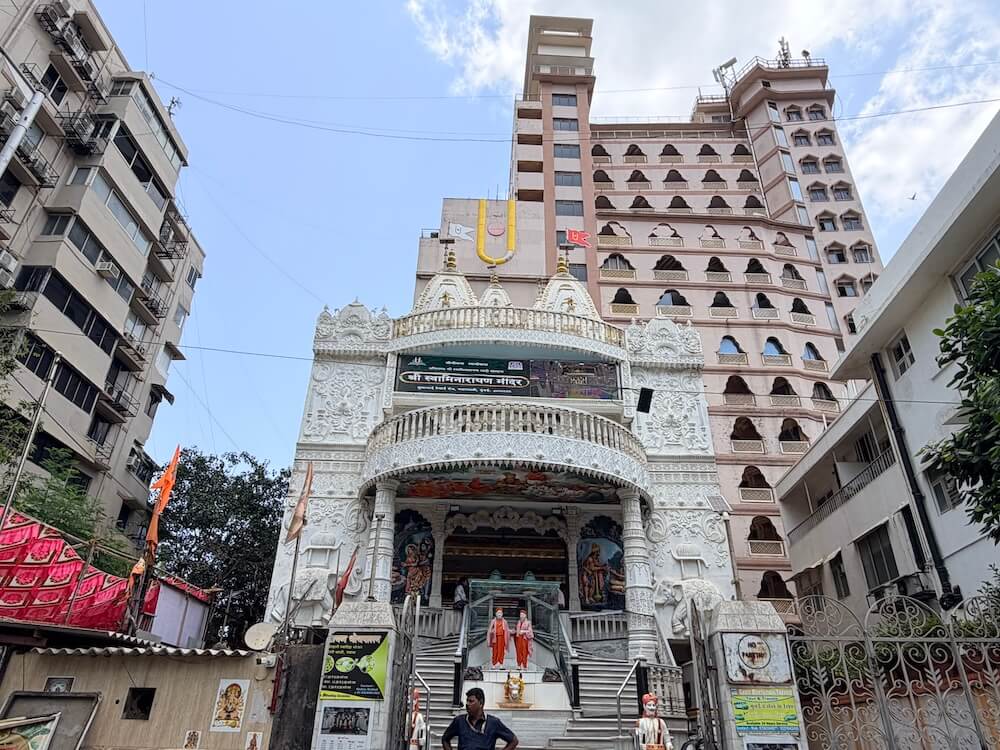
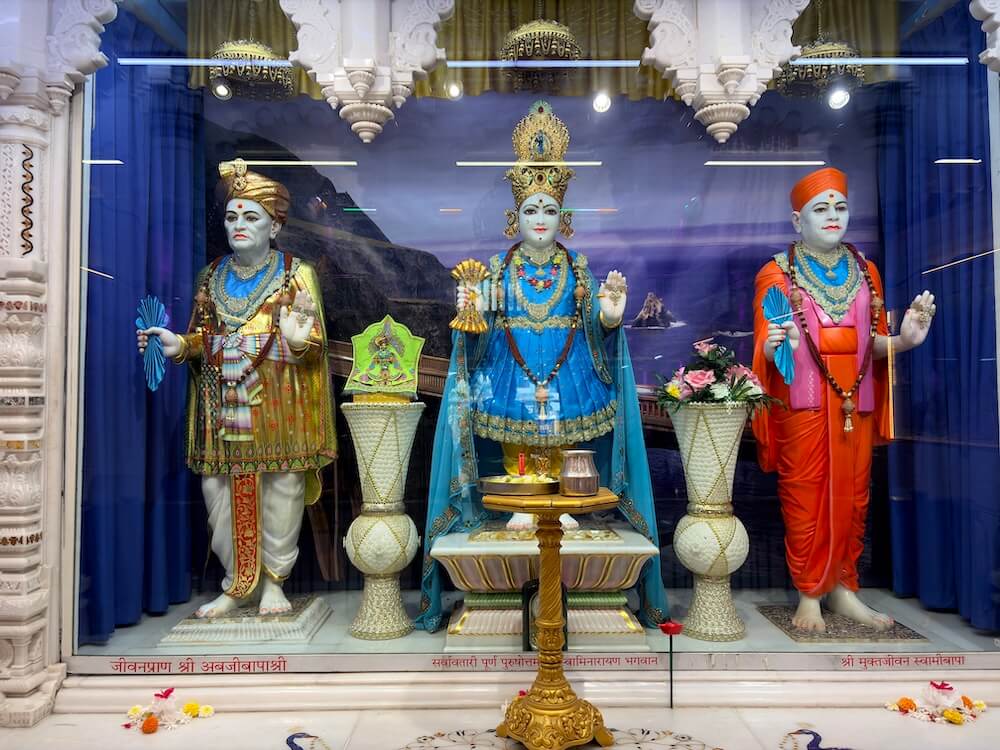
Shop Photo FramesNear the Mahalaxmi Temple in Mumbai, on Bhulabhai Desai Road, stands a marble temple of the Swaminarayan Sampraday. In Mumbai, there are temples belonging to two independent branches of the Swaminarayan Sampraday: the Bochasanwasi Akshar Purushottam Swaminarayan Sanstha (BAPS) and the Laxminarayan Dev Gadi Sansthan of Vadtal. The Swaminarayan Gadi Sansthan of Maninagar is the third important branch of this tradition. This Swaminarayan temple in the Mahalaxmi area was established by this Maninagar Gadi. This temple is an important place of worship for the followers of this Gadi. Here, along with Swaminarayan, the idols of Jeevanpran Abji Bapashree and the founder of the Gadi, Muktajivan Swamibapa, are consecrated.
Swaminarayan is a famous religious tradition in India. Swami Sahajanand is the founder of this tradition. He was born on 3 April 1781 into a Samavedi Brahmin family in Chhapaiya, near Ayodhya. His original name was Ghanshyam Pande. He performed penance in the Himalayas for many years. During this period, he was known as Neelkanth Varni. In the year 1800, he arrived in Saurashtra. He received initiation from Ramanand Swami (born 1739, Ayodhya, Uttar Pradesh), the guru of the Ramanandi or Uddhav Sampraday. Ramanand Swami gave him the name Sahajanand Swami. Drawing primarily from Ramanujacharya’s Vishishtadvaita and Vallabhacharya’s Shuddhadvaita, and coordinating them with other philosophies, he propagated this harmonizing tradition. He taught the abandonment of evil practices prevalent in the society of that time, such as Sati and female infanticide, as well as the consumption of alcohol and meat, violence, animal slaughter, theft, adultery, and superstition.
The followers of this sect believe that Sahajanand is Swaminarayan, the incarnation of God. He is addressed as Swaminarayan as well as Shreeji. He attained Nirvana on 1 June 1830. Prior to that, in 1825, he created two Gadis (seats) in his tradition. One was established in Ahmedabad and is known as the Narnarayan Dev Gadi, while the Gadi at Vadtal is known as the Laxminarayan Dev Gadi. He had ordained that the Acharyaship of this sect should be hereditary. Accordingly, he appointed Ayodhyaprasad, the son of his elder brother Rampratap Pande, to the Narnarayan Dev Gadi in Ahmedabad, and Raghuvir, the son of his younger brother Ichharam, to the Laxminarayan Dev Gadi in Vadtal. Later, due to disagreements over this issue of Acharyaship and the philosophy of the sect, Shastri Yagnapurushdas (Shastriji Maharaj) left the Vadtal Gadi in 1905 and established a separate organization in Bochasan. It is known as the Bochasanwasi Akshar Purushottam Swaminarayan Sanstha (BAPS). This organization believes that Swaminarayan is alive on earth through the Gunatit gurus of the tradition. Later, in 1966, the ‘Gunatit Samaj’ was formed as an independent organization from BAPS. Additionally, separating from the Ahmedabad Gadi, the ‘Swaminarayan Gadi’ (Maninagar) institution was formed in 1942. The followers of this Gadi believe that the Gadis established by Swaminarayan in Ahmedabad and Vadtal were practical in nature and that his true spiritual heir was Gopalanand Swami. It is said that this is corroborated by texts such as ‘Bhaktichintamani’ written by Nishkulanand Swami and ‘Harililamrut’ written by Viharilal Maharaj, the third Acharya of the Laxminarayan Gadi.
The research book ‘An Introduction to Swaminarayan Hinduism’ by Raymond Brady Williams, published by Cambridge University Press in 1984, is considered a scholarly resource on the history of the Swaminarayan tradition. Information about the history of the Maninagar institution is available from this book as well as the book ‘Shree Swaminarayan Gadi’ published by the ‘Maninagar Shree Swaminarayan Gadi Sansthan’ in 1981. This Gadi was established by the first Acharya, Muktajivandas Swami. He is referred to as ‘Jeevanpran Swamibapa’ in the tradition. He was born on 7 October 1907 (Bhadrapad Amavasya, Samvat 1963) in a village named Mahij near the city of Kheda. His original name was Purushottam. His parents were Muljibhai Patel and Ichhaba. On 13 November 1929 (Kartik Sud 11, Samvat 1986), Ishwarcharandas Swami initiated him and gave him the name Muktajivandas. His name was counted among the prominent saints in the lineage of the Ahmedabad Gadi. Around 1940, a dispute arose with the then-head of the Ahmedabad Gadi over who the true heir of Swaminarayan was. According to Muktajivandas Swami, Gopalanand Swami, a contemporary of Swaminarayan, was his true spiritual heir. Swaminarayan had stated that his Satsang Gadi is a ‘Tyagi ni Gadi’ (seat of the renunciant) and that it is secret. Stating that Gopalanand is in my place, Swaminarayan had installed Gopalanand Swami on his ‘Tyagi Gadi’. Muktajivandas Swami established this Swaminarayan Gadi in the Maninagar area of Ahmedabad in 1942. The historical and sectarian guru lineage of this Gadi is Swaminarayan, Gopalanand Swami, Nirgundas Swami, Ishwarcharandas Swami, Jeevanpran Abji Bapashree, Muktajivandas Swami alias Jeevanpran Swamibapa, and Purushottampriyadas Swami. After the passing of Purushottampriyadas Maharaj during the corona pandemic in the year 2020, Jitendrapriyadas Swami has been appointed to this Gadi. The Maninagar Gadi Sansthan has established many Swaminarayan temples in India and abroad. One of the major temples among these is located near the famous Mahalaxmi Temple in Mumbai.
The foundation stone for this temple was laid during the tenure of the first Acharya, Muktajivandas Swami alias Swamibapa (1907-1979). Swamibapa often visited Mumbai for religious propagation. However, there was no arrangement for his stay here at that time. At that time, his devotees would vacate their own residences to make arrangements for him. Eventually, some devotees came together and purchased two large flats at Babulnath in 1967. Arrangements for Swamibapa’s residence were made there, and the temple was first established at this location. It was Swamibapa’s wish that there should be a large Shikharbandh temple of the Swaminarayan Gadi in Mumbai. He instructed his followers to look for a large space for this purpose. Accordingly, a plot on Bhulabhai Desai Road was finalized. At that time, this plot near the Mahalaxmi Temple was occupied by unauthorized shanties. This area was notorious due to the bullying by the slum lords and the daily criminal activities occurring there. It is said that as soon as the construction of the Swaminarayan Temple began here, these criminal activities were curbed.
Jeevanpran Muktajivandas Swami Bapa attained his heavenly abode on 30 August 1979 (Bhadrapad Sud 7, Samvat 2035) in the city of Bolton, Britain. Under the guidance of Swami Purushottampriyadas Maharaj, who succeeded him to this Gadi, the work of the temple continued. On 8 June 1989 (Jyeshtha Sud 4, Samvat 2045), the idols of Jeevanpran Abji Bapashree, Jeevanpran Muktajivan Swamibapa, and others were consecrated in the new premises of this temple by the hands of Purushottampriyadas Swami. Established in a flat in 1967, this temple is now housed in a magnificent edifice.
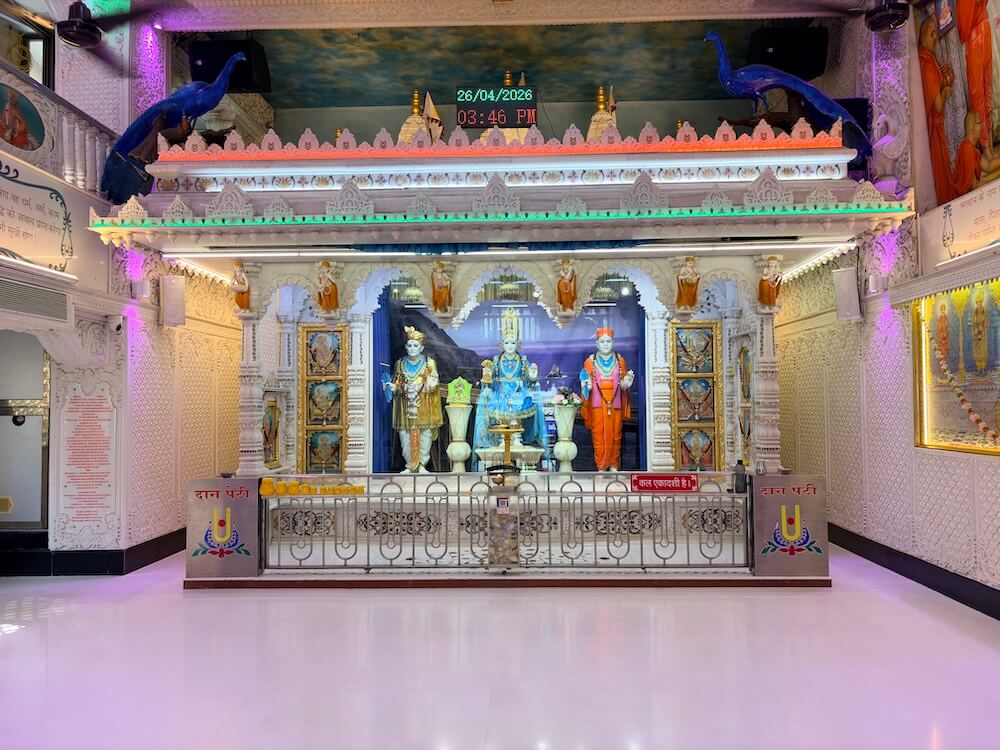
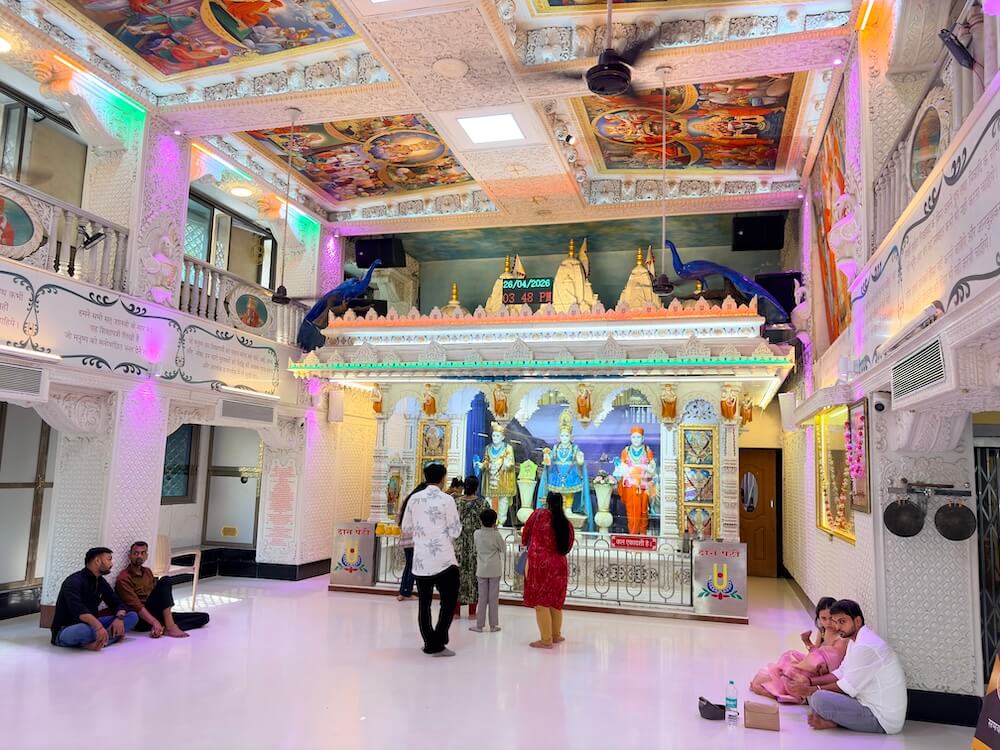
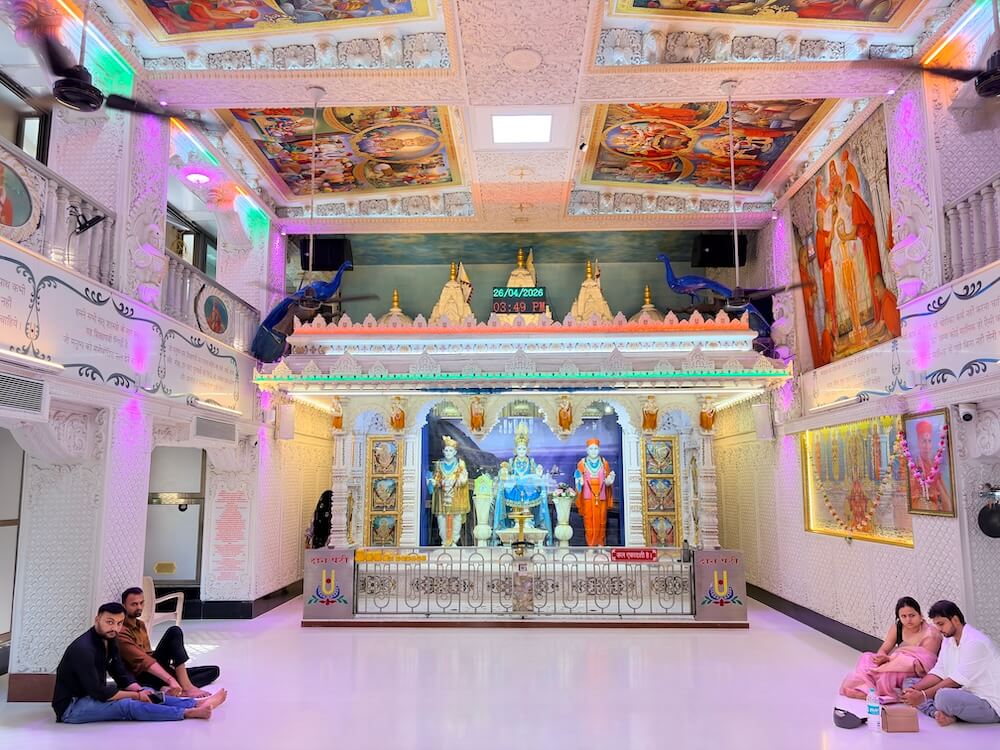
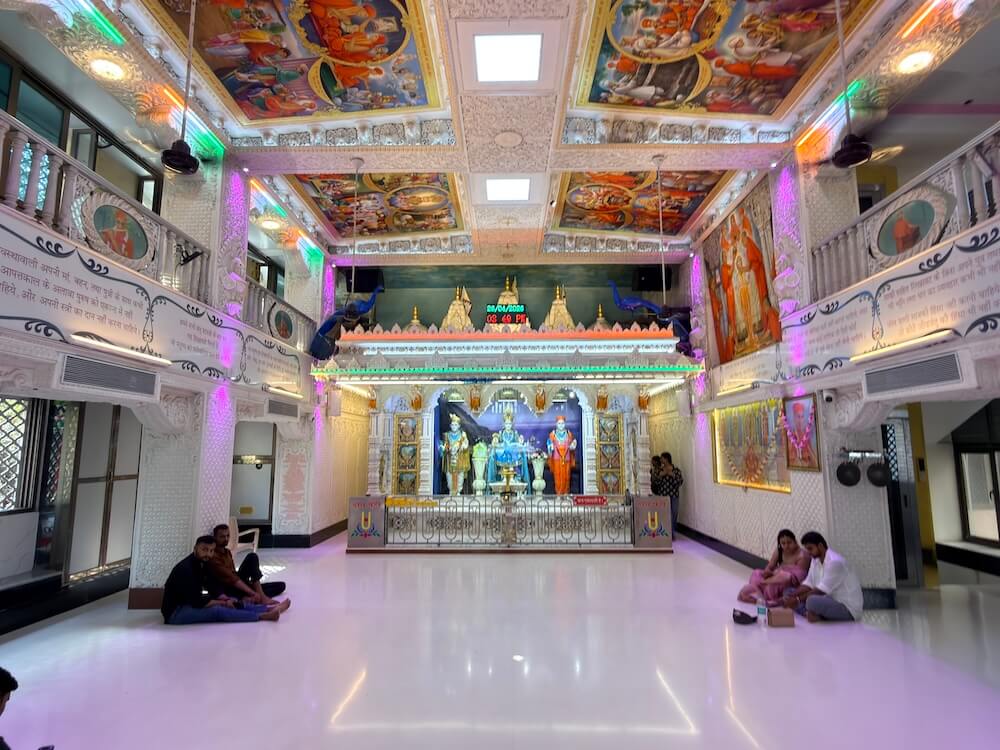
This two-story temple appears distinctive due to its fine marble carvings, circular ornate pillars, Makartoranas (arches), and the images of elephants carved on the outer walls of the temple. Like other temples of the Swaminarayan Sampraday, this structure is built on a high plinth. Near the entrance of the temple premises, there are two statues of gatekeepers dressed in British-era attire. From here, there is a marble staircase of 26 steps. In the middle of this wide staircase, inside a large square glass case, stand the idols of Swamibapa and Purushottampriyadas Swami in their saffron robes. There is a Nandimukh at the base of these idols. The structure of this temple consists of a Mukhamandap (entrance hall), Sabhamandap (assembly hall), and Garbhagriha (sanctum sanctorum). On the ceiling of the semi-circular Mukhamandap, a grand mural of Swaminarayan and his disciples and followers is painted. To the left of the entrance of the Sabhamandap, there is a relief sculpture of Neelkanth Varni, Shankar, Parvati, and Ganpati, while on the right, there is a relief sculpture depicting the scene of Hanuman offering fruits to Neelkanth Varni. In the Sabhamandap, on the left, there is a large marble idol of Ganesha on a high pedestal inside a marble shrine, and on the right, a large marble idol of Hanuman. Here, near the entrance, there are two brass elephants. The Sabhamandap of the temple is spacious and two-storied. Its specialty lies in the paintings on the ceiling panels and the walls. Various episodes from the lives of Swaminarayan and the Gurus of the Swaminarayan Gadi tradition are depicted here. Directly in front is the Garbhagriha of the temple. On the front wall of this Garbhagriha, which has five spires, portraits of the revered Swamis of the Swaminarayan Gadi are placed in golden frames. On the arches of the Garbhagriha, there are sculptures of devotee-musicians. Large peacock sculptures are installed on both sides of the parapet on the roof. The Garbhagriha has five spires: three of the Urushringa type and two dome-shaped. Inside, on a high altar, the idol of Swaminarayan is seated in the center on a lotus flower. To the left is the idol of Jeevanpran Abji Bapa, considered an avatar of Swaminarayan, and to the right is the idol of Muktajivan Swamibapa. Here, the marble idols of Swaminarayan and Abji Bapa are adorned with clothes and ornaments. Abji Bapa is wearing a Gujarati-style turban, while Swaminarayan’s head is adorned with a crown studded with precious stones.
Swamibapa is dressed in the traditional saffron robes of the Sampraday. There is a golden canopy above these idols. This temple has two large Urushringa-style spires. These spires are topped with an Amalaka and a three-tiered golden pinnacle, and the Dharma Dhwaja (religious flag) of the Swaminarayan Gadi flutters there.
Devotees can avail the benefit of Darshan in this temple from Monday to Saturday between 6.30 AM and 8 PM, and every Sunday from 6.30 AM to 8.30 PM. Along with daily worship, discourses, meditation, and the recitation of the Vachanamrut and Bapashree ni Vato are held daily in the temple. Various Hindu festivals and celebrations such as Swaminarayan Jayanti, Ram Navami, Janmashtami, Diwali, Annakut on the New Year, and Nirjala (Bhim) Ekadashi are celebrated in the temple. Patotsav (the temple foundation day) is a major festival here.
Followers of the Swaminarayan Gadi from Mumbai participate in this ceremony, which is celebrated on Jyeshtha Sud Chaturthi/Panchami. Here, Jhula Darshan is held in the months of Ashadh and Shravan, and Sadguru Din is celebrated every Amavasya through Bhajans, Kirtans, discourses, and special worship. Accommodation for devotees is provided in the multi-story building behind this temple.
The institute also runs a Swaminarayan Bhojanalaya (dining hall) here. Breakfast is served from 7.30 AM to 9.30 AM, lunch between 11.30 AM and 2.30 PM, and dinner from 7.30 PM to 9.30 PM.
This sacred temple stands as a testament to deep spiritual devotion, ancient architectural grandeur, and rich local cultural traditions.
The sanctum sanctorum houses the divine idol consecrated according to ancient Vedic traditions, surrounded by serene courtyards and traditional temple architecture.
Navratri, Maha Shivratri, Annual Temple Jatra & Deepotsav
Compare and book flights, secure top-rated local hotels near the temple, hire reliable guides, and rent cars instantly.
Extend your pilgrimage by visiting other highly sacred temples located nearby.


Add ₹999 more to unlock FREE SHIPPING!
Your sacred cart is currently empty.
Shop Photo FramesFill in your delivery details below to place your order.
Add comment