
Add ₹999 more to unlock FREE SHIPPING!
Your sacred cart is currently empty.
Shop Photo FramesThe Ashtabhuja Temple is situated in the Nava Mondha area of Parbhani city, which serves as the headquarters for both the district and the taluka. With a history spanning over two thousand years, this city was known in ancient times as ‘Prabhavati Nagari’. This city was ruled by dynasties such as the Mauryas, Satavahanas, and Vakatakas, and later by the Mughals, the Nizams, and the British. Due to this rich heritage, Parbhani city is home to many sacred shrines, including the Someshwar Mahadev Temple, Lalita Devi Temple, Balaji Temple, Godi Parshwanath Shwetambar Jain Temple, Ranganath Maharaj Temple, Peda Hanuman Temple, Lakshminarayan Temple, and Ughada Mahadev Temple. Among all these religious sites, this temple of Ashtabhuja Devi is considered a significant center of faith for devotees. It is the firm belief of the devotees that the Goddess here grants their prayers.
Ashtabhuja Devi holds an important place in Indian Puranas and iconography. ‘Ashtabhuja’ means the Goddess with eight arms. This is considered a symbol of her power and cosmic function. The mythological reference to this Goddess is found in the ‘Devi Mahatmya’, also known as ‘Durga Saptashati’, which is part of the ‘Markandeya Purana’. When a demon named Mahishasura defeated the gods and took control of heaven, a supreme power was created from the radiance of all the gods. Various deities bestowed their weapons upon this power, and from this, the form of Durga holding eight arms manifested. In connection with this context, descriptions of this valiant form of the Goddess also appear in the Harivansha Purana and Shiva Purana. There, she is considered the combined form of Mahakali, Mahalakshmi, and Mahasaraswati.
From the perspective of iconography and architecture, the weapons held in the eight arms of Ashtabhuja Devi are distinctive. Generally, her right hands hold the chakra, mace, sword, and arrow, while her left hands hold the conch, bow, shield, and trident or bell. These weapons were given to her by Vishnu, Shiva, Indra, Varuna, and other prominent deities to destroy the demons. The Goddess’s vehicle is the lion, and she is often depicted in the form of Mahishasuramardini, destroying Mahishasura. Evidence of Ashtabhuja Devi idols in India dates back to the Gupta Empire. Early remnants of this can be seen in the Gupta-era temples at the Udayagiri Caves and Bhumara in Madhya Pradesh.
During the medieval period, as temple architecture developed, Ashtabhuja Devi idols were given a special place on the outer walls and entrances of temples. Proportionate sculptures of Ashtabhuja Devi are carved in the Chalukyan-era temples of Badami and Aihole, as well as in the Rashtrakuta-era Kailasa Temple at Ellora. According to various inscriptions, Ashtabhuja Devi temples were built to protect trade routes and forts. Since her eight arms were considered a symbol of protecting the eight directions, kings and warriors of that time would worship this Goddess before going to war. This is proven by historical references in various copper plates and inscriptions.
According to local residents, this temple of the Goddess is about three to four hundred years old. Some devotees link this site directly to the Puranic era. There are some legends prevalent locally regarding this temple. According to one legend, in ancient times, a demon ruled this region. The life of the common people became miserable due to the atrocities of that demon, who was intoxicated with power. At that time, the citizens prayed to the Goddess. To save her devotees from the crisis, the Goddess manifested in the Ashtabhuja form. The Goddess killed the demon in battle and freed the devotees from the crisis. After the battle, the devotees built this temple at the place where the Goddess rested. The second legend is linked to the historical period. According to this legend, during the era of foreign rule, a ruler governed this area. Due to his regime, the common people had to constantly face injustice and atrocities. Finally, as the injustice became unbearable, the people united and revolted against that ruler. The people overthrew this regime. The Ashtabhuja Devi temple was established here as a symbol of this people’s victory and unity.
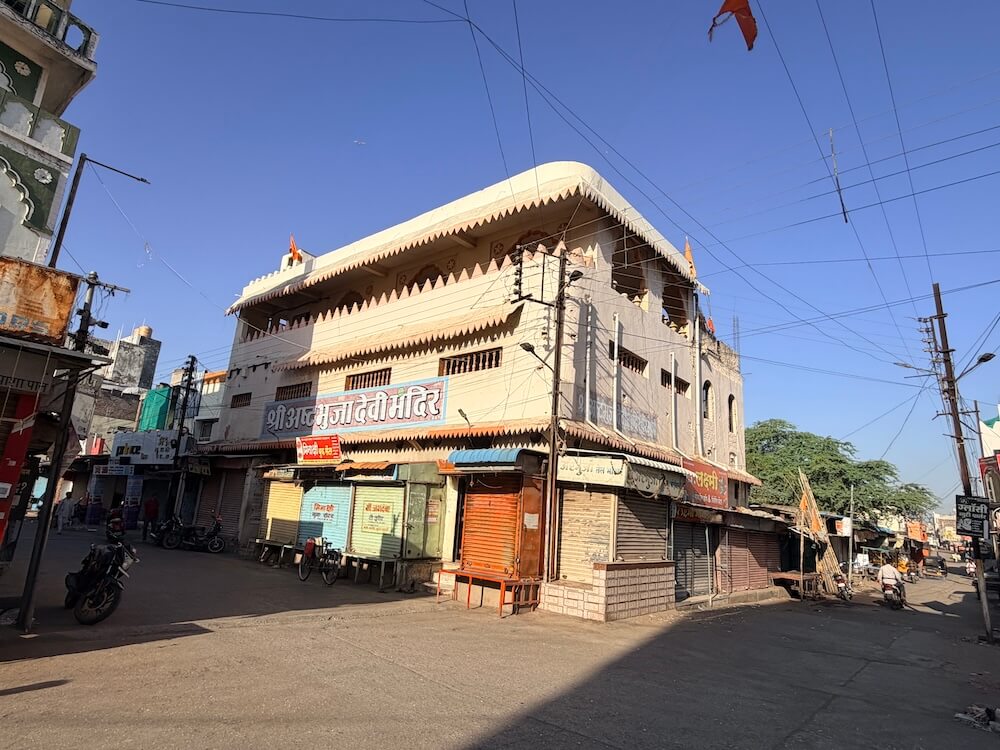
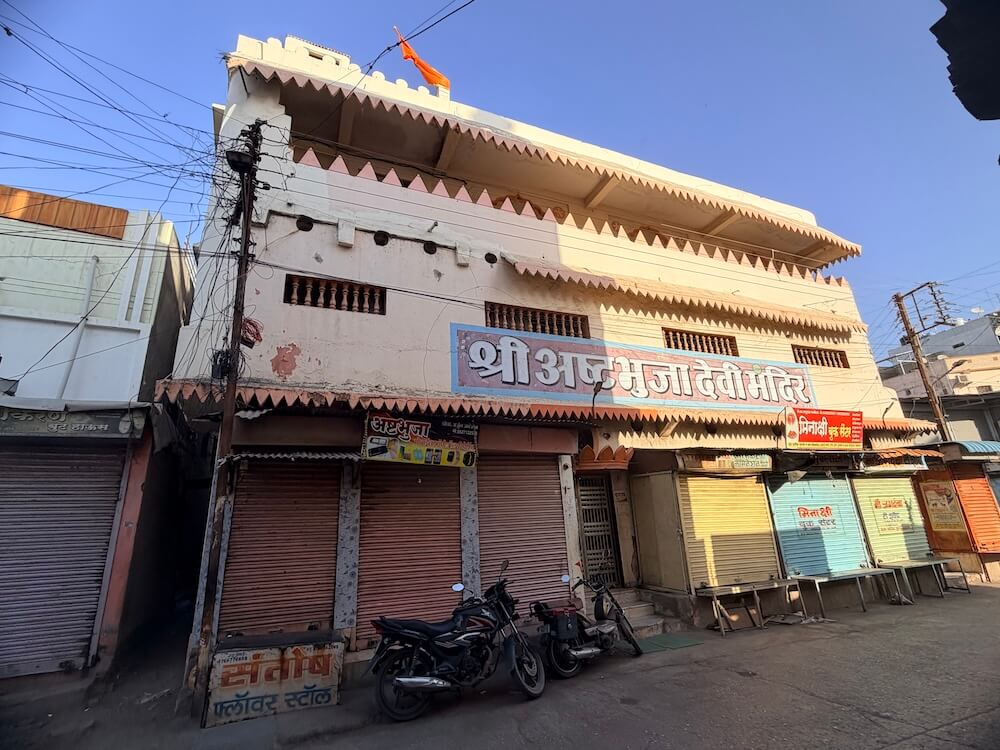
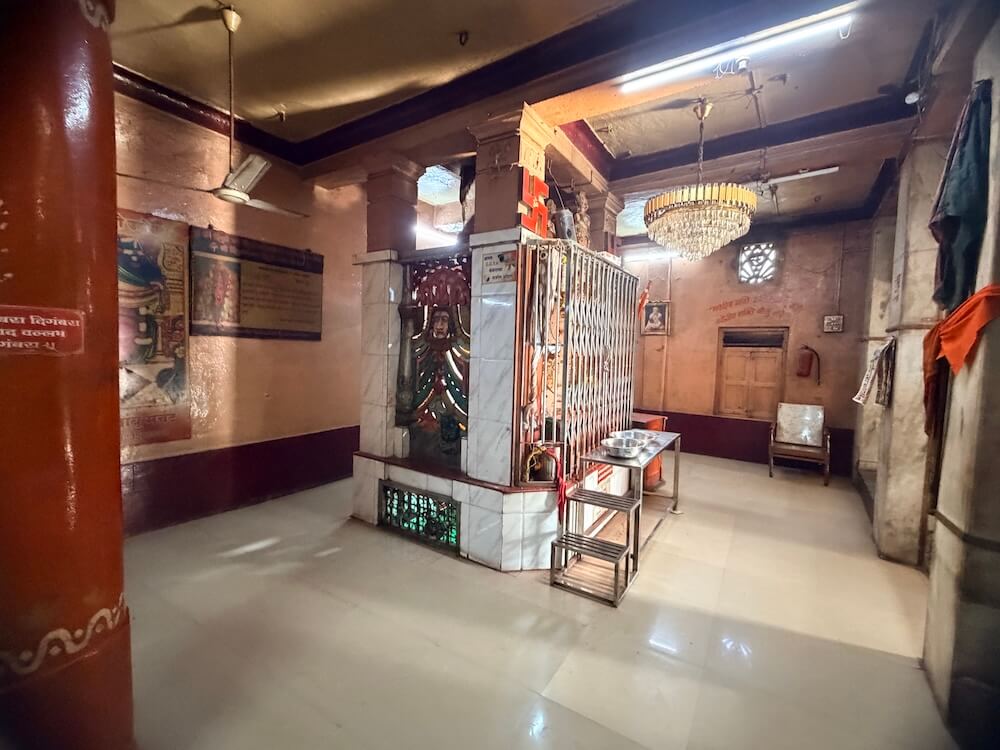
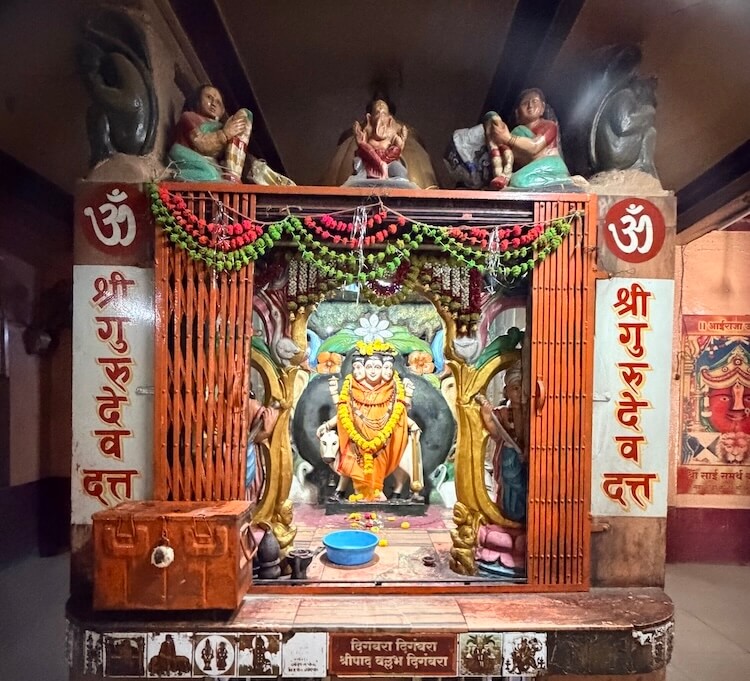
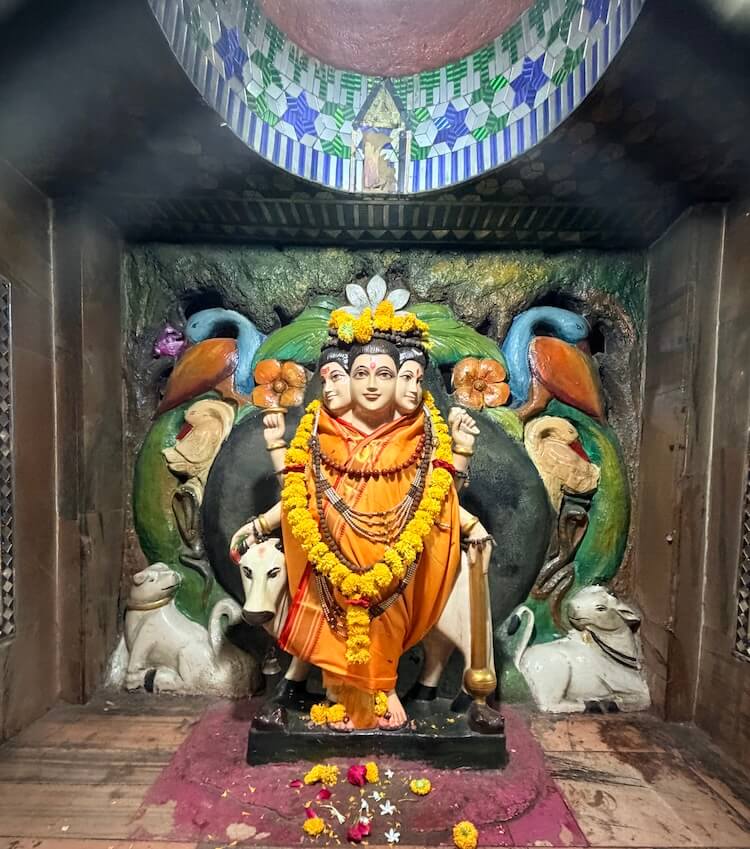
This two-story temple is located along the main road in the commercial area of Nava Mondha in Parbhani city. There are shops selling worship materials on both sides of the temple entrance. The structure of this temple consists of a sabhamandapa (assembly hall) and a garbhagriha (sanctum sanctorum). This temple is built on a plinth slightly higher than the road level. The enclosed sabhamandapa has windows for sufficient light and ventilation. Traditional baskets for flour and salt are kept along the walls in the sabhamandapa. Devotees offer grains, flour, salt, and chili brought from home in them. Idols of Hanuman, Ganpati, and Vitthal-Rakhumai are installed in a decorated niche on the vajrapitha (altar) on the left side of the sabhamandapa. There is an idol of Shri Dattatreya in the niche on the vajrapitha on the right side. On the left side of the sabhamandapa, there is a basement with four steps. A Shivling is installed in this basement. Behind the Shivling, near the wall, is an idol of Goddess Parvati. In the center of the sabhamandapa, on the vajrapitha, there is an idol of Goswami Giriji Maharaj in a meditative posture.
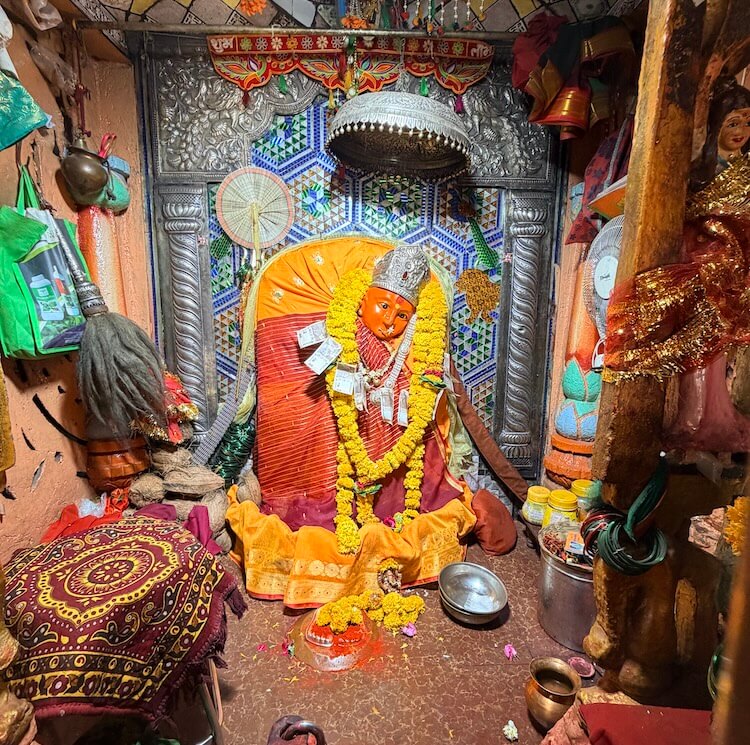
In the front part of the sabhamandapa, about two feet deep, is the garbhagriha. On both sides of the steps leading down into this garbhagriha are carved stone pillars, and an arched torana is carved upon them. In the center of the garbhagriha, in a silver-worked niche on the vajrapitha, is the stone idol of Ashtabhuja Devi. The Goddess holds various weapons in her hands. One hand of the Goddess, who is in a battle-ready posture, is in a blessing posture. Because the Goddess’s neck is slightly tilted, this idol has acquired a unique appearance. This adorned idol is dressed in valuable jewelry and clothes. There is a silver umbrella over the head of the idol.
There is a dome-shaped shikhara (spire) on the roof of the sabhamandapa. This shikhara has carved vertical lines, and at its apex is an amalaka. On this amalaka, there is a kalasha and a flag. The shikhara on the roof of the garbhagriha is also dome-shaped. This shikhara is larger in size than the shikhara of the sabhamandapa. Vertical ridge patterns are carved on this shikhara. At its apex, there are two amalakas placed one above the other, topped with a kalasha.
The Sharadiya Navaratrotsava is the principal annual festival of this temple. During this period, the Goddess is worshipped in different forms for nine consecutive days. A Mahayajna is organized in the temple during Navaratri. Throughout these nine days, various programs such as Bhajans, Kirtans, Jagaran, and Gondhal are conducted in the temple. Countless devotees from the surrounding areas come here for Darshan. They offer sarees and blouses to the Goddess and fill her lap with offerings of coconut and cloth. Apart from this, festivals like Chaitrotsava, Hanuman Jayanti, Ashadhi and Kartiki Ekadashi, Kojagiri Purnima, Datta Jayanti, Mahashivratri, Shravan month, and Gurupurnima are celebrated in the temple in a traditional manner. During festivals, there is a large crowd of devotees in the temple for Darshan. The Aarti of the Goddess takes place at 7 in the morning and 7:30 in the evening. Every Tuesday and Friday, Mahaprasad is distributed to the devotees after the Aarti. Devotees can have Darshan of the Ashtabhuja Devi in this temple daily from 7 in the morning to 1 in the afternoon and from 4 in the evening to 10 at night.
This sacred temple stands as a testament to deep spiritual devotion, ancient architectural grandeur, and rich local cultural traditions.
The sanctum sanctorum houses the divine idol consecrated according to ancient Vedic traditions, surrounded by serene courtyards and traditional temple architecture.
Navratri, Maha Shivratri, Annual Temple Jatra & Deepotsav
Compare and book flights, secure top-rated local hotels near the temple, hire reliable guides, and rent cars instantly.
Extend your pilgrimage by visiting other highly sacred temples located nearby.


Add ₹999 more to unlock FREE SHIPPING!
Your sacred cart is currently empty.
Shop Photo FramesFill in your delivery details below to place your order.
Add comment