
Add ₹999 more to unlock FREE SHIPPING!
Your sacred cart is currently empty.
Shop Photo FramesThe city of Parbhani, situated in the Marathwada region of Maharashtra, possesses a rich and ancient history. Known in ancient times as ‘Prabhavatinagar’, this city holds a prosperous heritage of the Mahanubhava Panth, the Warkari tradition, and various Sufi saints. Like other regions of Maharashtra, an ancient tradition of Shakti worship is observed here as well. It is for this reason that many ancient and famous Hanuman temples have been established in this area. Among these temples, the Peda Hanuman Temple located in the New Mondha area of Parbhani city is particularly famous. There is a firm belief among the people that the Hanuman here is ‘Jagrut’ (awakened) and always rushes to answer the calls of his devotees.
This temple is approximately three hundred to four hundred years old. Historically, this entire region was once a part of the Nizam’s Hyderabad State. The temple has existed here since that era. Many legends are prevalent at the local level regarding the name and establishment of the temple. According to one such legend, there were large wholesale markets (pedhas) of merchants in this area in the past. In those days, the local merchants would make a vow (navas) to Maruti regarding their businesses. Upon the fulfillment of their wishes, they would offer a ‘peda’ (a sweet) to Maruti. Due to this custom, this Maruti came to be known as ‘Peda Hanuman’.
Another legend is told about this temple. About twenty-five kilometers away from Parbhani, at Pedgaon, there is the famous ‘Trimurti Ichhapurti Hanuman Temple’. A supreme Hanuman devotee from Parbhani used to walk to Pedgaon every full moon day to seek the deity’s blessings. Later, due to old age, it became impossible for him to travel such a long distance for darshan. Therefore, he requested the deity to come to his hometown, Parbhani. Seeing his devotion, Hanuman was pleased and said, “I will walk behind you. You must not look back while walking. I will be established at the very place where you look back.” According to this condition, Hanuman started walking on foot behind the devotee towards Parbhani. The devotee was in front and the deity was following him. Upon reaching this specific spot in the New Mondha area, the devotee’s faith wavered slightly. Out of curiosity, he looked back to see if the deity was truly following him. At that very moment, the deity was established here in the form of an idol. Later, a temple was built on this very spot. Initially, this Maruti began to be called ‘Pedgaoncha Hanuman’. Thereafter, people started calling him ‘Pedhya Hanuman’. Eventually, through linguistic evolution, the name ‘Peda Hanuman’ became permanent.
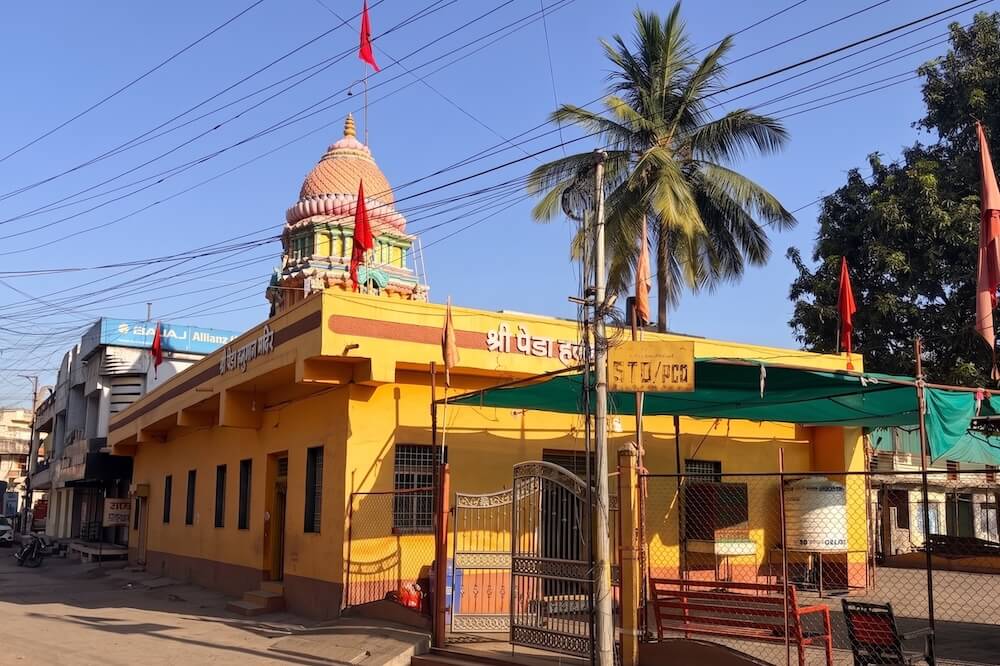
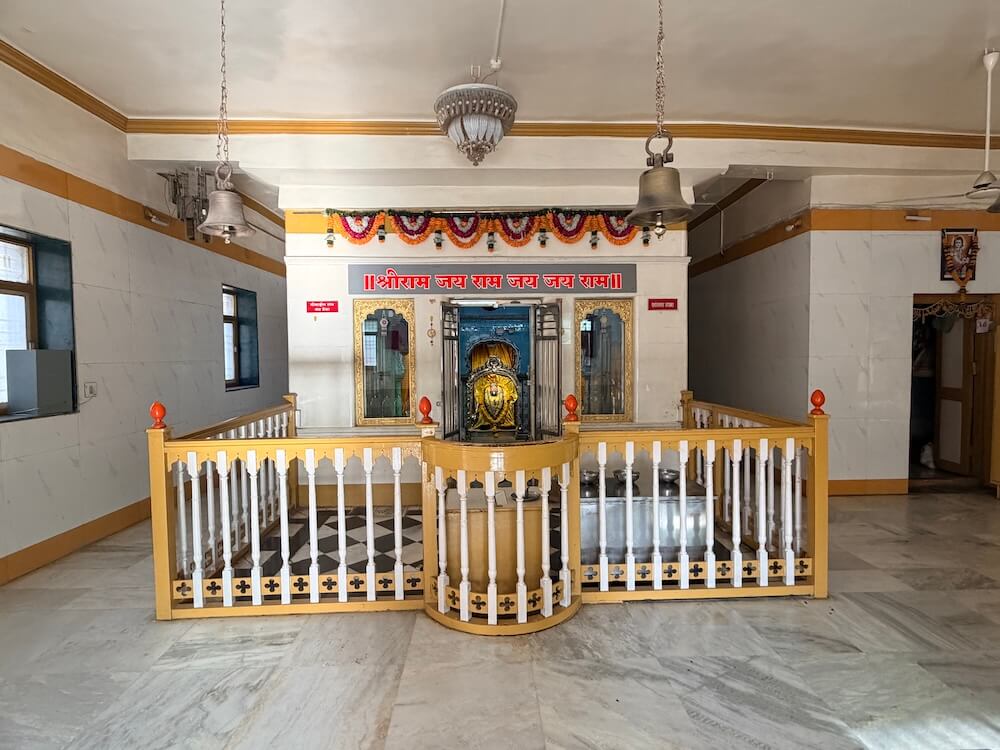
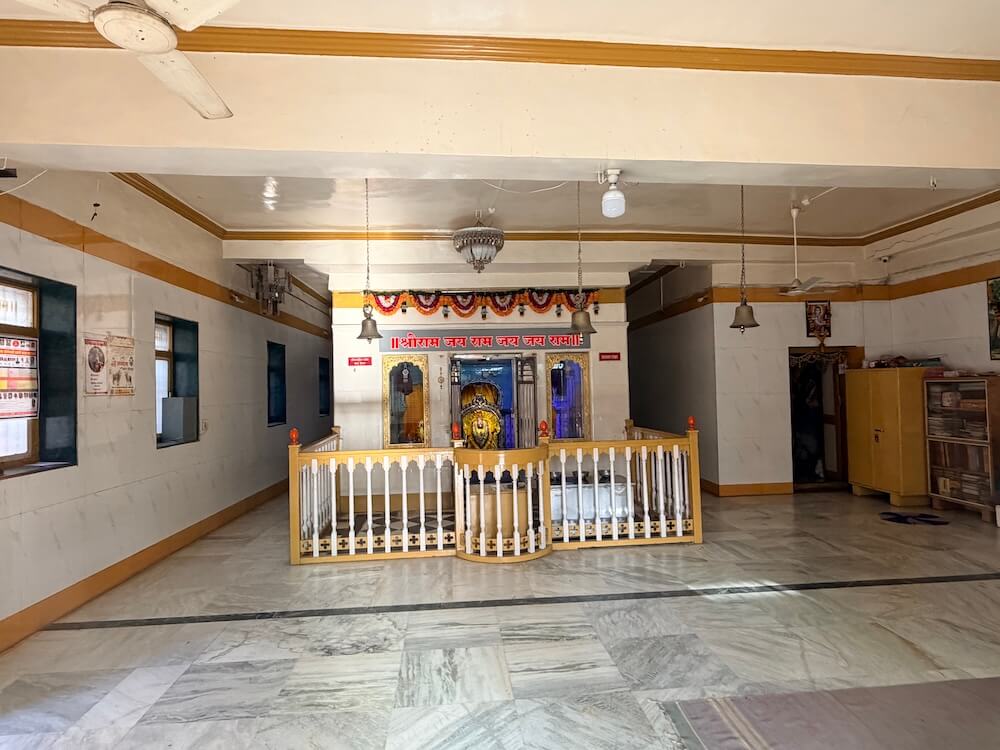
This temple is situated in a busy square in the New Mondha area. In recent times, this temple has been renovated. The structure of the temple consists of a ‘Sabhamandap’ (assembly hall) and a ‘Garbhagriha’ (sanctum sanctorum). The Sabhamandap has a total of four entrances: two at the front and one each on the left and right sides. There are windows in this enclosed Sabhamandap to allow sufficient light and air. Sturdy pillars are erected within the walls of the Sabhamandap. The roof of the Sabhamandap rests on strong beams placed over these pillars. Six large brass bells are hung in a horizontal row from the ceiling. Pictures of various deities are displayed on the walls of this Sabhamandap.
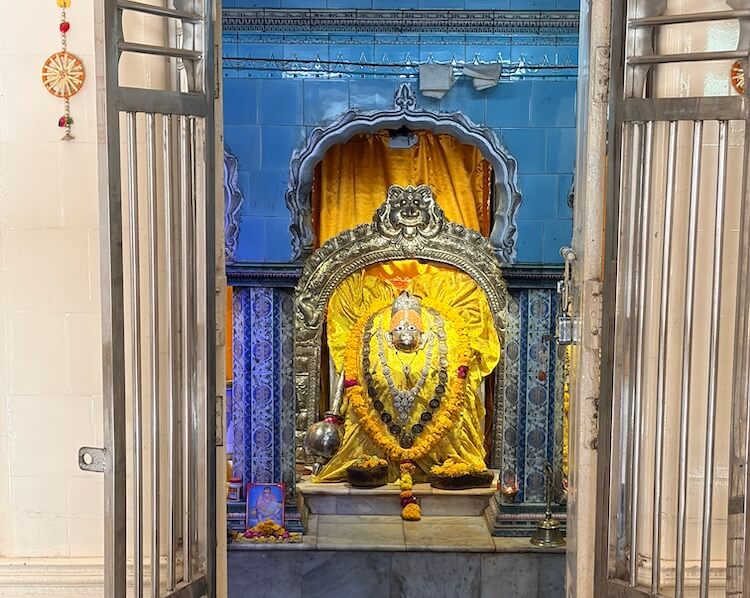
While moving forward from the Sabhamandap, one sees a wooden railing with small pillars in front of the entrance to the Garbhagriha. This space serves as an ‘Antarala’ (vestibule). The door frame of the Garbhagriha features a traditional vertical design. Sturdy wooden doors are fitted in this entrance. Inside the Garbhagriha of the temple, a ‘Makhar’ (shrine) is erected on a ‘Vajrapitha’ (pedestal). There are four small pillars on the front side of this Makhar. An arched ‘Torana’ is crafted over these pillars.
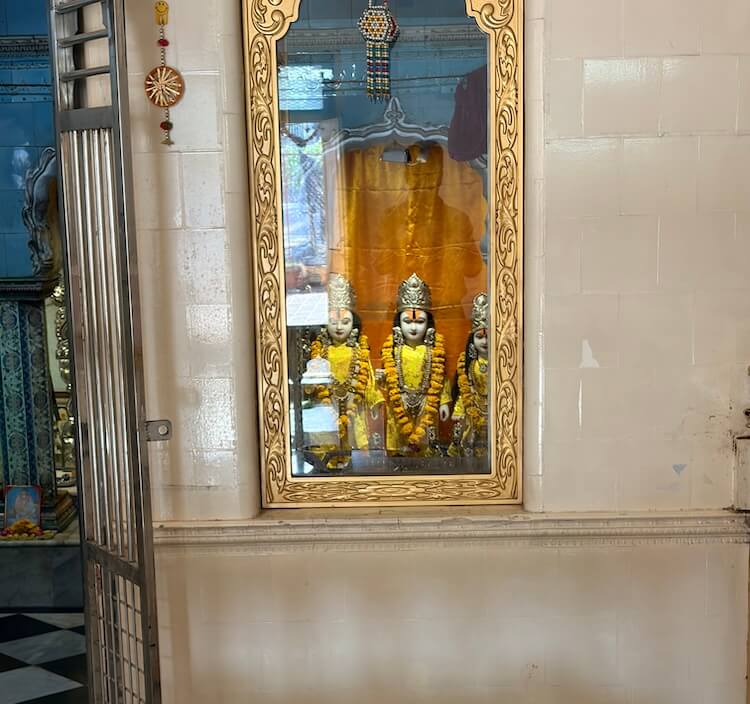
Right in the center of the Makhar is the vermilion-smeared stone idol of Hanuman. To the right of this Hanuman idol is a white marble idol of Ganpati. To the left of the Makhar, idols of Lord Shri Ram, Lakshman, and Mother Janaki are installed. All these idols in the Makhar are adorned with garments and traditional ornaments. Crowns are placed on the heads of all these idols. A canopy is hung from the ceiling of the Makhar.
A safety railing is built around the roof of the temple. A three-tiered ‘Shikhara’ (spire) is erected over the roof of the Garbhagriha. The lower two tiers of this Shikhara are octagonal in shape. Idols of various deities are placed upon them. The topmost, i.e., the third circular tapering tier of the Shikhara, has vertical carvings. At the apex of the Shikhara is a stone ‘Amalaka’. On this Amalaka, there is a ‘Kalash’ and the temple’s flag.
The Hanuman Jayanti festival, held on Chaitra Purnima, is the annual festival of this temple. During this festival, thousands of devotees come for darshan. On the day of Hanuman Jayanti, a special festival idol of Hanuman is placed in a cradle, and the birth celebration is performed. At this time, all the present devotees sing traditional cradle songs. This creates a devotional atmosphere in the entire area.
On the occasion of this celebration, programs such as Maruti Yajna, Bhajans, Kirtans, scripture recitations, and Ramkatha readings are organized in the temple.
Along with major festivals like Ram Navami, Chaitra Navratri, and Ganesh Jayanti, special religious programs are organized in the temple on the occasions of Dussehra, Diwali, the month of Shravan, the month of Margashirsha, and Adhik Maas.
During these festivals, the area takes on the appearance of a fair due to the crowd of thousands of devotees who come for darshan. There is also a crowd of devotees at this temple every Saturday.
Devotees whose vows have been fulfilled offer ‘Peda’ prasad to the deity. Devotees can have darshan here daily from 6:00 AM to 11:30 AM and from 4:00 PM to 9:00 PM.
This sacred temple stands as a testament to deep spiritual devotion, ancient architectural grandeur, and rich local cultural traditions.
The sanctum sanctorum houses the divine idol consecrated according to ancient Vedic traditions, surrounded by serene courtyards and traditional temple architecture.
Navratri, Maha Shivratri, Annual Temple Jatra & Deepotsav
Compare and book flights, secure top-rated local hotels near the temple, hire reliable guides, and rent cars instantly.
Extend your pilgrimage by visiting other highly sacred temples located nearby.


Add ₹999 more to unlock FREE SHIPPING!
Your sacred cart is currently empty.
Shop Photo FramesFill in your delivery details below to place your order.
Add comment