
Add ₹999 more to unlock FREE SHIPPING!
Your sacred cart is currently empty.
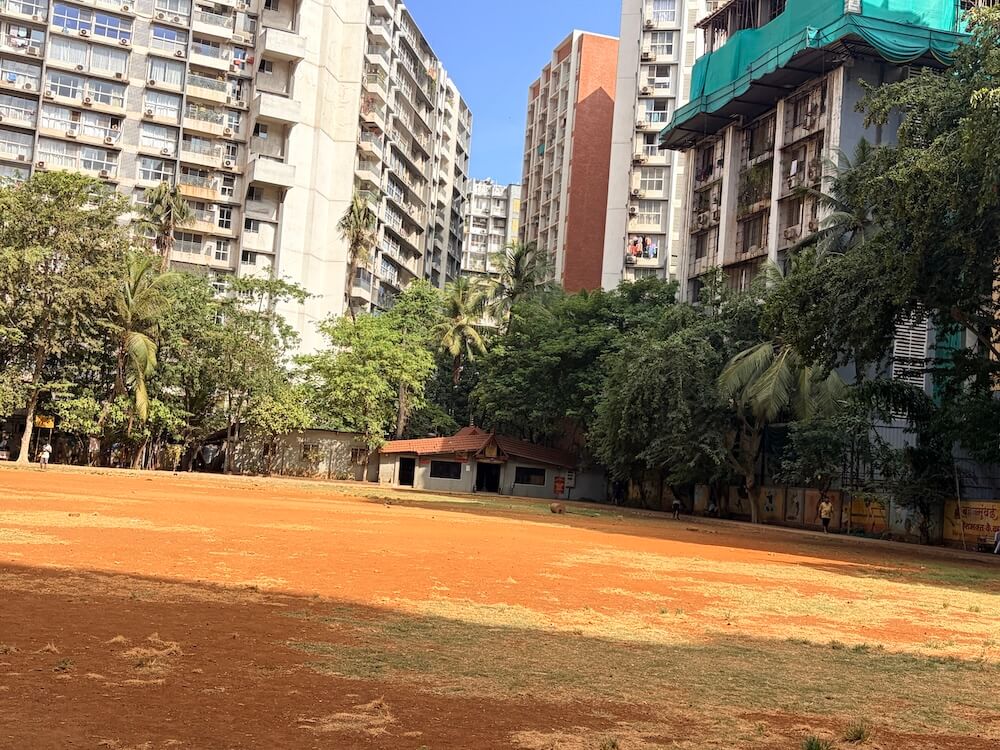
Shop Photo FramesChembur, one of Mumbai’s ancient villages, is today an important suburb on Mumbai’s Harbour railway line. The temple dedicated to Bhagwan Ayyappa is situated in a maidan here, known by the name of Kumaraswami Kamaraj, a Congress leader who fought the British for independence and suffered imprisonment many times. This temple was established by the ‘Shri Ayyappa Sangam’ organisation, which functions on the principle of ‘Lokah Samastah Sukhino Bhavantu’. Due to its disciplined worship rituals and the ‘Mandala-Makaravilakku’ festival organised by the organisation, this temple has become a revered place for countless Ayyappa devotees in the Chembur area.
The history of the modern suburb of Chembur begins in the British era. Chembur, situated on the Salsette island, was an important village even in ancient times. The name of the village, Chembur, is mentioned in ‘Mahikavatichi Bakhar’, edited and researched by the historian V. K. Rajwade. This bakhar recounts the story of Mumbai’s first king, Pratap Bimb, and also Bimbdev Yadav. From the mention of its name, it is understood that Chembur was a significant village at that time. It is said that because a large number of ‘chimbori’ (crabs) were found in the Chembur area, it was called Chimbori. However, as the British found it difficult to pronounce Chimbori, they started calling it Chembur. However, in the Mahikavatichi Bakhar, the village is mentioned as ‘Chembhur’. This clearly indicates that this has been its name since ancient times.
A few years after the islands of Mumbai and Salsette, which were under Portuguese control, came into English hands, the fortunes of the Chembur area brightened. In January of one thousand eight hundred and five, during the tenure of British Governor Jonathan Duncan, after the Sion bridge was built, this area was connected to the island of Mumbai by road. In the year one thousand eight hundred and fifty-three, railway traffic started between Mumbai and Thane. Subsequently, in one thousand nine hundred and six, the railway line from Kurla to Chembur was started. This route was built for garbage transportation. A large amount of land was reclaimed here by filling in the marshy areas with this garbage. On the fourth of February, one thousand nine hundred and twenty-four, this route was opened for passenger traffic. To increase the population here, the government allotted plots of land to citizens at very low rates between one thousand nine hundred and twenty-five and one thousand nine hundred and forty. In one thousand nine hundred and forty-five, Chembur was included in Greater Mumbai. During that period, camps were set up here for the rehabilitation of refugees displaced by the Partition. After industrialisation gained momentum in areas like Chembur, Trombay, etc., the need arose to create new urban settlements here. Between one thousand nine hundred and fifty-five and one thousand nine hundred and fifty-eight, the ‘Bombay Housing Board’ created some planned settlements here. Station Colony (Subhash Nagar), Township Colony (Tilak Nagar), and Shell Colony (Sahakar Nagar) are among them. Shell Colony was primarily built for the workers and employees of the then ‘Shell Oil Company’. In the fifties and sixties, a large number of South Indian citizens began to reside in this multilingual, multicultural suburb. From their cultural, social, and religious needs, various temples of deities were built here. The Ayyappa Temple in Kamaraj Maidan in Shell Colony is one of them.
The original grand temple of Bhagwan Ayyappa is in Sabarimala, Kerala. Ayyappa is also known by the names Sastha, Hariharaputra, and Manikandan. He is considered the son of Shiva and Vishnu in the form of Mohini. Bhagwan Vishnu took the female avatar of Mohini to slay Bhasmasura. After this, Mohini enchanted Shivshankar with her beauty. Ayyappa was born from their union. Therefore, he is also referred to as Hariharaputra. The worship of Ayyappa is a unique confluence of Shaiva, Vaishnava, and Shakti traditions. Strict celibacy, abstinence from alcohol and non-vegetarian food, and a rigorous code of conduct are considered essential for his devotion. Devotees undertaking the Sabarimala pilgrimage observe such a forty-one-day vow before visiting the temple. “Shribhutanatha Sadananda Sarvabhuta Dayaparah. Rakshah Rakshah Mahabaho Shastre Tubhyam Namonamah.” This is the worship mantra of Ayyappa. Temples of Bhagwan Ayyappa, who is revered by countless South Indian and especially Malayali devotees, are found in many places around the world today. The temple in Kamaraj Maidan, Chembur, is one of them.
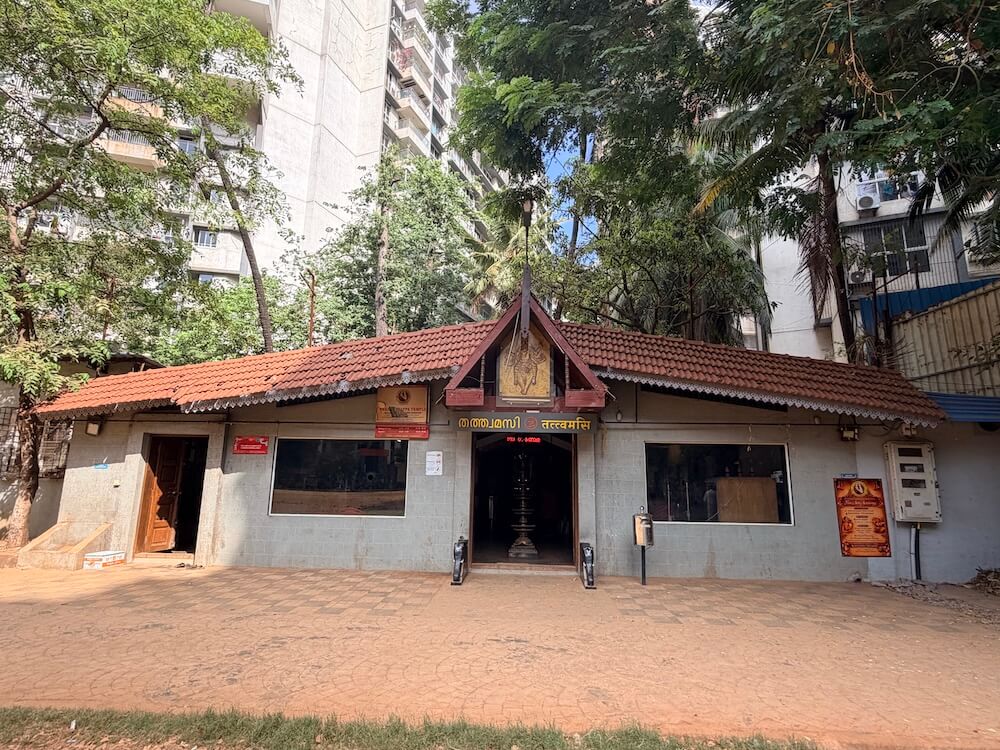
The exact year of the establishment of this temple is not precisely known. It is said that some prominent citizens from the Malayali community who settled here after the fifties laid the foundation of this temple. They established the Ayyappa Sangam organisation in the name of their revered deity and built this temple approximately six decades ago. After entering through the small entrance of Kamaraj Maidan, this temple is situated in a corner to the right of the maidan. This temple is built in a special Keralite architectural style, using modern construction materials. Since Kerala, like the Konkan, is a region with heavy rainfall, the roofs of houses and temples there are mostly sloping on all four sides. The roof of this temple is also sloping and tiled. The structure of this temple consists of a Mukhamandapam and a ‘Sreekovil’, which is the sanctum sanctorum. The Mukhamandapam has a large square entrance. On both sides of it are elephant sculptures. The dictum ‘Tat Tvam Asi’, which is the essence of Bhagwan Ayyappa’s teachings, is inscribed on the doorframe. This mantra first appeared in the dialogue between Maharshi Uddalaka and his son Shvetaketu in the sixth chapter of the Chandogya Upanishad, which is related to the Samaveda. Its literal meaning is ‘That thou art’. According to the Kevaladvaita philosophy, this sentence is used to denote the unity of the Jiva and Brahman. In the upper part of the doorframe, there is a triangular carved idol of Ayyappa seated on a tiger.
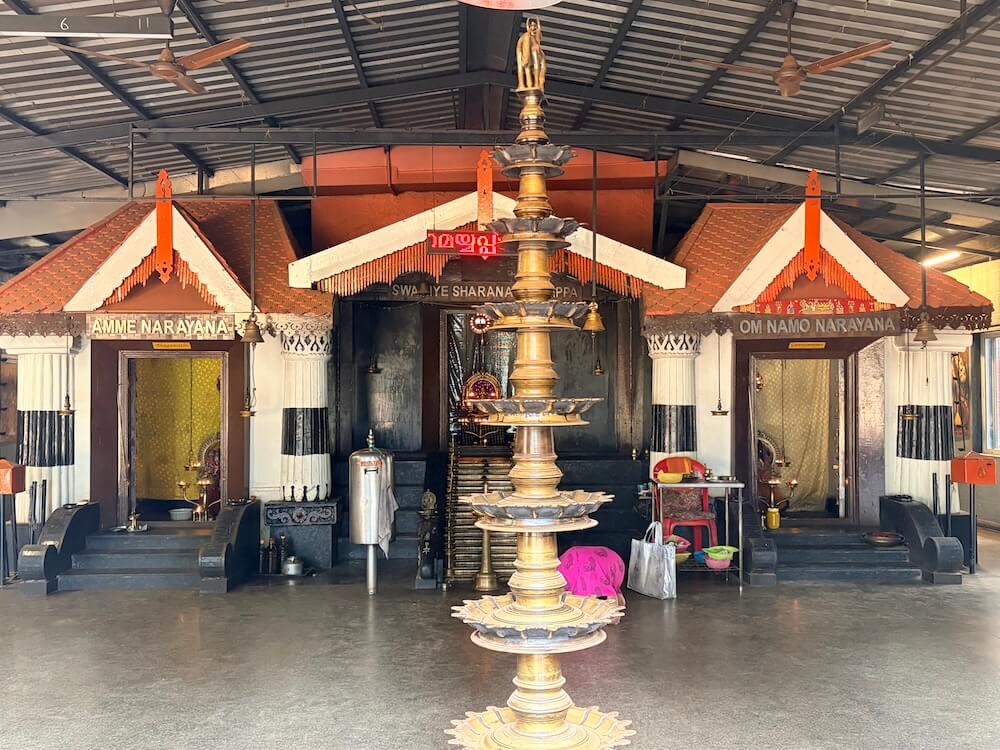
Within the *mukhamandapa* of the temple, there stands a tall, seven-tiered *deepastambha* shaped like a *samai*. Directly in front of it is the main *Srikovil* of the temple. This *Srikovil* is built upon a high *jagati* and features *sopanam* in the Keralite temple architectural style. In front of it, and on its *१९* small steps, *samai* lamps are arranged on both sides. These are lit during special *pujas*.
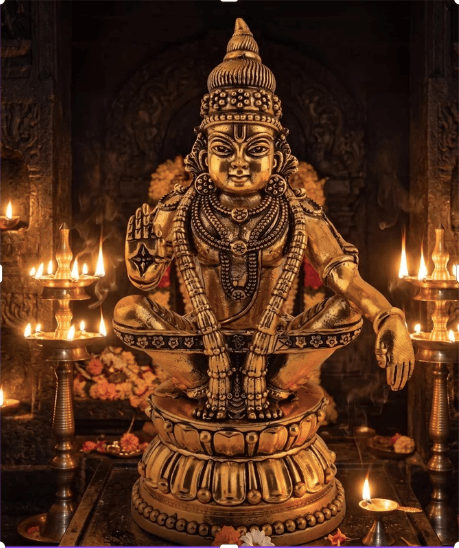
Within the *Srikovil*, the *murti* of Ayyappa Swami is gracefully seated upon a high *vajra peetha*. Lord Ayyappa, seated with knees bent, rests the elbow of one hand upon His left knee, while His other hand is in the *ashirvad mudra*. A crown adorns the *murti*’s head, and behind it is a crescent-shaped *makara*. In most South Indian temples, electric lights are generally not used in the *garbhagriha*; instead, only ghee lamps illuminate the sacred space. Here too, numerous lamps glow around the *murti* of Ayyappa Swami.
Adjacent to the main *Srikovil*, on both the left and right sides, are two additional *garbhagrihas*. In the right *garbhagriha*, the *murti* of Guruvayoorappan (Lord Vishnu) is enshrined, while the left *garbhagriha* is dedicated to Devi Bhagavati.
Devotees may partake in *darshan* at this temple from Sunday to Friday, between *५.३०* AM and *१०.३०* AM, and again from *५.३०* PM to *८.३०* PM. On Saturdays, the temple experiences a large gathering of devotees seeking *darshan*. On this day, *darshan* timings are from *५.३०* AM to *११* AM, and from *५.३०* PM to *९* PM.
The grandest festival celebrated at this temple is the ‘Mandala-Makaravilakku’ festival, which spans from November to January. During this *४१*-day festival, various religious and cultural programs are observed. Devotees who are unable to undertake the pilgrimage to the original Sabarimala temple come here during this period to complete their *vratadharana*. On Makar Sankranti, the special ‘Makaravilakku’ festival is celebrated, and the temple is adorned with a magnificent display of lights. Additionally, programs such as *Bhagavata Saptaham* and *Maha Annadanam* (*Prasad Ottu*) are also organized here. Photography is strictly prohibited within this temple.
This sacred temple stands as a testament to deep spiritual devotion, ancient architectural grandeur, and rich local cultural traditions.
The sanctum sanctorum houses the divine idol consecrated according to ancient Vedic traditions, surrounded by serene courtyards and traditional temple architecture.
Navratri, Maha Shivratri, Annual Temple Jatra & Deepotsav
Compare and book flights, secure top-rated local hotels near the temple, hire reliable guides, and rent cars instantly.
Extend your pilgrimage by visiting other highly sacred temples located nearby.


Add ₹999 more to unlock FREE SHIPPING!
Your sacred cart is currently empty.
Shop Photo FramesFill in your delivery details below to place your order.
Add comment