
Add ₹999 more to unlock FREE SHIPPING!
Your sacred cart is currently empty.
Shop Photo FramesNrisimhadeva is at Kolhagrama; the Supreme Self is Sadashiva.
He alone is manifest as the divine
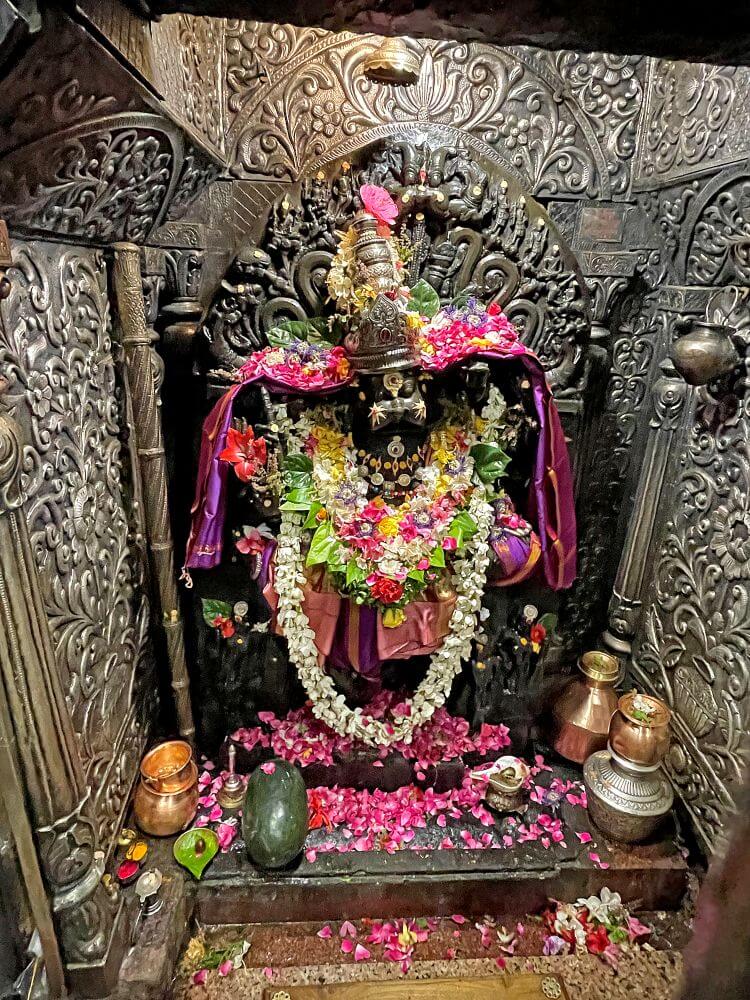
This is the same deity described by Saraswati Gangadhara in the Gurucharitra, namely Shri Nrisimha of Kole Narsimhapur. Situated on the banks of the Krishna River in Walwa taluka of Sangli district, this is a sacred abode of Lord Nrisimha. The defining feature here is the exquisite, sixteen-armed idol carved from deep black stone (Shshaligrama), possessing captivating beauty from head to toe. This very place is renowned as Jwala Nrisimha Tirtha. It is said that this site is thousands of years old. It is because of this temple that the village came to be named Kole Narsimhapur.
The legend of this temple is that Maharshi Vyasa’s father and Vasishtha Rishi’s grandson, as well as the seer of the Rigveda mantras, Rishi Parashara, resided at Somatirtha in Karvir. It is mentioned as such in the ‘Karvir Mahatmya’. In the text ‘Shri Krishna Mahatmyam’, it is stated that “Yada punastada bhaktya tapah kartum Parasharah. Narasimham tada dhyayan Krishna tire Munishvarah..”, which means that Rishi Parashara devoutly performed penance for Lord Narasimha on the banks of the Krishna River. At that time, the Supreme Lord appeared before him in the form of Narasimha. However, when that divine vision occurred, flames were emanating from that Shaligram idol. Therefore, this region is also known as Jwala Narasimhapur. Since it was impossible to establish this idol on earth, Parashara immersed it in a deep pool of the Krishna River.
It is said that thousands of years after this incident, a Brahmin couple lived in the village of Anjana in Karnataka. Due to the curse of a sage, their eyesight and Their speech had been lost. After they begged for forgiveness, that sadhu granted them a counter-curse that if they worshipped Lord Narasimha with utmost devotion and pleased Him, their physical impairment would vanish. Accordingly, they performed penance for 12 years. Then one day, they had a divine vision in a dream. Lord Narasimha appeared in the dream and told them, My idol is in the deep pool of the Krishna River. Convey this information to King Bhima of Koundinyapur. At that very moment, their sight and speech were restored. Koundinyapur is today’s town of Kundal in Sangli district. King Bhima of that place came here and lifted the Shaligram idol of Narasimha out of the pool. Afterwards, he built a temple here.
The ‘Sangli Gazetteer’ states that a Yadava king named Satyeshwara ruled at Kundal. He passed away on Chaitra Shuddha Panchami, Saka 310 (388 CE). According to the ‘Samudreshwara Mahatmya’, King Satyeshwara had seven descendants, of whom Bhishmaka was his first descendant. His name eventually became corrupted into Bhima. This makes it clear that the original temple here was built in the 4th century. Satyeshwara was a Yadava king. Later, King Ramadevaraya of this very same Yadava lineage commanded his Karnadhipa, meaning Chief Minister, Hemadri, to construct a temple here. This temple is believed to have been built in 1273 CE, two years after Ramadevaraya ascended the throne.
The next historical record about this temple dates back to the twelfth century. Prior to Sant Namdev Maharaj, the seventh ancestor in his lineage, Yadushet Relekar, was a great devotee of Lord Vitthal. Modern research has revealed that he was originally from the village of Narsi Brahmani in Parbhani district. Earlier, there was a misconception that this village of Narsi Brahmani was located near Karad. Some people called this village Bhayenarsingpur, while others called it Kole Narsingpur. Because of this, this Yadushet came here for the Lord in the year 1124 CE It is narrated here that she had come for service. According to historical records, in the year 1426 CE, the Bahmani Sultan donated land for the illumination (lamp) of this temple. In the year 1662 CE, Samarth Ramdas Swami visited this temple for darshan. In the year 1718 CE, Shrimant Shahu Maharaj (First), the son of Chhatrapati Sambhaji Raje and the Chhatrapati of Satara, also granted lands for this temple.
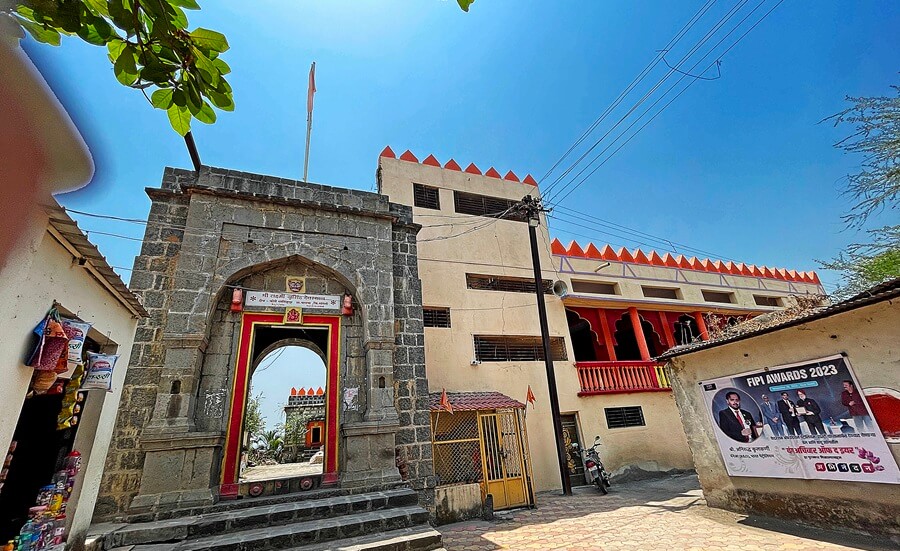
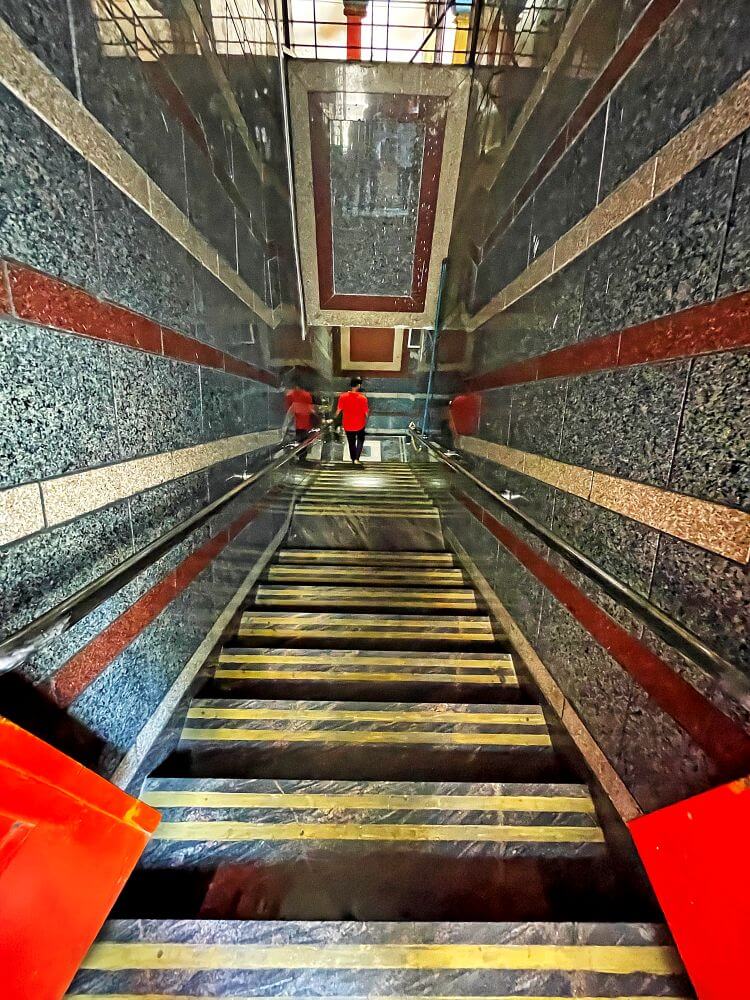
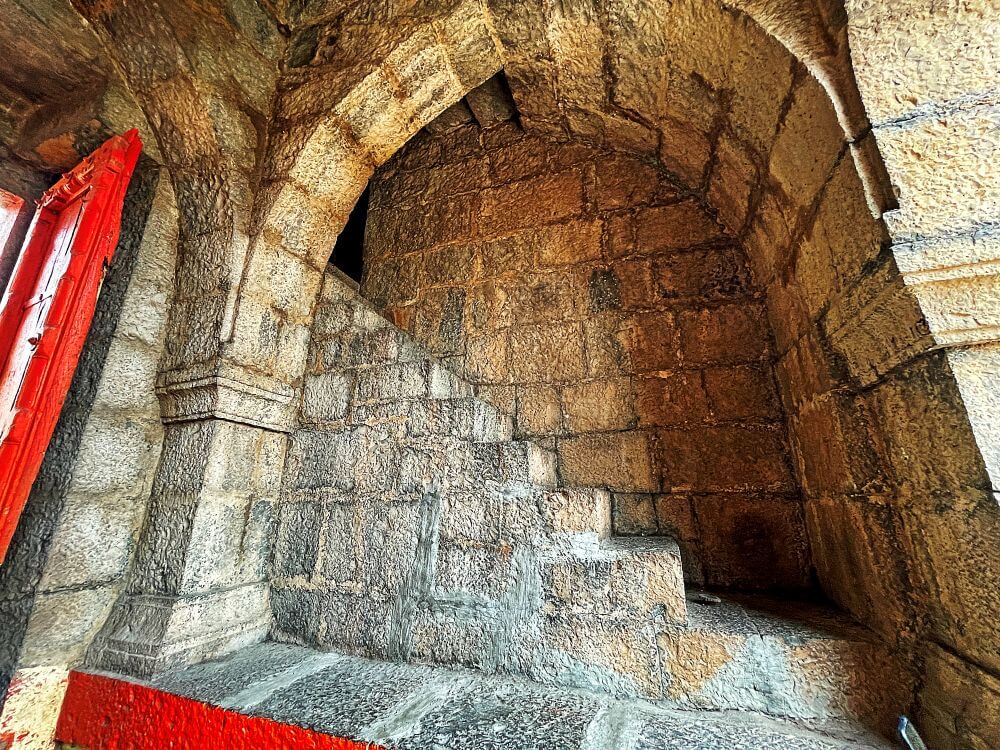
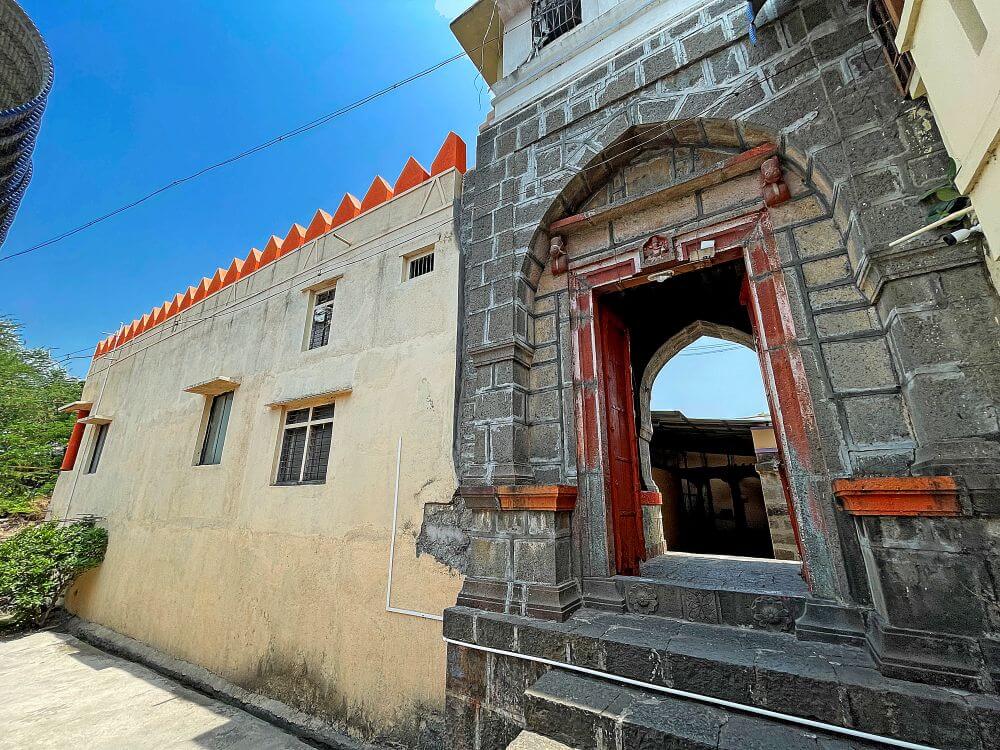
This temple is situated in the central part of the village of Kole Narasinhapur and on the banks of the Krishna River. One enters the courtyard of this temple through a stone arched gateway known as a dindi darwaza. In this courtyard, there are two tall stone lamp pillars (deepmalas) and two tulsi vrundavans in front of them. Since the vrundavan on the left is located directly above the idol in the sanctum sanctorum situated in the underground cellar, it is believed that circumambulating (pradakshina) this vrundavan completes the pradakshina of the Lord. There is a window in the wall of the right-hand vrundavan, through which, if coins are dropped, they fall directly into the donation box of the sanctum. Since the main idol of Lord Narasimha in this temple is located in an underground cellar that is fourteen feet deep, a pipeline has been installed through this vrundavan for ventilation. An inscription reading, “Bhanu Tukdev, his son Gopal Bhaskar, his son Bhanu Gopal,” is found on the first step of the underground pathway. Descending nine steps from here, one enters the underground sanctum. Right here, in a niche, are the deities Mahalakshmi, Gajalakshmi, and the sacred sandals (padukas) of Siddheshwar Maharaj dating back to the eighteenth century. In this subterranean sanctum, there is an idol of Lord Narasimha that is about six feet tall.
Out of the sixteen arms of this idol carved from a single monolithic rock, four arms are somewhat damaged. In the hands on the left side, weapons such as a shield, vajra, bow, and noose are held, and one hand is holding the head of Hiranyakashipu. The nails of one hand are pierced into his abdomen. In the hands on the right side, weapons such as a flute, lotus, battle-axe, and discus are held, and one hand is holding the foot of the demon. While It is tearing open its belly with its remaining hand. The mane around the neck and the wide-open eyes of this idol give it a fierce appearance. With erect ears and an open mouth roaring, the tongue is peeking out. It has a broad forehead and a crown on its head. This idol, with its distinct, well-defined, proportionate limbs, expressive emotions, and beautiful ornaments, is uniquely characteristic.
On the halo behind this idol, the ten avatars of Lord Vishnu—Matsya, Kurma, Varaha, Vamana, Narasimha, Parashurama, Krishna, Rama, Buddha, and Kalki—are carved. In this sequence, the Krishna avatar appears first, followed by the Rama avatar. Additionally, there are Makarmukhas (crocodile-faced motifs) on both sides. In the center of the same halo is the Kirtimukha. Seated on the threshold, this form of Lord Narasimha has placed Hiranyakashipu on His lap, with one foot lowered. Carved near the right foot of this idol are the figures of Bhudevi and Garuda, and near the left foot are the figures of Prahlada and Lakshmi.
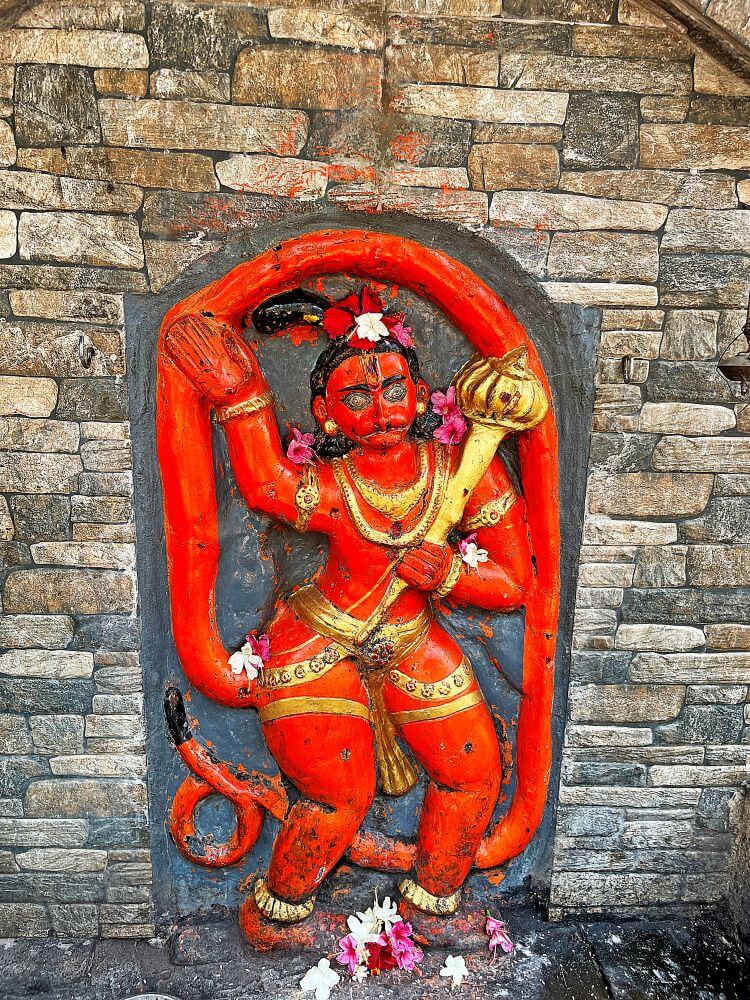
A garden has been developed on the banks of the Krishna River at the back of the temple. Adjacent to it is an ancient temple of Lord Mahadeva. Outside this temple, there is a Nandi on a raised platform. Beside the temple, there is a small shrine of Lord Ganesha. Close by is the temple of Siddheshwar Maharaj. The Samadhi of Ramchandra Maharaj, the son of Siddheshwar Maharaj, is situated on the banks of the Krishna. The majestic, meandering course of the Krishna River here appears enchanting. The festival of Nrisimha Jayanti is celebrated here from Vaishakh Shuddha Saptami to Purnima. During this period, thousands of devotees visit for Darshan.
This sacred temple stands as a testament to deep spiritual devotion, ancient architectural grandeur, and rich local cultural traditions.
The sanctum sanctorum houses the divine idol consecrated according to ancient Vedic traditions, surrounded by serene courtyards and traditional temple architecture.
Navratri, Maha Shivratri, Annual Temple Jatra & Deepotsav
Compare and book flights, secure top-rated local hotels near the temple, hire reliable guides, and rent cars instantly.
Extend your pilgrimage by visiting other highly sacred temples located nearby.

Add ₹999 more to unlock FREE SHIPPING!
Your sacred cart is currently empty.
Shop Photo FramesFill in your delivery details below to place your order.
Add comment