
Add ₹999 more to unlock FREE SHIPPING!
Your sacred cart is currently empty.
Shop Photo FramesThe Jagruteshwar Shiva Temple, located in Vashi on the outskirts of Mumbai, is one of the most ancient, awakened (Jagrut), and renowned sites in Navi Mumbai. It is said that the Swayambhu (self-manifested) Shiva Linga here emerged from the earth. Due to this divine significance, hundreds of devotees visit the temple daily for darshan. The temple also houses the shrine of the deity Vasoba, from whom the village of Vashi is said to have derived its name. Devotees believe that this is a deity who responds to their prayers and fulfills their wishes.
Belapur in Navi Mumbai was an important center since ancient times due to its strategic location. Vashi was a small village that formed part of the kingdom of the rulers of Belapur Fort. The visionary Chief Minister of Maharashtra, Vasantrao Naik, laid the foundation for the planning of Navi Mumbai in 1966. In 1972, Navi Mumbai was developed as a planned city. Subsequently, with the construction of the Thane Creek Bridge in 1973, Vashi was connected to Mumbai, giving the village a modern identity and significance. In such a city stands the seat of Jagruteshwar, which has a history spanning over two centuries. The ancient temple of Jagruteshwar is situated on the banks of a lake along the creek.
A legend associated with this temple states that about 250 years ago, villagers spotted a stone shaped like a Shiva Linga on the banks of the Vashi creek. When they began digging, the stone started sinking deeper into the earth. Consequently, they stopped the excavation and decided to build a temple by constructing walls around the Linga. The temple was built some years later. It is said that no matter how high the tide rises or how turbulent the sea becomes, the water has never reached the walls of this temple to this day. Thus, the villagers believe that Jagruteshwar protects the village from the wrath of the sea. Because of this faith, the temple is always crowded with devotees seeking the blessings of Jagruteshwar.
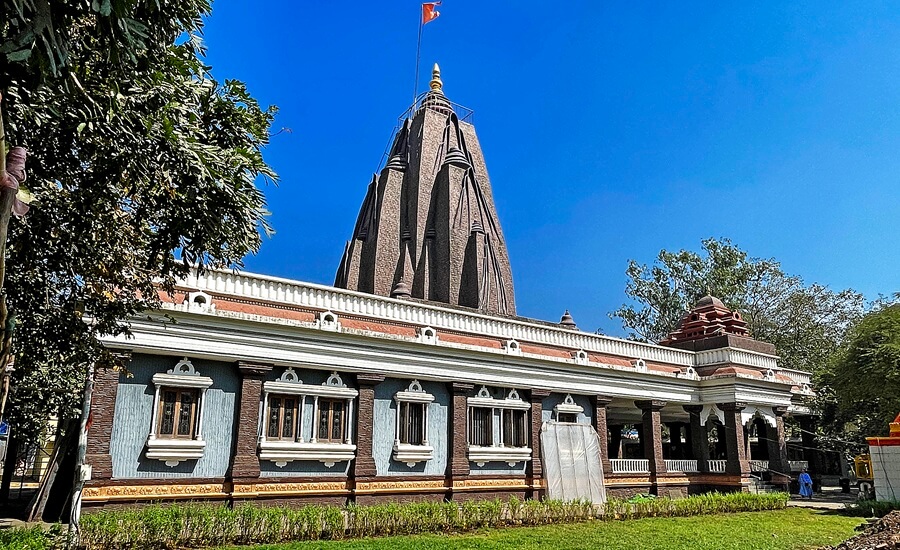
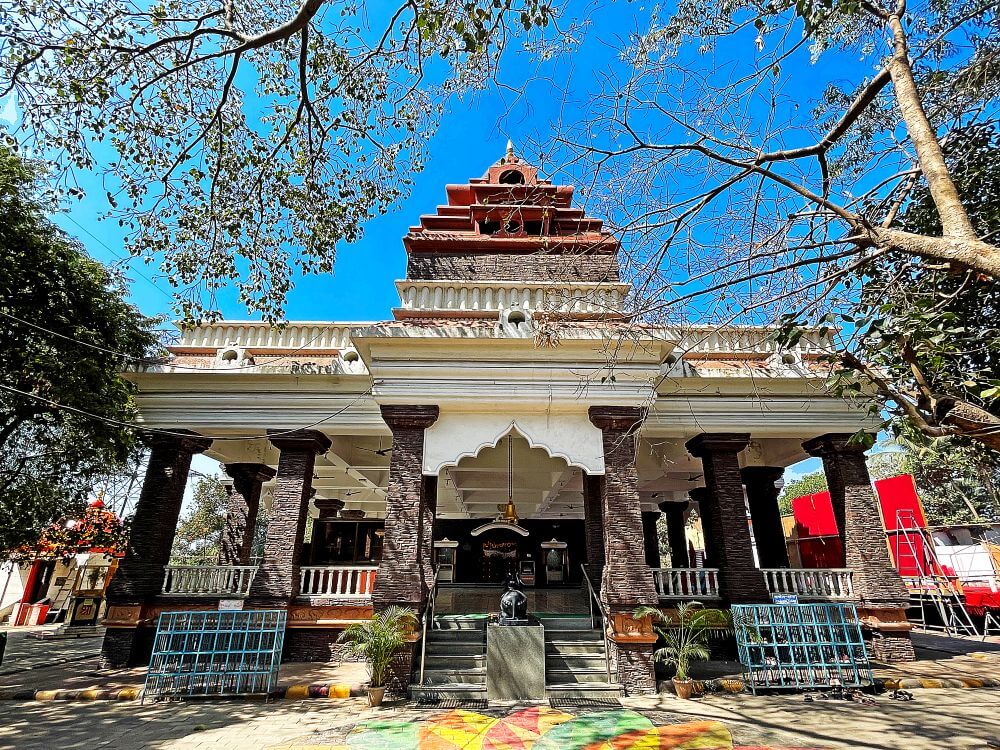
The Jagruteshwar temple is located on the banks of a large lake within a grand courtyard spanning about two and a half acres. There are two entrances to reach the temple. One enters the spacious courtyard through the main arch in the boundary wall. A garden has been developed around the temple, featuring lush green grass and numerous ornamental plants. Benches are provided at various spots for the convenience of devotees. Originally, the temple had a tiled roof. Over time, it has undergone several renovations. The temple acquired its current appearance after the renovation in 2015. The ground-breaking ceremony for the renovation was performed on November 10, 2007, by Shantibrahma Maruti Maharaj Kurhekar of Dehu Alandi, and on March 25, 2015, the consecration of the idols and the Kalash Puja were performed by Balayogi Sadanand Maharaj of Tungareshwar.
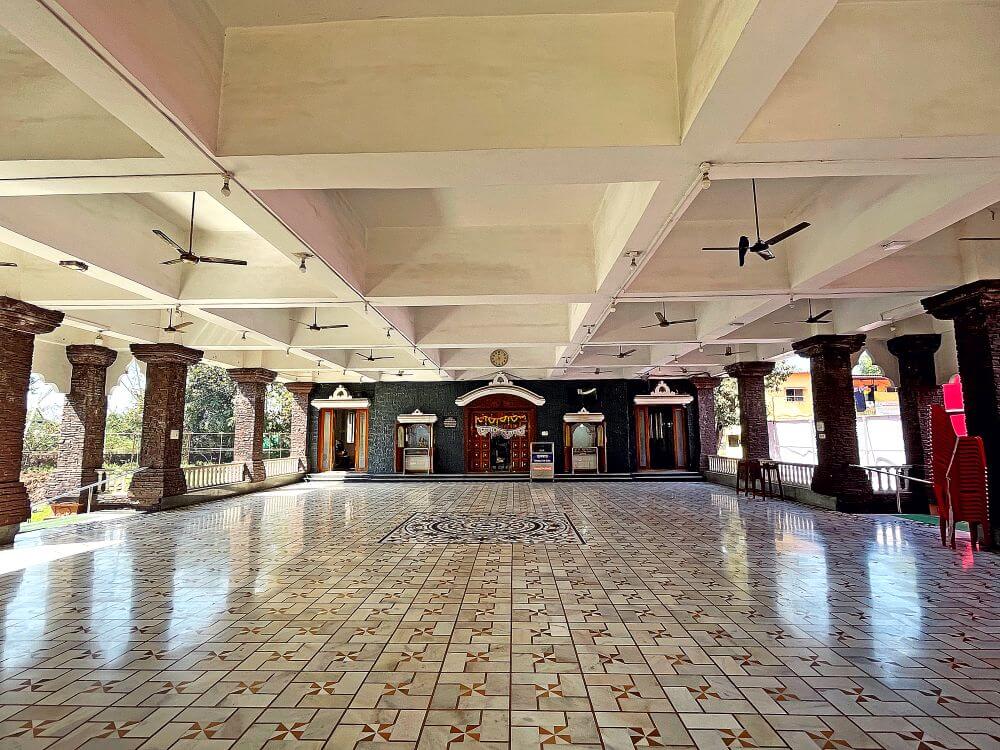
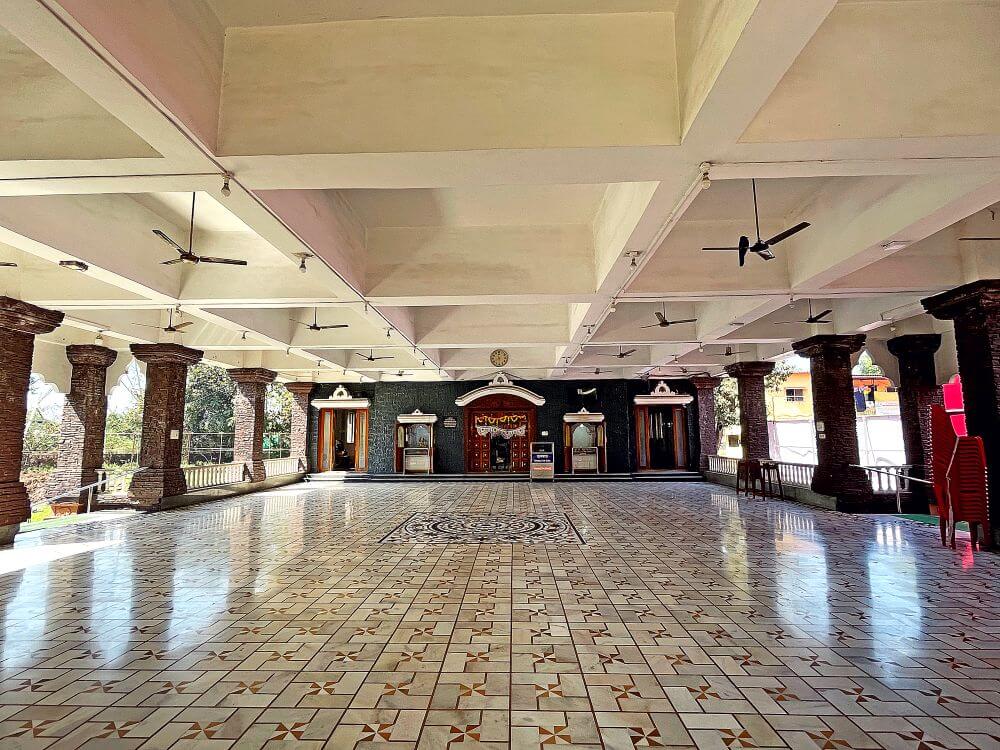
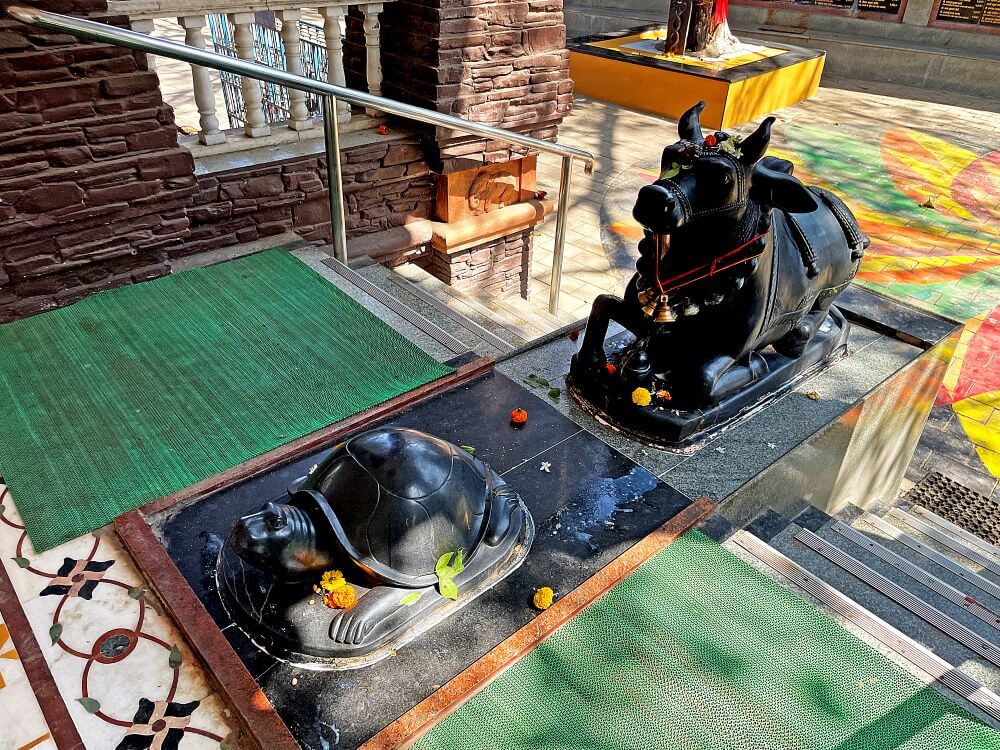
The temple structure consists of a Nandi Mandapa, Sabha Mandapa, Antarala (vestibule), and Garbhagriha (sanctum sanctorum). Under an ancient Peepal tree in front of the temple entrance, there is an old stone-carved Naga sculpture. On the platform of the steps leading to the main entrance of the temple, there are monolithic stone idols of Nandi and a tortoise. The Sabha Mandapa is spacious and open. A conscious effort has been made to give the pillars an antique look, making them quite eye-catching. On the front wall of the Antarala, on either side of the entrance, are ornate marble niches housing Ganesha and the village deity, Vasoba.
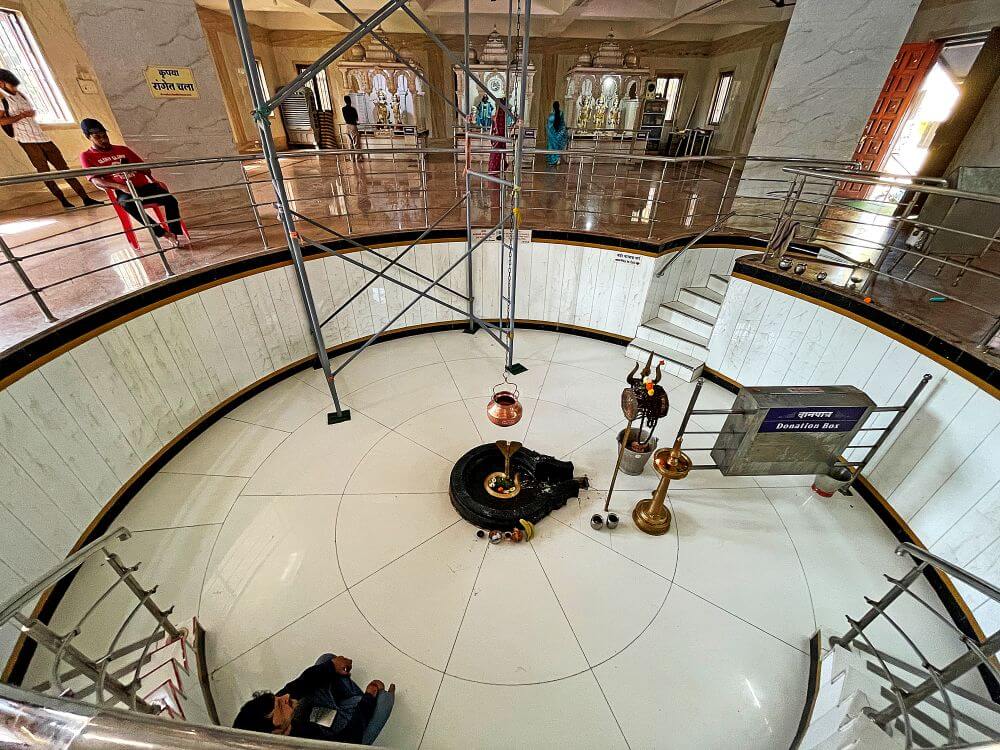
The Antarala here is unique. Upon entering the Antarala from the Sabha Mandapa, one finds a circular, sunken area about six to seven feet deep. This is the Garbhagriha. There are steps near the entrance of the Antarala to descend into it. In the center of this Garbhagriha is the Swayambhu Linga of Jagruteshwar. A serpent hood (Naga) provides a canopy over it, and an abhishekam is performed via a vessel (Galantika) suspended over the Shiva Linga. In the Antarala, beyond the Garbhagriha and at a higher level, there are three more shrines. In the central shrine, there are idols of Vitthal-Rukmini, flanked by Saint Dnyaneshwar and Saint Tukaram. To the left is Radha-Krishna, and in the shrine to the right are the idols of Shri Ram, Lakshman, Sita, and Hanuman. The temple complex features a main entrance hall, a assembly hall, two smaller spires, and a main tall spire over the Garbhagriha topped with a Kalash.
In the vicinity of the main temple, there is a temple dedicated to Mariai and Shitala Devi. To the left of the Mariai-Shitala Devi temple is a Hanuman temple. Above the entrance of this temple, in the center, are idols of Ram-Lakshman-Sita, with sculptures of Hanuman bowing to them on both sides. In the Garbhagriha, there is an idol of Ganesha on the left. In the center stands a vermilion-smeared idol of Hanuman. To the right is the shrine of Shani Dev. There is also a Dattatreya temple in the complex, housing idols of Gajanan Maharaj, Swami Samarth, Dattaguru, and Sai Baba.
Devotees can have darshan of Jagruteshwar daily from 7:00 AM to 1:00 PM and from 4:00 PM to 10:00 PM. From 5:00 PM to 6:30 PM, Haripath is recited by the villagers, a tradition that has been followed here for many years. Daily rituals such as Abhishekam, Rudrabhishekam, Puja, and Shanti Puja are performed at the temple. A Saptah (seven-day festival) is organized seven days before Mahashivratri, during which bhajans, kirtans, and discourses are held until 11:00 PM. Annadaan (food distribution) is provided to devotees throughout these seven days. Programs are also held for seven days before Gokulashtami, featuring continuous chanting of Gopal Krishna’s name, Akhand Harinam Saptah, bhajans, and kirtans. On Gokulashtami, the chapter of Krishna’s birth is read, followed by the distribution of Mahaprasad. Two days before the Amavasya of the month of Magh, the Jatra (fair) of Shitala Devi-Mariai is held. The day before the fair, a Jagran-Gondhal ceremony is performed for the Goddess. On the following day, thousands of devotees visit the temple for darshan. On this day, programs such as Abhishekam, Puja, bhajans, kirtans, and the singing of traditional devotional songs of the Agri-Koli community are held. Additionally, festivals like Ram Navami, Hanuman Jayanti, and Tukaram Beej are also celebrated.
This sacred temple stands as a testament to deep spiritual devotion, ancient architectural grandeur, and rich local cultural traditions.
The sanctum sanctorum houses the divine idol consecrated according to ancient Vedic traditions, surrounded by serene courtyards and traditional temple architecture.
Navratri, Maha Shivratri, Annual Temple Jatra & Deepotsav
Compare and book flights, secure top-rated local hotels near the temple, hire reliable guides, and rent cars instantly.
Extend your pilgrimage by visiting other highly sacred temples located nearby.


Add ₹999 more to unlock FREE SHIPPING!
Your sacred cart is currently empty.
Shop Photo FramesFill in your delivery details below to place your order.
Add comment