
Add ₹999 more to unlock FREE SHIPPING!
Your sacred cart is currently empty.
Shop Photo FramesShantadurga is the Goddess who established peace in the universe by ending the war between Vishnu and Shiva. This Goddess, who is a manifestation of Jagadamba, is a deity of peace as well as a protector. There are many temples of Shantadurga, the family deity of the Gaud Saraswat Brahmin community, in the land of Gomantak. One of the most famous among these is situated in the ancient Kapitagram (Kavlem). Devotees believe that the Goddess here is ‘Jagrut’ (awakened/manifest). The annual grand chariot festival held here on Magh Shukla Panchami still attracts many people today. Thousands of devotees participate in this procession.
The mythological story explaining the name of Goddess Shantadurga is that in ancient times, a fierce war took place between Shiva and Vishnu. At this time, the entire universe was shaking due to the clashing of Vishnu’s Sudarshana Chakra and Shiva’s Pashupatastra. The possibility of the end of the universe arose due to this war. Because of the conflict, the duties of sustenance and destruction of these two deities were coming to a halt. Seeing this, Lord Brahma finally created the Adi Shakti Jagadamba with his divine radiance. He sent her to the earth and asked her to bring about reconciliation between the two gods. Accordingly, the Goddess arrived on the battlefield and, standing between the two warriors, preached to them. According to the ‘Ambika Khand’ of the ‘Skanda Purana’, the Goddess preached to them that Brahma is the same as Hari and Maheshwara.
In this way, the Goddess stopped the war and established peace, which is why she was named Shantadurga. The ‘Devikosh’ author Prabhudesai has stated that “this metaphor might have been created to bring about a reconciliation in the conflict between Shaivites and Vaishnavites, which is still experienced today.” Like the Goddess, the task of bringing about the union of Vishnu and Shiva was later carried out by Adi Shankaracharya. The Panchayatana Puja, seen everywhere just like in Goa, is a part of this. Adi Shankaracharya was considered an incarnation of Shiva. However, he sang the glory of Vishnu by composing the ‘Shri Vishnu Bhujanga’ stotra and ‘Hari-Mide’ stotra. According to the beliefs of the people of Gomantak, Shantadurga is a form of Sateri Devi. Sateri, worshipped in the form of an anthill in Goa, is considered one of the Saptamatrikas (Seven Mothers). This Goddess is also known by the names Bhumka, Bhumika, and Purvi.
The story of how this Goddess came to Gomantak is that after Parashurama settled Gomantak, he performed a Yajna for his victory. For its success, he brought ascetic and scholarly Saraswat Brahmins from Trihotrapur in the north—namely Bharadwaj, Kaushik, Vatsa, Kaundinya, Kashyap, Vashistha, Jamadagni, Vishwamitra, Gautam, and Atri—to Gomantak. According to the Marathi Vishwakosh, the Mithila country had a total of 12 names. One of them was Tairabhukti. Its corrupted form became Trihotra. The area north of the Ganges in the present-day state of Bihar is called the Tirhut region. There were 66 clans of these Brahmin sages who came from here. They also brought their family deities with them: Mangeshi, Mahalaxmi, Mahadev, Shantadurga, Nagesh, Saptakoteshwar, and Mahalasa. This deity was first established in Gomantak at Keloshi.
Later, on 28 February 1510, the Portuguese arrived in Gomantak, and in the year 1560, the Inquisition was established in the Goa islands. After that, the brutal persecution of the Hindus here began. They were forced to convert. They were strictly forbidden from worshipping Hindu gods and goddesses. Their temples began to be demolished and burned down. Historian Pandurangrao Shenvi Pissurlencar wrote an article titled ‘Pre-history of the Shri Shantadurga Temple’ in the ‘Shri Shantadurga Chaturshatabdi Mahotsav Granth’ (1966). In it, he stated that “it is certain from contemporary Portuguese documents that the migration of the deities took place after 14 January 1566 and before 29 November 1566.” However, historian Vinayak Narayan Shenvi Dhume expressed the opinion that this migration date should be before 1 May 1560. Meanwhile, in the book ‘Cultural and Religious Traditions in Temples of Goa’ by Kamala Mankekar, published by the Publications Division of the Ministry of Information and Broadcasting of the Government of Goa in 2004, the year of migration from Keloshi is recorded as 1564.
This book provides a story of this migration: when the idol of Goddess Shantadurga was brought here from Keloshi, it was kept in the settlement of the Dalit community in the village. Finding the place suitable for a temple, the local Brahmins asked the Dalit community of the village for the land. They gave it happily, but at that time they set a condition that they should be given an opportunity to enter the sanctum sanctorum once a year and worship the Goddess. This condition was accepted. Another story regarding this is that the people of the Dalit community, without caring for their own lives, brought the idol of the Goddess safely from the original temple in Keloshi to Kavlem. As a reward for this service, they are permitted to worship the Goddess once a year. According to the information provided on the temple’s website, every year on the day of Magh Shukla Shashthi, the temple authorities invite the Harijans of Kavlem and honor them by gifting them a saree, blouse piece, and coconut for the Goddess.
After the migration of the Goddess to Kavlem, for many years the idol remained in a simple hut-like temple. Naroram Shenvi, a minister in the Ashtapradhan Mandal of Shahu Chhatrapati, was a devotee of Goddess Shantadurga. He built a large temple structure here in the year 1738. Similarly, due to his efforts, the first Bajirao Peshwa granted the village of Kavlem as an Inam (gift) to the temple in 1739. After periodic renovations and restorations, the temple attained its current grand form.
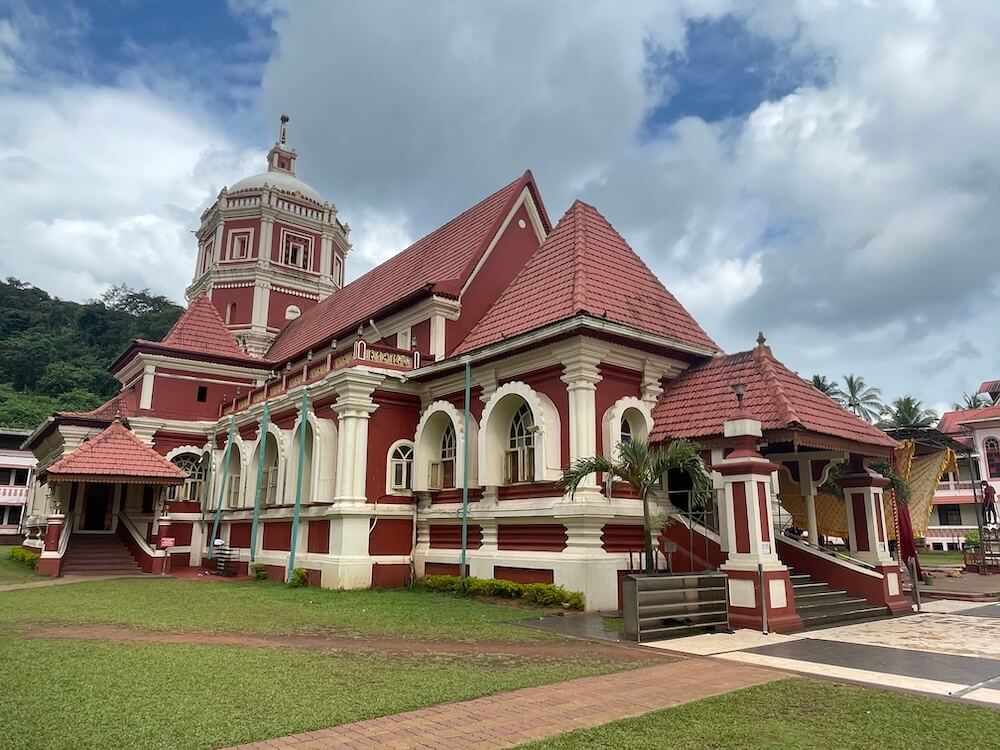
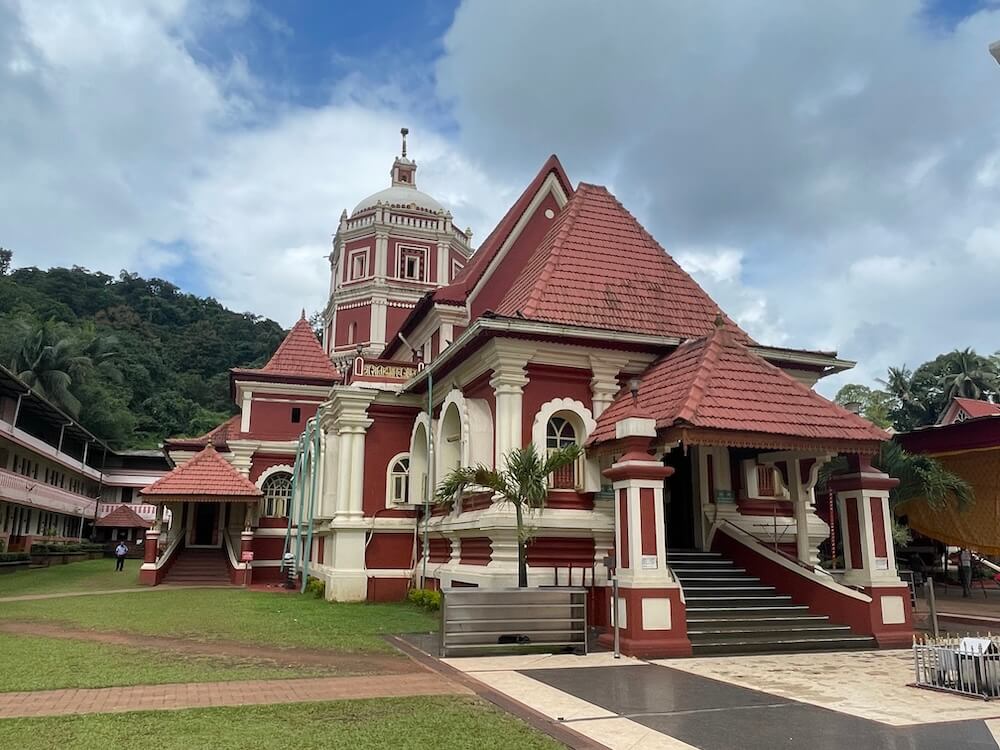
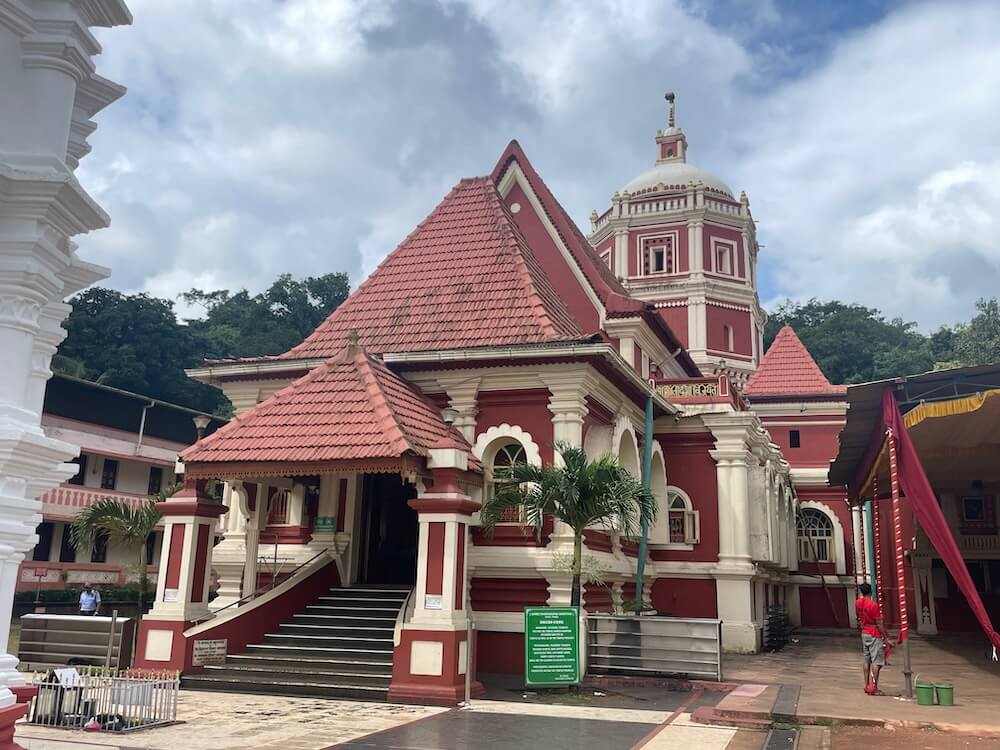
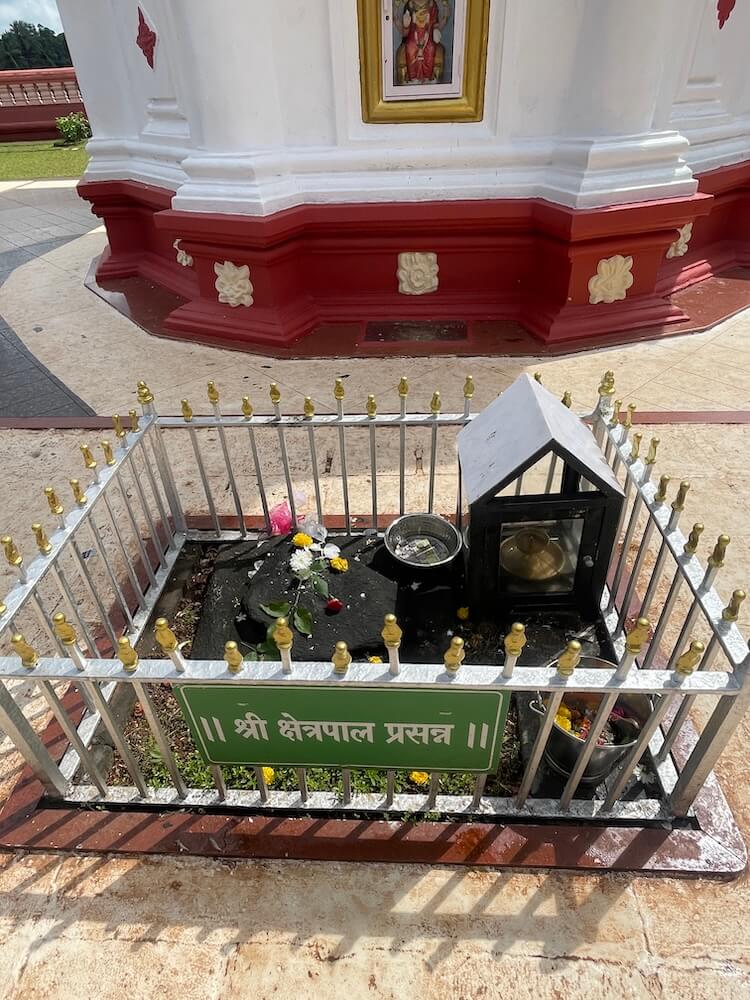
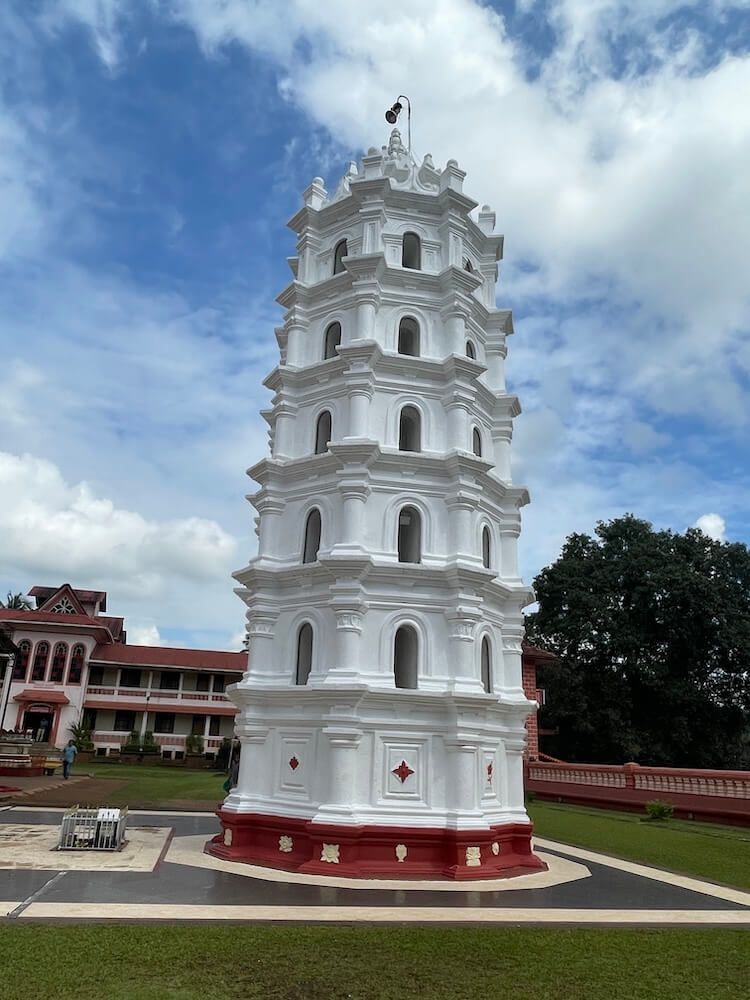
After passing through a row of shops selling items for the worship of Goddess Shantadurga, one reaches a pond. One enters the spacious courtyard of the temple through the gate of the Naubatkhana (drum house) located on a small path along its bank. Inside, on the left side, there is a tall, seven-tiered octagonal lamp pillar painted in pristine white. Adjacent to it is the stone of the Kshetrapal (guardian deity). In front stands the grand structure of the temple, built in the distinct Gomantak architectural style. The structure of this temple consists of a Mukhamandapa (entrance hall), Sabhamandapa (assembly hall), Mahamandapa (great hall), and Garbhagriha (sanctum sanctorum). The Mukhamandapa has a pyramid-shaped tiled roof, while the Mahamandapa has a tiled roof sloping on both sides. The entrances on both sides of the Mahamandapa also have pyramid-shaped tiled roofs.
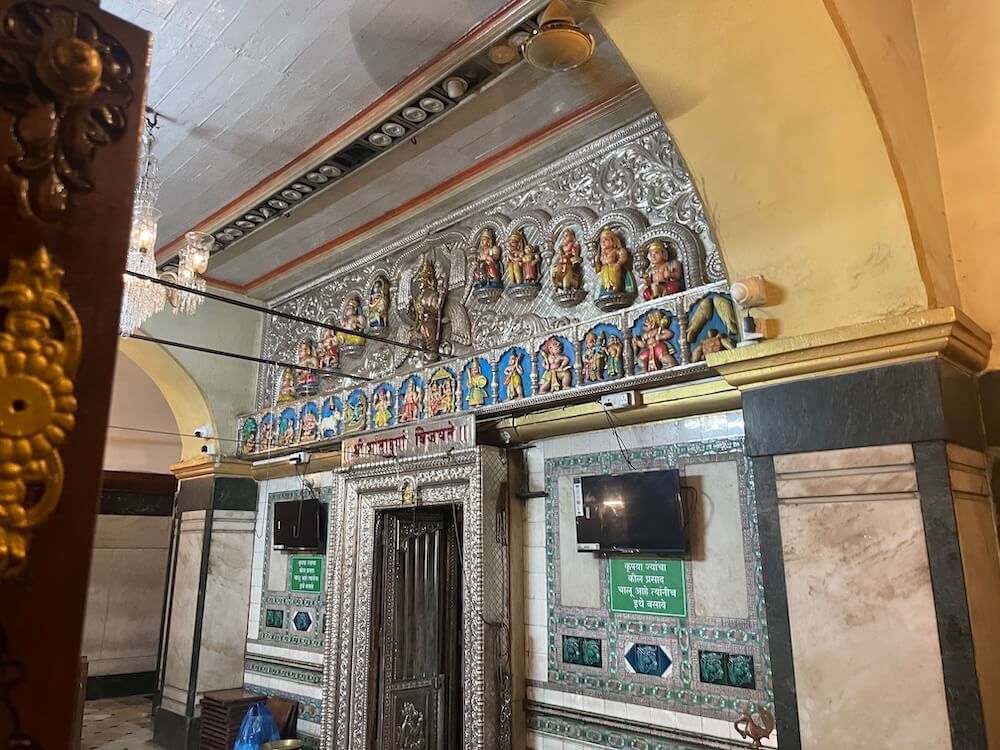
The temple stands on a high plinth. One enters the main hall of the temple by climbing ten steps. A distinctive feature of the temple’s assembly hall and the great hall is the woodcraft found here. Carved, colorful wooden sculptures of various deities and scenes from mythology on wooden panels fixed to the upper parts of the walls are a characteristic feature of many Goan temples. Numerous such wood carvings can be seen here. Apart from this, the halls of the temple are adorned with glass lanterns, attractive crystal chandeliers, silver plates embossed with intricate designs on the entrance doors and walls, marble flooring, and large pillars. There is a circumambulation path in the great hall of the temple. One of the pillars in the great hall is named the Minister’s Pillar. Due to the invaluable contribution made by the Peshwa’s minister, Naroram Shenvi, in the construction of this temple, he and his descendants are accorded a place of honor next to the religious preceptors in the temple. Furthermore, a reserved space has been kept near this pillar for his family members to sit during the temple’s worship and evening prayers. Hence, it is called the Minister’s Pillar.
The front wall of the temple’s inner sanctum has latticed windows on both sides, containing large statues of gatekeepers. The entrance to the inner sanctum is also decorated with silver plating. To the left in the inner sanctum of the temple is the Goddess’s bedchamber. It contains a silver bed upon which two idols of the Goddess are seated. In the main sanctum, the principal idol of Shantadurga is in the form of a linga. Behind it, in a silver arch, sits the Goddess’s panchaloha (five-metal) idol, adorned in traditional silk garments and jewelry including a mangalsutra. The Goddess’s ornaments include a mangalsutra, galshri, mohanmal, bangles, and anklets. The Goddess wears a golden crown on her head. Beside the Goddess’s seat are two statues of attendants. The halo behind is also decorated with intricate carvings. Additionally, the festival idols of the Goddess are kept in the sanctum. The sanctum is topped by an octagonal tower, followed by a dome, a small canopy-like structure, and a pinnacle, forming a tall and magnificent spire.
To the right of the Shantadurga temple, there is a well and a sacrificial hall. A short distance away is the Lakshminarayan temple. This temple, which has an assembly hall and a sanctum, houses the idol of Lakshminarayan. Notably, only the idol of Narayan is present here, and Lakshmi is considered invisible. Here, an idol of Ganesha made of black stone is placed in a large silver shrine.
Daily religious rituals such as morning, afternoon, and evening prayers, worship, and offerings are performed in this temple. During the afternoon prayer, a food offering is presented to the Goddess, which includes lentils, rice, flatbread, yogurt, ghee, and sweets. At night, only fruits and kokum curry are offered to the Goddess. After the triple chant of ‘Shri Shantadurga Jagadamba Udayaste’, the Goddess retires for the night. Before the afternoon offering, a sun-bathing ritual is performed in this temple, where sun rays are directed onto the idol of the Goddess using a mirror. The annual fair is held here from the first to the eighth day of the bright fortnight of the month of Magha. On the first day of Magha, a community prayer is offered. Later, a procession of the Goddess is taken out in a palanquin carried on shoulders. On the second day, the procession is taken out in a litter, and on the third day, in a victory chariot. On the fourth day of the fair, thousands of devotees gather to witness the Goddess’s boat procession in the pond outside the temple. On the eighth day, the Goddess’s victory chariot procession is held at night. During these eight days, mythological recitations, devotional singing, and theatrical programs are organized. Like the annual fair, Navratri is also celebrated with great enthusiasm here. During the fair and Navratri, breakfast, lunch, and dinner are provided free of charge to everyone. Devotees believe that the presence of Shantadurga Devi here is spiritually awakened. Therefore, many people seek the Goddess’s divine guidance (kaul) for the fulfillment of their wishes. Additionally, the annual festival of Lakshminarayan is celebrated every year in the Lakshminarayan temple here on the fifth day of the dark fortnight of Jyeshtha.
This sacred temple stands as a testament to deep spiritual devotion, ancient architectural grandeur, and rich local cultural traditions.
The sanctum sanctorum houses the divine idol consecrated according to ancient Vedic traditions, surrounded by serene courtyards and traditional temple architecture.
Navratri, Maha Shivratri, Annual Temple Jatra & Deepotsav
Compare and book flights, secure top-rated local hotels near the temple, hire reliable guides, and rent cars instantly.
Extend your pilgrimage by visiting other highly sacred temples located nearby.


Add ₹999 more to unlock FREE SHIPPING!
Your sacred cart is currently empty.
Shop Photo FramesFill in your delivery details below to place your order.
Add comment