
Add ₹999 more to unlock FREE SHIPPING!
Your sacred cart is currently empty.
Shop Photo FramesThe Shri Balaji Mandir, situated in the Sambhaji Nagar area of Jalna city in Maharashtra state, is a significant spiritual centre for devotees of the local Vaishnava tradition. This temple was established on the thirtieth of August, one thousand nine hundred and ninety-four. The magnificent idol of Bhagwan Venkateshwara, enshrined in the main sanctum sanctorum of the temple, is the primary object of worship for all devotees. Here, traditional South Indian Vedic rituals are meticulously observed daily. Especially on every Friday of the holy Shravan month, as well as during the annual Brahmotsavam, various religious ceremonies are organised on a grand scale.
In his scholarly work, ‘Shri Vitthal: Ek Mahasamanvay’ (Shri Vitthal: A Grand Synthesis), the great researcher Ra. Chi. Dhere has noted that Vitthal of Pandharpur and Venkatesh of Tirupati are both deities of similar dharma. Both are not associated with the Puranic avatars or forms of Vishnu, yet they have attained the form of Vishnu. Vitthal is considered Balakrishna (child Krishna), while Venkatesh is known by the name Balaji. Vitthal’s consort, Radha, is said to have sulked in Dindirvan, citing an excuse, while Venkatesh’s consort, angered by her husband enduring the insult inflicted by Bhrigu, first stayed separately in Karvir and then in Tiruchanur. Like Vitthal, Venkatesh holds his left hand on his hip and bestows boons upon devotees with his right hand. Devotees of such a Balaji are found in large numbers in Maharashtra.
The story of the construction of this temple in Jalna is that in one thousand nine hundred and ninety-four, local residents in the Sambhaji Nagar area of the city, where the temple now stands, had planned to build a Ganesha temple. Excavation work for the foundation of this proposed temple was commenced. As labourers were excavating the earth, suddenly a labourer’s pickaxe struck a metal object deep within the ground, producing a loud, resonant sound. This unexpected noise drew everyone at the worksite together with curiosity. Upon further investigation at that specific spot, an extremely beautiful and ancient brass idol of Bhagwan Balaji was discovered from the earth. The discovery of this idol created an atmosphere of joy throughout the entire area. Local devotees did not consider this event merely a coincidence but rather a divine sign from Bhagwan Vishnu. It was a divine indication that instead of a Ganesha temple, Bhagwan Balaji Himself should be enshrined here. For this very reason, the local people altered their original plan and decided to construct a magnificent Balaji temple at this sacred site, showcasing the excellent South Indian architectural style.
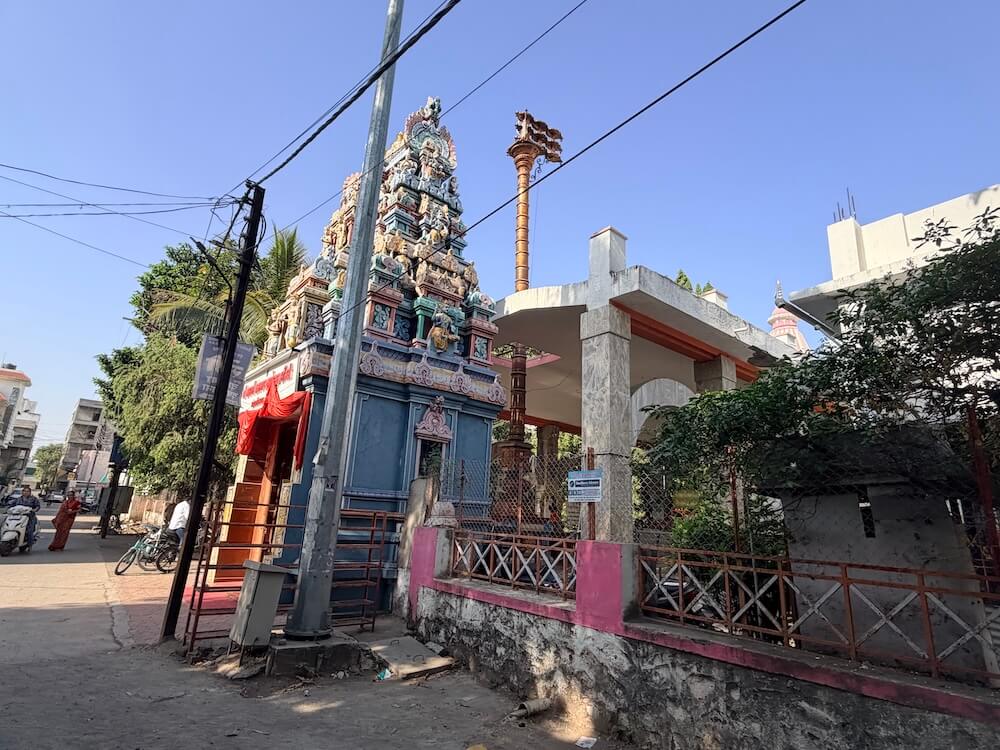
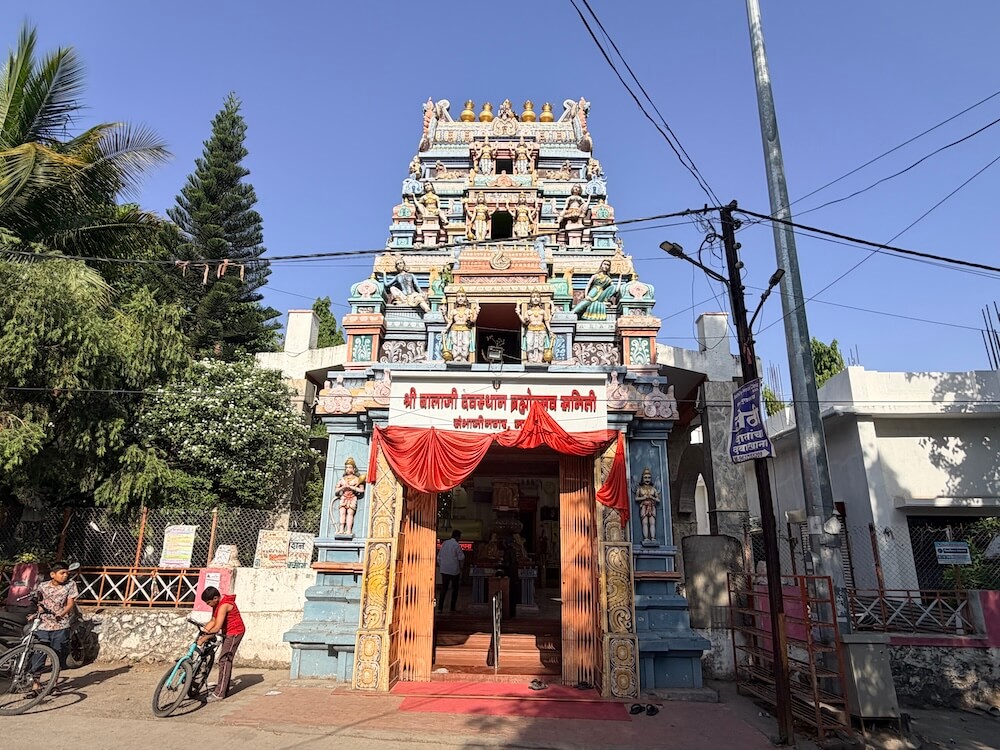
The gopuram of the Balaji Mandir is a beautiful and excellent example of South Indian Dravidian architectural style. In South Indian temple architecture, the gopuram holds immense importance and is considered a symbol of divine glory. The design of this gopuram tapers from the base upwards, forming a pyramid shape. At the base of the gopuram, on both sides, there are robust square stone pillars. Idols of dwarpalas (gatekeepers) are carved on both these pillars. Above the entrance, there are four superimposed tiers, and on each of these tiers, beautiful and lifelike idols of various deities, gandharvas, and apsaras are sculpted. The colour scheme and the intricate carvings on these idols are extremely attractive. On the topmost tier of the gopuram, five kalashas (finials) are installed on a semi-circular shikhara (spire). These kalashas are believed to be centres for attracting cosmic energy. The intricate carvings, arches, and niches throughout the gopuram precisely highlight the accuracy and aesthetics of South Indian sculpture. This gopuram, erected on the land of Maharashtra, is a splendid confluence of South Indian culture and architecture.
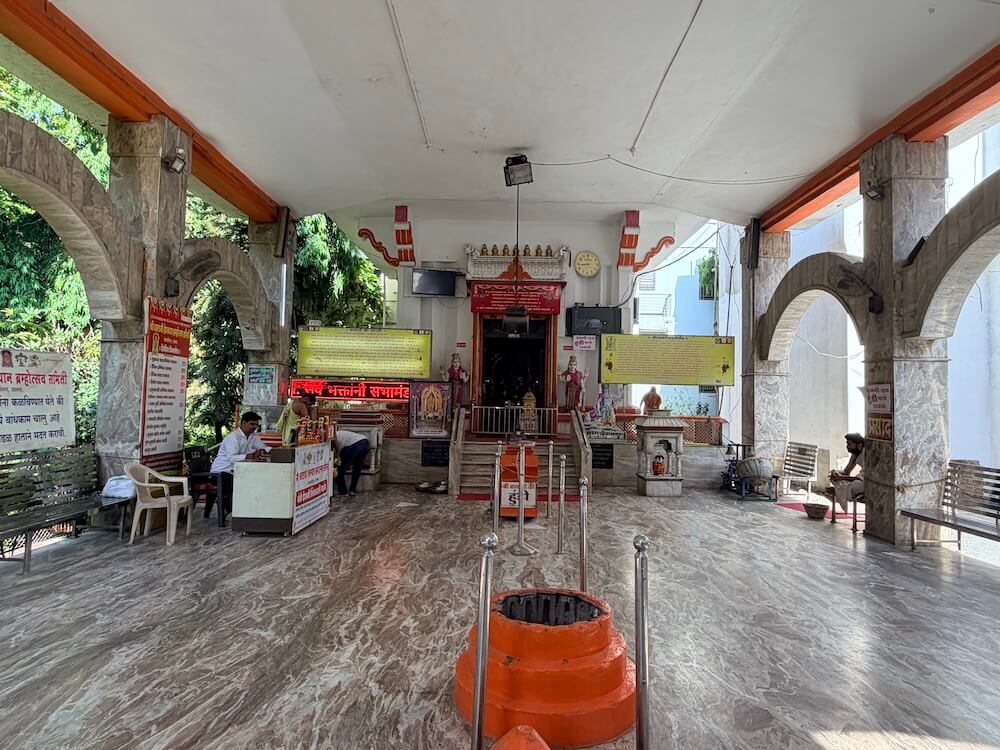
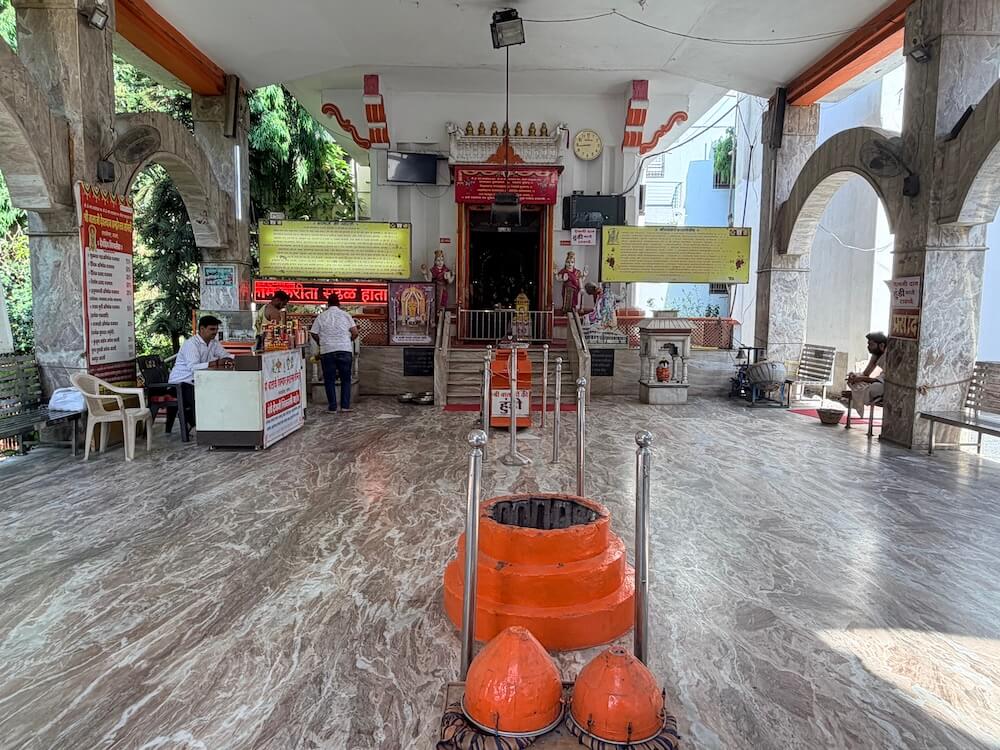
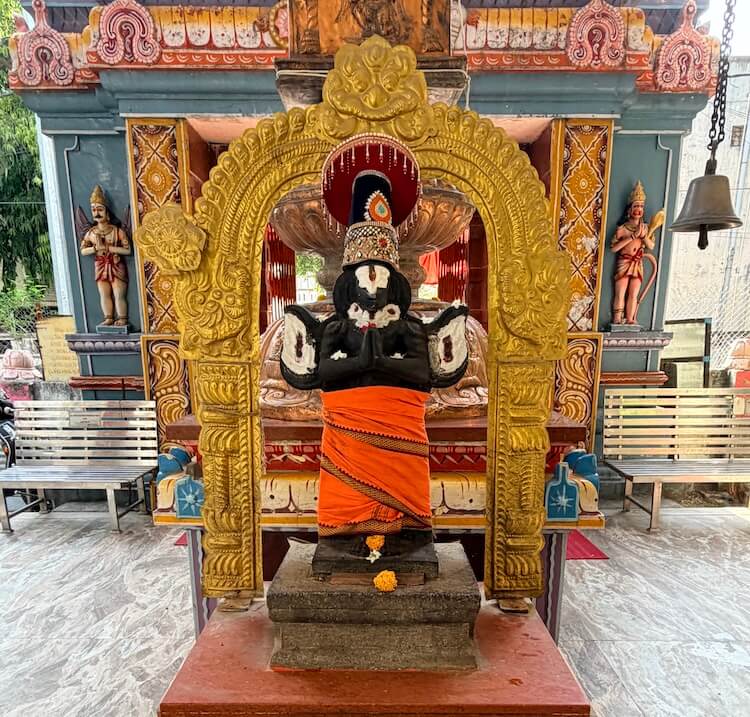
From the gopuram, one ascends four steps to enter the sabhamandap (assembly hall) of the temple, which is situated on a raised platform. The temple’s structure comprises a sabhamandap and a garbhagriha (sanctum sanctorum). In front of the semi-open sabhamandap, a tall, grand dhwajastambha (flagpole) clad in copper sheets is erected. This dhwajastambha rises directly upwards through the open part of the sabhamandap’s roof, and on its lower square section, idols and symbols related to Bhagwan Vishnu and Balaji are carved. Further into the sabhamandap, in front of the dhwajastambha, there is a black stone idol of Garuda on a vajra-pitha (diamond pedestal). This Garuda-deva stands with folded hands in anjali mudra, and wings are carved on his back. Behind the idol, an ornate golden aura (prabhaval) is created. In this sabhamandap, which has marble flooring, there is a homakunda (fire pit) and nagaras (kettledrums) in the centre. These nagaras are played during aarti and puja.
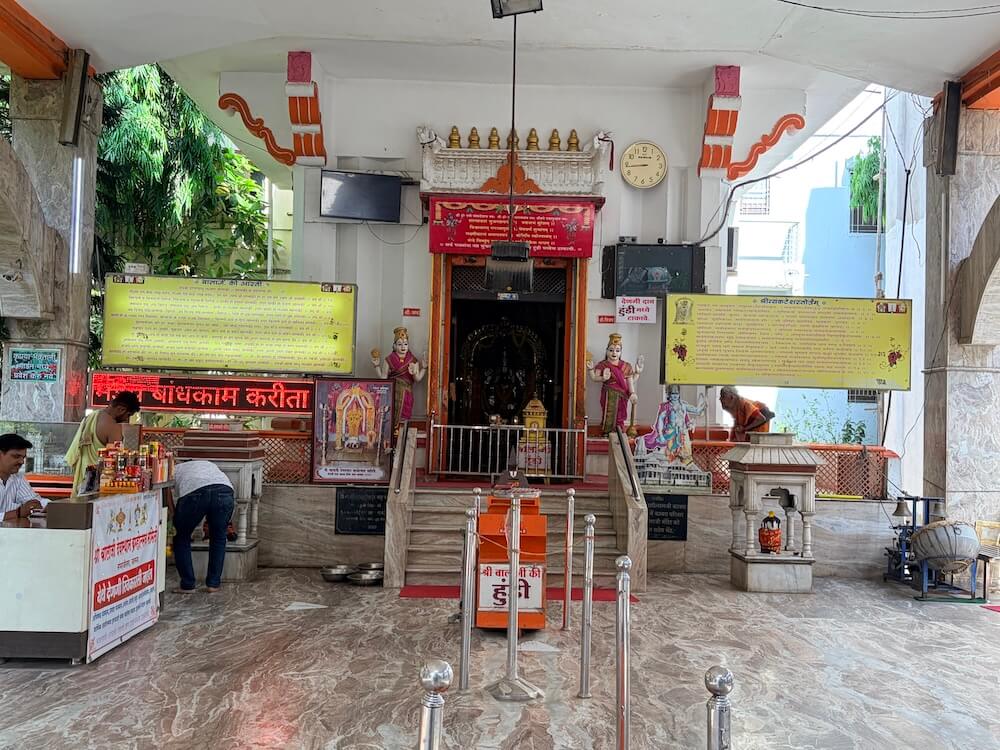
From the sabhamandap, one ascends five steps to enter the elevated garbhagriha. On both sides of the garbhagriha’s entrance are the dwarpalas Jaya and Vijaya, and on the uttaranga (lintel), there is torana (archway) carving with seven mangal kalashas (auspicious pots), symbols of prosperity. Inside the garbhagriha, on a marble seat, is the idol of Bhagwan Venkateshwara, also known as Balaji. This is a standing idol of black stone with four arms. The composition of this idol is extremely proportionate. A beautiful golden crown adorns the deity’s head, and a crescent moon symbol is carved on the forehead. In the upper two hands of the idol, Vishnu’s traditional weapons, namely the conch and the discus, are held. The idol is situated within a beautifully gilded golden makara (archway). Near the feet of this idol, a small brass idol is placed. This is the very idol that was found in the ground during the temple’s foundation laying. The shikhara (spire) structure on the garbhagriha’s roof is also designed like a South Indian vimana. The outer walls of the temple, i.e., the jangha, are plain and have limited carvings. Within the temple premises, there is a separate temple dedicated to Hanuman.
Since the establishment of the temple, many religious traditions have been faithfully observed here. Annually, Vaikuntha Ekadashi and the Brahmotsavam, celebrated on the lines of South Indian temples, are observed here with great enthusiasm, ritualistically, and on a grand scale. During these festivals, thousands of devotees come for darshan. Additionally, special religious observances are organised here during the holy month of Shravan. On every Friday of the Shravan month, a grand programme of collective Vishnu Sahasranama chanting is organised in the temple with the presence of devotees.
The temple’s daily schedule commences at six o’clock in the morning with Vishwaroop Darshan Suprabhatam. This is followed by the daily Abhishekam at six-thirty in the morning, the Maha-Abhishekam on Fridays, and the Utsav Murti Abhishekam on Ekadashi. At eight o’clock in the morning, Dhoop, Deep, Mantrapushpanjali, and Ashtottar Archana are performed, while at eight-thirty in the morning, Maha-Aarti and Teerthprasad are offered. Between twelve o’clock and twelve-fifteen in the afternoon, the Madhyanha Aarti and Naivedya are offered, and thereafter, from twelve-fifteen in the afternoon until four-thirty in the afternoon, the temple remains closed for darshan for the devotees. From four-thirty until six-fifteen in the evening, Sarvadarshan is available, and between six-fifteen and six-thirty in the evening, Aradhana is performed. At six-thirty in the evening, a Maha-Aarti comprising Dhoop, Deep, Nakshatra Aarti, and Kumbh Aarti takes place. Between six-thirty and six-forty-five in the evening, Archana Mantrapushpanjali is performed, and at seven o’clock in the evening, Maha-Aarti Ashirwad and Teerthprasad are offered. Following this, from seven o’clock in the evening until nine o’clock at night, Sarvadarshan resumes. At nine o’clock at night, Ekant Seva Shayana Aarti is performed, and at nine-fifteen at night, the temple doors close for darshan for the devotees.
This sacred temple stands as a testament to deep spiritual devotion, ancient architectural grandeur, and rich local cultural traditions.
The sanctum sanctorum houses the divine idol consecrated according to ancient Vedic traditions, surrounded by serene courtyards and traditional temple architecture.
Navratri, Maha Shivratri, Annual Temple Jatra & Deepotsav
Compare and book flights, secure top-rated local hotels near the temple, hire reliable guides, and rent cars instantly.
Extend your pilgrimage by visiting other highly sacred temples located nearby.


Add ₹999 more to unlock FREE SHIPPING!
Your sacred cart is currently empty.
Shop Photo FramesFill in your delivery details below to place your order.
Add comment