
Add ₹999 more to unlock FREE SHIPPING!
Your sacred cart is currently empty.
Shop Photo FramesAccording to the ‘Shrimattottaratantra’ scripture in Shaiva philosophy, ‘Hataka’ means gold, while according to the ‘Parakhyatantra’, ‘Hataka’ refers to Mahadeva seated upon a golden throne. The name Hatakeshwar or Hatkeshwar is a particularly renowned name for Lord Shiva. There are many famous temples of Hatakeshwar in the country. Among these, well-known temples of Hatakeshwar are located in Srisailam in the state of Tamil Nadu, Dwarka in Gujarat, Junnar and Dhule in Maharashtra, as well as in many places across North India. The Shivling of Hatakeshwar is considered to be of special importance in the Tantra tradition. One such ancient and famous temple of Hatakeshwar is located in Tasgaon.
According to the Puranic legend, while Lord Mahadeva, grief-stricken by the separation from Sati, was wandering the earth in a naked (Digambara) state, he arrived at a sage’s ashram in Dwarka. Seeing the radiant, golden, naked form of Mahadeva, the sage’s wife became infatuated. Enraged by this, the sage cursed Mahadeva, saying that his golden linga would fall upon the earth. He pronounced a curse. Due to that curse, Mahadeva’s golden Linga fell and scattered across many places on Earth. Consequently, chaos erupted on Earth. Seeing this, all the sages prayed to Mahadeva. Then, Mahadeva blessed them, saying that if this golden Shiva-pindi is worshipped daily, the sorrows and troubles on Earth will be dispelled, and those who worship it will attain their heart’s desires. Since then, the Hatkeshwar Shiva-pindi began to be worshipped. It is said that although this Shiva-pindi appears ordinary to devotees, it is visible as a golden Shiva-pindi to the Siddhas, Yogis, and Tantriks.
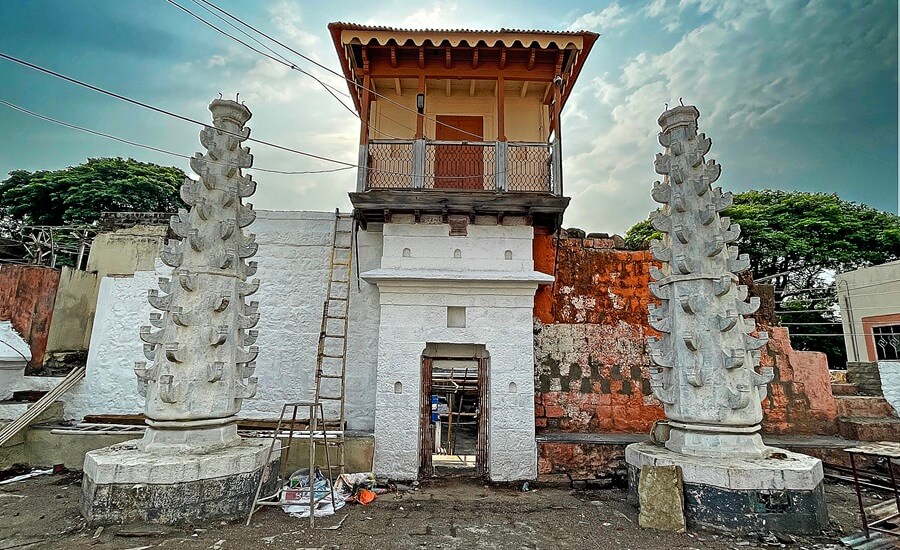
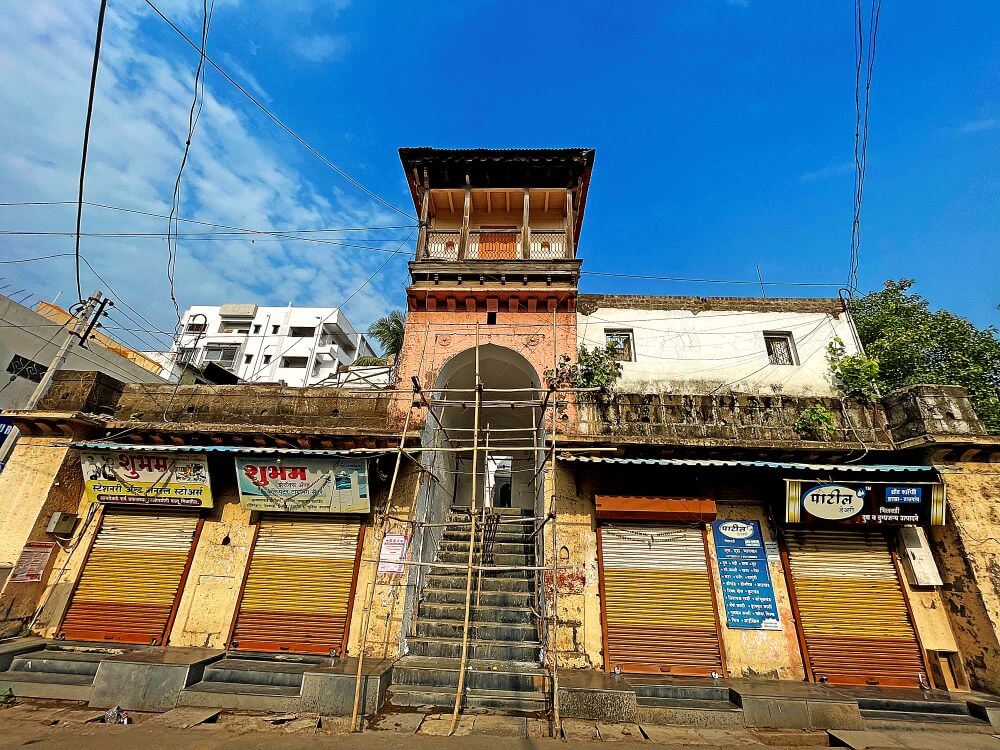
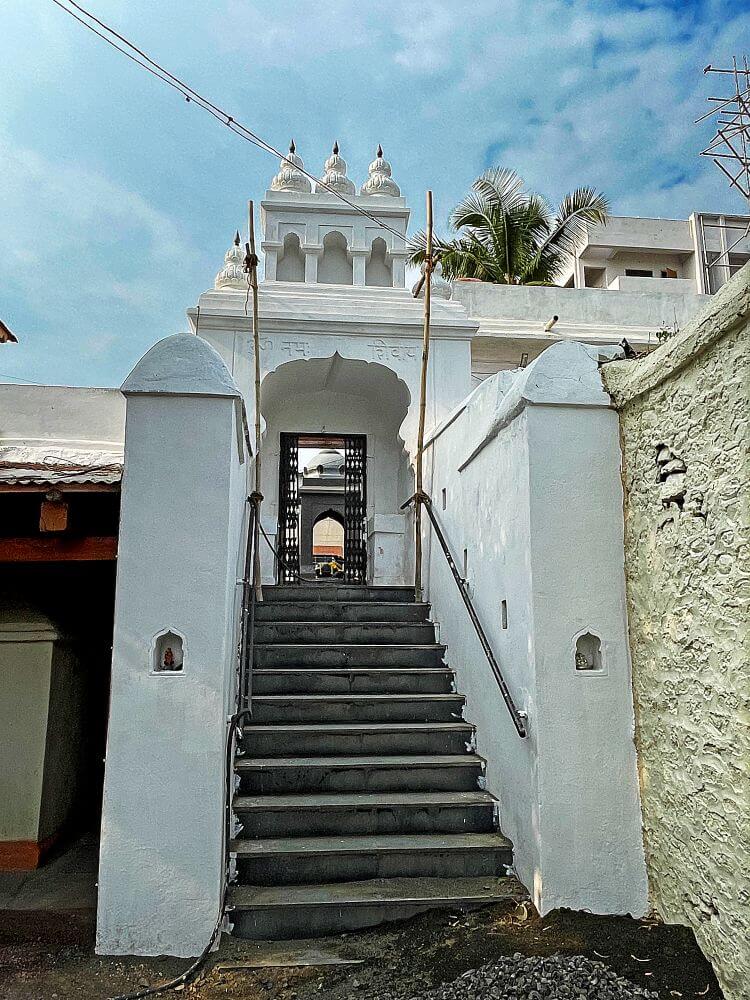
It is said that this temple dates back about a thousand years. The temple’s stone construction in the Hemadpanti architectural style, the intricate carvings on the temple, and its grand entrance gates highlight its antiquity. The temple is located along the road in a bustling part of the city. There is a sturdy perimeter wall surrounding the temple. It has two entrance gates, one in the front and one on the right side. Since the temple is situated at a higher elevation than the road, there are 15 steps leading up to each of the two entrances. The front entrance is two-storied, with a Nagarkhana (drum house) on the upper floor. On both sides of the entrance, for the guards There are platforms. The door jambs of the entrance feature vertical fluted carvings, and an image of Lord Ganesha is carved on the lalatabimba (lintel). Above the projection on the lalatabimba, there is a shikhara sculpture flanked by lotus flower carvings on both sides. There are lamp niches (deepakosthakas) in the walls on both sides of the entrance. Upon entering through this doorway, one finds octagonal platforms on both sides in the courtyard, topped with two-tiered lamp pillars (deepamalas). At the top of these lamp pillars, there is a shikhara and separate brackets for lighting the lamps.
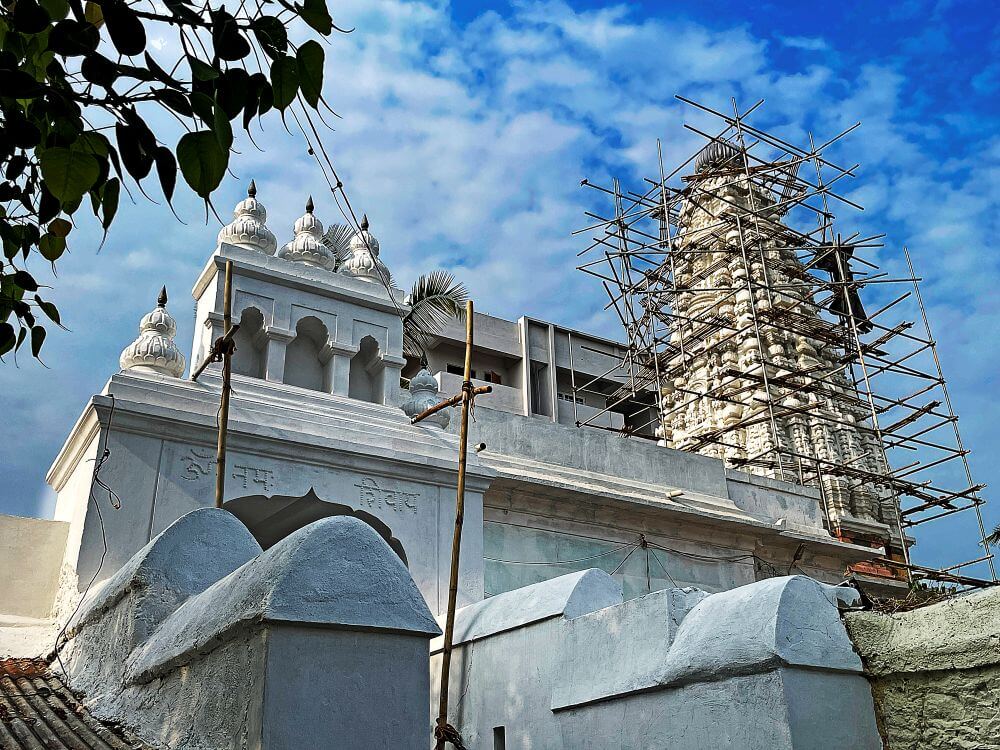
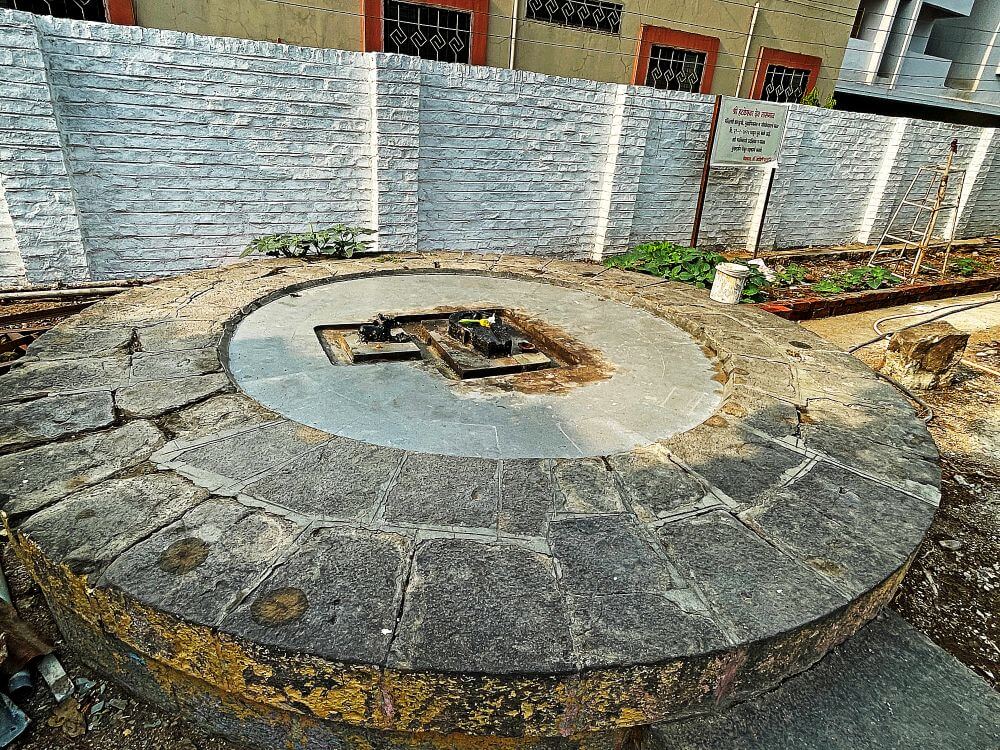
On the roof of the first floor of the two-storied entrance on the right side, there are two shikhara (spires) on both sides, topped with kalash. On the roof of the second floor, located between these shikharas, there is a row of three shikharas, also topped with kalash. Near this entrance, in the temple courtyard, there is a platform with a Tulsi Vrindavan. In the courtyard, on a circular platform with two steps, there is a Shivling in the center and an idol of Nandi in front of it. Further ahead is the Nandi Mandap, which has four square pillars supporting a roof and a shikhara. Inside, there is an idol of Nandi carved from black stone.
In the temple’s sabhamandapa (main hall), there are four rows of four intricately carved stone pillars each. The pillars, standing on square bases, feature capitals at their tops. Various religious motifs are painted on the shafts of the pillars. All the pillars are connected to one another by arched gateways. Above the arches lies the architrave, which supports the ceiling. The sabhamandapa is of an enclosed type (gudhamandapa). Its walls are adorned with paintings of various mythological scenes. In the center of the sabhamandapa floor, there is a sculpture of a tortoise (kurma).
On the left and right sides of the entrance to the Antarala (vestibule), there are two devakoshtas (niches) on each side. In the niches on the left, there is a four-armed idol of Ganesha and an idol of Vitthal-Rukmini in the second niche. In the first niche on the right side of the entrance, there is an idol of Parvati, and in the second niche, there is an idol of Maruti. Paintings of dwarapalas (gatekeepers) are depicted on both sides of this entrance to the Antarala. On the left wall of the Antarala, there is a painting of Garuda, while on the right wall, there is a painting of Hanuman. There are exits on both the right and left sides of the Antarala.
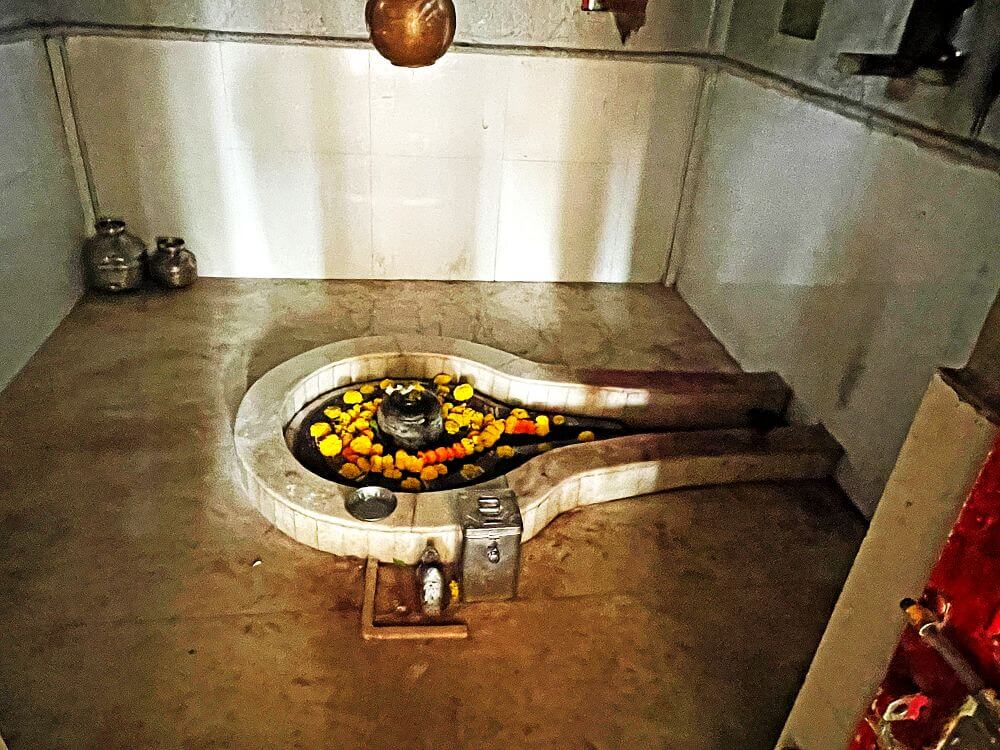
On the doorjambs at the entrance of the sanctum sanctorum (Garbhagriha), there are sculptures of four-armed gatekeepers (Dwarapalas) holding a conch, discus, and mace at the base. Above them are carvings of pillars, vines, and floral motifs. On the lintel (Lalatabimba), there is a sculpture of Lord Ganesha, and the archway features spire sculptures on both sides with intricate frame carvings in the center. A Kirtimukha is carved on the architrave (Mandarka). To the right of the Kirtimukha, a lotus motif is carved, and to the left, a discus (Chakra) motif is carved. In the center of the sanctum floor, there is a self-manifested (Swayambhu) Shiva Linga, with a copper Abhishek vessel suspended from the ceiling above it, dripping water onto the deity.
There is a safety railing all around the roof of the Sabhamandapa (assembly hall). There are small shikharas (spires) on all four corners, topped with kalashas. The roof of the Garbhagriha (sanctum sanctorum) features a nine-tiered square shikhara. In the devakoshta (niche) on the front side of the shikhara, there is an idol of Mahadeva mounted on Nandi.
Maha Shivratri is the main annual festival here. Festivals and occasions such as Shravan Maas, Kartik Purnima, Dussehra, and Diwali are celebrated with great enthusiasm. During the festival period, programs like Bhajans, Kirtans, Pravachans, and music performances are organized in the temple. On these occasions, thousands of devotees come here to seek the blessings of the deity and to fulfill their vows. There is also a large number of devotees who come for Darshan every Monday, as well as on Purnima, Amavasya, Pradosh, and other auspicious days.
This sacred temple stands as a testament to deep spiritual devotion, ancient architectural grandeur, and rich local cultural traditions.
The sanctum sanctorum houses the divine idol consecrated according to ancient Vedic traditions, surrounded by serene courtyards and traditional temple architecture.
Navratri, Maha Shivratri, Annual Temple Jatra & Deepotsav
Compare and book flights, secure top-rated local hotels near the temple, hire reliable guides, and rent cars instantly.
Extend your pilgrimage by visiting other highly sacred temples located nearby.


Add ₹999 more to unlock FREE SHIPPING!
Your sacred cart is currently empty.
Shop Photo FramesFill in your delivery details below to place your order.
Add comment