
Add ₹999 more to unlock FREE SHIPPING!
Your sacred cart is currently empty.
Shop Photo FramesLord Ganesha, worshipped throughout the entire Asian continent, is the presiding deity of Maharashtra. His popularity is so immense that a distinct Ganapatya sect was established within Hinduism during the ninth and tenth centuries. In this sect, the Ganesha idol with a left-turning trunk is worshipped more frequently as it represents the Chandra Nadi (moon channel), signifying cooling qualities. In some temples, the Ganesha idol has a right-turning trunk. This form of Ganesha is considered the deity of intellect and valor. The ancient Ganpati Panchayatan temple in Tasgaon houses such an idol with a right-turning trunk. Devotees believe that this is a ‘Jagrut’ (awakened) Ganesha who fulfills the prayers of his devotees.
According to historical references, Ganesha was the family deity of the Patwardhan dynasty of Tasgaon. Parashurambhau, the commander of the Peshwas, was the founder of this institution. He was born in Pune in 1740 AD. In the ‘Harivanshachi Bakhari’, his birth is recorded as, “Ramchandrapant Appa’s son Parashurambhau was born, who was the incarnation of Lord Parashurama himself.” During the reign of Shrimant Madhavrao Peshwa (1761 to 1772), the Tasgaon region was acquired from the Kolhapur rulers and included in the Patwardhan estate. Since then, they resided in Tasgaon. Parashurambhau inherited the legacy of Ganesha devotion and the art of warfare from his family. At the age of fourteen, in 1754-55, he participated in the Karnataka-Savanur campaign alongside Nanasaheb Peshwa. History records that he displayed great valor in over a hundred battles during his 45-year career.
Parashurambhau displayed immense bravery in battles against Hyder Ali, the ruler of Mysore, in 1764, 1771, and 1772; the Nagpurkar Bhonsles in 1769; the British in 1781; Tipu Sultan in 1786 and 1790; as well as against the rulers of Kolhapur and Satara. In the Battle of Kharda in 1795 between the Marathas and the Nizam of Hyderabad, Parashurambhau led an army of one hundred thousand Maratha soldiers. However, in the battle between the Patwardhans and Chhatrapati Shivaji Maharaj of Kolhapur at Pattankudi in 1799, his forces were defeated, and he was killed in that battle. During his career, Parashurambhau contributed significantly to the development of Tasgaon. For his residence, he built a large mansion (Wada) and a temple for his presiding deity, Ganesha.
A legend regarding this temple states that the Patwardhan family originally hailed from the Konkan region. Parashurambhau often visited Ganpatipule for darshan. Once, Ganesha appeared to him in a dream and instructed him to install his idol in Tasgaon. Accordingly, he built a beautiful temple for Ganesha here between 1771 and 1779. Most of his military campaigns took place in Karnataka and South India. He was deeply influenced by the temple architecture of that region. Therefore, he brought masons, carpenters, and sculptors from Karnataka for the construction of this temple. Along with them, he brought painters from Rajasthan and stone sculptors from Andhra to realize the current Gopuram-style Panchayatan temple. After returning from the Karnataka campaign, Parashurambhau installed the Ganesha idol in this temple on Thursday, February 18, 1779. Along with this, the Ganesha festival was also started in the form of a chariot procession (Rathotsav). During the Peshwa era, the Ganesha festival was celebrated on a grand scale at Shaniwar Wada. Similarly, the festival began to be celebrated here as well. Due to its public nature, this is considered the first public Ganesha festival in Maharashtra. However, it is believed that its nature is different from the public Ganesha festival started by Lokmanya Tilak. The Shri Ganpati Rathotsav started by Bhau is still celebrated here on a large scale by his descendants today.
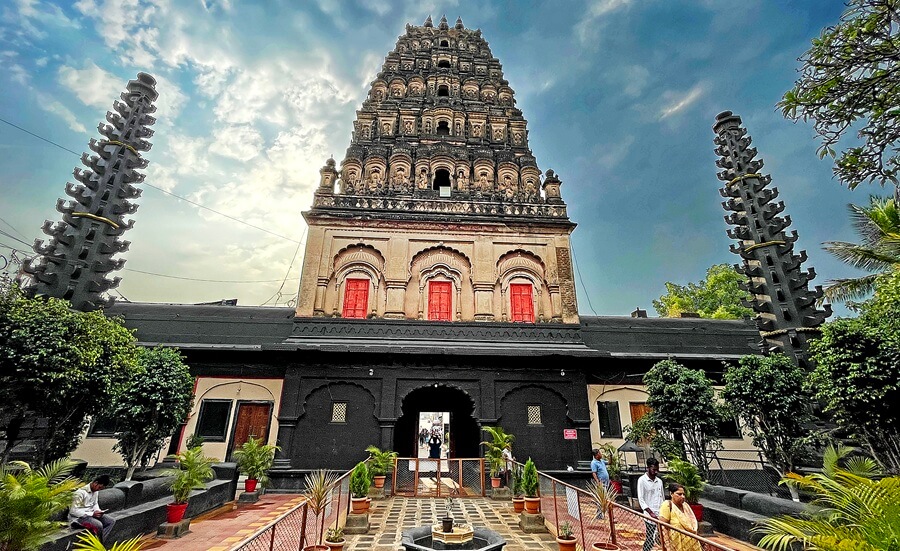
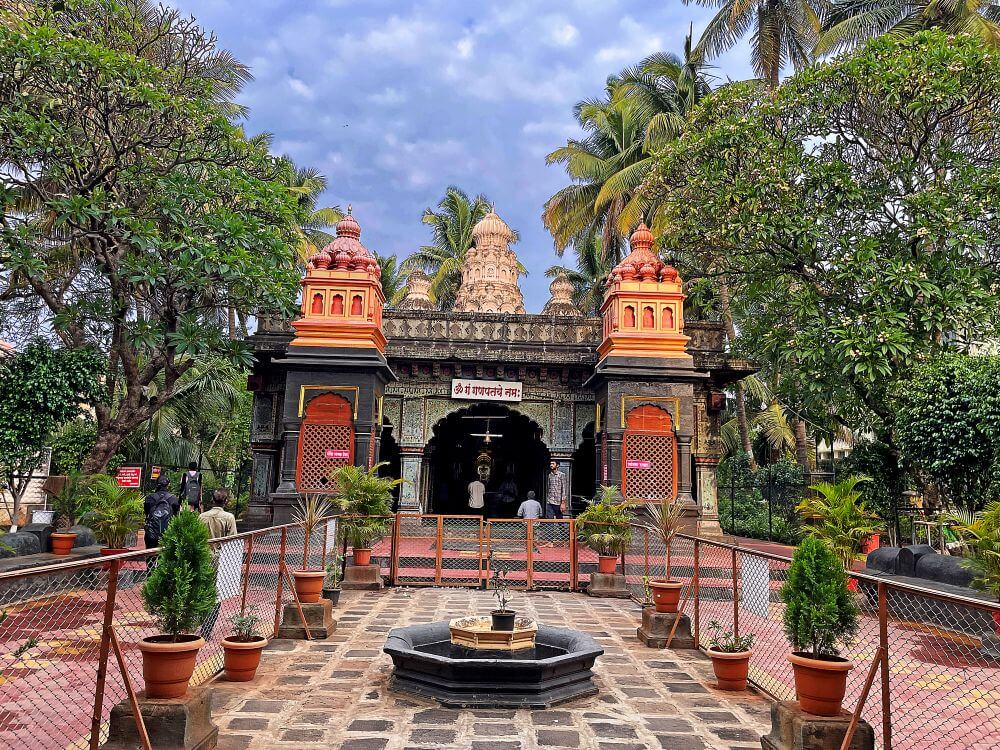
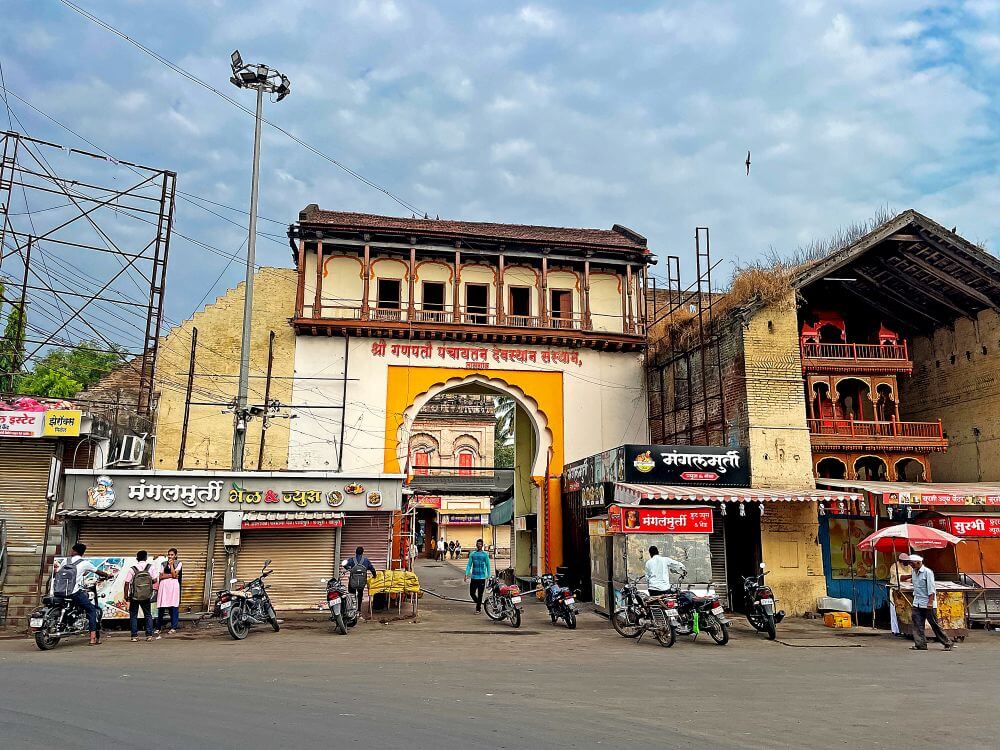
Located in the heart of the city, this temple has a sturdy perimeter wall and a two-story entrance gate with a Nagarkhana (drum house). The entrance features ornate pillars on both sides of the passage with an arch above. There are guard rooms on both sides inside. The upper floor of the entrance houses the Nagarkhana, topped with a tiled roof. Beside the entrance is the chariot room, which houses a large three-story chariot used for the Rathotsav. Passing through the entrance, one enters the spacious courtyard of the temple. The garden developed in this courtyard and the many trees here make the surroundings look beautiful.
Further ahead is the second entrance of the temple. Below it is the temple office, and above it stands a seven-tiered, 96-foot-high, intricately carved South Indian-style Gopuram. The first tier of the Gopuram has four ornate pillars and three arched gateways. There are three windows with wooden shutters. The upper tiers have four niches on each side, containing divine images with a central window. The four corners are adorned with four Meghadambaris (canopies) and spires on top. The upper three tiers each have four niches on both sides, containing divine images with a central window. The top of the Gopuram is adorned with three finials (Kalash).
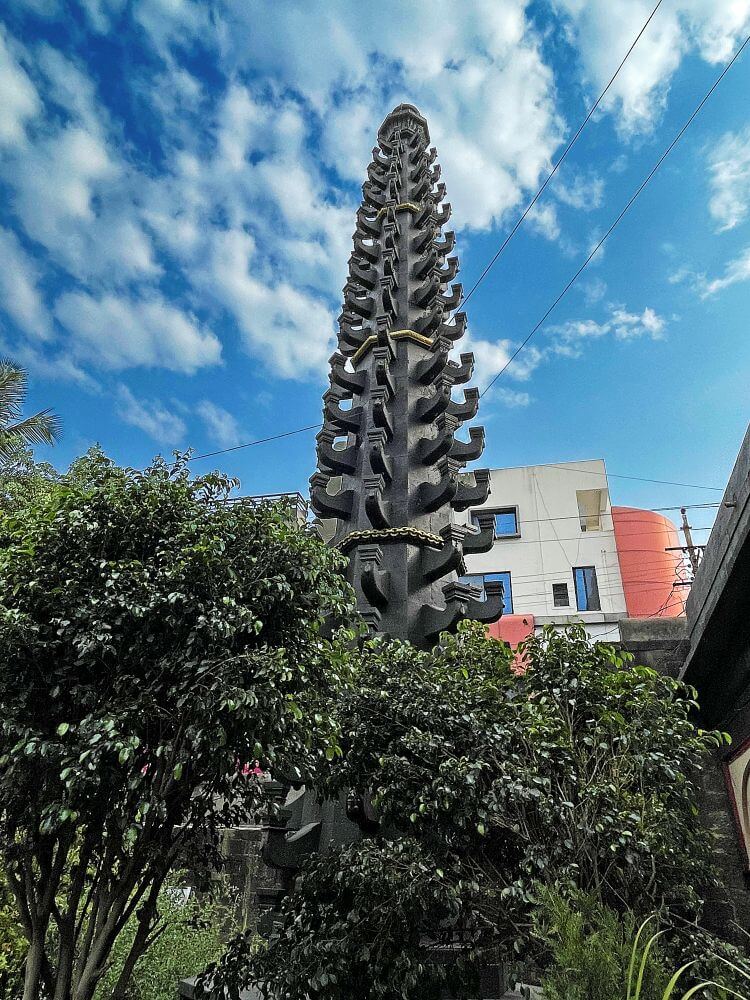
The entrance in the Gopuram is decorated with three ornate door frames. On its lintel is an image of Ganesha, and on the Mandarak is a Kirtimukh. The guard rooms on both sides inside the entrance have arched doorways. The ceiling of the entrance features an ornate dome. On both sides of the Gopuram are two platforms, each with a thirty-foot-high, four-tiered hexagonal lamp tower (Deepmala). From these two lamp towers up to the temple’s assembly hall (Sabhamandap), seating arrangements are provided for devotees.
Further ahead, in front of the Sabhamandap, there are two small temples, one on each side, each with a roof supported by four pillars and topped with a spire. The square spires feature twelve niches and a design of 20 sub-spires. At the top is an Amalaka and a finial. On all three sides of these temples, there are lattice walls and arched designs. The Nandikeshwar temple on the left houses an idol of Nandi, and the Garudeshwar temple on the right houses an idol of Garuda.
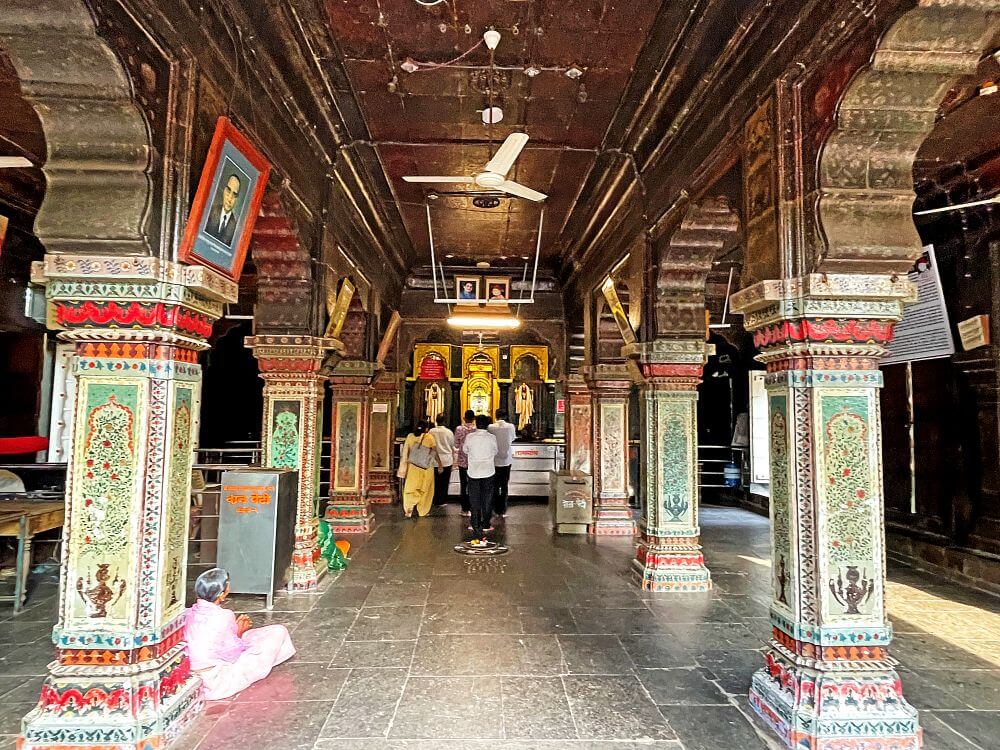
The Sabhamandap is open from the front and has four rows of five ornate square pillars each. The base of the pillars is somewhat wide. All four sides of the pillars are covered with silver plating and feature intricate carvings. At the top of the pillars are brackets, supporting beams, and a roof above the beams. The ceiling here is also carved. All the pillars here are connected to each other by ornate arched designs. On the right side of the Sabhamandap, near the wall, the palanquin used during the festival is kept.
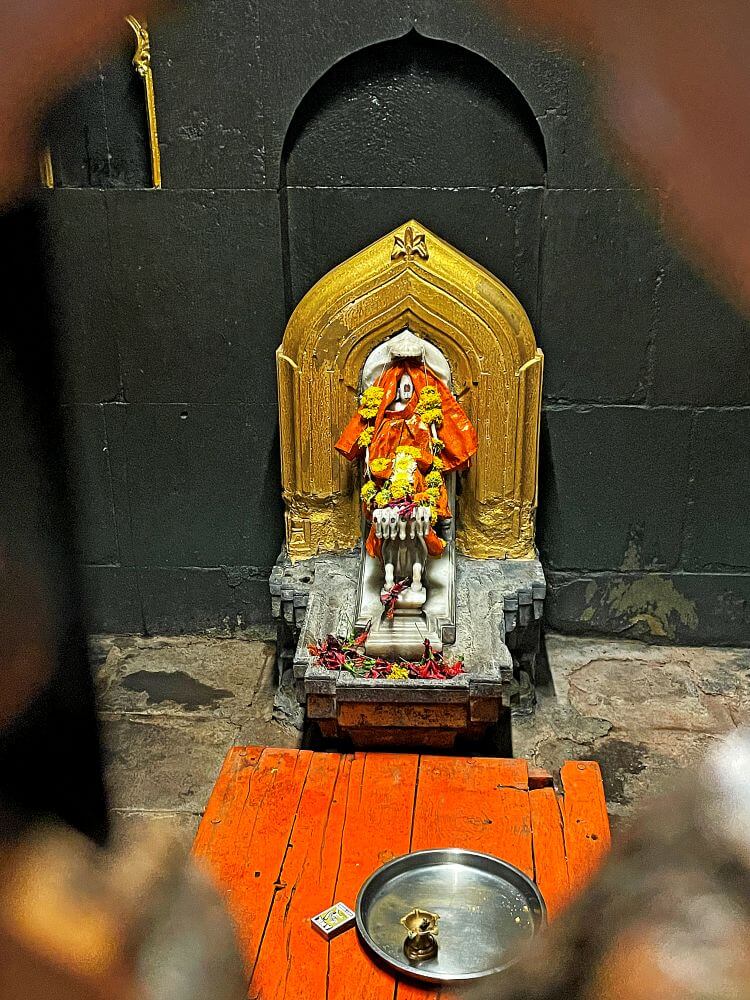
Further ahead, the intricately carved entrance of the sanctum sanctorum (Garbhagriha) features floral motifs on its doorjambs, with Lord Ganesha presiding over the lintel (Lalatbimba). The arch above the lintel is adorned with various carvings. On the architrave (Mandarka), there are lion sculptures on both sides and a moonstone (Chandrashila) in the center. Inside the sanctum, a four-armed Ganesha idol with a right-turning trunk is seated on a golden throne. In the upper hands, the deity holds a noose (Pasha) and a goad (Ankusha), while the lower hands are in the gestures of granting boons (Varada-hasta) and bestowing gifts (Dana-hasta). On both sides of Ganesha, there are mouse (Mushaka) idols placed on pedestals (Vajrapitha). The temple roof is enclosed by a parapet on all sides. The roof of the sanctum features three spires (Shikharas), with the main spire consisting of three tiers. The first two tiers each contain twelve niches (Devakoshtakas) topped with smaller spires, housing idols of various deities. The main spire is crowned with a dome and a finial (Kalash). To the left and right of the main spire are dome-shaped spires, each topped with an Amalaka and a Kalash.
The main annual festival at this temple is the one-and-a-half-day celebration of Bhadrapada Ganesha Chaturthi, which is observed with great fervor. After installing the clay (Parthiva) Ganesha idol in the palace, on the following day, this idol along with the 125 kg Panchadhatu Ganesha idol of the Tasgaon Sansthan is brought to the temple in a chariot amidst music and celebrations. After performing Aarti there, the procession continues to the Kashi Vishveshwar temple. There, the clay Ganesha is immersed in camphor, and the chariot returns to the temple. Many devotees take vows to pull this chariot; consequently, thousands of devotees eagerly come forward to pull the chariot using ropes. During the procession, there is a tradition of having an elephant dance before the chariot, as well as showering gulal and pedhas. This chariot festival has a tradition spanning approximately 250 years. The temple sees a large influx of devotees on occasions such as Ganesha Jayanti, Sankashti Chaturthi, and Tuesdays.
This sacred temple stands as a testament to deep spiritual devotion, ancient architectural grandeur, and rich local cultural traditions.
The sanctum sanctorum houses the divine idol consecrated according to ancient Vedic traditions, surrounded by serene courtyards and traditional temple architecture.
Navratri, Maha Shivratri, Annual Temple Jatra & Deepotsav
Compare and book flights, secure top-rated local hotels near the temple, hire reliable guides, and rent cars instantly.
Extend your pilgrimage by visiting other highly sacred temples located nearby.


Add ₹999 more to unlock FREE SHIPPING!
Your sacred cart is currently empty.
Shop Photo FramesFill in your delivery details below to place your order.
Add comment