
Add ₹999 more to unlock FREE SHIPPING!
Your sacred cart is currently empty.
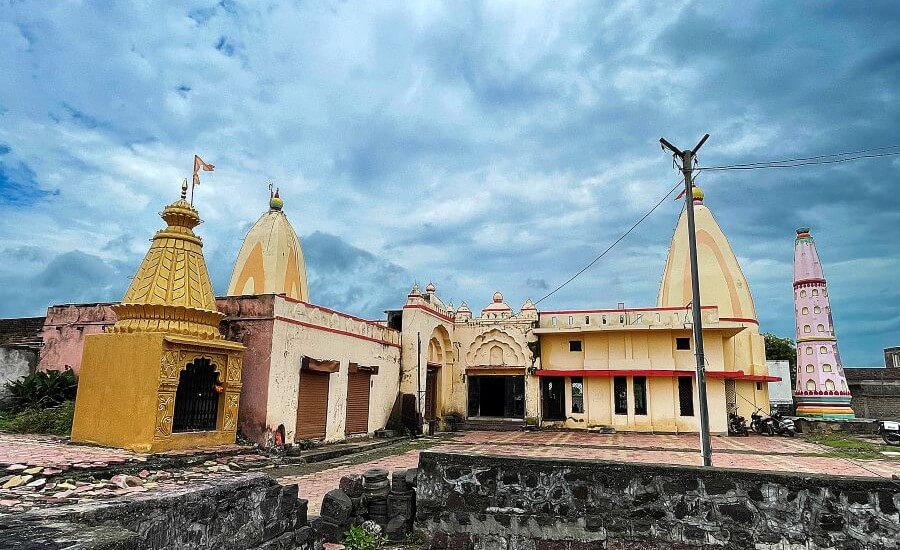
Shop Photo Framesis a prominent sacred site in Anwa village. It comprises the temple of Jagadjanani Ajubai, along with a Mahadev temple built in the twelfth century, an ancient Vitthal temple, and the sacred spot where Ajubai Mata attained antardhan (disappearance). Ajubai Mata is revered as an incarnation of Jagadamba. Her temple is situated behind the ancient Mahadev temple, and a new temple has been erected at a distance from there, marking the place of her antardhan. Devotees from Maharashtra, Madhya Pradesh, Andhra Pradesh, Gujarat, and Karnataka visit both these holy sites for darshan.
Anwa village has been known as a sacred place since ancient times. Besides Vaishnava and Shaiva temples, it also hosts a site for followers of the Mahanubhav sect. In the thirteenth century, Sarvadnya Shri Chakradhar Swami resided in Anwa village for fifteen days. The Lilacharitra mentions this: ‘Gosavin tethouni Anaveyasi bijen kele: Gavamutare ban: Teth gudharu amba: Teth Gosaviyansi dis panhara avasthan jale:’ From this Lila, it is understood that Gosavi, meaning Chakradhar Swami, came to Anave from another village and stayed in a mango grove there. In this very village, in the sixteenth century, Ajubai, an incarnation of Jagadamba, was born. During her avatar, Ajubai alleviated the suffering of many, from kings to paupers, and guided people onto the path of devotion.
It is said about Ajubai’s birth that a couple named Tukarampant and Chandrikabai lived in this village. They were deeply saddened by not having children. To be blessed with progeny, they both went to Tuljapur and performed penance at the Bhavani Mata temple for twelve years. Pleased by their devotion, the Goddess granted them a boon, promising to be born as their child. However, she also stated that she would attain antardhan after five years. Accordingly, the Goddess was born as a daughter to this couple in the year १५७२, on Chaitra Shuddha Chaturthi. This daughter was named Ajubai.
Another story about Ajubai recounts that from her childhood, this girl performed many miracles. Her fame gradually spread everywhere. People began to consider her a divine incarnation. During this period, a Yavani king ruled the region. Upon hearing this, he decided to test the young girl. The Yavani king asked her to perform a tailadivya (oil ordeal). In ancient times, jaladivya (water ordeal) and tailadivya were performed. In a tailadivya, a coin would be dropped into boiling oil, and the person would be asked to retrieve it. If their hand was injured while retrieving it, the person was considered to have failed the ordeal. The Yavani king set such a dreadful test for this child. However, little Ajubai, with a smile, put her hand into the cauldron of boiling oil and gently retrieved the coin. Her delicate hands were not even slightly burned. But the king who had ordered the tailadivya began to feel a burning sensation in his body. He then surrendered to Ajubai. To finally alleviate his burning, Ajubai created a Kallol, a stepwell with stone steps, right there in Anwa village. During her five years of life, Ajubai liberated many. Finally, as the five-year period foretold by Bhavani Mata was coming to an end, Ajubai announced that it was time for her avatar to conclude. She blessed Tukarampant and Chandrikabai with the boon of a son. The thought of Ajubai leaving plunged everyone into a sea of sorrow. They began to pray, “Mother, do not leave us.” At that time, Ajubai told the villagers that every year on Chaitra Shuddha Ashtami, a man from her lineage would carry her palanquin, and through that, she would grant darshan to everyone. Saying this, Ajubai attained antardhan.
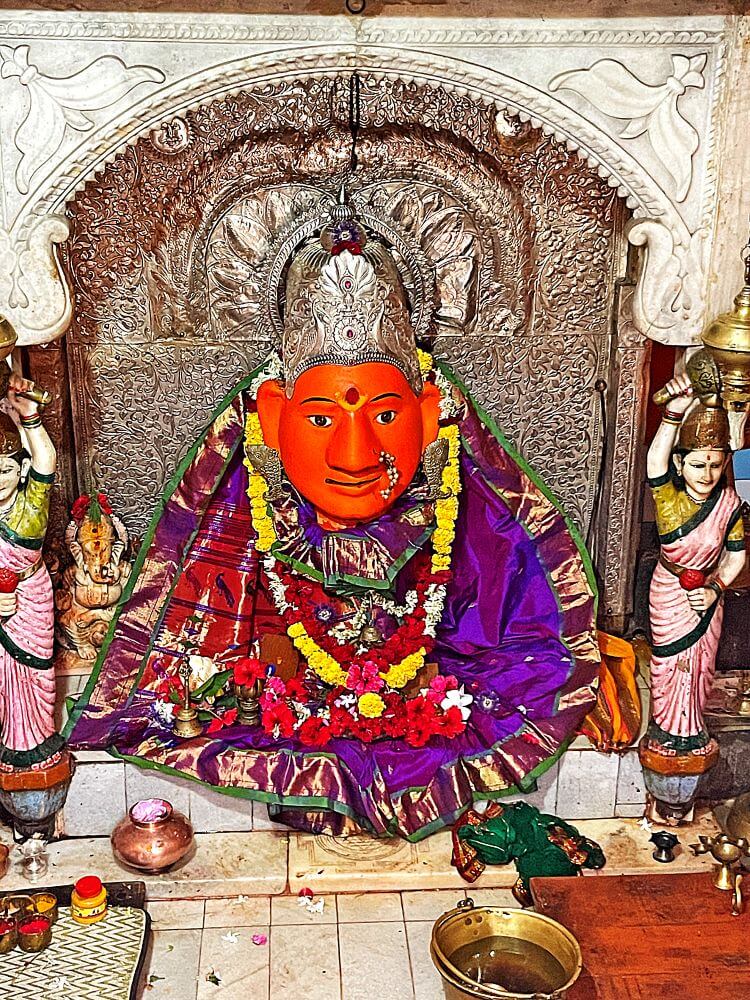
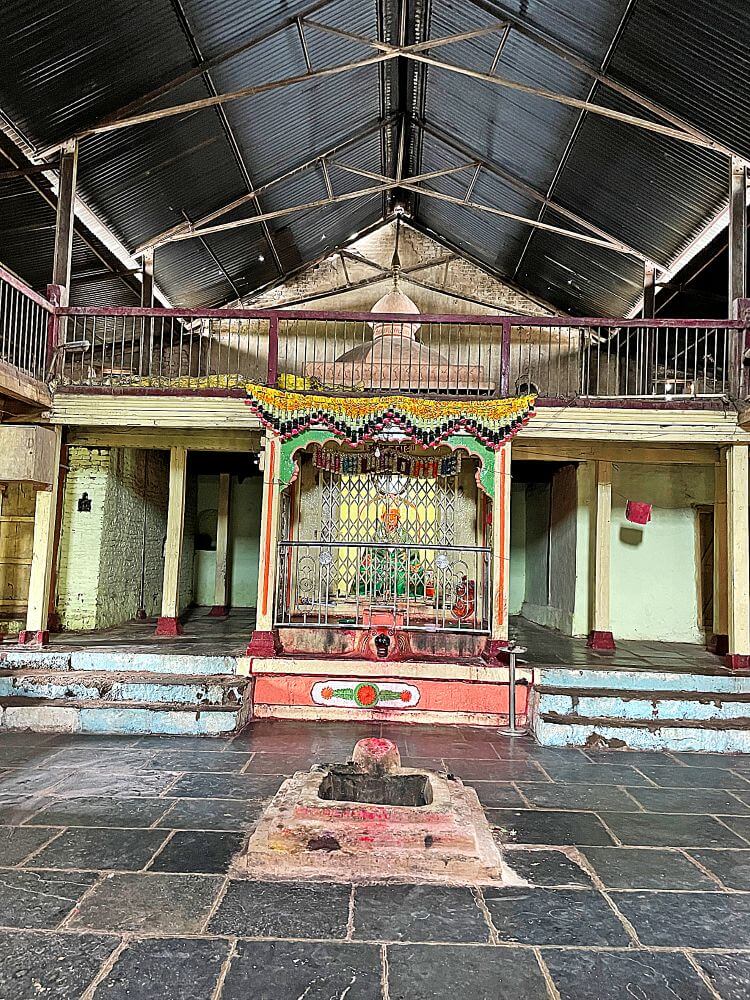
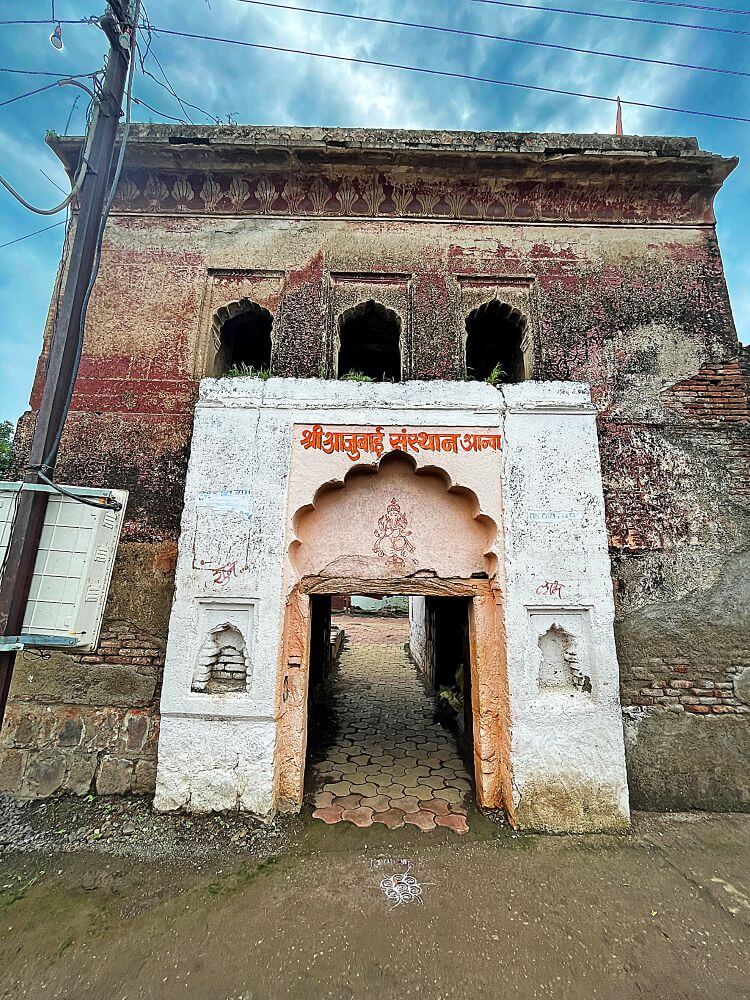
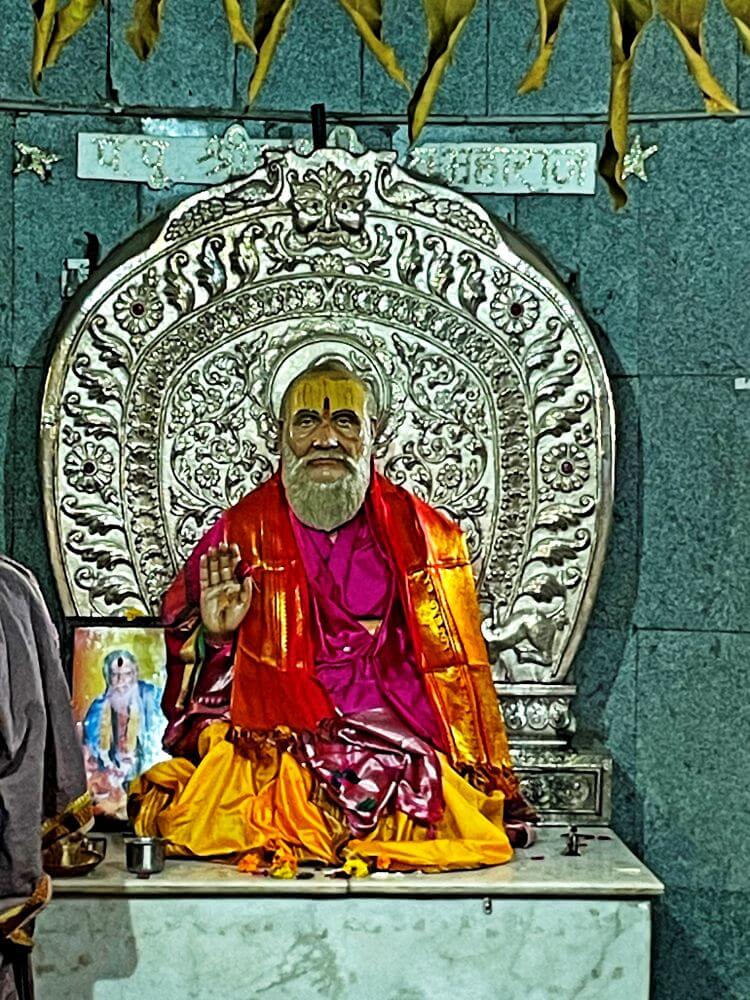
The temple of Ajubai stands today at the very place where she was born in the sixteenth century. The outer wall of this wada (mansion) is thick and made of bricks. The entrance is also like that of old houses. Inside, there is an open courtyard, and further on, one reaches the door of the wada, which is Ajubai’s birthplace. While the exterior of this wada has been newly constructed, the interior resembles an old chausopi wada (a traditional house with a central courtyard). There is a large open space in the middle and a spacious verandah with wooden pillars on all four sides. Upon entering, there is a homakund (sacred fire pit) directly ahead. To the right, on the verandah, is Ajubai’s garbhagriha (sanctum sanctorum). A lion-faced idol is installed on the platform of the garbhagriha. Inside the garbhagriha, on a high platform, is a full-length, seated idol of Ajubai in abhaya mudra (gesture of fearlessness). The idol has a nose ring, a necklace full of ornaments, and a crown on its head. Directly opposite this garbhagriha, on the verandah, there is another garbhagriha. It contains an image of Sadguru Lakshmikant Maharaj on a seat. Lakshmikant Maharaj was a lifelong celibate who dedicated his life to Ajubai.
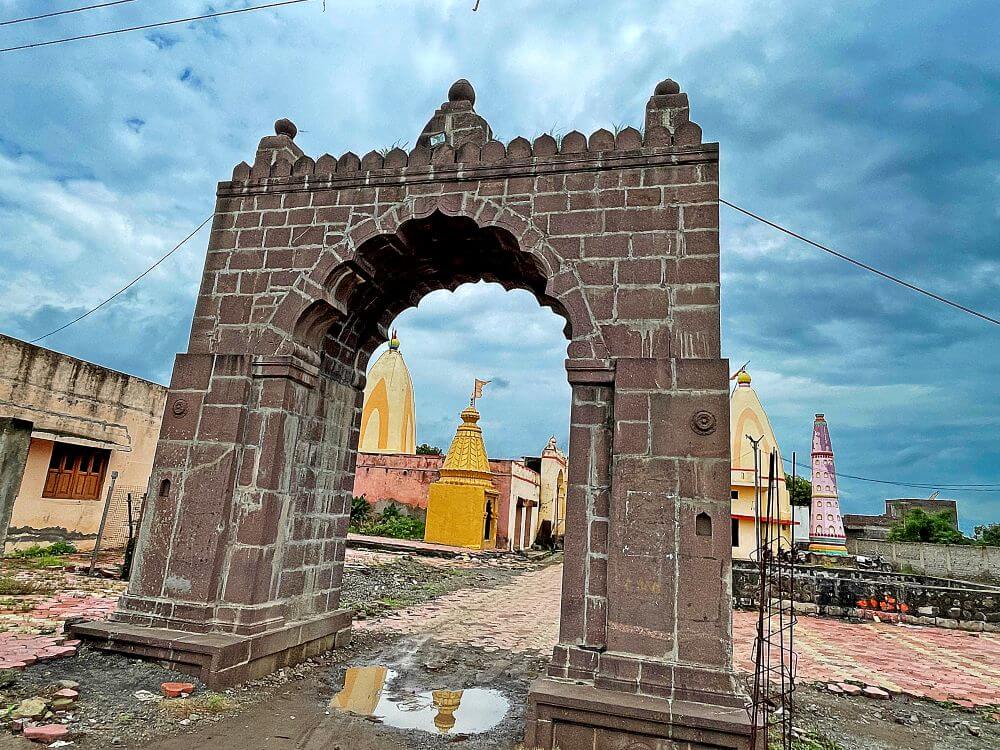
At some distance from this temple, another temple has been built at the spot where Ajubai attained antardhan. It is known as the Ajubai Antardhansthan Mandir. The entrance to this temple is built with square carved stones. It features an arched gateway, with a fort-like structure on top and three small shikhars (spires). Nearby is an old stepwell with stone steps. A little further on is the entrance to Ajubai’s temple. Inside is the Kallol Tirth, created by Ajubai. Here, in a marble temple, is Ajubai’s tandala (symbolic representation). In this area, there is a large temple of Sadguru Lakshmikant Maharaj. The temple has a spacious sabhamandap (assembly hall), Lakshmikant Maharaj’s padukas (footprints) in the garbhagriha, and an idol of him on a platform. The idol depicts Maharaj seated cross-legged, granting abhaya (fearlessness) to devotees.
Before Ajubai took samadhi, She had promised that the men of my lineage would carry Her divine presence. Accordingly, since then, the tradition of carrying Her divine presence has continued hereditarily in their family. Sadguru Lakshmikant Maharaj used to carry Her divine presence from nineteen sixty-two. After his passing, Parama Pujya Sonu Maharaj has been carrying Her divine presence since two thousand four. As per the custom here, Ajubai’s yatra is held on Chaitra Shuddha Ashtami in Anva. On that day, in the morning, Sonu Maharaj is given a ritual bath amidst the chanting of mantras. Afterwards, he sits in meditation, contemplating the Goddess. Around midnight, he seeks the Goddess’s permission at the Bhagawati temple in the village. Thereafter, he dons the garments of Ajubai Devi. Following this, the Goddess is shown a mirror, allowing Her divine form to be seen. After this, the procession of the divine presence commences. At this time, devotees light their ‘pots’ (vows). These ‘pots’ are offerings vowed to the Goddess. Their ‘khela’ (ritual play) takes place. Amidst the resounding music of instruments, the procession of the divine presence proceeds towards Ajubai’s temple in the village. There, after the ritual of weapon-wielding, the divine presence becomes serene. Then, a throng of devotees surges forward to have darshan of Sonu Maharaj, who embodies Ajubai. This yatra of Ajubai is considered the largest yatra in Bhokardan taluka. Devotees also come from other states for the yatra.
This sacred temple stands as a testament to deep spiritual devotion, ancient architectural grandeur, and rich local cultural traditions.
The sanctum sanctorum houses the divine idol consecrated according to ancient Vedic traditions, surrounded by serene courtyards and traditional temple architecture.
Navratri, Maha Shivratri, Annual Temple Jatra & Deepotsav
Compare and book flights, secure top-rated local hotels near the temple, hire reliable guides, and rent cars instantly.
Extend your pilgrimage by visiting other highly sacred temples located nearby.

Add ₹999 more to unlock FREE SHIPPING!
Your sacred cart is currently empty.
Shop Photo FramesFill in your delivery details below to place your order.
Add comment