
Add ₹999 more to unlock FREE SHIPPING!
Your sacred cart is currently empty.
Shop Photo FramesMahalaxmi, the primordial energy (Mula Prakriti), is known by various names such as Adimaya, Durga, Mahishasuramardini, and Jagadamba, and is also revered as the deity of prosperity. She was the family deity (Kuldevata) of the Shilahara dynasty, much like the Kadamba dynasty that ruled over Gomantak (Goa). This temple in Panaji is the culmination of the struggle of the local Hindu brethren. It is the first temple that the oppressive Portuguese religious regime permitted to be built in Panaji after approximately 300 years. The Mahalaxmi here is honored as the village deity (Gramadevata) of Panaji. Thousands of devotees participate in the festival held here on Chaitri Pournima.
In the scripture ‘Durga Saptashati’, Mahalaxmi is described as having a pleasant countenance, seated on a lotus, and as the slayer of Mahishasura (Mahishasuramardini). The story of the incarnation of Goddess Mahalaxmi is given in the ‘Devi Mahatmya’. It is said that once, after defeating the gods, the demon Mahishasura became the master of the world. The defeated gods then sought refuge with Lord Vishnu and Lord Shiva. Hearing the tale of Mahishasura’s atrocities, Vishnu and Shiva were enraged. At that moment, a great radiance emerged from their bodies, as well as from the bodies of Brahma, Indra, and other gods. All this divine radiance merged, and from it, a female deity manifested. She fought the demons and slew Mahishasura. This Goddess is called Mahishasuramardini or Mahalaxmi. In the Panaji temple, the Goddess is enshrined in a gentle (Saumya) form.
The ancient name of Panaji was Panjani Khali, meaning a place by the creek where small boats could pass. In the past, it was a small village. Its earliest mention is found in the inscription dated 7 February 1107, by the Kadamba King Tribhuvanamalla, also known as Vijayaditya. The administration of this area was given by the Kadamba King to Gandagopal Kelima. During the Adilshahi era, a large fort was built here. After conquering the island of Goa in November 1510, the Portuguese established their military camp in this very area. The history of the Mahalaxmi Temple in Panaji begins in this period. At that time, Havik (Havyak or Ahichhatra) Brahmins lived in the Karwar-Kumta region of Karnataka. These were primarily Pancha Dravida Yajurvedi Brahmins. Some of these Brahmins came to the Panaji area in the sixteenth century. They were worshippers of Mahalaxmi and would carry the idol of Mahalaxmi with them wherever they went to receive alms. Upon arriving in Taleigao, they learned of the cruel stories of Portuguese religious fanaticism. Fearing that their deity would be desecrated, they fled from there. On the way, they saw a large stable and hid there. This stable belonged to the Portuguese government. At that time, a prominent gentleman named Raghavendra Kamat Mahamayi lived here. He worked for the Portuguese army. When he learned that these Brahmins were hiding in the stable, realizing they were unsafe, he brought them all to his mansion (Wada). This mansion was located in front of the Adilshahi palace (the Old Secretariat). Later, he safely sent those Brahmins to Mayem village in Bicholim taluka. They installed the idol of Mahalaxmi there. For the next 300 years, this idol remained in Mayem village.
One night in 1817, a respected gentleman from Panaji, Narayan Kamat Mahamayi, had a dream. He saw Mahalaxmi in his dream. The very next morning, he took some people with him, went to Mayem, and brought the idol of Mahalaxmi from there. This idol was kept in the mansion of Raya Kamat Ghanekar. Meanwhile, due to the fear and pressure of Chhatrapati Shivaji Maharaj, Chhatrapati Sambhaji Maharaj, and later the Peshwas of Pune, the atrocities of the Portuguese had been curbed. Even so, no one dared to build a new Hindu temple here. However, Narayan Kamat Mahamayi staked his reputation and obtained permission to build the temple from the liberal-minded Portuguese Governor of Goa, Conde de Rio Pardo. This was the first time such permission had been granted in three centuries.
Following this, the citizens of Panaji collected a sum of one thousand Shah Asharfis for the construction of the temple. The temple was built with these funds. On 10 July 1818, on the auspicious occasion of Ashadh Shukla Saptami, the idol of Mahalaxmi was consecrated along with other family deities. A large assembly hall (Sabhamandap) was built for this temple in March 1870. The expenses were borne by Gauri Soyru Shenvi Dempo, a wealthy resident of Panaji. After it became dilapidated, Vasantrao Shrinivas Shenvi Dempo of the same family rebuilt it. The new assembly hall was inaugurated on Sunday, 9 January 1983, by the hands of Gokarn Partagali Jeevottam Mathadhipati Vidyadhirajateertha Shripad Wadeyar Swami.
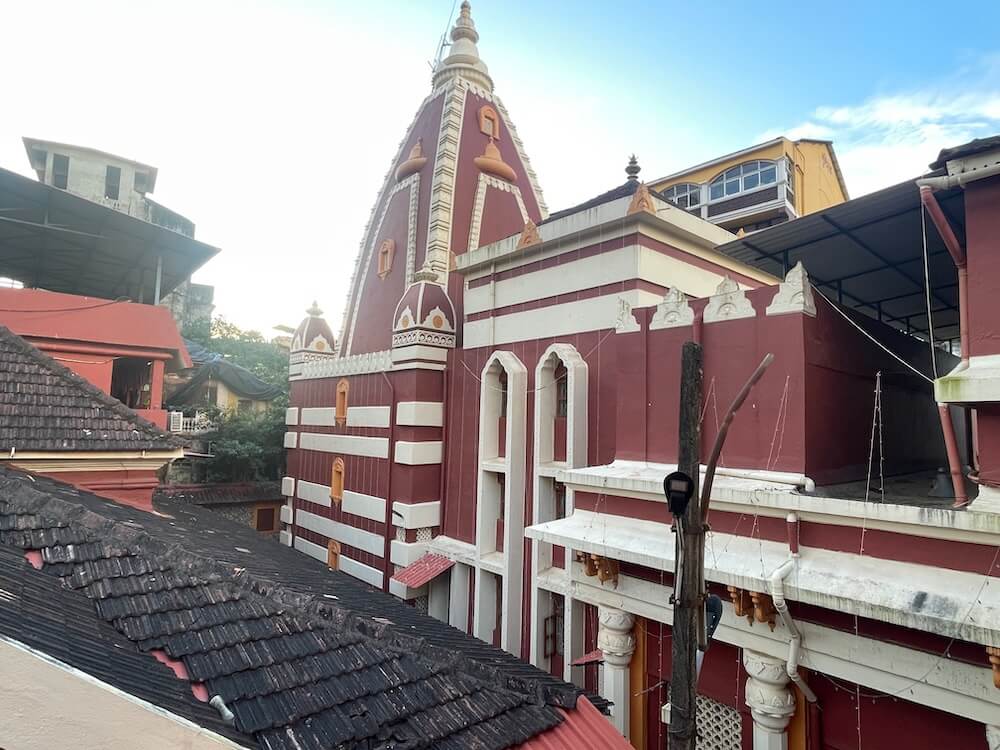
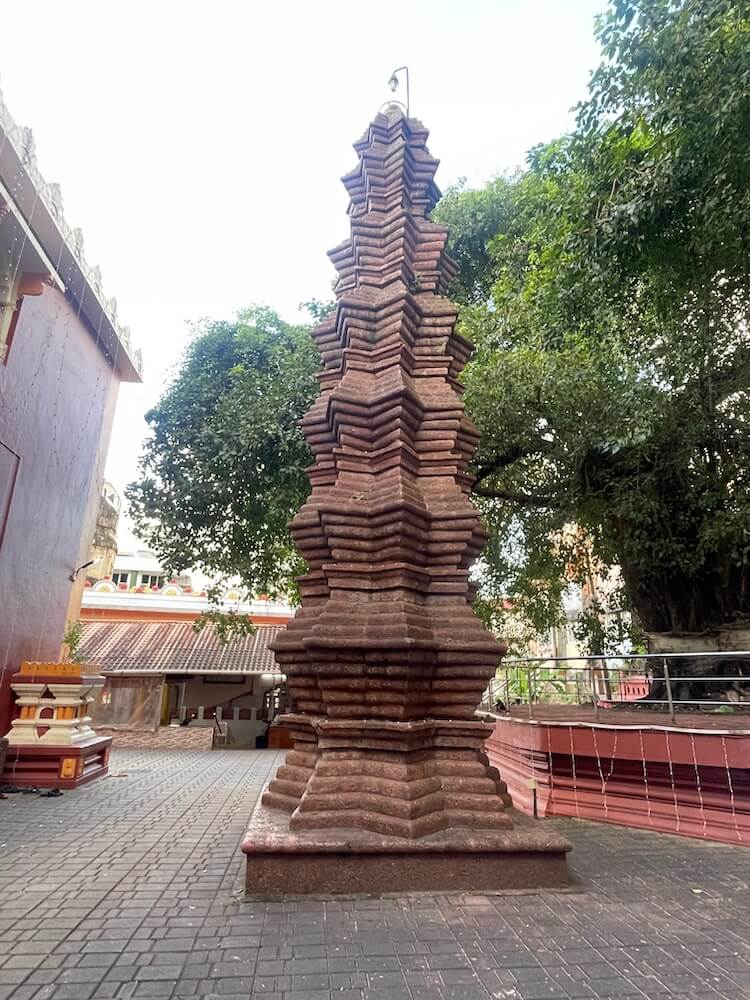
This grand temple is situated in a spacious courtyard in a densely populated area of Panaji, at the foothills of Altinho hill. The structure of this temple, which is approximately three stories high, consists of a large assembly hall (Sabhamandap), a main hall (Mahamandap), and the sanctum sanctorum (Garbhagriha). In front of the assembly hall stands an eight-tiered lamp pillar (Deepastambha) built of laterite stone in a star shape. Behind it is a large banyan tree with a high platform built around it.
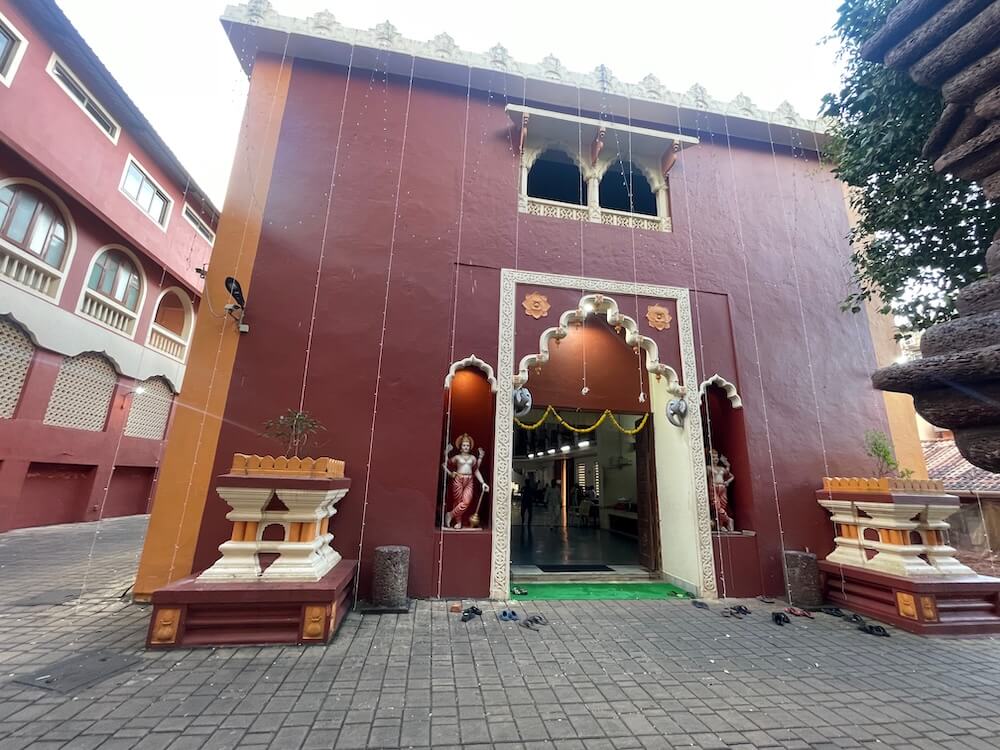
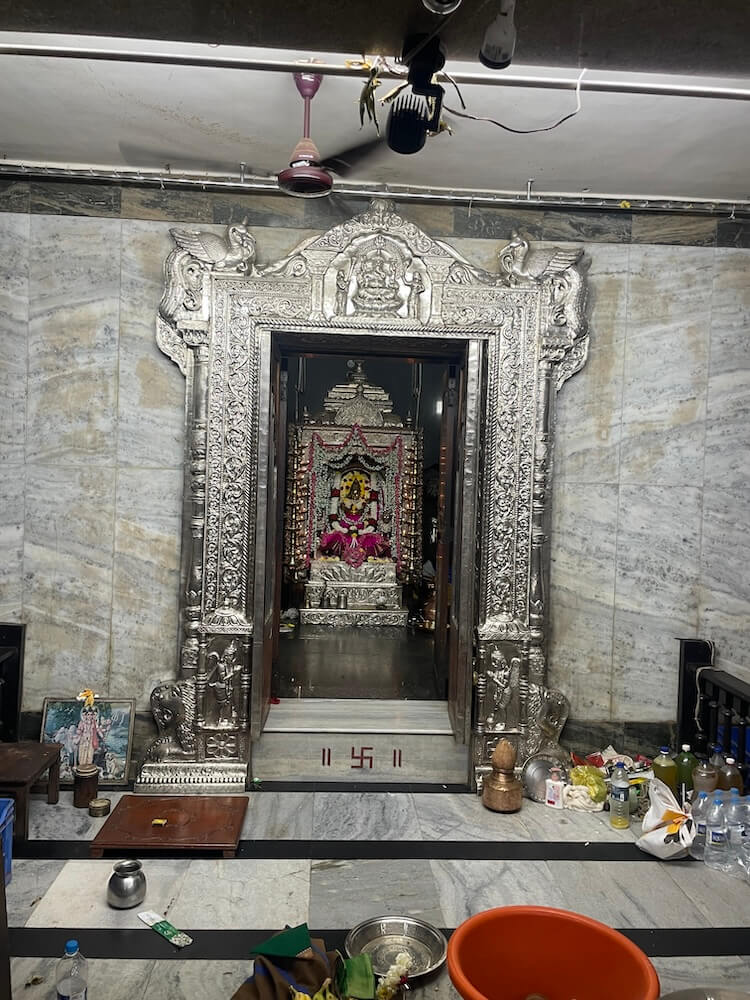
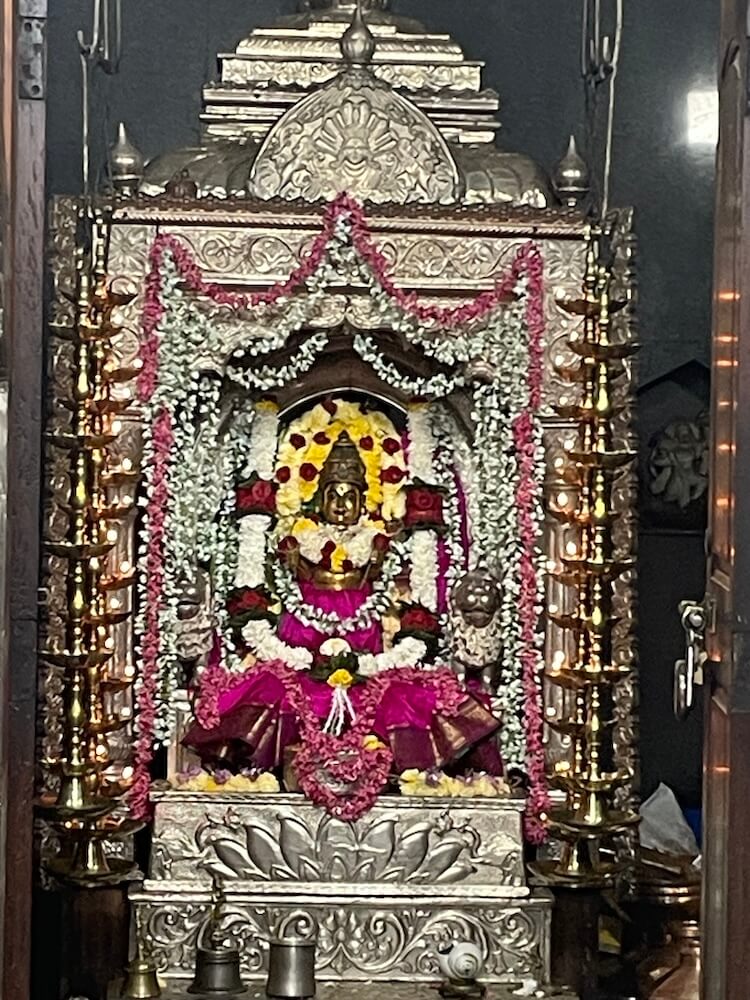
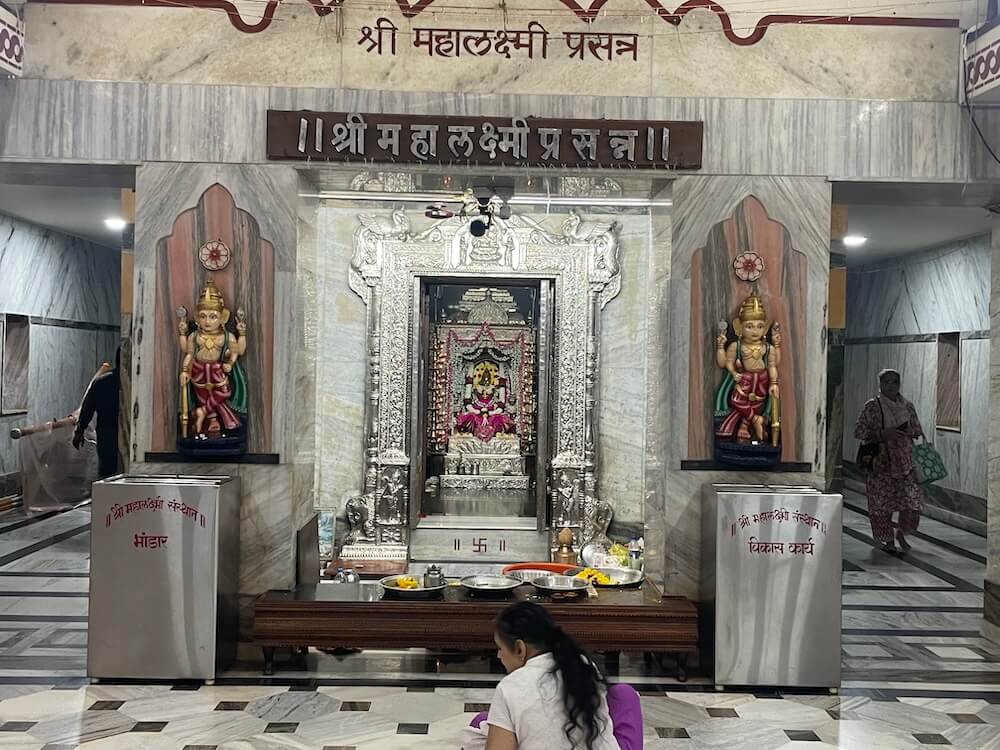
The assembly hall of the temple is tall and square. This hall, with its flat facade, has an arched entrance decorated with Gajamukhas (elephant faces). In the upper part, there are two small windows. On both sides of the entrance, there are tall niches containing statues of Vaishnava Dwarapalas (gatekeepers), as well as two Tulsi Vrindavans. This tall and spacious assembly hall is illuminated by latticed windows set into the left and right walls. Inside, there is a balcony with railings on three sides above. Two circular staircases in the front lead to this area. On the walls of the assembly hall, paintings in black and white depict the Dashavatara, as well as mythological events such as Gajendramoksha, Samudra Manthan, and the gems found therein. The Mahamandap has a wide entrance. A large replica of the Garuda Vimana is placed in the upper part. Inside, in the center, is the sanctum sanctorum of the temple. There is a circumambulation path (Pradakshina marg) from the Mahamandap itself. The walls of the sanctum are decorated with marble tiles. In the niches in the walls on both sides of its small open space, there are colorful statues of gatekeepers. The entrance to the sanctum is covered with silver plating featuring intricate carvings. Here, sculptures of lions, Garuda, and Hanuman are carved on the door pillars. At the lintel of the door frame is an image of Ganesha. In the upper part, images of peacocks are carved. Inside, on a silver Vajrapitha, there is a large silver shrine. In it, the four-armed idol of Mahalakshmi, featuring a brass mask, is consecrated on a silver throne. Adorned with a nose ring (nath), necklaces, and a crown upon her head, the Goddess with a serene countenance is beautifully decorated with garments, ornaments, and floral garlands. The original ancient idol of the Goddess, carved from black stone, is kept in a chest within the sanctum sanctorum. Above the sanctum rises a towering shikhara (spire). Its architecture features smaller shikharas at the four corners, with the main spire tapering upwards on all four sides in the center. It is crowned with an amalaka and a tall kalasha.
Near the main entrance within the temple courtyard stands the temple of Varadvinayaka. To the right of the Mahalakshmi temple is the Maruti temple. This temple was established on 25 February 1929. Inside this temple resides an idol of Hanuman holding the Dronagiri mountain, sculpted from marble. Similarly, two idols of Ganesha and an idol of Shani Deva are also enshrined here. Additionally, the courtyard houses a Shiva temple that was erected at the time of the original temple’s founding. To its right are the temples of the family deities (parivar devatas) Ravalnath, Rampurush, and Grampurush.
In the Mahalakshmi temple, the Aarti of the Goddess is performed daily at 12:30 PM and 8:00 PM. Likewise, the Aarti of Ganesha is performed in the local Vinayaka temple at 12:00 PM and 7:30 PM. The temple trust celebrates festivals such as Ram Navami, Hanuman Jayanti, Chaitra Purnima, Vijayadashami, Ganeshotsav, Ratha Saptami, Maha Shivratri, and the Kalotsav in the month of Margashirsha with great devotion and enthusiasm. A Saptah (week-long observance) is celebrated here every year starting from Nag Panchami. In ancient times, the local people celebrated a seven-day festival of the Goddess to ward off an epidemic. In memory of this, continuous bhajans are performed here for seven days. The Chaitra Purnima festival is one of the most important festivals at this temple. On this day, a grand chariot procession (rath yatra) of the Goddess is taken out. During the festival, a traditional theatrical performance is held here. During this performance, the idol of the Goddess is placed on a special Garuda-asana in the assembly hall (sabhamandap). Thousands of devotees from across Goa participate in this festival.
This sacred temple stands as a testament to deep spiritual devotion, ancient architectural grandeur, and rich local cultural traditions.
The sanctum sanctorum houses the divine idol consecrated according to ancient Vedic traditions, surrounded by serene courtyards and traditional temple architecture.
Navratri, Maha Shivratri, Annual Temple Jatra & Deepotsav
Compare and book flights, secure top-rated local hotels near the temple, hire reliable guides, and rent cars instantly.
Extend your pilgrimage by visiting other highly sacred temples located nearby.


Add ₹999 more to unlock FREE SHIPPING!
Your sacred cart is currently empty.
Shop Photo FramesFill in your delivery details below to place your order.
Add comment