
Add ₹999 more to unlock FREE SHIPPING!
Your sacred cart is currently empty.
Shop Photo FramesNrusimha, who resides in the ancient temple at Pokharni in the Parbhani Taluka of Parbhani district, is considered a form of Lord Shiva. (According to local legends, Nrusimha, the fourth avatar among the Dashavatara of Lord Vishnu, is believed to be a form of Lord Shiva.) Legend has it that after slaying the demon Golasura, He resided on the eastern bank of the Indrani River. This temple is the family deity (Kuldaivat) for many families in the Marathwada region. The Nrusimha here is considered a very powerful and awakened (Jagrut) deity. The villagers believe that they cannot enjoy the opulence that belongs to Nrusimha in this ancient temple. Out of this sentiment, no two-story house is built in the village. Furthermore, the people here do not use umbrellas or wooden cots. The State Government has granted this temple the status of a ‘B’ class pilgrimage site.
Many legends are associated with this temple. About 40 kilometers away from Parbhani city, which was known as Prabhavati Nagari in ancient times, lies the village of Rampuri. Because there are twelve temples of Hanuman in this village, it is called ‘Rampuri of the Twelve Hanumans’. According to one legend, in ancient times, many sages and seers lived in the Papdandeshwar region on the banks of the Godavari River flowing through Rampuri village. Sage Chyavana had established his ashram there. Due to certain reasons, a demon-like child with a spherical body was born to his wife. Because of his round shape, this child was named Golasura. Golasura performed severe penance to Lord Brahma and obtained many boons. Empowered by these boons, Golasura became arrogant and started tormenting everyone. Troubled by him, all the gods and humans sought refuge with Lord Shiva. To slay Golasura, Lord Shiva assumed the form of Nrusimha. He manifested three powers or Matrukas named Indrani, Vaishnavi, and Narsimhi. A war between Nrusimha and Golasura continued for many years. Finally, in this war, Nrusimha destroyed Golasura and freed the earth from the crisis. Near Rampuri village, there is a famous area called Indrani-cha-Maal. It is believed that this plateau is actually the Golasura who was killed in the war. The river originating from this plateau is named Indrani or Indadi. There is also a temple of Goddess Indrani at this place. After slaying Golasura, Nrusimha stayed on this plateau for some time along with Indrani, Vaishnavi, and Narsimhi. Over time, feeling uncomfortable staying on this plateau, Nrusimha prayed to Lord Shiva. Then, Lord Shiva told Him to reside on the eastern bank of the Indrani River. Accordingly, Nrusimha came to the present location on the eastern bank of the Indrani River. He dug a Pushkarani, which is a well, here. Then, He brought and poured the water of all holy pilgrimage sites into it. Thereafter, He began to reside near this Pushkarani. Since Lord Shiva and Nrusimha are one and the same, Lord Mahadeva also came here over time. It is because of this Pushkarani that the village was later named Pokharni.
According to another legend, the Nrusimha here previously resided at Rampuri. Having come here from there, Nrusimha asked Lord Shiva for a place. Mahadeva gave Him the place. He imposed a condition, “People coming here must first have my darshan.” Due to this condition, the sanctum sanctorum (Garbhagriha) of Nrusimha in this temple was built slightly to the side of the main part. It is also said that the Nrusimha residing in the temple came here from Salapuri. There was an ancient Shivalaya here previously. A story is also famous that Nrusimha gave a vision in a dream to the Patil of this village and asked for two spans of space in this Shivalaya.
The villagers have immense faith in the Nrusimha here. The villagers believe that prosperity has come to the village only due to the grace of Nrusimha. This temple is two-storied. Therefore, no one in the village builds a house taller than the temple or a two-story house. It is believed that if one does so, the concerned person has to face bad experiences. Baked bricks have been used in the construction of this temple. Because of this, baked bricks are not used while building houses in the village. Instead, people use stones or cement bricks. The cot for Nrusimha to rest on is made of wood. That is why a wooden cot is not used in any house in the village. There is an umbrella over the idol of Nrusimha. Therefore, no person in the village buys an umbrella for themselves. Villagers can only use an umbrella gifted by guests or someone from outside the village. It is not appropriate for us to enjoy the opulence that Nrusimha possesses. With this sentiment, this unique tradition has been followed in the village since ancient times. People who violated these rules were previously fined by the village Panchayat.
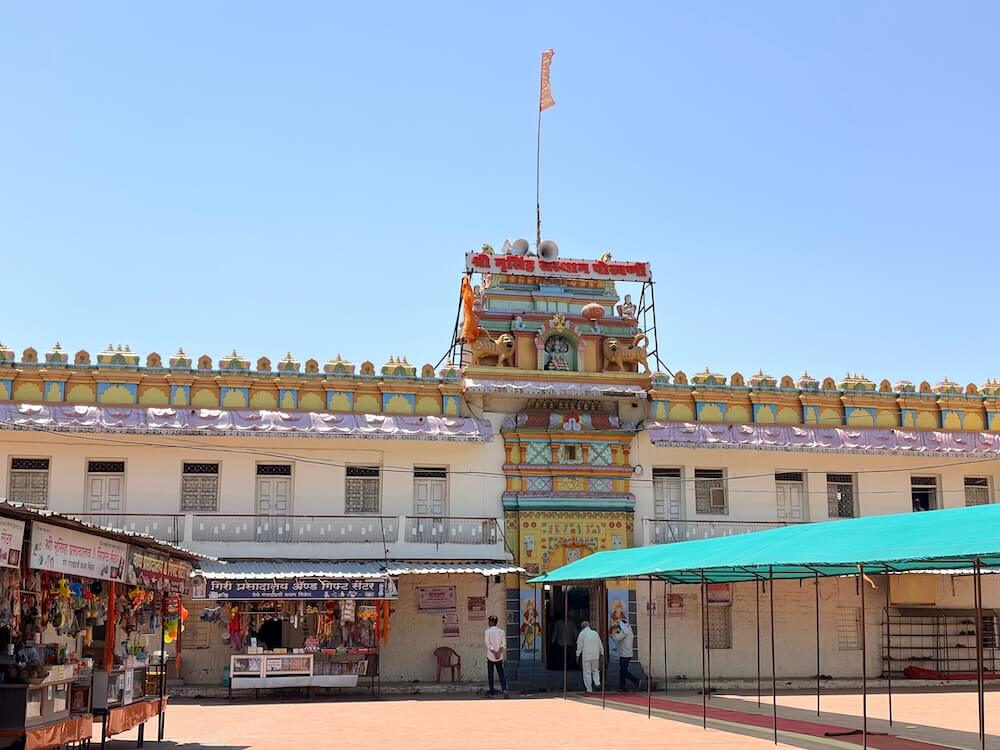
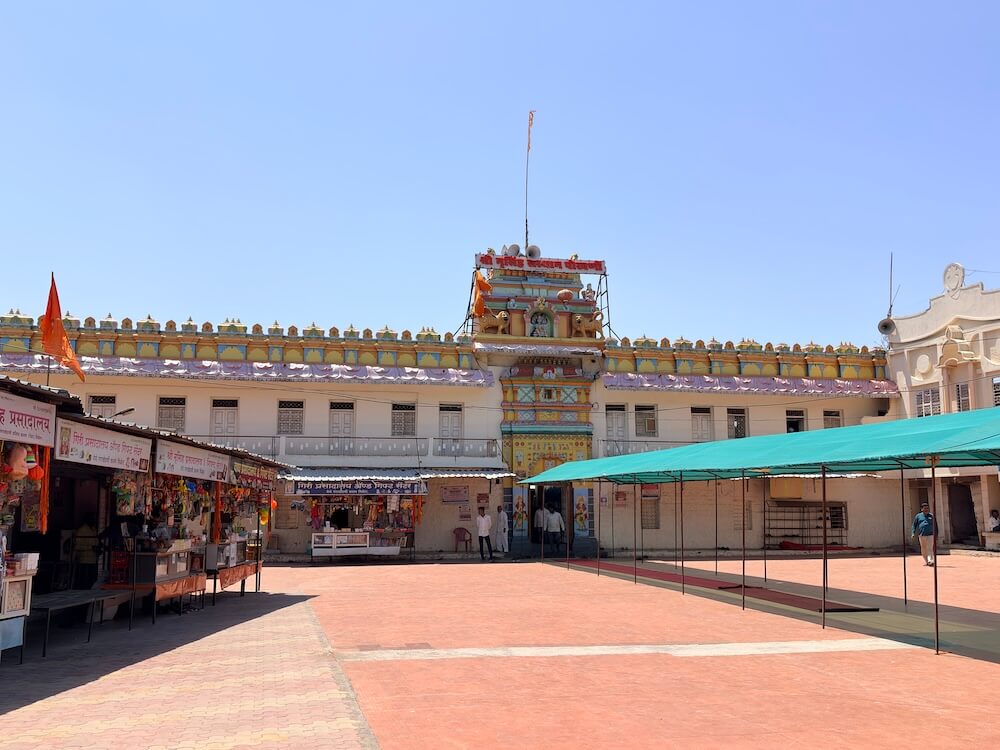
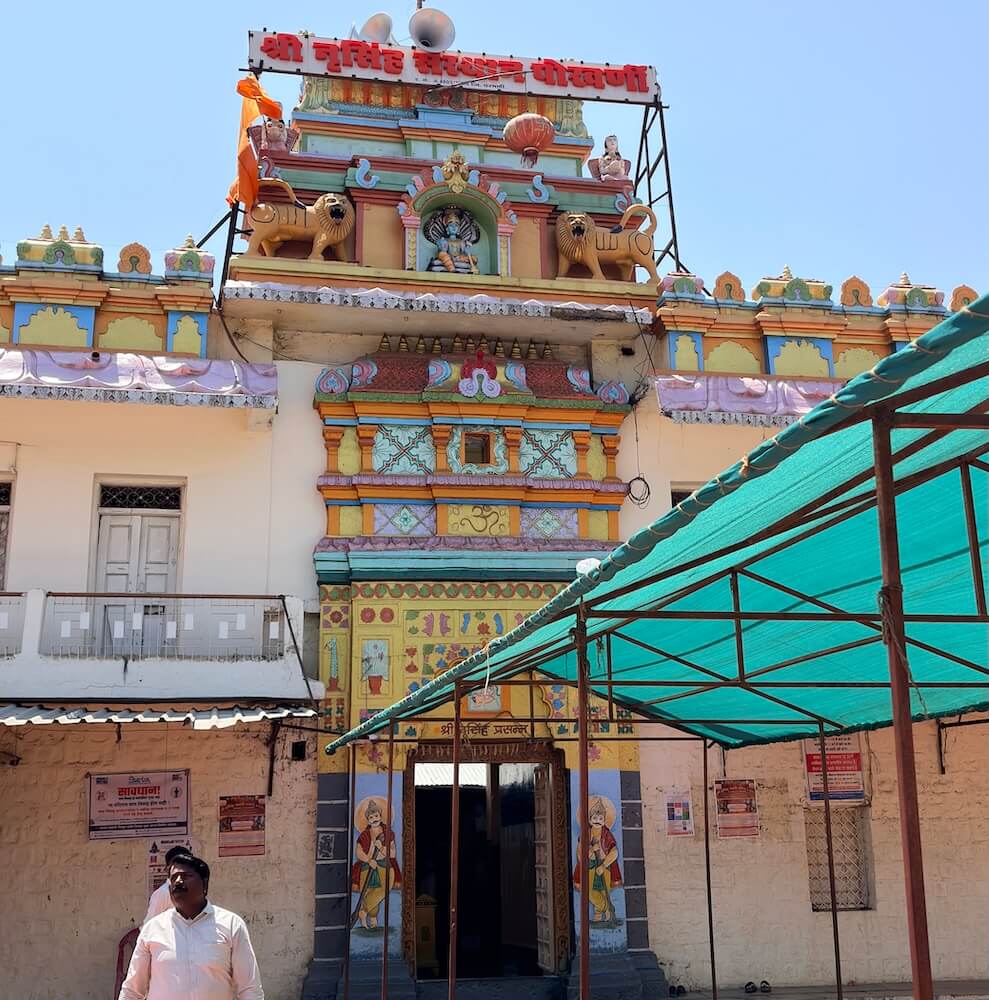
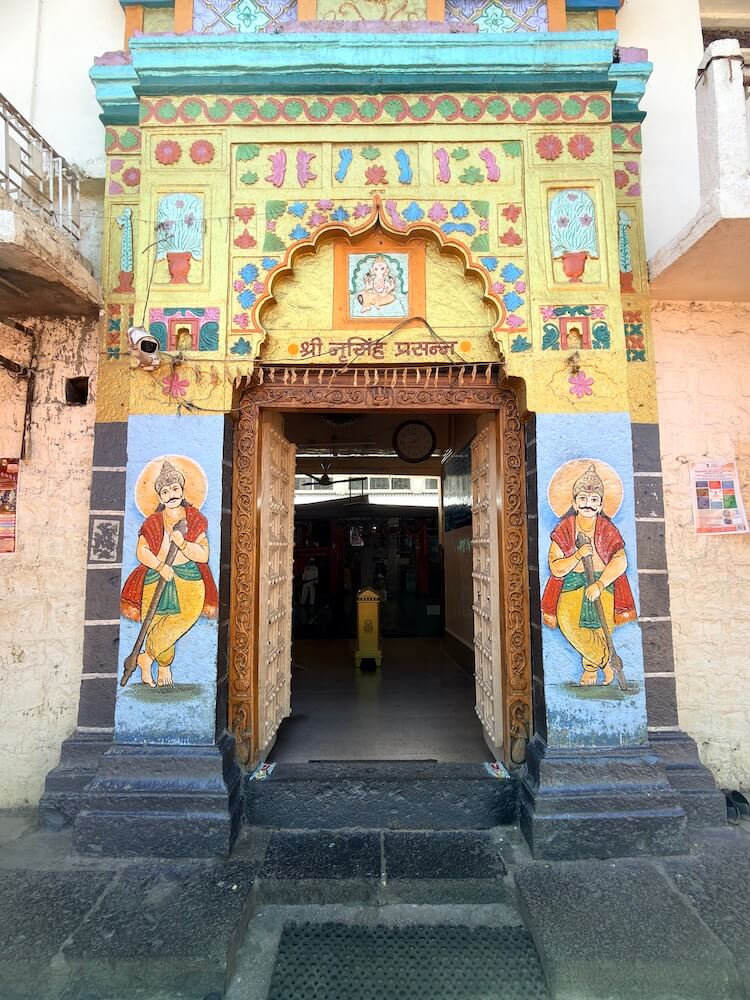
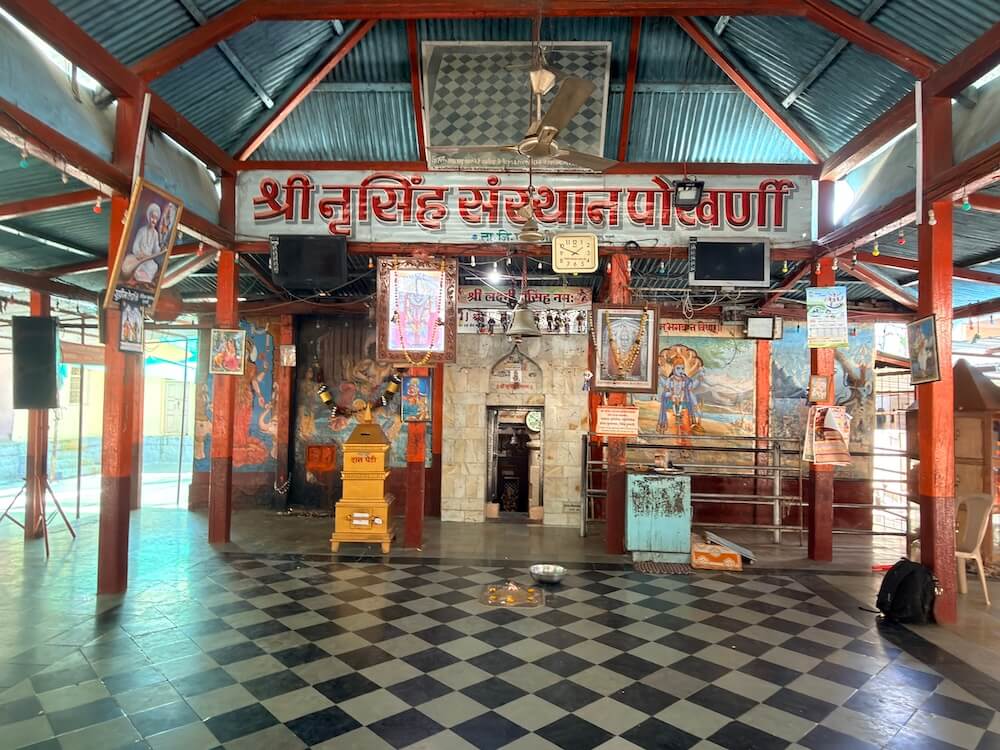
This temple is situated about one kilometer away from the main arch of the village. There is a large courtyard in front of the temple. In this courtyard, there are various shops selling worship materials and offerings. A roofed pathway has been built from the middle of the courtyard to reach the temple. The two-story structure of the temple has a grand entrance. On both sides of this entrance, there are colorful paintings of gatekeepers (Dwarapalas). In the upper part of the entrance, in the center, there is a picture of Ganesha. At the very top, on both sides, there are sculptures of lions. Also, in the center, the idol of Nrusimha is seated. After coming inside through this entrance, one enters the courtyard in front of the temple. Two-story verandas are built on all four sides of the courtyard. Right in front is a semi-open pavilion (Mandap) built on wooden pillars. In the center of this pavilion, which has a tin roof, a marble idol of Nandi is installed on a pedestal. On the front wall, to the left, a picture of Lakshmi is painted. Next to it, an image of Nrusimha slaying Hiranyakashipu is shown. On the right wall, there are pictures of Lord Vishnu and Mahadeva. From here, one enters the main assembly hall (Sabhamandap) of the temple. In the sanctum sanctorum in front of the assembly hall, a Shiva Linga is installed in a large Shalunka. A mask is placed on this Shiva Linga. Behind this Pindi, there is a three-foot-tall marble idol of Ganesha.
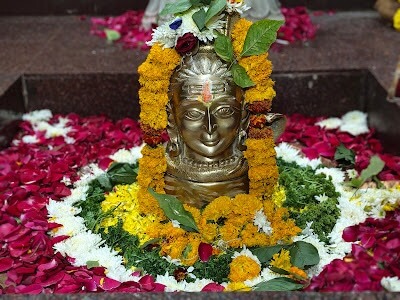
After coming out of Mahadeva’s sanctum sanctorum, there is a separate sanctum sanctorum for Nrusimha on the left. One has to enter this sanctum through a small frame. This entrance frame is very narrow and low in height. The structure is such that a person can only go inside by bending down. However, it is said that no matter how fat a person is, they can easily go inside through this frame. Only three to four people can stand in this sanctum at a time. Male devotees have to remove their shirts before entering this sanctum. In the sanctum sanctorum, to the right, resides the fierce form of Lord Narasimha, carved from sandstone. The demon Hiranyakashipu is seated upon His lap. A gold-plated mask is adorned upon this idol. Behind the idol stands a beautiful, gold-gilded halo. Directly in front of the entrance to this sanctum is the Shayan Kaksha (resting chamber) of Lord Narasimha. It is believed that Lord Narasimha rests here along with Goddess Lakshmi.
Behind this temple, there is a small Ganesha temple. Within the temple premises, there are several ancient historical idols. Behind the temple lies an ancient Pushkarini, or stepwell, built in the Hemadpanti architectural style. This stepwell, constructed in the twelfth century, features a flight of stairs to descend into it. It is said that the water in this stepwell never dries up, even during the summer. A beautiful garden has been developed within the temple premises. For the convenience of devotees arriving from afar, there is a Bhakta Niwas (pilgrims’ lodging) available here.
Devotees from across Marathwada arrive in large numbers for the darshan of the awakened (Jagrut) Lord Narasimha. The Lord Narasimha here is the family deity (Kuldaivat) of families such as Chidrawar, Nilawar, Wadkhelkar, Pardikar, Pache, Rudrawar, More, as well as many Kulkarni, Deshpande, Dubbewar, and Jujjalwar clans. Daily Abhishekam is performed in the temple every morning. Bhajans are organized every Saturday and on Ekadashi. On the day of Narasimha Jayanti in the month of Vaishakh, the area takes on the form of a grand fair. Thousands of devotees from various parts of Maharashtra, as well as from the states of Karnataka, Andhra Pradesh, and Telangana, arrive for this festival. On this day, after the Maha Puja at dawn, the temple hosts Bhajans, Kirtans, and various religious rituals throughout the day. In the evening, the birth anniversary celebration is observed in the presence of thousands of devotees. At this time, the chant ‘Narhari Shamraj Ki Jai’ echoes through the air. Gulal is showered, and fireworks light up the sky. On this occasion, a procession of the deity’s palanquin is taken through the village. The Narasimha Sansthan makes arrangements for the lodging and meals of the devotees arriving for the celebration. Thousands of devotees also visit for darshan on every Saturday of the month of Shravan. On Vijayadashami, also known as Dussehra, the palanquin of Lord Narasimha is taken on a circumambulation of the entire village. A Deepotsav (festival of lights) is celebrated in the temple on Tripurari Purnima. A special Parayan ceremony is organized here in the month of Paush. Devotees can have darshan here daily from 4 o’clock in the morning until 8 o’clock at night.
This sacred temple stands as a testament to deep spiritual devotion, ancient architectural grandeur, and rich local cultural traditions.
The sanctum sanctorum houses the divine idol consecrated according to ancient Vedic traditions, surrounded by serene courtyards and traditional temple architecture.
Navratri, Maha Shivratri, Annual Temple Jatra & Deepotsav
Compare and book flights, secure top-rated local hotels near the temple, hire reliable guides, and rent cars instantly.
Extend your pilgrimage by visiting other highly sacred temples located nearby.


Add ₹999 more to unlock FREE SHIPPING!
Your sacred cart is currently empty.
Shop Photo FramesFill in your delivery details below to place your order.
Add comment