
Add ₹999 more to unlock FREE SHIPPING!
Your sacred cart is currently empty.
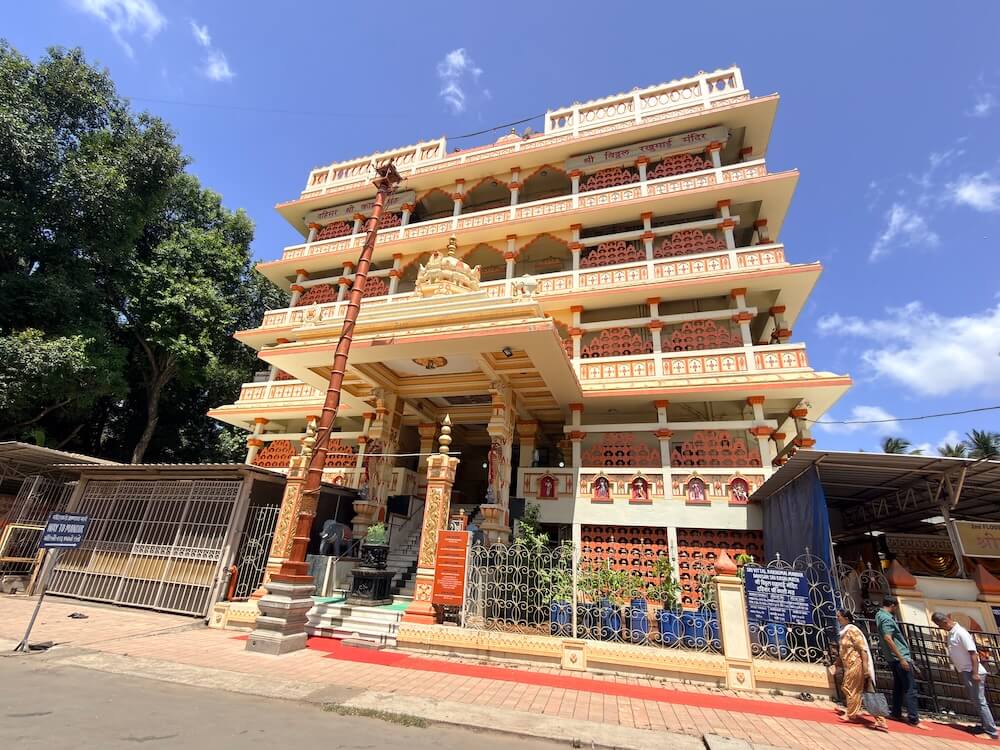
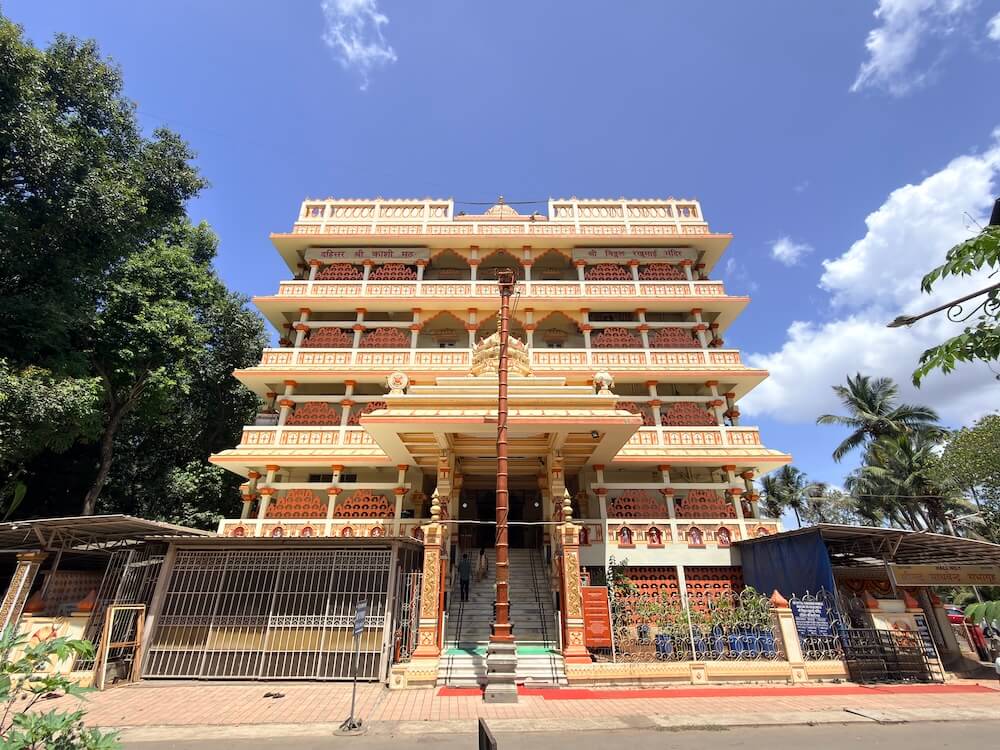
Shop Photo FramesDahisar is a western suburb situated at the northern tip of Greater Mumbai. Here stands the Vitthal-Rukmini Temple of the Kashi Math, which belongs to the Dvaita-Vedantic Madhva tradition. Housed in a multi-storeyed structure, this magnificent temple is a major religious and cultural center for the Warkari sect in the Dahisar area. Known as the ‘Dahisar Kashi Math’, this temple witnesses a large gathering of Vaishnavas on Ekadashi. A grand Brahmrathotsava festival is organized here in the month of Margashirsha. On this day, thousands of devotees from various suburbs of Mumbai arrive here for darshan. During this period, the temple premises take on the appearance of a fair.
According to Warkari faith, Vitthal, the Mother of saints who has been standing at Pandharpur with hands on the waist for twenty-eight yugas, is a form of Lord Vishnu. Described by saints as ‘Chovisanvegala’ (distinct from the twenty-four avatars of Vishnu), this ‘Baparakhumadevivaru’ Vitthal is the presiding deity of Maharashtra. Known by various names such as Vitthal, Pandurang, and Pandharinath, this Vithoba is considered a symbol of the cultural unity of Maharashtra, Karnataka, and Andhra Pradesh. This deity is Kannada. Saint Dnyaneshwar applied both the adjectives ‘Kanada’ and ‘Karnataku’ to Him. Saint Eknath said, “The pilgrimage is Kannada, the deity is Kannada. The region of Pandhari is Kannada,” while Saint Namdev, while referring to Him as “Kanada Vitthal standing on the banks of the Bhima,” also made a linguistic reference to Vitthal by saying, “Vitthal knows how to speak Kannada. Pundalik knows His language.”
The Vitthal Temple in Dahisar has been built by the Kashi Math, which belongs to the Madhva Vaishnava tradition of devotion that emerged from this very Karnataka. Madhvacharya, the founder of the Madhva tradition, was born in the year 1199 AD at Pajaka Kshetra near Udupi in Karnataka. He refuted the Mayavada and Advaita philosophy propounded by Shankaracharya and advocated the Dvaita (dualistic) doctrine. According to the ‘Marathi Vishwakosh’, this tradition is based on principles such as: the Vedas are apaurusheya (divine) and possess inherent authority; the world is real; God is only the instrumental cause of the world; salvation can be attained only through the worship of Vishnu; even in salvation, the soul does not become one with Vishnu; and salvation consists of residing in the proximity of Vishnu after the destruction of all sorrows. Followers of this tradition worship Vishnu in the form of Shalagrama. In this tradition, Vayu is considered to hold a position second only to Vishnu. Hanuman, Bhima, and Madhvacharya are considered the three avatars of Vayu. Madhvacharya wrote 37 works, including commentaries on the Dashopanishads, the Gita Bhashya or Gita Tatparya, and the Brahma Sutra Bhashya. The Madhva tradition had a profound influence on the religious and social life of medieval India.
It is said that in the year 1278 AD, on Magh Shuddha Navami, Madhvacharya disappeared forever while walking through the snow near Badrikashrama in the Himalayas. Saint Dnyaneshwar, who was born three years before his departure, laid the foundation of the Bhagavata Dharma in Maharashtra. It is noteworthy that although this tradition is essentially a path of devotion, it is not dualistic like the views of Madhvacharya. Saint Dnyaneshwar provided the Warkari tradition with a foundation of Advaita. Saint Tukaram even rejected the Advaita ideology in these words: “I find no satisfaction in Advaita. Sweet are Thy feet, Thy service.” However, despite such ideological differences, the Vitthal-Rukmini Temple of the Kashi Math in Dahisar has become a center of faith for the Warkari sect as well.
Kashi Math is considered the most ancient and supreme spiritual seat of the Goud Saraswat Brahmin (GSB) community of the Madhva tradition. Located on the Brahma Ghat in Varanasi, this Math was established in 1542 AD by Vijayendra Tirtha Swami. He is addressed as ‘Saraswat Dharmapitha Sthanacharya’. Yadavendra Tirtha was the first Swami or Mathadhipati of this Math. Vyasamuni, Shriram, and Narasimha are the presiding deities of this Math. The Math has many followers in the country, primarily in Goa, Mumbai, and parts of Karnataka and Kerala. It is said that in the thirteenth century AD, Madhvacharya, the proponent of the Dvaita-Vedanta doctrine of the Vaishnava tradition, visited Gomantak. At that time, the Vaishnava Goud Saraswat Brahmins here accepted his Dvaita doctrine. The Kashi Math Sansthan, which stands on this spiritual-ideological foundation, has two branches in Mumbai. One branch is at Walkeshwar and is famous as ‘Walkeshwar Kashi Math’. The second institution is ‘Dahisar Kashi Math’ and the Vitthal-Rukmini Temple there.
The history of this Math and temple here begins from the latter half of the twentieth century. The then Mathadhipati Sudhindra Tirtha Swami had envisioned this project. For this purpose, a large plot of land in the eastern part of Dahisar was purchased in 1968 AD. Today, that area is known as ‘Shri Sudhindra Nagar’. Sudhindra Tirtha Swami laid the foundation stone of this Math and the adjoining temple project on 23 March 1992. Over the next decade, this Math-temple took shape through the financial support of many philanthropists from the Goud Saraswat Brahmin community across the country, and primarily from the Mumbai-Dahisar area. Sudhindra Tirtha Swami and his prime disciple Samyamindra Tirtha Swami performed the Pranapratishtha of this temple on 25 March 2003, while the Math was inaugurated on 22 May 2003.
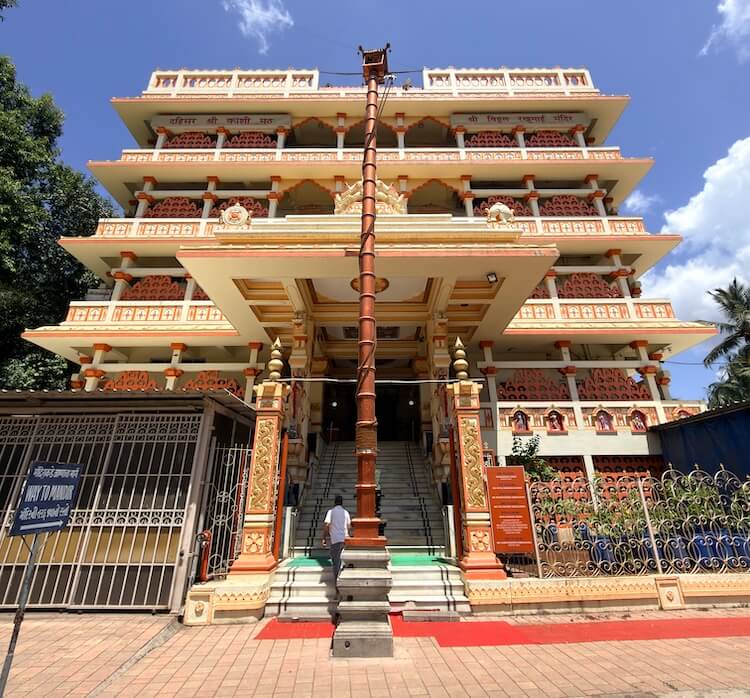
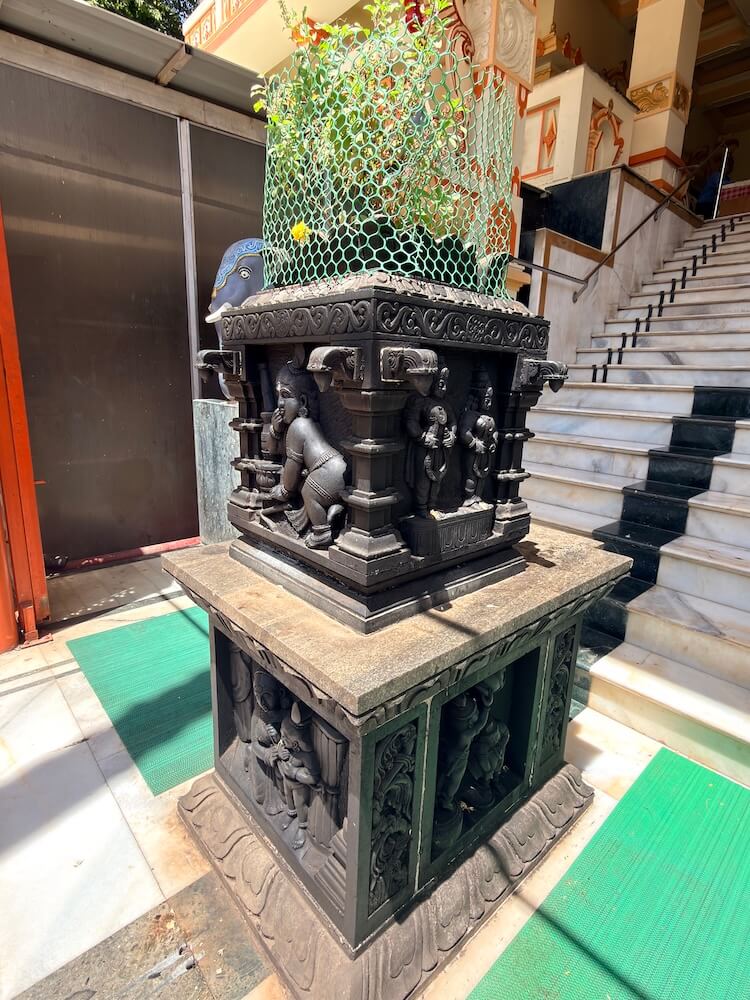
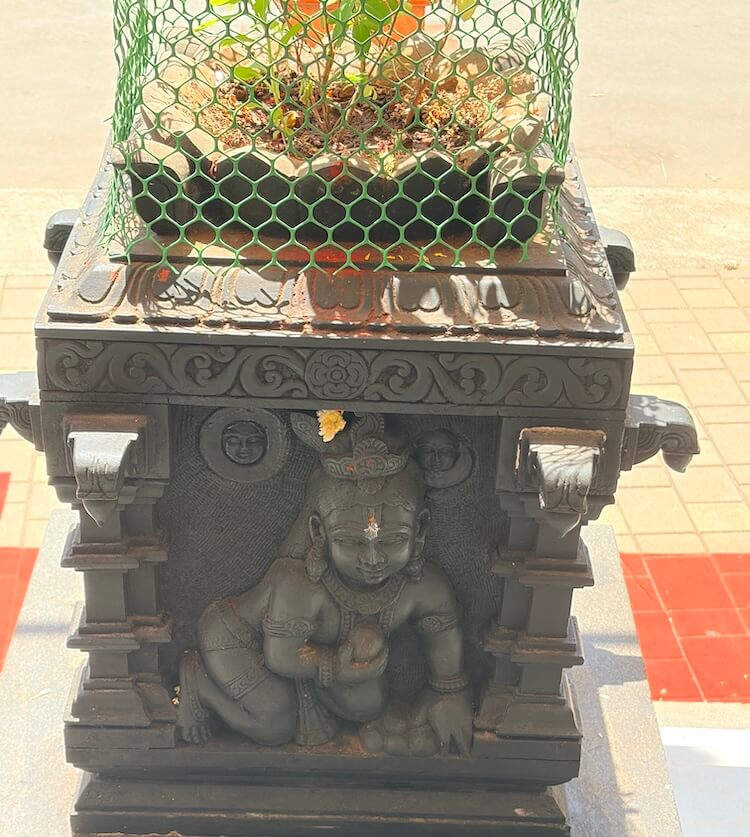
This Math-Mandir is situated in a five-story building spanning a total area of 40,000 square feet. The Madhavendra Hall is located on the second floor of the building. The third floor has been named the ‘Vyas Mandir’. This floor is reserved for the Math’s Swami whenever they visit Dahisar. The fourth floor houses the ‘Math Sharada Nilaya’, a museum of rare artifacts, items used by various Swamis of the Kashi Math Samsthan, and other works of art. The fifth floor features the Lakshmi-Narayan Hall and a dining hall. The main temple is located on the first floor. In front of the temple, following the South Indian temple tradition, stands a tall metal flagstaff. In front of it, on a stone pedestal, is a stone Tulsi Vrindavan. Sculpted upon this Vrindavan are the idols of Vitthal-Rukmini along with various scenes depicting the pastimes of Balakrishna. In front is a staircase of 23 steps, flanked by artistic square pillars and a balustrade. Two pillars on this balustrade feature Vyala sculptures. A Vyala is a fierce-looking mythical creature, also known by names such as Varalak, Varal, and Vralika. In South India, it is called Yali. According to scholars, this sculptural style entered India during the Mauryan period through Scythian or Achaemenian influence. Vyala figures are found in abundance in the architecture of the Vijayanagara Empire, which has a special connection to the Madhva tradition. Near these pillars, on both sides of the balustrade, are elephant figures. From these steps, one enters the temple’s Mukhamandapa (front hall) and from there into the main Sabhamandapa (assembly hall). The Mukhamandapa has a shrine-like structure, while the Sabhamandapa features a dome-shaped design at the front, and the spire at the back is topped with a tall, dome-shaped Kalash.
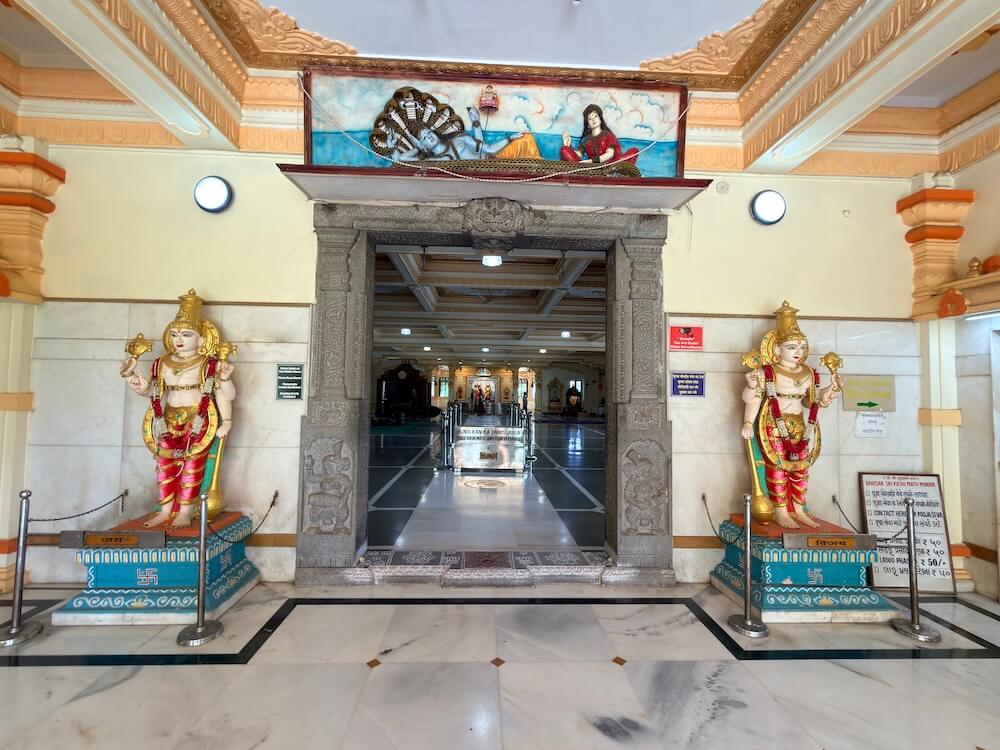
On both sides of the entrance to the main Sabhamandapa, tall and colorful idols of the Vaishnava gatekeepers, Jaya and Vijaya, are enshrined in the South Indian style. The entrance is made of stone and features intricate carvings. On the pillars of the door frame, there are sculptures of Surasundaris at the bottom, while a Kirtimukha is carved at the lintel. In the upper section of the door frame, there is a beautiful, colorful relief sculpture of Sheshashayi Narayana and Lakshmi. The Sabhamandapa of the temple is extremely spacious. It is adorned with marble flooring throughout, a designated queue for Darshan, square carved pillars with elephant heads at the top, carved lotus flowers on the ceiling, and idols of saints from the Varkari tradition placed on walls and pillars at various points. These include sculptures of Sant Dnyaneshwar in a meditative posture, Sant Namdev immersed in Kirtan, Sant Eknath, the author of the ‘Bhagwat’, Sant Tukaram absorbed in Abhangs, Sant Muktabai sitting on ‘that’ wall in Alandi and baking flatbreads on Dnyanoba’s back, and the devotee Pundalik. In the Sabhamandapa, to the left, there is a large wooden Makhar (shrine) containing a silver cradle. To the right in the Sabhamandapa is a large wooden altar containing a portrait of Satyanarayan. The Satyanarayan Mahapuja ceremony is organized here. On the wall beside this Makhar are portraits of Madhvacharya and the Acharyas of the Kashi Math of the Madhva tradition.
Directly in front is the Garbhagriha (sanctum sanctorum) with a circumambulation path. On the front wall of the Garbhagriha, idols of Garuda and Hanuman are enshrined in a posture of salutation. The Garbhagriha has a wide entrance covered with silver plating. Its door frame is decorated with intricate carvings, Makara Toranas, and idols of deities. At the lintel is an idol of Ganesha, while the upper section features a sculpture of Gajalakshmi. Inside, on a high stone pedestal, beautiful black stone idols of Vitthal and Rukmini are consecrated. These idols are adorned with rich garments, ornaments, and flower garlands. In front of these idols, a smaller idol of Vitthal-Rukmini is placed in a silver Makhar. In the niches on the outer walls of the Garbhagriha are idols of Brahma, Vishnu, and Mahesh.
A unique feature of this structure’s architecture is the blend of modern construction style and the Nagara style of temple architecture. The Sabhamandapa and related structures are in the modern style, while the Garbhagriha and its surrounding circumambulation path are in the Nagara style. Although it appears to be part of the same building from the inside, when viewed from the outside, it is distinct in design from the main building. This Nagara-style star-shaped Garbhagriha is multi-layered and stands taller than the fifth floor of the building. Its spire tapers towards the top, which is crowned with a tall Kalash on a dome-shaped base.
Devotees can visit the temple daily from 7:00 AM to 12:30 PM and from 5:30 PM to 9:00 PM. Mangal Aarti takes place every morning at 8:00 AM, followed by Madhyanha Puja at 12:00 PM. Deepnamaskar is held at 7:30 PM and Ratrapuja at 8:30 PM. Various festivals are celebrated throughout the year according to the Hindu calendar. The biggest festival for Vitthal devotees is Ashadhi Ekadashi. On this day, Mahapuja begins at 4:00 AM. Thousands of devotees stand in queues for Darshan throughout the day. The Akhand Harinam Saptah concludes in the temple on this day. At night, the Palkhi (palanquin) procession of Vitthal is taken out. The second major festival is Kartiki Ekadashi.
On this day as well, all religious rituals are performed just like on Ashadhi Ekadashi. On Gokulashtami in the month of Bhadrapada, the birth celebration is held at 12:00 midnight. The next day, a Dahi Handi event is organized in the temple premises. According to the traditions of the Kashi Math, the anniversaries of the Sannyasa initiation and the Punyatithi of the Mathadhipati Swamijis are also celebrated here according to the lunar calendar. Every year on Chaitra Shukla Pratipada (Gudi Padwa), a grand Panchang reading program is held.
For the past 13 years, the Brahma Rathotsava has been celebrated in this temple with great enthusiasm and amidst huge crowds of devotees. This chariot festival takes place between Margashirsha Shukla Dwitiya and Shasthi. Along with this, various social, cultural, and educational activities are also conducted through this Math.
This sacred temple stands as a testament to deep spiritual devotion, ancient architectural grandeur, and rich local cultural traditions.
The sanctum sanctorum houses the divine idol consecrated according to ancient Vedic traditions, surrounded by serene courtyards and traditional temple architecture.
Navratri, Maha Shivratri, Annual Temple Jatra & Deepotsav
Compare and book flights, secure top-rated local hotels near the temple, hire reliable guides, and rent cars instantly.
Extend your pilgrimage by visiting other highly sacred temples located nearby.


Add ₹999 more to unlock FREE SHIPPING!
Your sacred cart is currently empty.
Shop Photo FramesFill in your delivery details below to place your order.
Add comment