
Add ₹999 more to unlock FREE SHIPPING!
Your sacred cart is currently empty.
Shop Photo FramesIn the Borivali East area of Mumbai, adjacent to the Sanjay Gandhi National Park, stands a tall and magnificent temple. This temple is known as Trimandir. It was built to transcend sectarian divisions and narrow religious views, placing importance on secularism. The primary purpose of this temple is to break down the invisible walls between various castes and religions, fostering peace, unity, eternal happiness, and spiritual understanding among people. This temple is not limited to any one specific sect. It is considered a common ground that brings together the three major streams of Jainism, Shaivism, and Vaishnavism.
The original concept of the Trimandir was proposed by the Jain spiritual thinker Dada Bhagwan. He was the proponent of the movement known as ‘Akram Vignan’, the science of spontaneous self-realization. The original name of Dada Bhagwan was Ambalal Muljibhai Patel. He was born on 7 November 1908 in Tarsali, Gujarat. He had a spiritual inclination from childhood. He completed his formal education up to the tenth grade and subsequently came to Mumbai for business. He worked as a contractor for ‘Patel and Company’, which maintained the dry docks at the Mumbai port. In June 1958, on platform number 3 of the Surat railway station, he experienced what he perceived as self-realization. Following this experience, he founded the ‘Akram Vignan’ movement in the 1960s. He passed away on 2 January 1988. After his passing, his disciples continued this work.
According to Dada Bhagwan, humans have fragmented God and religion, but in reality, all deities have emphasized self-knowledge and the purity of the soul. Therefore, the core objective of this temple is to provide people with devotion and peace of mind under one roof, without any discrimination. Global religious harmony is promoted at this place. This Trimandir is built on the philosophy that all deities guide us to understand the nature of the soul and to attain self-realization. According to the ‘Dada Bhagwan Foundation’, ‘Akram Vignan’ is different from traditional paths that demand the renunciation of worldly life or strict self-restraint. It is considered an easy and direct path to self-realization. In traditional paths of self-knowledge, people have to renounce worldly life and material possessions. One has to practice self-control. In Akram Vignan, this is not required. According to this science, when the ignorance of the soul is completely removed through the grace of a self-realized person, then a fundamental transformation begins in the inner self. The process of attaining self-knowledge is called Gnan Vidhi. It is claimed that through this, knowledge of the soul is attained in just two hours. Gnan-Bhakti is the fundamental principle of Akram Vignan. Expressing devotion through knowledge towards Simandhar Swami and his medium, Dada Bhagwan, by surrendering completely, is the core essence of this science.
According to Jain tradition, Simandhar Swami is a living Tirthankara currently residing in another world called ‘Mahavideha Kshetra’. It is believed that he was born during the time of the 17th Tirthankara Kunthunath and the 18th Tirthankara Arhanath. His physical form is approximately 1500 feet tall. Devotees believe that his current age is about 1,50,000 years and he will live for another 1,25,000 years. According to mythology, King Dasharatha also received initiation from him. In all the Trimandirs built by the ‘Dada Bhagwan Foundation’, Simandhar Swami is the main deity, and he is worshipped here with great devotion.
The Trimandir is considered a revolutionary religious concept. It gives equal status to all major religions. Dada Bhagwan’s teaching is that ‘people have themselves divided God and religion. Instead of choosing any one God, we should understand and practice the core principles of all religions. All deities have told us the importance of the soul and self-realization.’ Based on these thoughts, many such temples stand in various places today, and one of them is the Trimandir in Borivali.
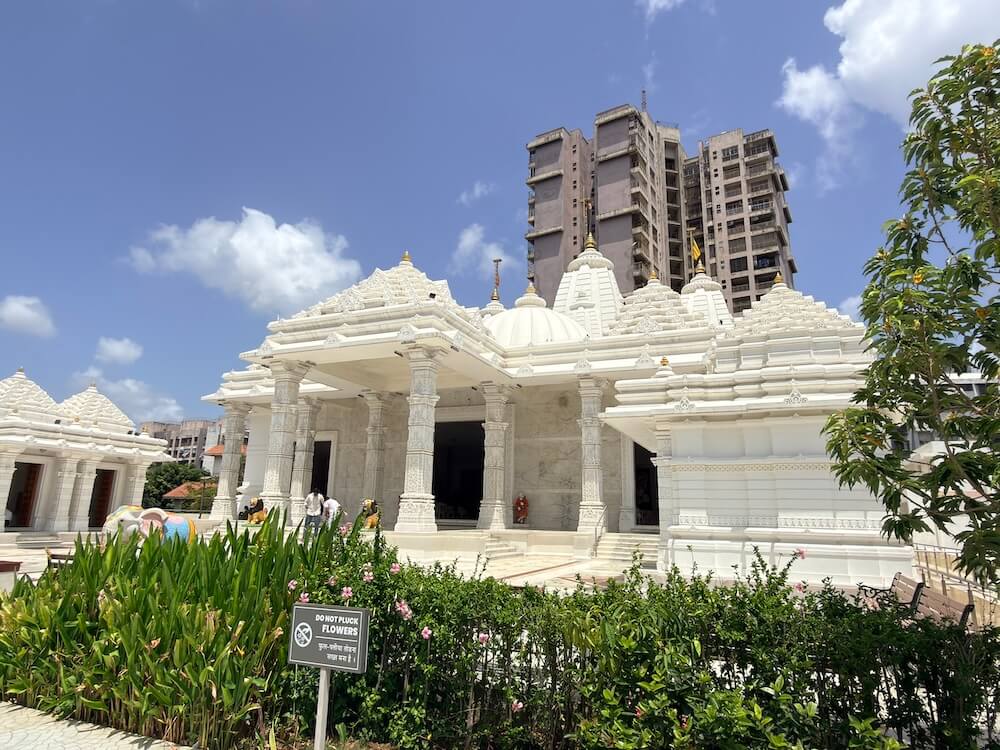
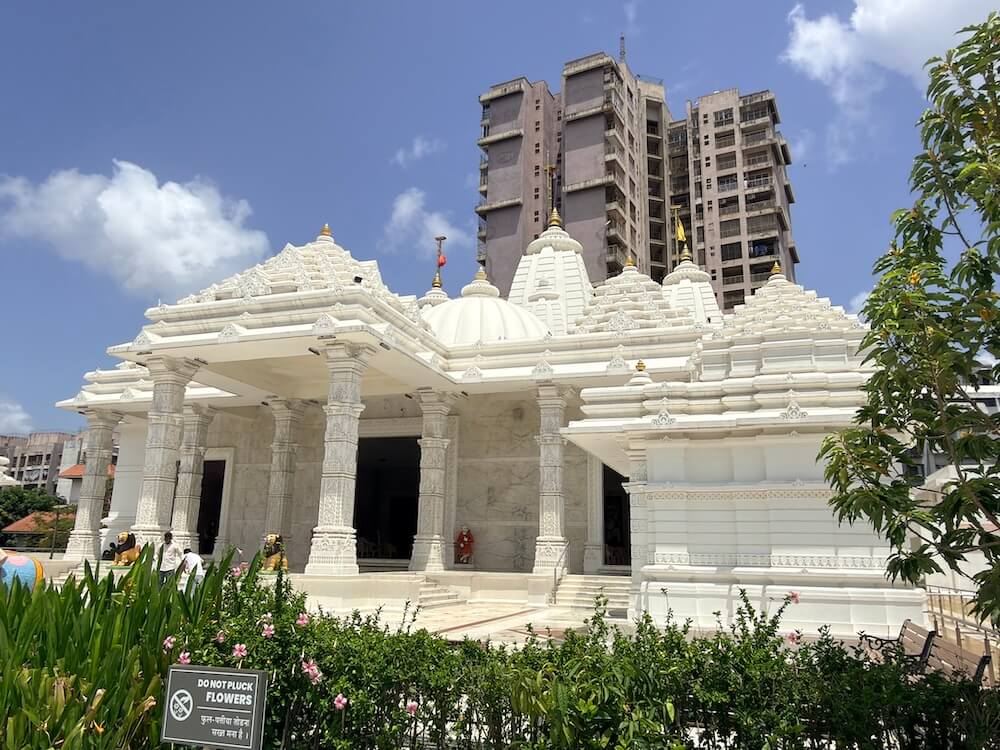
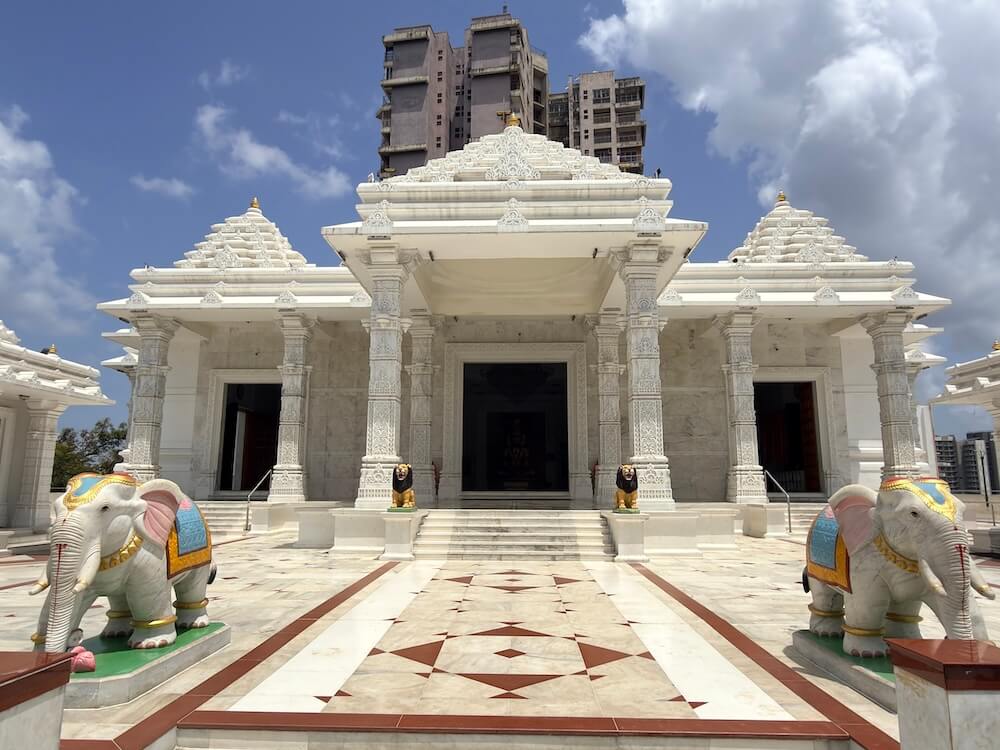
This Trimandir is a beautiful example of traditional and modern architecture. The temple is surrounded by a strong stone boundary wall. One enters the spacious courtyard of the temple through the main gate in this boundary. In this courtyard, various types of ornamental and flowering plants are planted in front of the temple. Additionally, many benches have been provided in the courtyard for devotees to sit. On the path leading from the courtyard to the temple, there are two large sculptures of elephants made of marble. In the front part of the temple, on the left side, there are two small shrines. The idols of Padmavati Devi and Padmanabh Bhagwan are enshrined in these temples. In the two small shrines on the right side, the idols of Saibaba and Ambamata have been installed. After climbing six steps from the courtyard, one sees lion sculptures near the main entrance, i.e., the Mukhamandapa. The pillars here have intricate carvings. There are sculptures of gatekeepers on this massive entrance. This entire structure has three Mukhamandapas, a main Sabhamandapa, three Antaralas, and three Garbhagrihas.
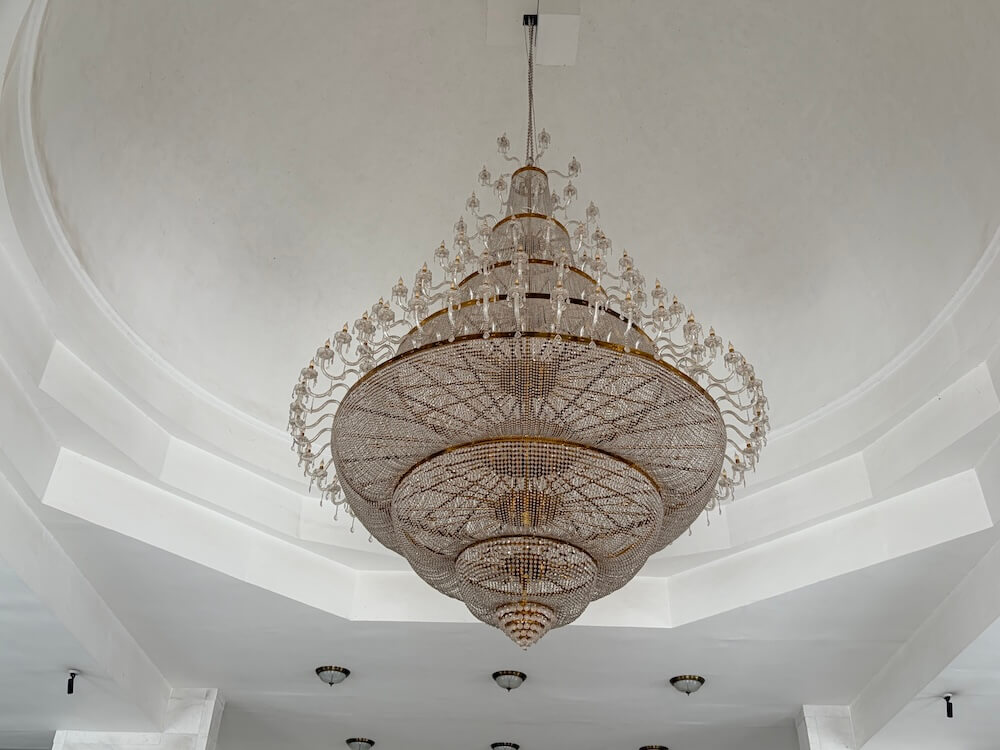
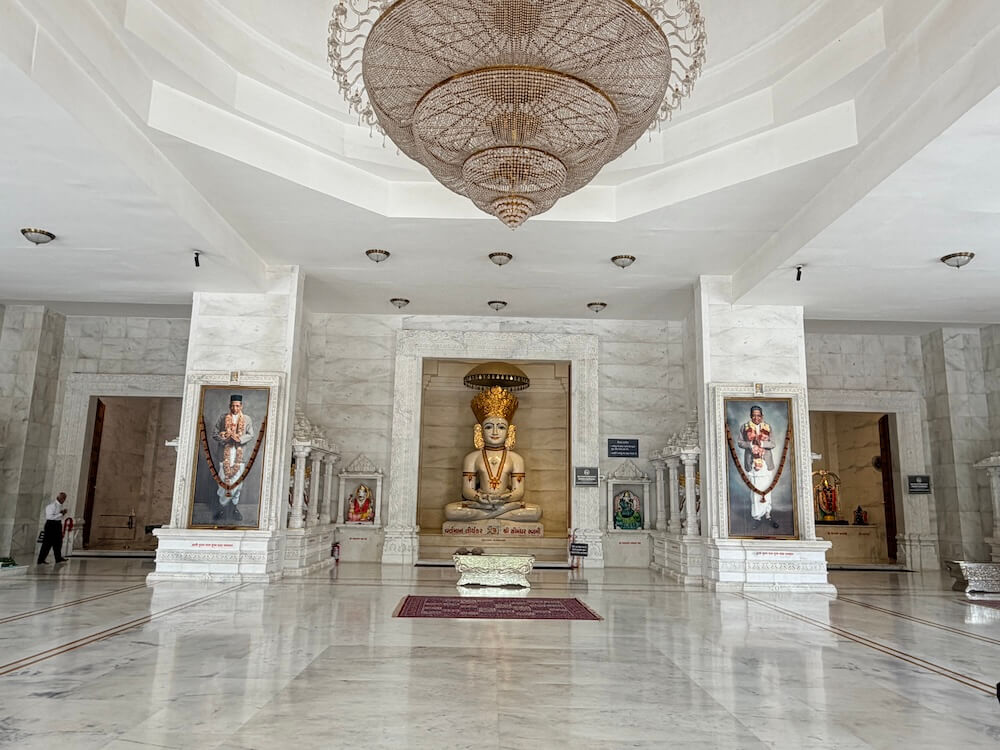
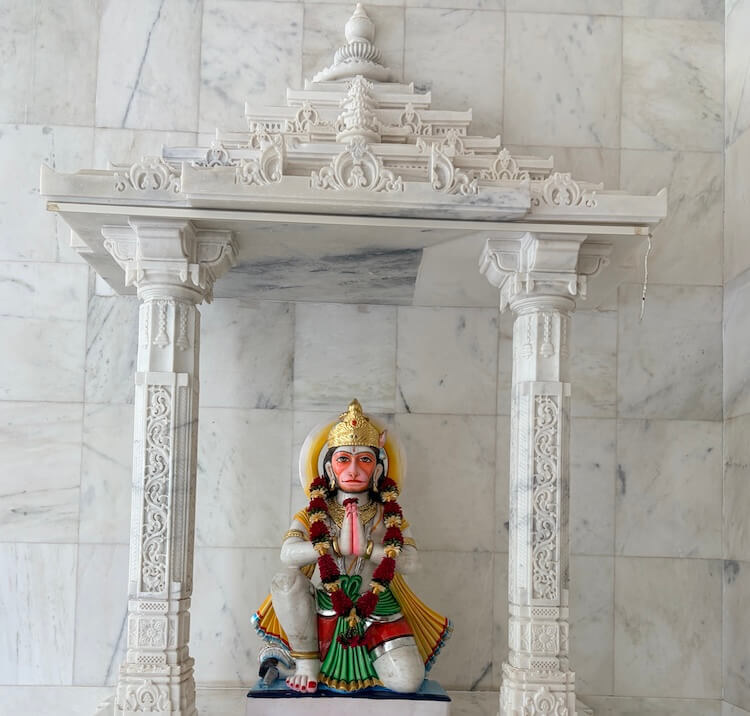
A large crystal chandelier is hung in the center of the ceiling of the main Sabhamandapa here. In the central Garbhagriha, the current Tirthankara of Jainism, Shri Simandhar Swami, is seated. In the left Garbhagriha, Sangameshwar Mahadev of the Shaiva tradition is seated, while in the right Garbhagriha, Yogeshwar Krishna of the Vaishnava tradition is seated. In the main Garbhagriha, the magnificent idol of Shri Simandhar Swami is carved in white marble. This idol is seated in a meditative, i.e., Padmasana posture, on a high Vajrapitha. The Swami’s idol is adorned with golden ornaments and a crown. In his Antarala, on the niches of the front wall of the Garbhagriha, are the idols of Chandrayan Yaksha and Panchanguli Yakshini Devi. In the other niches of the antarala, idols of Bhagwan Parshvanath, Bhagwan Mahavir, Bhagwan Ajitnath, and Bhagwan Rishabhdev have been installed. In front of the sanctum sanctorum of the Shaiva tradition, there are marble idols of Nandi and a tortoise. In the niches of the antarala here, there are idols of Hanuman and Ganpati. In this sanctum sanctorum, there is a large Shiva Linga in the center on the floor, and in the niche on the wall behind it, a white marble idol of Mother Parvati is enshrined. In the sanctum sanctorum of Yogeshwar Krishna, the black stone idol of Shrinathji is placed on a Vajra-pitha. Additionally, a white marble idol of Yogeshwar Krishna Bhagwan, Tirupati Balaji, and a Garuda idol are consecrated here. Large portraits of Dada Bhagwan are placed on the two pillars outside the main sanctum sanctorum.
On the ground floor of the temple, there is a large Satsang hall for devotees and seekers. Weekly Satsangs and spiritual discourses are organized in this hall. In this same area, there is a sales center for various books and scriptures based on the life journey of Dada Bhagwan. There is also a museum and a small cinema hall here. In this cinema hall, documentaries on the life of Dada Bhagwan are shown in Gujarati, Hindi, and English languages. The temple timings are from 7 in the morning to 9 at night every day. Various rituals are performed here daily in a highly disciplined manner. Every morning, the deities are bathed. This ritual is called Prakshal. Thereafter, a special Abhishekam is performed for the three main deities—the Jain Tirthankaras, Bhagwan Shiva, and Yogeshwar Krishna—with water and other sacred substances according to scriptural methods. Aarti is performed in the temple daily at 8:15 in the morning and 6:30 in the evening.
Regarding annual festivals, this temple is considered an excellent example of inclusivity. Major festivals of all traditions are celebrated here together and with great enthusiasm. Festivals like Guru Purnima, Rakshabandhan, Ganesh Chaturthi, Navratri, Paryushan Parva, Diwali, and New Year are celebrated harmoniously in the temple. According to the Shiva tradition, special worship of the Shiva Pindi is performed on Mahashivratri. On this day, an all-night vigil and bhajans are organized. The Shri Krishna Janmashtami festival, the major festival of the Vaishnava tradition, is celebrated here on a grand scale. During this festival, the idol of Shri Krishna is adorned with special attire and ornaments, and a cradle ceremony as well as Dahi Handi are organized at night. During the holy Paryushan Parva of the Jains and Mahavir Swami Janma Kalyanak, special religious reading, meditation, and penance sessions are organized in the temple. Citizens from the Jain community attend these sessions in large numbers. Apart from this, traditional festivals like Diwali, Padwa, and Rakshabandhan are also celebrated here with enthusiasm. On Kartik Shuddha Trayodashi, the birth anniversary of Param Pujya Dada Bhagwan is celebrated on a large scale by organizing special spiritual camps, ‘Gnan Vidhi’, and Satsangs for seekers. During this special occasion, many seekers and devotees make it a point to visit this Trimandir for Darshan.
This sacred temple stands as a testament to deep spiritual devotion, ancient architectural grandeur, and rich local cultural traditions.
The sanctum sanctorum houses the divine idol consecrated according to ancient Vedic traditions, surrounded by serene courtyards and traditional temple architecture.
Navratri, Maha Shivratri, Annual Temple Jatra & Deepotsav
Compare and book flights, secure top-rated local hotels near the temple, hire reliable guides, and rent cars instantly.
Extend your pilgrimage by visiting other highly sacred temples located nearby.


Add ₹999 more to unlock FREE SHIPPING!
Your sacred cart is currently empty.
Shop Photo FramesFill in your delivery details below to place your order.
Add comment