
Add ₹999 more to unlock FREE SHIPPING!
Your sacred cart is currently empty.
Shop Photo FramesThe ancient temple of Vaijanath Mahadev and Arogya Bhavani is situated at the foothills of the historically renowned Mahipalgad. This temple, dating back to approximately the twelfth century, is recognized as a fine example of the Hemadpanti architectural style. Devotees believe this to be a highly awakened (Jagrut) sacred site. In ancient times, the area surrounding Mahipalgad was rich in medicinal plants. Within the temple courtyard, there is a water tank (Kund) possessing medicinal properties. For this reason, the Bhavani Mata worshipped here is known as Arogya Bhavani. It is the firm belief of devotees that bathing in this tank cures skin ailments.
This site is mentioned in the Gurucharitra as an important pilgrimage destination in the south. In the fourteenth chapter of this scripture, verses 45 and 46 state: ‘Thus satisfied, Shri Guru departed from there, to the place where Arogya Bhavani and the great Vaijanath Kshetra reside. Accompanied by all his disciples, Shri Guru arrived while visiting holy places; he stayed incognito at the famous Vaijanath.’ Historians believe that Saraswati Gangadhar composed the Gurucharitra in the Marathi language around the year 1535. This indicates that the temple of Vaijanath and Arogya Bhavani was already famous in the first half of the sixteenth century. The mythological legend of this temple states that in ancient times, a king named Mahipal was afflicted with leprosy. After bathing in this tank, his leprosy was cured. The king then decided to reside here and established the fort of Mahipalgad.
Historical records indicate that this fort was a part of Swarajya. In the ‘Sabhasad Bakhar’, there is a section regarding the inventory of Chhatrapati Shivaji Maharaj’s kingdom. In the list of 108 forts under the heading ‘The list of new forts established by the King’, Mahipalgad is mentioned. This clarifies that Chhatrapati Shivaji Maharaj established this ancient fort.
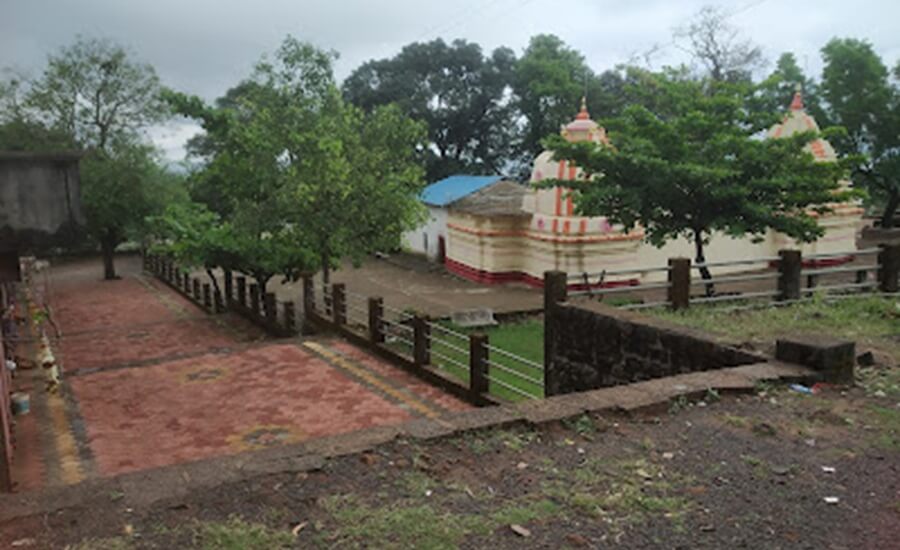
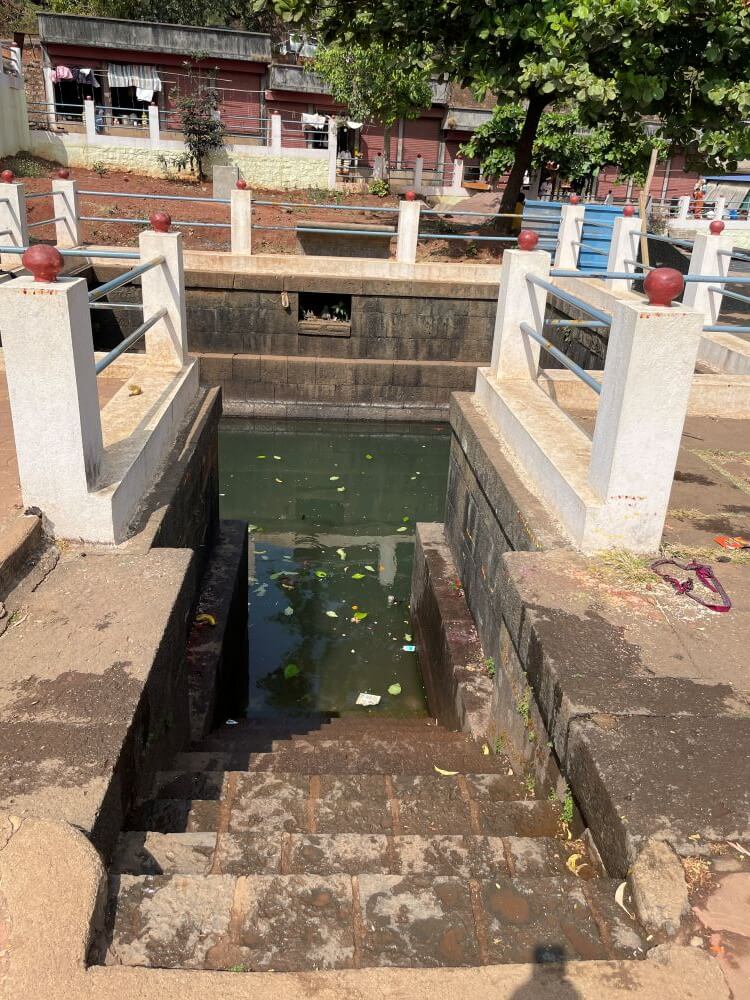
This temple complex is situated in a large courtyard along the main road in the fort area. The courtyard is located slightly below the road level and features a distinctive welcome arch. On the square sections above and below the two pillars of this arch, there are lotus flower carvings on all four sides. On the cornice, there are elephants, and above the elephants, there is a crescent-shaped arch. In the center of the arch is a Shiva Linga, with elephants bowing to the Shiva Linga on both sides. One enters the temple courtyard by descending 20 steps from here. Inside, on the right side, is the Dharamshala building. The tank in front of this Dharamshala is referred to as the ‘Chavdar Water Tank’. The carvings on the inner walls of the tank, built with dressed stone, are still clearly visible today. On the walls of the tank, a royal emblem is carved in the center, with elephants bowing on both sides in relief style. In another wall, there is a niche (Devkosthak) with images of cobras with raised hoods on both sides. On the stone slab above the niche, a Shiva Linga is carved in the center, with the moon, sun, and lotus flowers on both sides. Legend has it that King Mahipal’s leprosy was cured after he bathed in this very tank. On the bank of this tank, there is a Tulsi Vrindavan and a Dattatreya temple.
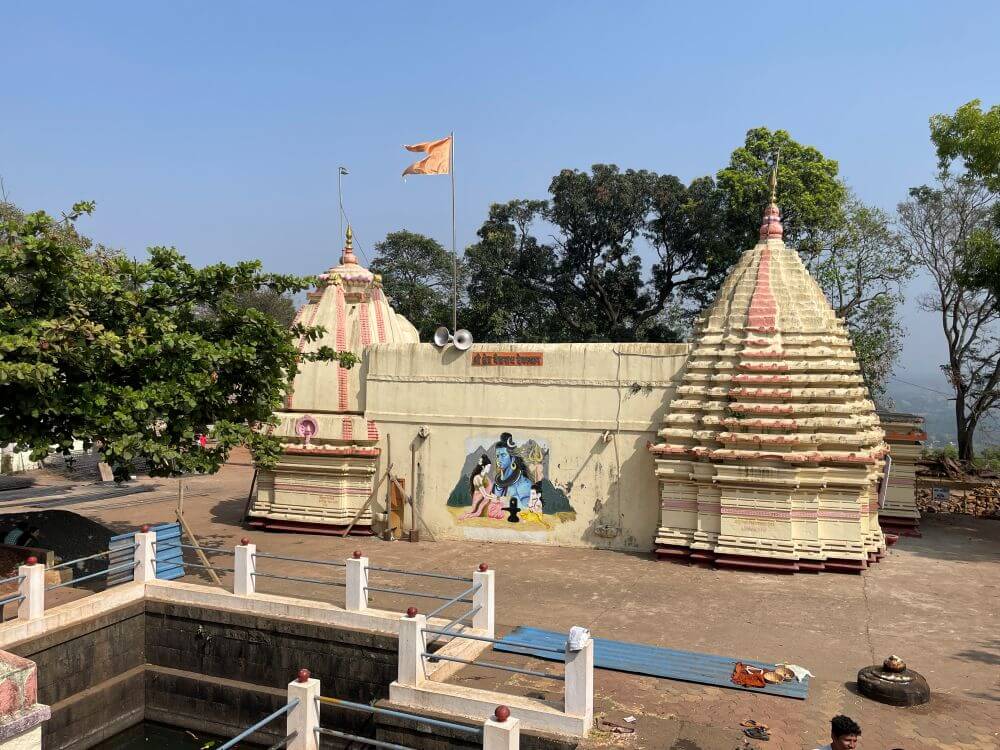
Opposite the tank are the Hemadpanti style temples of Vaijanath and Arogya Bhavani Mata. Since these two temples are connected from the back and front, they are called ‘Twin Temples’. It is said that both temples, originally independent, were joined at some later point. One enters the common space of both temples through the entrance at the front. The assembly hall (Sabhamandap) of the Vaijanath temple is semi-open on one side due to a railing and enclosed by a wall on the other. The assembly hall has four rows of four pillars each. The craftsmanship of the sculptor is evident in the square, hexagonal, octagonal, circular, cylindrical, and triangular shapes of the pillars. Above the pillars are cornices, then brackets, and upon these brackets rest the beams and the roof. The beams and ceiling are adorned with lotus flower carvings in various places. The ceiling features ornate squares created through a specific arrangement of stones. Near the walls are several idols of deities made of black stone.
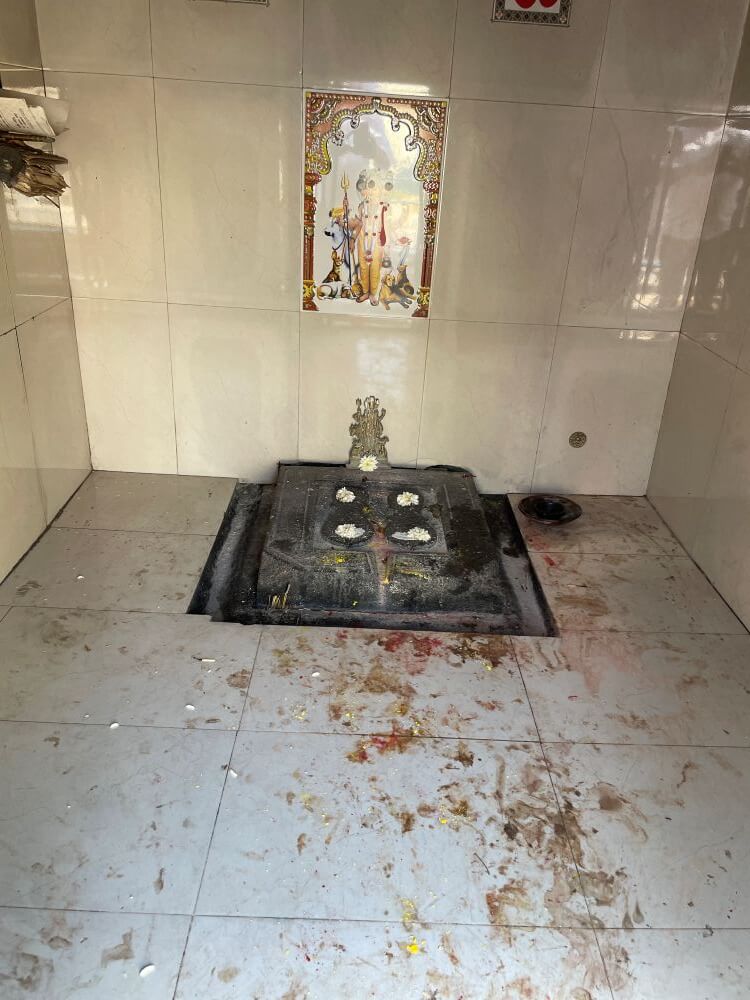
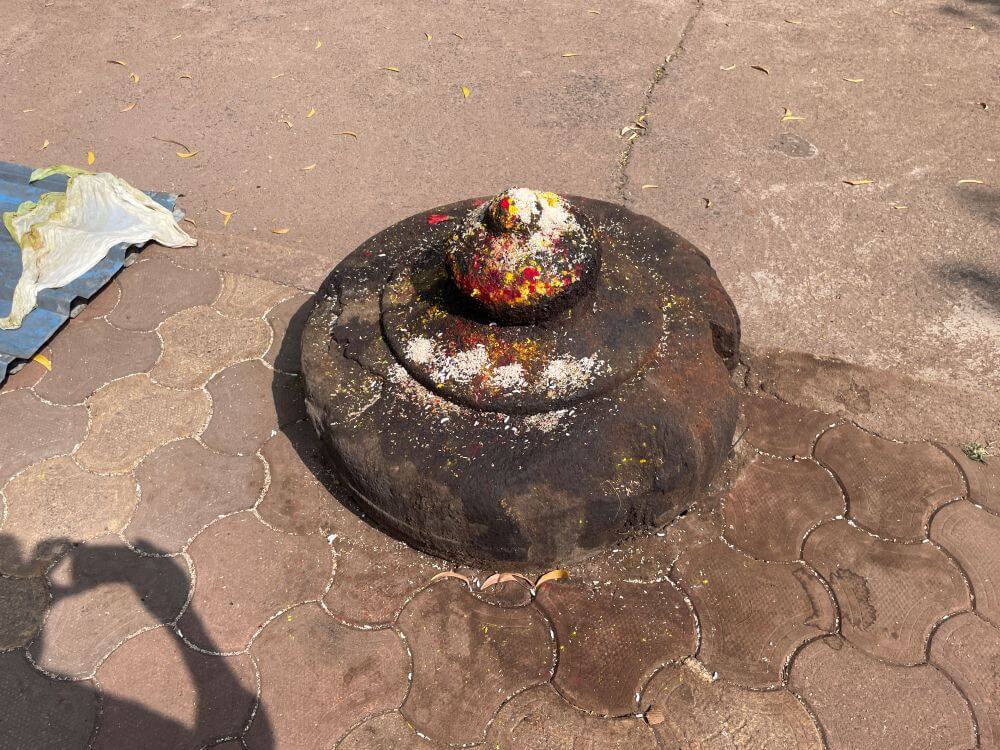
In the center of the assembly hall, on a pedestal, is a Nandi idol made of black stone. Beside the Nandi is a Shiva Linga. In front of this Nandi is the entrance to the vestibule (Antarala). The door frames are decorated with intricate carvings. Further ahead, on both sides of the sanctum sanctorum (Garbhagriha) entrance, there are ornate pillars and latticed windows. In the sanctum sanctorum, there is a Swayambhu Shiva Linga with a brass cobra canopy held over it.
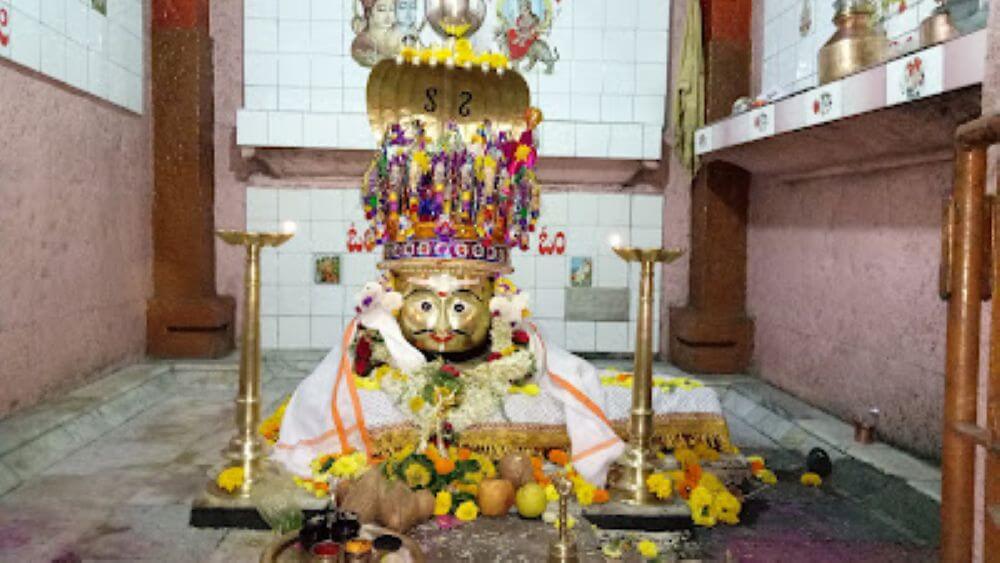
The structure of the Arogya Bhavani temple suggests that its outer assembly hall was built at a later date. This assembly hall has square wooden pillars and beams above them. This hall is of an enclosed nature. The door of the main assembly hall, which has a wooden frame, has four ornate door jambs. Above the lintel, there are five temple images set within five lotus flowers. Upon entering, one sees four rows of four pillars each in the main assembly hall. The walls here contain niches with divine sculptures. The floor between the four pillars in the assembly hall is enclosed with a stainless steel mesh. This space is used for religious rituals during festivals. Further ahead, on the lintel of the ornate entrance to the vestibule, is the image of the presiding deity. The entrance to the sanctum sanctorum has six ornate door jambs. The slab above the lintel features five temple images set within five lotus flowers. In the sanctum sanctorum, on a Vajrapitha, stands the eight-armed idol of Arogya Bhavani made of black stone.
The outer walls of both temples are carved with intricate designs up to the spire (Shikhara). The tapering spire of the Shiva temple is formed by twenty-one layers of stone stacked one upon another, topped with an Amalaka and a Kalash. On the spire of the Arogya Bhavani temple, three vertical ridges are carved on each of the four corners. In the upper part of the spire, four triangles emerge from the main structure. Above this is a replica of a top lotus, followed by an Amalaka and a Kalash. Along with the main festival of Maha Shivratri, festivals such as Chaitra Padwa, Navratri, Dussehra, Diwali, Tripurari Purnima, and Datta Jayanti are celebrated in these temples. During all festivals, Abhisheka and Mahapuja are performed. Throughout the day, programs like Bhajans, Kirtans, discourses, Jagaran, and Gondhal are organized. Thousands of devotees visit here for Darshan during these times. There is also a large crowd of devotees here every Shravani Monday.
This sacred temple stands as a testament to deep spiritual devotion, ancient architectural grandeur, and rich local cultural traditions.
The sanctum sanctorum houses the divine idol consecrated according to ancient Vedic traditions, surrounded by serene courtyards and traditional temple architecture.
Navratri, Maha Shivratri, Annual Temple Jatra & Deepotsav
Compare and book flights, secure top-rated local hotels near the temple, hire reliable guides, and rent cars instantly.
Extend your pilgrimage by visiting other highly sacred temples located nearby.


Add ₹999 more to unlock FREE SHIPPING!
Your sacred cart is currently empty.
Shop Photo FramesFill in your delivery details below to place your order.
Add comment